
Key points
If a signal is not working, stop as you would if there were stop signs in all directions.
Source: Handbook p. 30
“Generally, if a signal is not working, stop as you would if there were stop signs in all directions.”
Montana Driver Manual, Handbook p. 30On a steady red, stop at the stop line, or before the crosswalk, or before the intersection if neither is marked.
Source: Handbook p. 30
“A steady red signal means “STOP.” Stop before a stop line on the pavement. If there is no stop line, stop before entering the nearest crosswalk or before entering the intersection if there is no crosswalk.”
Montana Driver Manual, Handbook p. 30When entering a two way street, you may cautiously turn right after stopping on red, unless a sign or officer forbids it.
Source: Handbook p. 30
“When entering a two-way street, you may cautiously turn right after stopping. You may make the right turn unless a sign or police officer tells you not to turn against the red light.”
Montana Driver Manual, Handbook p. 30A flashing red signal means the same as a stop sign.
Source: Handbook p. 30
“A flashing red signal means the same as a stop sign. Come to a complete stop.”
Montana Driver Manual, Handbook p. 30Do not enter on a steady yellow unless you are too close to stop safely.
Source: Handbook p. 30
“Do not enter an intersection against a steady yellow light unless you are too close to stop safely.”
Montana Driver Manual, Handbook p. 30A flashing yellow arrow allows a left turn, but only after yielding to oncoming traffic and pedestrians.
Source: Handbook p. 30
“A flashing yellow arrow means left turns are allowed, but you must first yield to oncoming traffic and pedestrians.”
Montana Driver Manual, Handbook p. 30In a roundabout, yield to vehicles already in the circle, which have the right of way, and travel counterclockwise.
Source: Handbook p. 32
“Yield to vehicles that are already in the roundabout; they have the right-of-way. Traffic flows in a counterclockwise direction.”
Montana Driver Manual, Handbook p. 32Do not pull over or stop in a roundabout for an emergency vehicle. Exit as normal, then pull right where it can pass.
Source: Handbook p. 32
“Do not pull over or stop in the roundabout when approached by an emergency vehicle. Continue on and exit as normal, then pull to the right where there is room for the emergency vehicle to pass.”
Montana Driver Manual, Handbook p. 32Stop not less than 15 feet from the nearest rail when signals warn of a train or a train is within 1500 feet.
Source: Handbook p. 33
“You are required to STOP at railroad crossings as close as practicable but not less than 15 feet from the nearest rail when warning signals, crossing gates, stop signs, or human watchmen indicate the approach of a train, or when the train is within 1500 feet of the crossing”
Montana Driver Manual, Handbook p. 33At gates, stay stopped until the gates are raised and the lights stop flashing.
Source: Handbook p. 33
“Remain stopped until the gates are raised and the lights stop flashing.”
Montana Driver Manual, Handbook p. 33
Numbers to know
| Number | What it means | Manual |
|---|---|---|
| 15 mph | top speed in a roundabout | Handbook p. 32 |
| 15 feet | minimum stopping distance from the nearest rail | Handbook p. 33 |
| 1500 feet | a train this close means you must stop at the crossing | Handbook p. 33 |
Recognize these signs

Roundabout 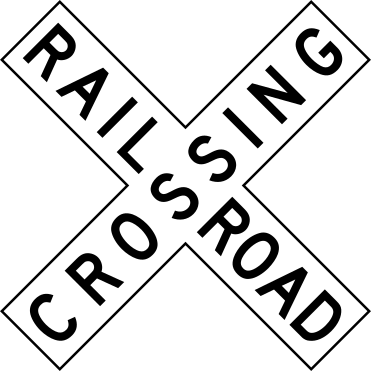
Railroad crossbuck
3 questions from the Montana practice test
1. A signal is not working at an intersection. What should you do?
- Stop only if you are turning left
- Continue through if no other vehicle is visible
- Treat the intersection as though stop signs face every direction
- Yield only to vehicles approaching from the left
Show answer
Treat the intersection as though stop signs face every direction. A dark or malfunctioning signal removes the normal light cycle, so Montana drivers should stop as though every approach has a stop sign. The driver who stops first generally proceeds first, but that courtesy does not remove the duty to check for hazards. The tempting idea is to continue because no light is displayed, yet an unregulated intersection can still contain cross traffic or pedestrians. Treat the location as an all way stop, make a full stop, scan carefully, and proceed only when safe.
2. How must a driver respond to a flashing red traffic signal in Montana?
- Stop completely, yield, and continue only when it is safe
- Slow briefly and continue without yielding
- Wait for the signal to become a steady green
- Treat it as a protected green arrow
Show answer
Stop completely, yield, and continue only when it is safe. A flashing red signal carries the same stopping requirement as a stop sign. The driver must make a complete stop, check left, right, and ahead, yield to traffic and pedestrians, and proceed only after the path is safe. A brief slowdown is not a complete stop, while waiting for green invents a requirement that applies to a different signal display. A green arrow grants a protected movement and has the opposite meaning. The visual cue is red flashing still begins with a full stop, even though the light is not steady.
3. What is the maximum speed for driving in a Montana roundabout?
- 25 mph unless a sign says otherwise
- 15 mph or less
- 35 mph on the circular roadway
- The posted speed for the road before entering
Show answer
15 mph or less. Montana describes roundabouts as low speed circular intersections and directs drivers to travel at 15 mph or less. A driver should reduce speed before entry, look left for circulating traffic, and yield to vehicles already inside. The road’s approach speed does not automatically carry into the circle, so selecting the ordinary posted limit would be unsafe. The practical cue is the center island and curved path: slow before the yield line, keep control, and continue around until the desired exit.
Practice this topic
Lock it in with signals and markings questions from the free Montana practice test. Every answer comes with a plain English explanation.
Source: the Montana Driver Manual, Chapter 3: Signs, Signals, and Markings. This lesson is a plain English summary, not the law itself; where it differs, the manual and the statute govern. Last checked 2026-09-27.