
Test 5 of 10 · 20 questions · Free 2026
MT Permit Practice Test 5
Jump to the test ↓A fixed 20 question set from the Montana bank with answers and plain English explanations.
Question 1 of 20 · 0 right so far
All 20 questions in test 5
Every question below comes from the Montana question bank on this page. Open a question to see the correct answer and the explanation. Nothing here is hidden behind a signup.
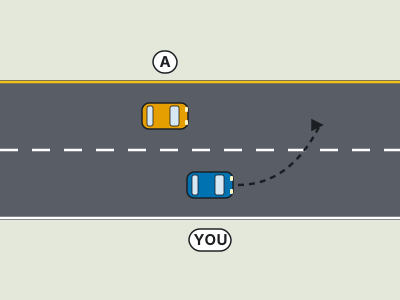
1. Which check is required immediately before changing lanes?
- Look over your shoulder for traffic in the blind spot
- Rely on the rearview mirror without turning your head
- Check only the lane ahead and ignore traffic behind
- Turn on hazard flashers and move without signaling
Show answer
Look over your shoulder for traffic in the blind spot. Mirrors cannot show every area beside and behind a vehicle. Montana tells drivers to look over the shoulder in the direction of movement because the rear corners are blind spots. Mirror-only scanning can miss a motorcycle or car positioned outside the reflected view. Ignoring traffic behind removes a crucial safety check, and hazard flashers do not communicate which lane you intend to enter. Signal, inspect the mirrors, then make a quick shoulder check immediately before moving so the decision reflects current traffic.
Study this in the handbook: Scanning, blind spots and signaling
2. How does Montana's Three-Second Rule help a driver judge following distance?
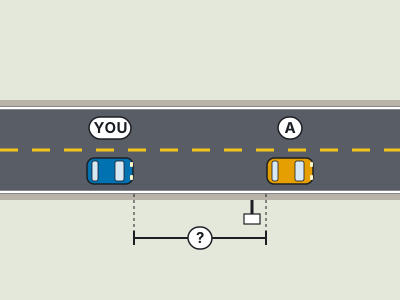
- It checks whether the vehicle reaches a reference point before three seconds pass
- It requires exactly three car lengths at every speed
- It applies only when traveling below 25 mph
- It measures the distance from the rear bumper to the curb
Show answer
It checks whether the vehicle reaches a reference point before three seconds pass. The Three-Second Rule uses time rather than a fixed number of car lengths. Watch the vehicle ahead pass a stationary object, then count until your vehicle reaches that same point. Arriving before the count is complete means the gap is too short, so drop back and check again. The method works at any speed and gives a practical cue when traffic flow changes.
Study this in the handbook: Adjusting speed for roads, weather and sight distance
3. Why should a driver reduce speed where a Slippery When Wet sign is posted?
- The roadway will always be closed during rainfall
- The sign means the lane is reserved for emergency vehicles
- The sign authorizes a driver to brake harder than usual
- Wet pavement can be unusually slick and demands smoother control
Show answer
Wet pavement can be unusually slick and demands smoother control. The slippery-when-wet warning identifies pavement that becomes unusually slick after rain. The safe response is to reduce speed, avoid hard braking or sudden direction changes, and leave more space ahead. It does not reserve the lane, encourage aggressive braking, or announce a closure. A useful cue is to make every steering and braking input gradual as soon as the road surface is wet.
4. How low may a Montana school zone speed limit be set?
- No lower than 25 mph
- No lower than 20 mph
- 5 mph
- As low as 15 mph
Show answer
As low as 15 mph. Montana law lets school zone speed limits be set as low as 15 mph, and local authorities decide the posted speed and how many blocks around a school the zone covers. Floors of 20 or 25 mph are wrong because the law allows lower limits, and 5 mph is below the figure the manual gives. Fines are doubled in all school zones throughout Montana, so speeding near a school costs twice as much. Watch for children near schools and parks day and night.
Study this in the handbook: Road signs by shape and color
5. A Montana driver wants to park near a railroad crossing. What is the minimum distance?
- 15 feet
- 50 feet
- 30 feet
- 100 feet
Show answer
50 feet. Parking is prohibited within 50 feet of a railroad crossing in Montana. That space keeps parked vehicles from blocking the view of trains and from crowding the tracks. Fifteen feet is the fire hydrant distance and 30 feet is the distance for a traffic signal, stop sign, or yield sign, so both are too close here. The no parking list does not use 100 feet for anything. Parking on the railroad tracks themselves is also forbidden.
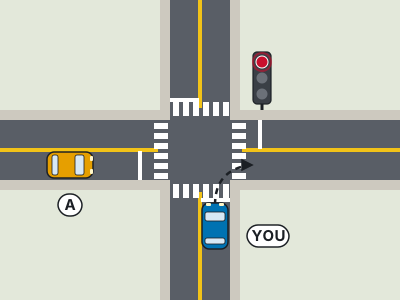
6. At a traffic light, when may you turn right on red?
- Before stopping if no pedestrians are visible
- After stopping and confirming the turn is safe, unless prohibited
- Only when another driver waves you through
- Never under Montana rules
Show answer
After stopping and confirming the turn is safe, unless prohibited. A right turn on red is conditional, not automatic. Montana permits it after the vehicle has stopped, is in the proper lane, and the driver has determined that proceeding is safe, unless a sign prohibits the turn. Failing to stop makes the movement unlawful even on an empty-looking corner. A wave from another motorist cannot replace the signal, sign, or safety checks. Look left, right, and ahead for traffic, bicyclists, and pedestrians.
Study this in the handbook: Who yields at intersections
7. What share of crashes with a hospitalized or killed person involved a drowsy driver, according to a AAA study in the Montana manual?
- 1 percent of each
- 50 percent of each
- 13 percent of hospitalization crashes and 21 percent of fatal crashes
- 90 percent of fatal crashes
Show answer
13 percent of hospitalization crashes and 21 percent of fatal crashes. A recent AAA Foundation for Traffic Safety study showed 13 percent of crashes in which a person was hospitalized and 21 percent of crashes in which a person was killed involved a drowsy driver. The manual adds that after being awake for 18 hours straight, driving skills resemble those of an impaired driver. It advises taking breaks every two hours or so, walking around and getting fresh air, and not planning to drive late when you are normally asleep.
8. If a traffic signal is not working, what should drivers do?
- Stop as though stop signs controlled all directions
- Continue through because the intersection has no active signal
- Yield only to traffic approaching from the left
- Wait for a police officer before any vehicle may move
Show answer
Stop as though stop signs controlled all directions. Montana treats a nonworking signal as a stop-controlled intersection in every direction. Drivers should stop, observe the other approaches, and proceed carefully according to who arrived first while confirming that movement is safe. Continuing through assumes the dark signal removes control, which creates a serious collision risk. Looking only left misses traffic and pedestrians from other directions. Police presence is not required for the intersection to function. The cue is a dark or malfunctioning signal: make a full stop and treat each approach as controlled by a stop sign.
Study this in the handbook: Traffic signals, roundabouts and railroad crossings
9. A Montana warning sign shows a right curve with a safe speed indication below it. What does that speed represent?
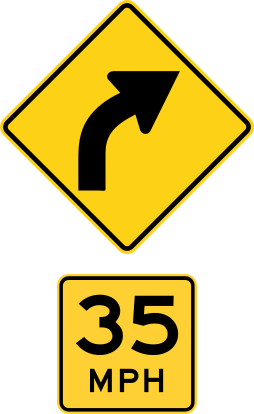
- A suggested safe speed for the curve
- The maximum legal speed until the next speed sign
- The minimum speed required on the curve
- The speed allowed only when passing
Show answer
A suggested safe speed for the curve. The number beneath this curve warning is guidance for handling the bend, not a new posted maximum. The manual describes it as a suggested safe speed, so a driver should consider that recommendation along with weather, pavement, traffic, and visibility. Choosing the legal-limit option is risky because a posted limit may still be too fast for a sharp turn or poor conditions. A useful cue is the sign's pairing: the diamond warns about the curve, while the small number helps you approach it conservatively. Slow before the bend and remain prepared to reduce speed further.
Study this in the handbook: Road signs by shape and color
10. When weather or blowing dust reduces visibility below 500 feet, what is required?
- Use parking lights only
- Use the headlamps
- Switch off all lights to reduce glare
- Use hazard flashers instead of headlamps
Show answer
Use the headlamps. Montana requires headlamps whenever weather or blowing dust reduces visibility to less than 500 feet. The purpose is both to illuminate the road and to help other road users see the vehicle. Parking lights alone do not satisfy that requirement, and hazard flashers do not replace headlamps. The cue is a major loss of sight distance, not merely darkness. Turn on the headlamps early, reduce speed to match what you can see, and leave enough room to stop safely.
Study this in the handbook: Required lights and equipment
11. Montana requires trucks of one ton capacity or larger, passenger buses and truck tractors to carry flares or similar warning devices. What may they carry instead?
- Nothing, flares are mandatory
- A single flashlight
- A white flag
- Three emergency reflective triangles meeting USDOT Safety Standard 125
Show answer
Three emergency reflective triangles meeting USDOT Safety Standard 125. As an alternative to the flares or lanterns otherwise required, three emergency reflective triangles conforming to USDOT Motor Vehicle Safety Standard 125 may be carried. All warning devices must be visible from at least 600 feet under normal atmospheric conditions at night. For a disabled vehicle, the manual advises placing warning devices such as flares behind the vehicle so other drivers can change lanes if necessary. A single flashlight or a white flag is not the listed alternative, and flares are not the only permitted option.
12. Your vehicle breaks down on a highway. What is the first priority if possible?
- Stand in the travel lane to wave at approaching drivers
- Move the vehicle off the road and away from traffic
- Leave the vehicle in place and begin changing a tire
- Park just beyond a hill so the vehicle is easier to see
Show answer
Move the vehicle off the road and away from traffic. When a vehicle becomes disabled, the safest first move is to get it off the roadway and away from traffic if that can be done. Once stopped safely, emergency flashers can make the problem visible and a warning device can alert approaching drivers. Standing in a lane exposes the driver to a secondary collision, while a hilltop or curve hides the disabled vehicle from others. Think in this order: escape moving traffic, make the vehicle visible, and seek help from a safe position.
Study this in the handbook: Brake failure, blowouts and other vehicle emergencies
13. On Montana intersection traffic control signs, what does the color red always mean?
- A service area and a hospital nearby
- A recommended speed and a scenic route
- Stop, yield, do not enter, or wrong way
- A passing zone with traffic moving both ways
Show answer
Stop, yield, do not enter, or wrong way. The Montana manual groups several urgent meanings under the color red on intersection traffic control signs: red always means stop, yield, do not enter, or wrong way. The STOP, YIELD, and DO NOT ENTER signs all use red for that reason. Service information, recommended speeds, scenic routes, and passing zones are not red sign meanings in the manual. Treat a red sign as an immediate instruction to stop, yield, or avoid the prohibited movement.
Study this in the handbook: Road signs by shape and color
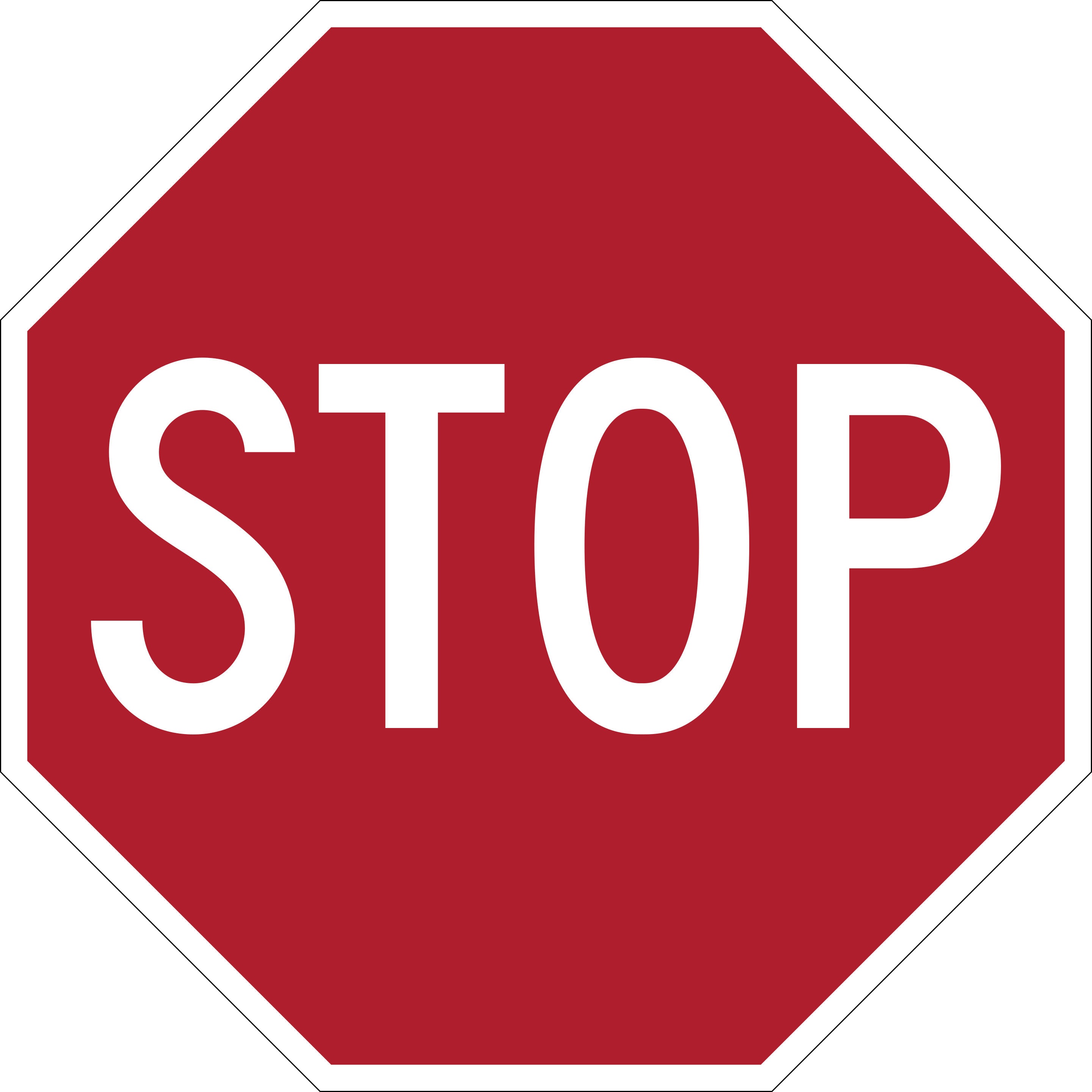
14. At this eight-sided sign, what must you do before entering the intersection?
- Stop only when another vehicle has already entered
- Reduce speed but continue if the lane looks open
- Stop completely, then yield to nearby traffic that could be an immediate hazard
- Yield without stopping unless a pedestrian is present
Show answer
Stop completely, then yield to nearby traffic that could be an immediate hazard. A STOP sign requires a complete stop before the intersection, followed by a careful yield to traffic close enough to create an immediate hazard. The open-looking lane in the choice “Reduce speed but continue if the lane looks open” is not enough to waive the stop. Waiting for another vehicle would reverse the rule, and yielding without stopping describes a yield sign rather than this octagonal sign. If a crosswalk is present, the stop occurs before entering it. The practical cue is the distinctive eight-sided shape, which remains recognizable even when poor visibility hides much of the sign face.
Study this in the handbook: Road signs by shape and color
15. What is the youngest age at which a Montana teen can hold a learner license, and what condition applies?
- 14, as long as a parent signs the consent form
- 14 and a half, if the teen is taking or has finished a state-approved traffic education program
- 15, after finishing any online driver education course
- 16, because no learner license is issued before 16
Show answer
14 and a half, if the teen is taking or has finished a state-approved traffic education program. Montana lets a teen get a learner license as early as 14 and a half, but only while participating in or after completing a state-approved traffic education program. Parent consent is required for anyone under 18, yet it does not lower the age to 14 by itself. The 15 year route also depends on an approved course, and online courses are not approved, so an online class does not qualify. Sixteen is the age for a learner license without traffic education, not the earliest possible age.
Study this in the handbook: Learner license and the teen GDL steps
16. How long may a Montana driver with the military exemption drive on that license after leaving the service?
- Indefinitely
- One year
- Up to 90 days after honorable separation
- 10 days
Show answer
Up to 90 days after honorable separation. Those who have the military exemption may drive on that license for up to 90 days after honorable separation from the military. A driver also has a grace period of 3 months after the expiration date, or 90 days after honorable discharge, to renew and avoid the penalty of retesting. Renewal after that window means taking the tests again, so renew before the 90 days run out.
17. A Montana driver has an open bottle of alcohol in a vehicle with no trunk. Where may the bottle legally be kept?
- On the front passenger seat if the cap is put back on
- In the center console within the driver's reach
- Under the driver's seat
- Behind the last upright seat, or in a closed container in an area the driver and passengers do not normally occupy
Show answer
Behind the last upright seat, or in a closed container in an area the driver and passengers do not normally occupy. For vehicles without a trunk, Montana allows an open alcoholic beverage container behind the last upright seat or inside a closed container kept in an area the driver and passengers do not normally occupy. A locked glove or storage compartment is also allowed. Putting the cap back on does not make the container unopened, and the front seat, the center console, and the space under the driver's seat are all within the passenger area where an open container is an offense.
Study this in the handbook: Alcohol, drugs and the law
18. How old must a Montana applicant generally be to receive a learner license without traffic education?
- 14 years old
- 15 years old
- 18 years old
- 16 years old
Show answer
16 years old. Without an approved traffic education course, the applicant must be at least 16 for a learner license. The 15 year option applies only when the applicant has successfully completed approved driver education, and 14 is associated with a different traffic education pathway. Remember the age distinction before choosing an answer: education can lower the minimum from 16 to 15, but it does not make every age eligible.
19. What is the purpose of a shared center lane marked with alternating left-turn arrows?
- Left turns, and permitted U-turns, for traffic in either direction
- Passing slower vehicles in either direction
- Straight travel through the intersection
- Parking while waiting for a turn
Show answer
Left turns, and permitted U-turns, for traffic in either direction. The shared center lane is a two-way turning space, not a travel lane for overtaking or cruising. Montana reserves it for left turns and for U-turns where those turns are permitted. The alternating arrows show that drivers from both directions may use the lane, so enter carefully and yield to an opposing user already there. Do not treat the center lane as a shortcut for straight travel or as temporary parking.
Study this in the handbook: Lane lines and pavement markings
20. What do rectangular signs with black words or symbols on a white background generally represent?
- Temporary weather advisories
- Roadside recreation areas
- Regulatory requirements
- Railroad crossing warnings
Show answer
Regulatory requirements. Regulatory signs communicate a rule that controls speed or another required action. Montana describes this category as rectangular with black words or symbols on a white background and says drivers must obey the rules shown. Recreation information is a guide function, weather hazards are warnings, and the railroad crossing warning has its own sign treatment. When you see a regulatory sign, adjust before reaching it and follow the posted instruction rather than treating it as a suggestion.
Study this in the handbook: Road signs by shape and color
QualitySpace is expanding to Montana
We are a California-based independent insurance brokerage working on licensing in more states. We cannot help with Montana insurance yet. Leave your email and we will let you know when we can.
Every question is written from the official Montana Driver Manual. Need paper? Printable MT practice test with answer key.
Last verified 2026-10-05. How we check every question · Study all 212 as flashcards
Frequently asked questions
How many questions are on this Montana practice test?
This fixed set has 20 questions. It is test 5 of 10 from the 212 question Montana bank.
How does this fixed test relate to the full Montana bank?
Each numbered test is a fixed set of questions in a fixed order, so you can retake the same test later and compare. Every test mixes road signs and the other topics in about the same proportion as the full bank. Tests 1 to 10 together cover 200 of the 212 questions in the Montana bank, each once. The full practice page mixes the whole bank at random.
Last verified 2026-10-05. See the Montana DMV facts page for sourced state details.