
Test 4 of 10 · 20 questions · Free 2026
MT Permit Practice Test 4
Jump to the test ↓A fixed 20 question set from the Montana bank with answers and plain English explanations.
Question 1 of 20 · 0 right so far
All 20 questions in test 4
Every question below comes from the Montana question bank on this page. Open a question to see the correct answer and the explanation. Nothing here is hidden behind a signup.
1. A Montana court finds a driver responsible for crash damages, and the driver does not pay within 60 days. How long does the resulting suspension last?
- 30 days, then it ends automatically
- One year, whether or not the amount is paid
- Until the driver buys a new insurance policy
- Until the amount is paid or 6 years have passed
Show answer
Until the amount is paid or 6 years have passed. When a court finds a driver responsible for crash damages and the driver fails to pay within 60 days, the license and registration suspension is automatic. It remains in effect until the amount has been paid or 6 years have elapsed. A 30 day or one year suspension understates how long an unpaid judgment can follow a driver. Buying insurance does not end it either, although the driver will also have to submit evidence of motor vehicle insurance.
Study this in the handbook: Your Montana license, renewal and insurance
2. What happens to traffic fines in a Montana highway work zone?
- They are the same as anywhere else
- They are doubled
- They are waived if no workers are present
- They are tripled only at night
Show answer
They are doubled. Montana doubles traffic fines in work zones, and exceeding the posted work zone speed is a violation. There is no single statewide work zone speed limit; the transportation department, a local authority, a utility, or a contractor sets the limit for each zone. The manual gives no exception for zones without visible workers and no night only tripling. Driving in a way that endangers people or property, or purposely striking a traffic control device, can also bring a reckless endangerment charge.
3. At a Montana railroad crossing where no signal is active, when must a driver still stop for an approaching train?
- Only when a crossing gate is down
- When the train is within 500 feet
- When the train is within 1,500 feet of the crossing or is clearly visible and an obvious hazard
- Only when the train sounds its horn
Show answer
When the train is within 1,500 feet of the crossing or is clearly visible and an obvious hazard. A driver must stop no less than 15 feet from the nearest rail when warning signals, crossing gates, stop signs, or human watchmen show a train is coming, and also when the train is within 1,500 feet of the crossing or is clearly visible and an obvious hazard. Waiting for a gate or a horn ignores that second trigger. Five hundred feet is far too close for the rule. Never try to beat a train across the tracks.
Study this in the handbook: Traffic signals, roundabouts and railroad crossings
4. How far from a fire station driveway must a Montana driver park?
- 15 feet on either side of the street
- 50 feet on the same side and 100 feet across the street
- 30 feet on either side of the street
- 20 feet on the same side of the street, or 75 feet when parking on the other side
Show answer
20 feet on the same side of the street, or 75 feet when parking on the other side. Montana prohibits parking within 20 feet of a fire station driveway on the same side of the street, or within 75 feet of the driveway when parking on the opposite side. The larger distance across the street gives fire trucks room to swing out. A single 15 or 30 foot rule for both sides is wrong, and 50 and 100 feet are not the distances in the manual. Never block any driveway, alley, or lowered curb either.
5. When must Montana drivers dim high beams for oncoming and overtaken vehicles?
- Within 200 feet in both cases
- Within 1,000 feet when meeting and within 500 feet when overtaking
- Within 300 feet when meeting and 100 when following
- Only when the other driver flashes
Show answer
Within 1,000 feet when meeting and within 500 feet when overtaking. High beams must be dimmed when meeting other vehicles at 1,000 feet and when overtaking or following other vehicles at 500 feet. Reflectors on the vehicle must be visible from 600 to 1,000 feet under high beams. The two distances differ because one applies to oncoming traffic and the other to a vehicle ahead in your direction, so 200 feet in both cases or a 300 and 100 foot pair do not match the manual. Dimming is required by distance, not by a flash from the other driver.
Study this in the handbook: Required lights and equipment
6. You are already inside a Montana roundabout when an emergency vehicle approaches. What should you do?
- Continue through and exit normally, then pull right where there is room
- Stop inside the roundabout immediately beside the center island
- Reverse out of the circle before the emergency vehicle reaches it
- Enter the center island to create an extra lane
Show answer
Continue through and exit normally, then pull right where there is room. A driver already in a roundabout should not pull over or stop inside the circle for an emergency vehicle. Continue around, exit normally, and pull right where there is room for the responder to pass. Stopping, reversing, or entering the center island creates an unpredictable obstruction. If you are approaching the roundabout, pull over only when there is room; otherwise proceed through and stop after exiting.
Study this in the handbook: Traffic signals, roundabouts and railroad crossings
7. If a tire suddenly goes flat while you are driving, which response follows Montana guidance?
- Hold the wheel firmly, keep straight, and slow gradually
- Brake hard and turn sharply toward the shoulder
- Release the wheel so the vehicle can settle itself
- Stop immediately in the travel lane and leave the vehicle
Show answer
Hold the wheel firmly, keep straight, and slow gradually. A sudden flat tire calls for a firm steering grip and a straight path while speed is reduced gradually. Hard braking or a sharp turn can destabilize the vehicle, which is why the option “Brake hard and turn sharply toward the shoulder” is unsafe. Releasing the wheel gives up directional control, and stopping in the lane creates a collision hazard. Take your foot off the accelerator, use the brakes lightly, and move off the road only after control is established.
Study this in the handbook: Brake failure, blowouts and other vehicle emergencies
8. A Montana teen on a first-year restricted license is caught breaking a license restriction for the first time. What penalty does the manual set?
- An automatic six month license suspension
- A written warning with no penalty
- Between 20 and 60 hours of community service
- A $500 fine and loss of the license
Show answer
Between 20 and 60 hours of community service. Montana penalizes violations of the first-year restricted license, such as the 11:00 p.m. to 5:00 a.m. night limit or the passenger limit. A first offense brings between 20 and 60 hours of community service. The six month suspension is the penalty for a second offense, so it is too severe for a first. A warning with no consequence understates the rule, and the manual lists no $500 fine or license loss for a first violation. Repeat violations escalate quickly, so the restrictions deserve respect from the first day.
Study this in the handbook: Learner license and the teen GDL steps
9. How should a driver respond to this triangular intersection sign?
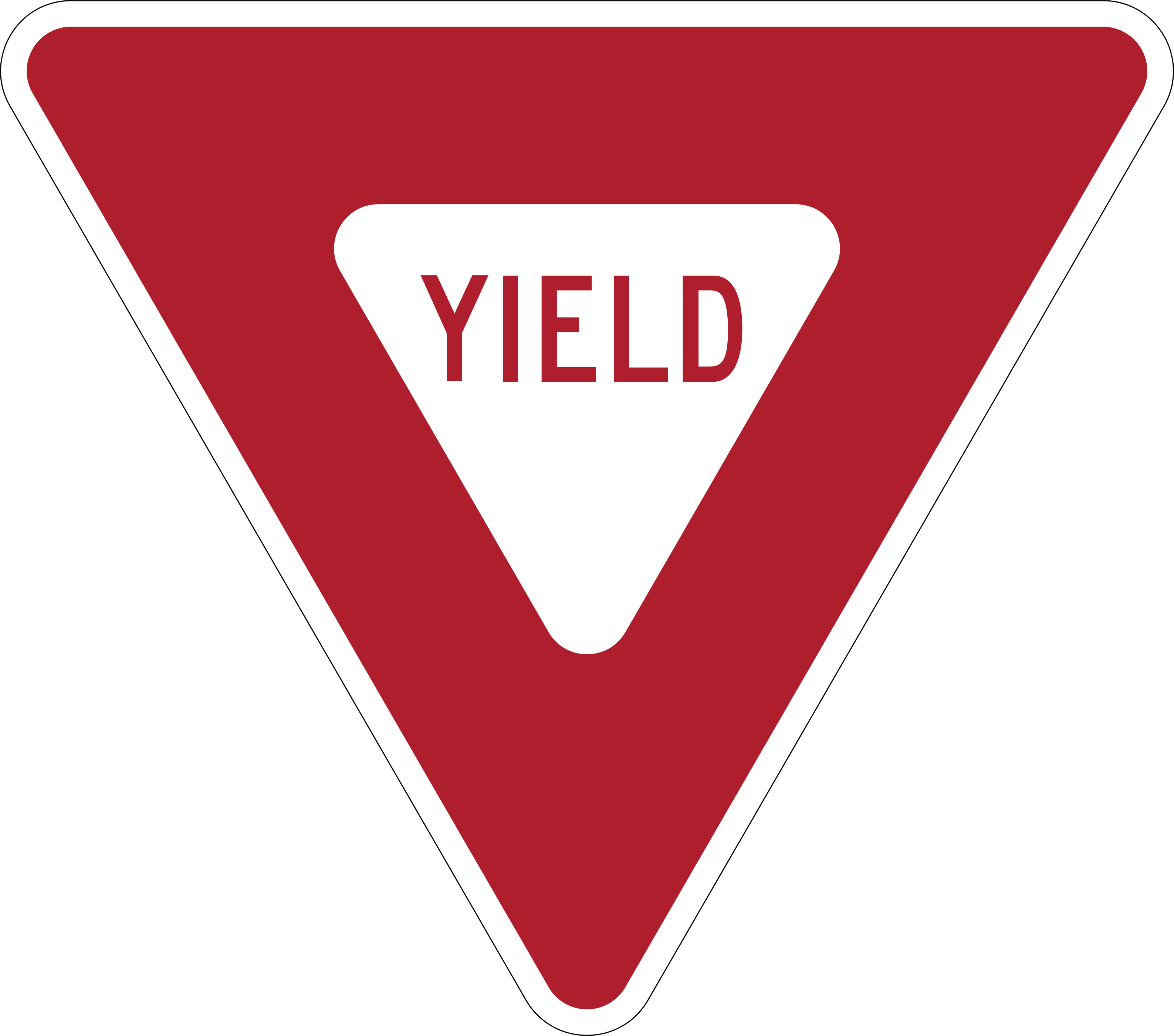
- Slow to a reasonable speed and yield to all vehicles on the roadway being entered
- Stop every time, even when no traffic is nearby
- Accelerate to claim the right-of-way before entering
- Proceed without checking because the sign gives priority
Show answer
Slow to a reasonable speed and yield to all vehicles on the roadway being entered. A YIELD sign calls for a reasonable reduction in speed and a yield to every vehicle on the roadway being entered. It does not impose the automatic full stop that a STOP sign requires, although stopping may still be necessary when traffic requires it. Accelerating to assert priority is especially unsafe because the sign assigns priority elsewhere. Proceeding without checking turns the sign upside down: yielding means giving way, not receiving preference. Scan the roadway, judge the gap, and stop if that is needed to let traffic proceed safely.
Study this in the handbook: Road signs by shape and color
10. If a driver is involved in a crash in Montana and someone is injured or killed, what must happen?
- A report is optional if the vehicles can be driven away
- The driver may leave after exchanging insurance cards
- Only the vehicle owner must contact law enforcement
- The driver must notify the police
Show answer
The driver must notify the police. The accident procedure requires police notification when any person is injured or killed. Whether the vehicles remain driveable does not erase that duty, and exchanging insurance information is an additional step rather than a replacement for contacting authorities. The owner-only option is too narrow because the obligation applies to the involved driver. Leaving after a private exchange can abandon people who need help and fails the stated reporting rule. A practical cue is injury or death changes a routine information exchange into an immediate law-enforcement report.
Study this in the handbook: Crashes, emergency vehicles and traffic stops
11. On a Montana roadway, what does a reserved lane marked HOV mean?
- The lane is a temporary shoulder during congestion
- The lane is reserved for emergency vehicles only
- The lane is reserved for vehicles with more than one person in them
- The lane is reserved for motorcycles after dark
Show answer
The lane is reserved for vehicles with more than one person in them. HOV stands for High Occupancy Vehicles, and it marks a lane reserved for vehicles with more than one person in them. Reserved lanes are marked by signs stating the special use, and often have a white diamond posted at the side of the road or painted on the road surface. The signs also say how many people must be in the vehicle and the days and hours the rule applies; HOV 3 means at least three people. It is not a shoulder, an emergency lane, or a motorcycle lane.
Study this in the handbook: Lane lines and pavement markings
12. What does hydroplaning describe?
- A tire losing air after striking a pothole
- Tires floating on a film of water and losing contact with the road
- A vehicle overheating while driving through rain
- A controlled braking method for slick pavement
Show answer
Tires floating on a film of water and losing contact with the road. Hydroplaning occurs when speed on a wet roadway causes tires to float on a film of water rather than maintain normal contact with the pavement. That loss of traction can make steering feel ineffective and can become complete in heavy rain, especially with worn tires. A puncture, overheating, or deliberate braking technique describes a different problem. The strongest prevention cue is speed: slow down in rain or whenever the road is wet, then avoid abrupt steering and braking if traction begins to disappear.
Study this in the handbook: Adjusting speed for roads, weather and sight distance
13. What share of Montana traffic fatalities are alcohol related, according to the manual?
- About 5 percent
- About 90 percent
- 50 percent, with over 2,100 injuries a year from drinking drivers
- About 15 percent
Show answer
50 percent, with over 2,100 injuries a year from drinking drivers. In Montana, 50 percent of all traffic fatalities are alcohol related, and over 2,100 injuries are the result of a drinking or drunk driver; nationally over 23,000 deaths occur yearly as a direct result of a drinking or drunk driver. The Report A Drunk Driver program, started in 1981, lets anyone call 1-800-525-5555 toll free to report a suspected impaired driver with a description of the vehicle and its direction of travel.
Study this in the handbook: Alcohol, drugs and the law
14. What is the maximum validity period for a basic Montana Class D driver license?
- Two years
- Four to eight years
- Ten years
- Until age 65
Show answer
Four to eight years. A basic Class D license can remain valid from four through eight years, depending on the holder and the expiration rules. Two years is too short for the ordinary license period, while ten years is longer than the manual allows. The practical cue is to check the expiration date printed on the credential rather than assume every license lasts the same number of years.
Study this in the handbook: Your Montana license, renewal and insurance
15. How are Montana regulatory signs generally shaped and colored?
- Round with white words on a red background
- Diamond shaped with black symbols on yellow
- Rectangular with black words or symbols on a white background
- Pentagonal with green symbols on white
Show answer
Rectangular with black words or symbols on a white background. Regulatory signs generally use a rectangular format with black words or symbols on a white background, and drivers must obey the rules they present. Diamond yellow signs warn about conditions ahead rather than state ordinary regulations. Round red signs and pentagonal green signs are not the general pattern described for Montana regulatory signs. Color and outline work together, so use both clues when identifying an unfamiliar sign.
Study this in the handbook: Road signs by shape and color
16. What color combination identifies Montana warning signs?
- Orange and black
- White and blue
- Green and white
- Black and yellow
Show answer
Black and yellow. Montana warning signs use black and yellow to call attention to dangerous conditions ahead. Their usual diamond shape reinforces the warning function, although the railroad crossing ahead sign is an exception because it is round. The white and blue choice describes neither the manual's warning colors nor its typical shape. Orange and black belong more closely to work-zone devices, while green and white are commonly associated with guide information. When visibility is poor, look for both color and shape, then reduce speed and prepare for the hazard the sign announces.
Study this in the handbook: Road signs by shape and color
17. What should a driver generally do when a solid white line separates lanes moving in the same direction?
- Cross immediately to the lane on the left
- Stay in the lane unless a special situation requires a change
- Treat it as a centerline between opposing traffic
- Stop on the line and wait for a gap
Show answer
Stay in the lane unless a special situation requires a change. White lines divide lanes moving in the same direction, and a solid white line signals that changing lanes should generally be avoided. The manual leaves room for a special situation, so it is not an absolute ban. A centerline is yellow, not white, and stopping on a lane boundary creates a needless obstruction. Continue steadily, check mirrors and blind spots, and move only when the situation genuinely calls for it.
Study this in the handbook: Lane lines and pavement markings
18. If your tires lose traction on standing water, what should you do first?
- Ease your foot off the gas pedal
- Brake hard while turning toward the shoulder
- Turn sharply toward the nearest lane
- Shift into a higher gear and accelerate
Show answer
Ease your foot off the gas pedal. When water separates the tires from the pavement, lifting your foot from the accelerator helps the vehicle slow without adding a sudden braking or steering demand. The manual also advises keeping the wheel straight and postponing a stop or turn until the tires grip again. Hard braking while turning can worsen the loss of control, and acceleration keeps the tires moving across the water film. Use the sensation of a light or unresponsive steering wheel as your cue to ease off the gas and wait for traction to return.
Study this in the handbook: Adjusting speed for roads, weather and sight distance
19. Before entering a Montana traffic circle or roundabout, you must yield to:
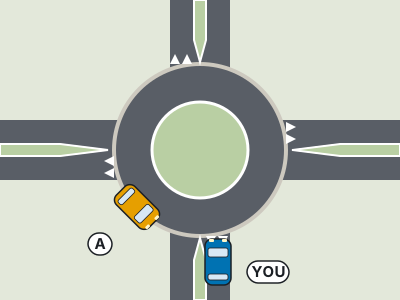
- No one when your speed is below 15 mph
- Vehicles waiting behind you
- Drivers entering from every approach
- Drivers already in the circle
Show answer
Drivers already in the circle. Traffic already circulating has priority over a vehicle that has not entered. Montana states that drivers entering a traffic circle or rotary must yield to drivers already in the circle. The entering driver still needs to approach at a safe speed and proceed only when the path is clear. Being first in line or traveling below 15 mph does not create priority. Look left before committing to the circle and watch for pedestrians at the crossing.
Study this in the handbook: Who yields at intersections
20. What does this right-curving warning sign tell the driver?

- A right curve is ahead, and a suggested safe speed may be posted below
- The driver must turn right at the next intersection
- A work-zone detour requires a U-turn
- The road becomes one-way to the left
Show answer
A right curve is ahead, and a suggested safe speed may be posted below. This warning announces a right curve ahead. A supplemental panel may show a suggested safe speed for negotiating that curve, but the arrow does not require a turn at an intersection. It also does not identify a detour or change the roadway to one-way travel. Reduce speed before entering the bend, keep the vehicle under control through it, and follow any posted advisory. The sign is advance notice of a changing alignment, so waiting until the steering wheel is already turning leaves less room to respond.
Study this in the handbook: Road signs by shape and color
QualitySpace is expanding to Montana
We are a California-based independent insurance brokerage working on licensing in more states. We cannot help with Montana insurance yet. Leave your email and we will let you know when we can.
Every question is written from the official Montana Driver Manual. Need paper? Printable MT practice test with answer key.
Last verified 2026-10-05. How we check every question · Study all 212 as flashcards
Frequently asked questions
How many questions are on this Montana practice test?
This fixed set has 20 questions. It is test 4 of 10 from the 212 question Montana bank.
How does this fixed test relate to the full Montana bank?
Each numbered test is a fixed set of questions in a fixed order, so you can retake the same test later and compare. Every test mixes road signs and the other topics in about the same proportion as the full bank. Tests 1 to 10 together cover 200 of the 212 questions in the Montana bank, each once. The full practice page mixes the whole bank at random.
Last verified 2026-10-05. See the Montana DMV facts page for sourced state details.