
Test 1 of 10 · 20 questions · Free 2026
MT Permit Practice Test 1
Jump to the test ↓A fixed 20 question set from the Montana bank with answers and plain English explanations.
Question 1 of 20 · 0 right so far
All 20 questions in test 1
Every question below comes from the Montana question bank on this page. Open a question to see the correct answer and the explanation. Nothing here is hidden behind a signup.
1. Who sets the speed limit for a Montana construction or work zone?
- The nearest school district
- The driver based on the normal highway speed
- The responsible transportation agency, local authority, utility, or contractor for that zone
- A single statewide work zone limit of 25 mph
Show answer
The responsible transportation agency, local authority, utility, or contractor for that zone. Montana does not use one standard speed limit for every construction or work zone. The Department of Transportation, a local authority, a utility company, or a private contractor sets a speed specific to that zone. Drivers must read the posted limit and obey it, even if the surrounding road normally permits faster travel. Assuming a universal 25 mph rule misses the local posting, while choosing the normal highway speed ignores the temporary control. Orange devices and work activity should prompt an early speed check.
2. Which warning sign is the exception to Montana's usual diamond shape?
- The sharp right turn sign
- The school ahead sign
- The winding road sign
- The railroad crossing ahead sign
Show answer
The railroad crossing ahead sign. Most Montana warning signs are diamond shaped, but the railroad crossing ahead sign is specifically identified as round. That unusual shape is a recognition aid when a driver is scanning signs in poor visibility. School, winding-road, and sharp-turn warnings belong to the usual diamond-shaped warning group. The exception does not make the railroad message less urgent: it still announces a hazard ahead and calls for slower, attentive driving. Remember the pairing as a quick test cue: black and yellow warning family, round railroad exception.
Study this in the handbook: Road signs by shape and color
3. On a multi-lane road, which lane is intended for passing slower vehicles?
- The left-most lane
- The lane nearest the right shoulder
- Any lane selected without signaling
- The center lane only, regardless of traffic
Show answer
The left-most lane. Montana's passing rule assigns a clear purpose on multi-lane roads: the left-most lane is intended for passing slower vehicles. That does not remove the duty to pass safely or to signal and observe surrounding traffic. The lane nearest the right shoulder is a travel lane, and passing on the right is legal only in limited situations, while choosing any lane ignores the manual's lane-use guidance. A center lane may be appropriate for through travel, but it is not automatically the passing lane. Look for the left-most lane when planning a lawful pass.
Study this in the handbook: Speed limits, passing and turning
4. What does Montana's School Crossing Ahead warning sign tell drivers to do?

- Maintain the ordinary highway speed unless a guard enters the road
- Slow down and watch for children at all times
- Stop only after a child steps into the lane
- Use the horn continuously while passing the crossing
Show answer
Slow down and watch for children at all times. The school crossing warning tells drivers that children may be using the roadway, so the manual directs them to slow down and watch for children at all times. A crossing guard is not required before the driver becomes cautious, and waiting for a child to enter the lane is too late. Honking does not replace observation or speed control. The safest mental marker is the combination of a school location and limited child visibility: reduce speed early, search both sides, and be ready to stop for a pedestrian.
5. An emergency vehicle approaches with a siren and flashing red or blue light. What must you do?
- Stop in the intersection immediately, even if blocking cross traffic
- Continue at normal speed while watching it in the mirror
- Pull to the right, stop, and remain stopped until it has passed
- Move left and maintain speed so it can pass on the shoulder
Show answer
Pull to the right, stop, and remain stopped until it has passed. Montana requires drivers to yield to an emergency vehicle using a siren or air horn with a flashing red or blue light. Pull as near to the right edge as possible, stop, and remain stopped until the vehicle passes. If you are already in an intersection, clear it first, then pull over safely. Stopping in the intersection can obstruct the responder, and moving left may place your vehicle in its path. The cue is the combination of audible and visual emergency signals, followed by a deliberate right-side stop.
Study this in the handbook: Who yields at intersections
6. When may you enter an intersection against a steady yellow light?
- Whenever you are turning right
- Whenever the road behind you is crowded
- Only when you are too close to stop safely
- Whenever no pedestrian signal is visible
Show answer
Only when you are too close to stop safely. A steady yellow signal warns that red is coming. Montana says not to enter against it unless the vehicle is already too close to stop safely. That narrow condition recognizes that an abrupt stop can itself create danger. A crowded road behind, a right turn, or the absence of a pedestrian signal does not authorize entry. As the light changes, check your distance and brake smoothly if stopping is safe. The yellow light should trigger caution and preparation, never a race to beat red.
Study this in the handbook: Traffic signals, roundabouts and railroad crossings
7. What administrative fee applies to Montana motor vehicle transactions since January 1, 2018?
- A flat $10 fee
- A 3 percent administrative fee
- No fee
- A 10 percent fee
Show answer
A 3 percent administrative fee. Starting January 1, 2018, a 3 percent administrative fee is added to all Montana MVD products and services, on top of the listed license, permit and endorsement fees, which are subject to change. Over 80 forms and manuals are available free on the MVD forms website, and the fee section of the manual lists the exact charges for each transaction.
Study this in the handbook: Your Montana license, renewal and insurance
8. For the second six months of a Montana first-year restricted license, how many unrelated passengers under 18 may ride without licensed-adult supervision?
- One
- Three
- Two
- Four
Show answer
Three. The passenger restriction expands during the second six-month period to three unrelated passengers under 18, unless a licensed adult driver is supervising. One is the first-period number, not the later one. Two and four do not match the stated limit. Think of the progression as one passenger first, then three during the second half of the restricted year, while keeping the adult-supervision exception in view.
Study this in the handbook: Learner license and the teen GDL steps
9. What does Montana's winding-road warning sign tell a driver to expect?

- The road ahead winds through a series of turns or curves
- A bridge too narrow for two vehicles to meet
- Loose gravel covering the highway ahead
- A steep hill requiring an immediate stop
Show answer
The road ahead winds through a series of turns or curves. The winding-road sign warns of a series of turns or curves rather than one isolated bend. The narrow-bridge choice describes a different warning, while loose gravel concerns the road surface and a steep hill concerns grade. Treat the sign as advance notice that the roadway keeps changing direction. Slow before entering the sequence, then maintain a speed that lets you steer smoothly around each curve.
Study this in the handbook: Road signs by shape and color
10. What driving adjustment is called for by this slippery-when-wet warning?

- Brake hard as soon as rain begins to clear the pavement
- Reduce speed, avoid hard braking or sudden direction changes, and increase following distance
- Follow more closely so another vehicle breaks the spray
- Maintain speed and make quick steering corrections
Show answer
Reduce speed, avoid hard braking or sudden direction changes, and increase following distance. The slippery-when-wet warning calls for a slower speed, gentle braking and steering, and more space behind the vehicle ahead. Hard braking or sudden direction changes can reduce control on unusually slick pavement. Following closely makes spray and stopping problems worse, while maintaining speed with quick corrections ignores the warning. Ease off the accelerator before the wet section, increase the gap, and make smooth inputs. The sign describes a condition that may not be obvious until rain reaches the pavement, so prepare before traction is lost.
11. After pulling over for an approaching emergency vehicle, how long must a Montana driver remain stopped?
- Until another driver waves the vehicle through
- Until the next traffic signal turns green
- For exactly one minute
- Until the emergency vehicle has passed
Show answer
Until the emergency vehicle has passed. After yielding to an emergency vehicle, a Montana driver must pull to the right and remain stopped until that vehicle has passed. A green signal does not release the driver, and the manual gives no one-minute timer or permission to wait for another motorist’s gesture. The stop protects the emergency route and gives the responding vehicle room to proceed. If the driver is in an intersection, clearing it comes first, followed by pulling over and stopping.
Study this in the handbook: Who yields at intersections
12. Until about what height does the Montana manual recommend booster seats for older children?
- About 4 feet 9 inches tall
- About 4 feet tall
- About 5 feet 6 inches tall
- About 3 feet 6 inches tall
Show answer
About 4 feet 9 inches tall. The manual recommends booster seats for older children until the vehicle's lap and shoulder belt fits properly, which usually happens when a child is about 4 feet 9 inches tall. Four feet and three and a half feet are too short for an adult belt to fit well, and waiting until 5 feet 6 inches goes beyond the manual's guidance. Current Montana law requires a harnessed seat or a booster with a lap and shoulder belt from age 4 up to 8, and an adult belt once a child is 9 or has outgrown the booster's limits.
Study this in the handbook: Required lights and equipment
13. What should a driver do before passing a bicyclist traveling in the same lane?
- Drive onto the shoulder to get around the bicyclist
- Share the lane closely if the bicyclist is near the shoulder
- Sound the horn and pass immediately within the same lane
- Wait until it is safe to pass in the adjoining lane
Show answer
Wait until it is safe to pass in the adjoining lane. Montana advises drivers not to share a lane with a pedestrian or bicyclist. The driver should wait until it is safe to pass in the adjoining lane, leaving the cyclist room instead of squeezing past within the same lane. A shoulder is not a shortcut around the safety check, and a horn does not make an immediate pass lawful or safe. Look for traffic approaching from behind and ahead, signal as needed, and complete the pass only when the neighboring lane provides enough space.
Study this in the handbook: Following distance, merging and passing
14. What is the minimum liability insurance amount for bodily injury or death of one person in a Montana crash?
- $10,000
- $25,000
- $50,000
- $100,000
Show answer
$25,000. Montana requires at least $25,000 for bodily injury or death of one person in any one accident. The $50,000 amount covers bodily injury or death of two people, while $20,000 applies to property damage. Match the dollar figure to the type and number of losses, because the three minimum coverage amounts describe different parts of the required liability policy. Keep those categories separate when reviewing insurance documents.
Study this in the handbook: Your Montana license, renewal and insurance
15. Why should a driver leave extra following space behind a truck or bus that may not see the vehicle?
- Trucks are required to travel below every posted limit
- The larger vehicle always has the right of way
- The larger vehicle may stop suddenly without knowing the follower is there
- A following driver must remain exactly one car length back
Show answer
The larger vehicle may stop suddenly without knowing the follower is there. A truck, bus, van, or vehicle pulling a camper or trailer may not be able to see a vehicle directly behind it. It could stop suddenly without knowing the following driver is there. Falling back provides more room to see ahead and react. The manual does not give the larger vehicle automatic priority in every situation, and it does not set a universal one-car-length rule. Extra space is a visibility and stopping buffer.
Study this in the handbook: Following distance, merging and passing
16. When possible, how should a vehicle pass a stationary emergency or police vehicle displaying emergency signals?
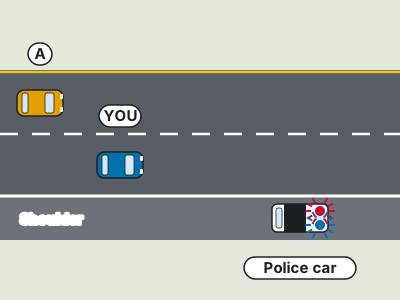
- Switch to a lane farther away from the stationary vehicle
- Move closer to the stationary vehicle before passing
- Stop beside the stationary vehicle until it leaves
- Stay in the adjacent lane even when another lane is safely open
Show answer
Switch to a lane farther away from the stationary vehicle. When possible, Montana advises moving into a lane farther away from a stationary emergency or police vehicle displaying emergency signals. That extra lateral distance gives responders more working room. Moving closer reduces the buffer, stopping beside the vehicle can obstruct traffic, and staying in the adjacent lane ignores the safer option when another lane is open. The manual also requires a speed reduction on highways posted at 50 mph or more, so drivers should combine both protections when the situation allows.
Study this in the handbook: Crashes, emergency vehicles and traffic stops
17. Traffic signs in the Montana manual are classified according to which three functions?
- Temporary, permanent, and seasonal
- Parking, toll, and fuel
- Urban, rural, and interstate
- Regulatory, warning, and information guide
Show answer
Regulatory, warning, and information guide. The classification tells you what a sign is trying to do. Regulatory signs command or prohibit an action, warning signs call attention to danger, and information guide signs help with travel information. The other groupings describe locations, services, or duration rather than the manual's functional system. Identifying the category helps you choose the right response: obey a rule, prepare for a hazard, or use the information to navigate.
Study this in the handbook: Road signs by shape and color
18. Which Montana license applicants must register with the Selective Service?
- Young men at least 15 and not older than 26
- All applicants over 18
- Only commercial drivers
- Only applicants born outside the U.S.
Show answer
Young men at least 15 and not older than 26. Young men who are at least 15 years old and not older than 26 are required to register with the Selective Service in compliance with the federal Military Selective Service Act. The manual says an individual must be able to meet those registration requirements when applying for an instruction permit, basic driver license, CDL, or Montana ID card, and a 15 to 17 year old must be able to be registered upon turning 18. The opportunity to register is offered on the application at a Montana driver licensing exam station.
19. What does a steady green arrow provide for a turning vehicle?
- A warning that the signal will turn red
- Permission to ignore pedestrians
- A protected turning movement
- A requirement to reverse direction
Show answer
A protected turning movement. A steady green arrow assigns a protected turning movement, which is different from an ordinary green light. Montana still expects drivers to proceed cautiously and watch the intersection. The arrow does not erase awareness of pedestrians or other hazards, and a red transition warning is described separately for yellow signals. Do not reverse direction because of the arrow. Enter only when the intended path is clear and complete the turn as directed.
20. When approaching a horse being ridden or led along a road, which action is required?
- Rev the engine to make the animal move faster
- Honk early so the rider knows the vehicle is close
- Pass at the posted limit as long as the horse is near the curb
- Use a reasonable speed and distance, and do not sound the horn
Show answer
Use a reasonable speed and distance, and do not sound the horn. A horse can react unpredictably to noise and a close vehicle. Montana requires due care, including a reasonable speed and a reasonable distance, and makes sounding the horn when approaching or passing a horse illegal. The honking option directly violates that instruction. A posted limit may still be too fast for the animal and surroundings, so it does not replace a reasonable speed. Revving adds noise and can frighten the horse. Ease off early, give the animal room, and wait if the rider signals you to stop.
Study this in the handbook: Following distance, merging and passing
QualitySpace is expanding to Montana
We are a California-based independent insurance brokerage working on licensing in more states. We cannot help with Montana insurance yet. Leave your email and we will let you know when we can.
Every question is written from the official Montana Driver Manual. Need paper? Printable MT practice test with answer key.
Last verified 2026-10-05. How we check every question · Study all 212 as flashcards
Frequently asked questions
How many questions are on this Montana practice test?
This fixed set has 20 questions. It is test 1 of 10 from the 212 question Montana bank.
How does this fixed test relate to the full Montana bank?
Each numbered test is a fixed set of questions in a fixed order, so you can retake the same test later and compare. Every test mixes road signs and the other topics in about the same proportion as the full bank. Tests 1 to 10 together cover 200 of the 212 questions in the Montana bank, each once. The full practice page mixes the whole bank at random.
Last verified 2026-10-05. See the Montana DMV facts page for sourced state details.