
Test 6 of 10 · 20 questions · Free 2026
MT Permit Practice Test 6
Jump to the test ↓A fixed 20 question set from the Montana bank with answers and plain English explanations.
Question 1 of 20 · 0 right so far
All 20 questions in test 6
Every question below comes from the Montana question bank on this page. Open a question to see the correct answer and the explanation. Nothing here is hidden behind a signup.
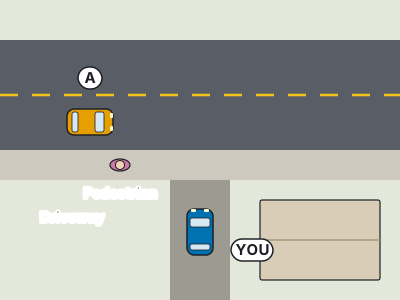
1. You are pulling from an alley onto a main road. What must you do before joining traffic?
- Use the shoulder until traffic clears
- Accelerate into the first available gap without stopping
- Expect main-road traffic to yield
- Stop and yield to vehicles already on the main roadway
Show answer
Stop and yield to vehicles already on the main roadway. The vehicle coming from a lesser access point is entering an established roadway, so it must stop and yield to traffic already there. This requirement covers driveways, alleys, and roadside entrances. Accelerating through a gap is not a substitute for the required stop, and main-road drivers do not automatically yield. The shoulder is not a waiting lane. Scan both directions, stop where you can see, and enter only after the roadway is safe.
Study this in the handbook: Who yields at intersections
2. At what core body temperature does heatstroke begin, according to the Montana manual?
- About 104 degrees, with about 107 degrees being lethal
- About 99 degrees
- About 120 degrees
- About 95 degrees
Show answer
About 104 degrees, with about 107 degrees being lethal. Heatstroke begins when the core body temperature reaches about 104 degrees and the body's cooling system is overwhelmed, and a core temperature of about 107 degrees is lethal. The manual quotes NHTSA that vehicle heatstroke occurs when a child is left in a hot vehicle and the child's temperature rises in a quick and deadly manner. Even great parents can forget a child in the back seat, especially when a routine suddenly changes, so check the back seat before walking away.
3. After clearing an intersection for an approaching emergency vehicle, what should a Montana driver do?
- Continue through the next several intersections
- Pull to the right and remain stopped until the vehicle passes
- Stop immediately where the vehicle is blocking traffic
- Follow the emergency vehicle to keep the route clear
Show answer
Pull to the right and remain stopped until the vehicle passes. After clearing an intersection, the driver should pull to the right and remain stopped until the emergency vehicle has passed. Continuing through several intersections delays the emergency response, and stopping where traffic is blocked creates another hazard. Following the emergency vehicle is not required and can interfere with its path. The sequence is simple: clear the intersection if necessary, move right, then stay stopped.
Study this in the handbook: Who yields at intersections
4. How should a driver handle an emergency vehicle approaching from any direction?
- Continue normally if the emergency vehicle is using its siren
- Stop in the center of the roadway to make the vehicle go around
- Accelerate until the emergency vehicle is no longer visible
- Yield and, when safe, pull over and stop at the right edge
Show answer
Yield and, when safe, pull over and stop at the right edge. Drivers must yield to an approaching emergency vehicle and, when possible and safe, pull to the right edge and stop. Stopping in the center blocks the responder, while acceleration and ordinary continuation disregard the emergency vehicle's priority. Check mirrors, signal your movement, and create a clear path without making a sudden maneuver. Reenter traffic only after the emergency vehicle has passed and the roadway is safe.
Study this in the handbook: Crashes, emergency vehicles and traffic stops
5. What do traffic signals control at some Montana intersections and midblock crosswalks?
- Drivers of vehicles and pedestrians
- Only pedestrians crossing at marked locations
- Only vehicles traveling on major highways
- Road workers directing traffic in construction zones
Show answer
Drivers of vehicles and pedestrians. Montana uses traffic signals to control both vehicle drivers and pedestrians at some intersections and midblock crosswalks. Signals promote better movement of traffic on busy roads by assigning right of way. They are not limited to pedestrians or to major highways, and they are not the same thing as workers directing traffic in a construction zone. Watch the signal as you approach, and remember that pedestrians follow pedestrian signals when those are present.
Study this in the handbook: Traffic signals, roundabouts and railroad crossings
6. How far to the rear must a Montana vehicle mirror provide visibility?
- 200 feet, on vehicles manufactured after January 1, 1956
- 50 feet
- 1,000 feet
- There is no mirror requirement
Show answer
200 feet, on vehicles manufactured after January 1, 1956. Vehicles manufactured after January 1, 1956 must provide 200 foot visibility to the rear through their mirrors. The same equipment section requires front seat belts on vehicles built between January 1, 1965 and January 1, 1968, and belts for every designated seat on vehicles built after that. Fifty and 1,000 feet do not match the mirror rule, and there is a mirror requirement. For full equipment details the manual refers drivers to Montana Code Annotated Title 61, chapter 9, with copies generally available in county courthouses and most libraries.
Study this in the handbook: Required lights and equipment
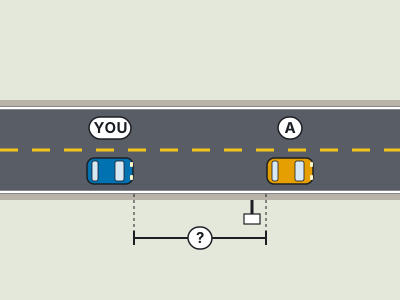
7. What following distance does Montana's Three Second Rule require?
- One second for every ten miles per hour
- At least three seconds behind the vehicle ahead
- A fixed distance of one car length
- Exactly two seconds on dry pavement
Show answer
At least three seconds behind the vehicle ahead. The Three Second Rule uses time rather than a fixed number of car lengths, so it works at any speed. Watch the vehicle ahead pass a stationary object, then count until your vehicle reaches that same point. Reaching it before finishing the count means the gap is too short. A fixed car length ignores speed, and two seconds or one second per ten miles per hour is not the three second baseline. The manual says a four second distance may be needed on slippery roads, when following motorcycles, or when it is hard to see.
Study this in the handbook: Adjusting speed for roads, weather and sight distance
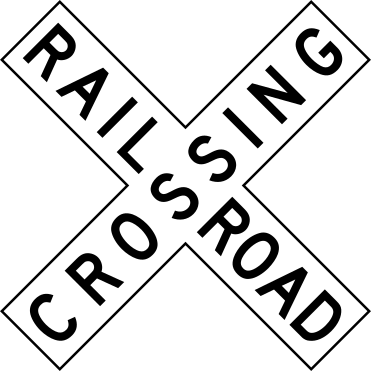
8. Where is this railroad crossbuck used, and what extra information may appear below it?
- At school crossings; a lower sign lists the crossing guard's name
- Only at private driveways; a lower sign gives the speed limit
- At public crossings; a lower sign may state the number of tracks
- Only after a train has passed; a lower sign announces a detour
Show answer
At public crossings; a lower sign may state the number of tracks. The railroad crossbuck identifies a public railroad crossing, and a supplementary sign below it can show how many tracks cross the roadway. The sign is not limited to private driveways or school areas, and it does not wait for a train to pass before applying. A driver should approach prepared to stop if a train is coming, while checking every track represented at the crossing. The extra track count matters because a clear first track does not necessarily mean the entire crossing is clear.
Study this in the handbook: Traffic signals, roundabouts and railroad crossings
9. How should you respond to a flashing yellow signal?
- Treat it exactly like a flashing red signal
- Stop fully and wait for a green indication
- Proceed with caution, usually after slowing down
- Accelerate so you clear the intersection quickly
Show answer
Proceed with caution, usually after slowing down. A flashing yellow signal permits movement but calls for caution, and Montana notes that it usually means slowing down. It is not the same as a flashing red, which requires a complete stop. The driver still needs to scan for vehicles, pedestrians, and changing conditions before entering. The useful habit is to lift off the accelerator and cover the brake as the signal comes into view, then proceed only after confirming that the intersection can be crossed safely.
10. A Montana funeral procession travels on a highway posted at 65 mph. What is the fastest a driver in the procession may go?
- 65 mph
- 55 mph
- 45 mph
- 60 mph, because procession drivers stay 5 mph under the limit
Show answer
55 mph. A driver in a Montana funeral procession may not exceed 55 mph on a highway where the speed limit is 55 mph or more, so a 65 mph posting does not let the procession travel at 65. On other streets and roads the rule works the other way: procession drivers may not go more than 5 mph below the posted limit, which is a minimum, not a cap. The manual sets no 45 mph limit. All headlights and taillights must be on.
Study this in the handbook: Pedestrians, school buses, funerals and bicycles
11. What is the closest a Montana driver may park to a stop sign?
- 15 feet
- 20 feet
- 30 feet
- 50 feet
Show answer
30 feet. Montana bars parking within 30 feet of a traffic signal, stop sign, or yield sign, because a parked car there can hide the sign from approaching drivers. Fifteen feet is the fire hydrant rule, 20 feet is the rule for a crosswalk or sidewalk at an intersection, and 50 feet is the railroad crossing rule. Mixing up these distances is a common test mistake, so learn each one together with the object it protects.
12. What does the Montana manual say about local laws on phone use while driving?
- No Montana city regulates phone use while driving
- Local laws restrict calls but allow texting
- Most Montana cities have passed laws against texting and talking on cell phones while driving
- Cities may ban texting only inside school zones
Show answer
Most Montana cities have passed laws against texting and talking on cell phones while driving. The manual notes that most Montana cities have passed laws against texting and talking on cell phones while driving, so a driver can be cited under a local ordinance. Saying no city regulates phone use contradicts that statement, and the local laws cover texting as well as talking rather than allowing texts. Nothing limits these laws to school zones. The manual's advice is simpler than any ordinance: never text or talk on the phone while driving, and pull over and stop first.
Study this in the handbook: Scanning, blind spots and signaling
13. Which situation is an exception to Montana's open container law?
- A passenger with an open drink in a hired limousine
- A passenger with an open beer in the back seat of a family car
- A driver with an open can in the cup holder at a red light
- An open bottle in an unlocked glove compartment
Show answer
A passenger with an open drink in a hired limousine. Montana generally bans open alcoholic beverage containers in the passenger area, but the law has exceptions, including passengers carried by a hired driver in a bus, taxi, or limousine. A family car's back seat is still the passenger area, so an open beer there is an offense. A cup holder is within the driver's reach, and stopping at a red light changes nothing. The glove compartment choice fails because the manual allows only a locked glove or storage compartment.
Study this in the handbook: Alcohol, drugs and the law
14. What is distinctive about the shape of a Montana STOP sign?
- It is the only eight-sided traffic sign
- It is the only round warning sign
- It is a five-sided school warning sign
- It is a rectangular guide sign
Show answer
It is the only eight-sided traffic sign. The STOP sign is identified by its eight-sided shape, which makes it recognizable even when visibility is poor. A round sign belongs to the railroad-crossing warning category, while a five-sided shape is associated with school-related warnings in standard sign systems. A rectangle describes many regulatory or guide signs, not the unique STOP outline. Shape recognition helps a driver respond before every word is readable.
Study this in the handbook: Road signs by shape and color
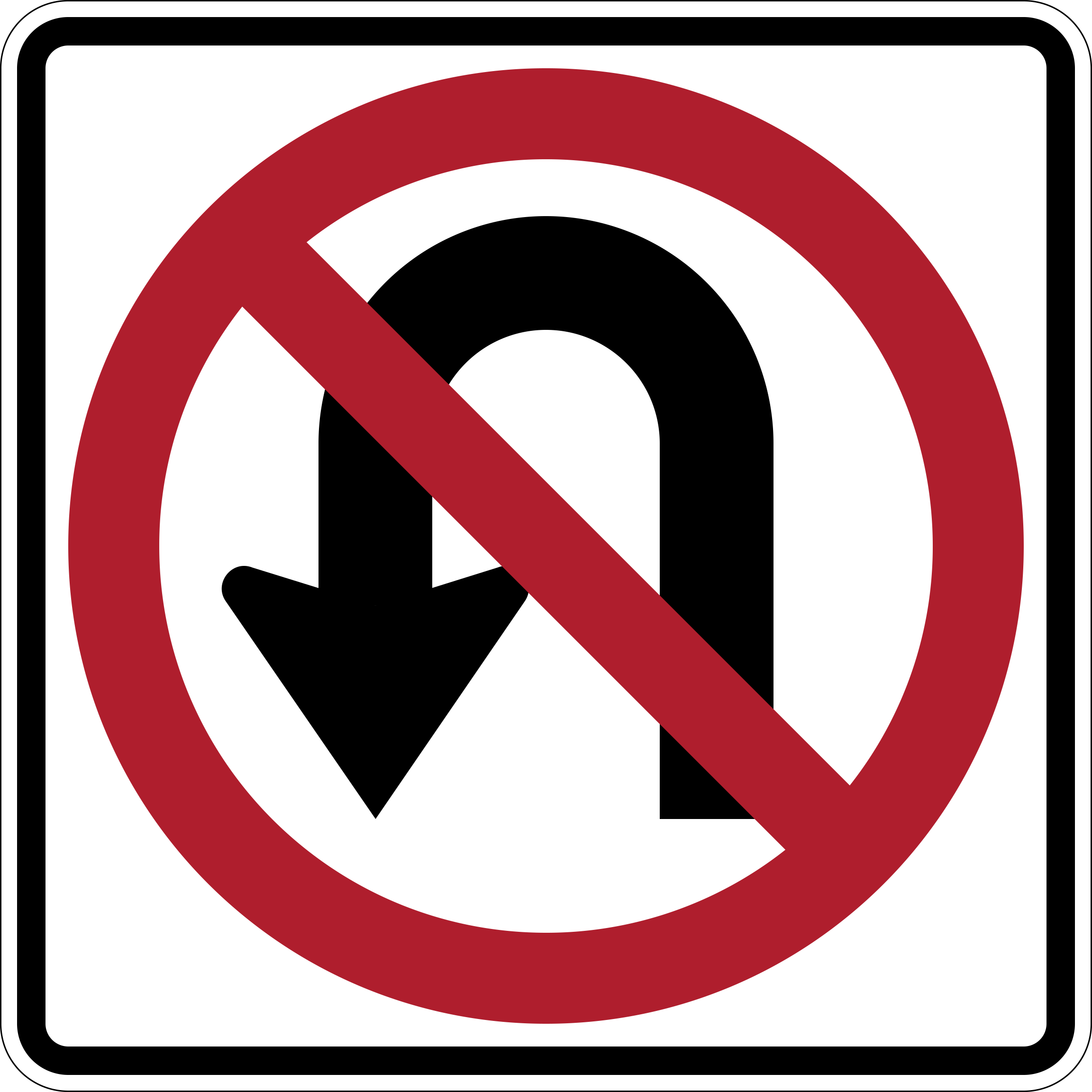
15. What movement is prohibited by this sign?
- Continuing straight through the intersection
- Passing a vehicle in the same lane
- Turning right at the next intersection
- Turning about to travel in the opposite direction
Show answer
Turning about to travel in the opposite direction. The NO U TURN sign prohibits turning about so the vehicle travels in the opposite direction at that intersection. It does not ban ordinary passing, a right turn, or proceeding straight. A driver who needs to reverse direction must wait for a location where the maneuver is legal, visible, and safe. Do not interpret the curved arrow as a general turn restriction: the defining feature is that the maneuver reverses the vehicle's direction. Check for additional lane controls before choosing another turn.
Study this in the handbook: Road signs by shape and color
16. What recent record must a Montana teen have before advancing from the instruction permit to the restricted-license step?
- No traffic violations during the preceding 30 days only
- No traffic violations or alcohol/drug offenses during the preceding six months
- No alcohol use at any time since birth
- No convictions after the teen turns 18
Show answer
No traffic violations or alcohol/drug offenses during the preceding six months. Before advancing to the first-year restricted license step, the teen must have no traffic violations or alcohol or drug offenses during the preceding six months. The rule is a recent record requirement, not a 30-day window or a lifetime statement about alcohol. It also applies before the step change, so an offense during that period prevents advancement. Track the six-month period from the intended transition date.
Study this in the handbook: Learner license and the teen GDL steps
17. How far into the lane do bicyclists often ride, and why, according to the Montana manual?
- On the shoulder only
- In the exact center, to block traffic
- About 18 to 24 inches, to discourage a dangerous in lane pass
- At least 5 feet from the curb by law
Show answer
About 18 to 24 inches, to discourage a dangerous in lane pass. Many bicyclists ride further into the lane, approximately 18 to 24 inches, to discourage motorists from attempting a dangerous in lane pass. A rider that far out is not being rude; the position keeps cars from squeezing by. Change lanes to pass when possible, and remember bicycle spoke reflectors must sit within 3 inches of the rim so drivers can see them at night.
Study this in the handbook: Pedestrians, school buses, funerals and bicycles
18. During the first six months of a Montana teen’s supervised instruction permit, how much night driving practice is required?
- At least 5 hours
- No night driving is required
- At least 20 hours
- At least 10 hours
Show answer
At least 10 hours. The supervised practice requirement is at least 50 total hours, including 10 hours at night, during a minimum six month period. The ten hour figure is a portion of the total, not an optional suggestion, and five hours is insufficient. A helpful study cue is to pair the numbers: 50 total hours, 10 nighttime hours, and six months of practice.
Study this in the handbook: Learner license and the teen GDL steps
19. When is a Montana teenager's lifetime crash risk highest, according to the manual?
- After five years of driving
- At age 25
- Only when driving at night
- In the first months of solo driving and the first 1,000 miles
Show answer
In the first months of solo driving and the first 1,000 miles. A teenager's highest lifetime crash risk is in the first months of solo driving and the first 1,000 miles, which is why Montana's first-year restricted license limits night driving and passengers. The manual notes that fatal crashes are more likely at night for all ages, but the risk is highest for teenagers. Once the teen reaches Step 3, the license confers full privileges. Five years of experience and age 25 are not the peak the manual names.
Study this in the handbook: Learner license and the teen GDL steps
20. If a solid yellow line is on a driver's side and a dashed yellow line is on the other side, may that driver pass?
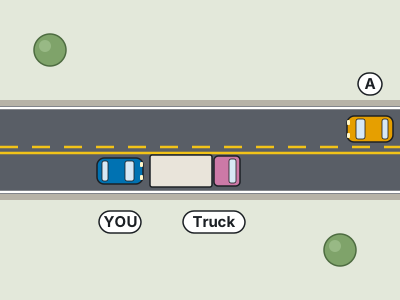
- Yes, because any dashed yellow line permits both directions to pass
- No, the solid line on that side bars crossing to pass
- Yes, but only by using the shoulder
- No, because all yellow lines prohibit every left turn
Show answer
No, the solid line on that side bars crossing to pass. A paired solid and dashed yellow centerline assigns the restriction by side. A driver beside the solid line may not cross it to pass, while traffic beside the dashed line may pass when safe. The presence of a dashed line on the opposite side does not authorize both directions. The shoulder is not a legal passing lane, and the rule is about overtaking, not a blanket ban on every left turn. Identify the line immediately next to your vehicle before deciding. Solid on your side means stay behind until a lawful opportunity appears.
Study this in the handbook: Lane lines and pavement markings
QualitySpace is expanding to Montana
We are a California-based independent insurance brokerage working on licensing in more states. We cannot help with Montana insurance yet. Leave your email and we will let you know when we can.
Every question is written from the official Montana Driver Manual. Need paper? Printable MT practice test with answer key.
Last verified 2026-10-05. How we check every question · Study all 212 as flashcards
Frequently asked questions
How many questions are on this Montana practice test?
This fixed set has 20 questions. It is test 6 of 10 from the 212 question Montana bank.
How does this fixed test relate to the full Montana bank?
Each numbered test is a fixed set of questions in a fixed order, so you can retake the same test later and compare. Every test mixes road signs and the other topics in about the same proportion as the full bank. Tests 1 to 10 together cover 200 of the 212 questions in the Montana bank, each once. The full practice page mixes the whole bank at random.
Last verified 2026-10-05. See the Montana DMV facts page for sourced state details.