
Test 2 of 10 · 20 questions · Free 2026
MT Permit Practice Test 2
Jump to the test ↓A fixed 20 question set from the Montana bank with answers and plain English explanations.
Question 1 of 20 · 0 right so far
All 20 questions in test 2
Every question below comes from the Montana question bank on this page. Open a question to see the correct answer and the explanation. Nothing here is hidden behind a signup.
1. How far before a turn should a Montana driver signal on a rural road?
- 300 feet
- 100 feet
- 200 feet
- 50 feet
Show answer
300 feet. Montana’s manual calls for a proper turn signal 300 feet before turning on rural roads. The 100 foot distance applies in town, so it is the tempting but incorrect shorter figure. Signaling early gives following and approaching road users more time to understand your plan. Use the road setting to select the distance: 100 feet in town and 300 feet on rural roads.
Study this in the handbook: Speed limits, passing and turning
2. What condition does Montana's sharp-right-turn warning sign identify?

- A four-way intersection ahead
- A sharp turn to the right in the road ahead
- A road that becomes one-way
- A railroad crossing immediately ahead
Show answer
A sharp turn to the right in the road ahead. The sharp-right-turn warning sign tells you that the roadway turns sharply right ahead. It is not an intersection sign, so the four-way choice would send your attention to crossing traffic that the symbol does not promise. It also does not announce one-way travel or a railroad crossing. Reduce speed before the turn, scan for opposing traffic, and keep the vehicle under control through the bend.
Study this in the handbook: Road signs by shape and color
3. After a first alcohol driving conviction in Montana, how long is the license suspended?
- 30 days
- Three months
- Six months
- Two years
Show answer
Six months. A first alcohol conviction in Montana brings a license suspension of six months, along with a fine and possible jail time. Thirty days and three months are too short, and two years exaggerates the first offense suspension. The manual warns that second and later convictions carry much worse penalties, and it separately says a driver can lose the license for refusing a BAC test when an officer asks. A driver under 21 can be arrested at a BAC of just 0.02.
Study this in the handbook: Alcohol, drugs and the law
4. A slow farm vehicle in Montana has traffic backing up behind it. When must it turn off the roadway?
- Only when a police officer orders it off
- When two vehicles are following
- Never, since farm vehicles have the right of way
- When four or more vehicles are slowed and there is room for a safe turnout
Show answer
When four or more vehicles are slowed and there is room for a safe turnout. Slow moving vehicles must drive in the extreme right lane, and when four or more vehicles are slowed behind one, it must turn off the roadway whenever there is enough room for a safe turnout. Two following vehicles do not trigger the rule, and no officer's order is needed. Farm tractors, animal drawn vehicles, and road maintenance vehicles usually travel 25 mph or less and carry a slow moving vehicle sign, but they have no general right of way over faster traffic.
5. What should you do when a vehicle is disabled and cannot be moved off the roadway?
- Remain just over a hill so traffic can pass behind you
- Stop where approaching drivers have a clear view and warn them
- Stand in the roadway to direct every approaching vehicle
- Turn off all lights so the battery will last longer
Show answer
Stop where approaching drivers have a clear view and warn them. If a disabled vehicle cannot be moved from the roadway, Montana advises stopping where other drivers have a clear view and warning road users that the vehicle is present. Emergency flashers, flares, or another warning device can help drivers change lanes. Stopping just over a hill or around a curve hides the hazard until it is too late. The driver should never stand in the travel lane. Choose visibility and personal safety together, using a safe roadside position while help is arranged.
Study this in the handbook: Brake failure, blowouts and other vehicle emergencies
6. What should a driver do when another motorist makes a mistake and needs to merge suddenly?
- Move into the other vehicle's lane to teach a lesson
- Close the gap so the other vehicle cannot enter
- Sound the horn continuously and maintain speed
- Slow down and let the other driver merge
Show answer
Slow down and let the other driver merge. The manual asks drivers not to make a difficult situation worse. If another motorist needs to change lanes suddenly, slowing down and allowing the merge can keep traffic moving and reduce the chance of contact. Closing the gap removes the escape space the other driver needs. A continuous horn does not solve the lane conflict, and moving into the other lane creates an intentional collision risk. Scan ahead for confused or struggling drivers, lift off the accelerator early, and preserve a usable gap. Courtesy here is a concrete collision-avoidance tool.
Study this in the handbook: Following distance, merging and passing
7. What safety chain does Montana require on a trailer of 3,000 pounds or less?
- No chain if the hitch is rated for the load
- A steel chain or cable at least a quarter inch in diameter fastened securely to the towing unit
- A rope of any size
- Chains only on trailers over 10,000 pounds
Show answer
A steel chain or cable at least a quarter inch in diameter fastened securely to the towing unit. Every trailer, semi trailer, or pole trailer of 3,000 pounds gross vehicle weight or less must have on the front a steel chain or cable fastened securely to the towing unit, and that chain or cable must be no less than a quarter inch in diameter. A rope of any size does not meet the rule, and a hitch rating does not replace the chain. The rule applies to these lighter trailers, so limiting chains to trailers over 10,000 pounds reverses it. Trailers with a gross weight over 3,000 pounds must instead have break away brakes.
8. Where should you stop for a STOP sign when a crosswalk is present?
- Before entering the crosswalk
- After the crosswalk, closest to the intersection
- In the center of the intersection
- Only at the far edge of the cross street
Show answer
Before entering the crosswalk. A STOP sign requires a complete stop before entering the intersection, and Montana adds that when there is a crosswalk, you stop before entering it. Stopping beyond the crosswalk can put the vehicle into a pedestrian path and reduces the driver's ability to yield safely. The center of the intersection and the far edge of the cross street are not stopping points. After stopping before the crosswalk, check for traffic close enough to be an immediate hazard before proceeding.
Study this in the handbook: Road signs by shape and color
9. When may a Montana driver use the left side of the centerline on a two-lane road?
- Whenever the road appears empty behind the vehicle
- Whenever the driver wants to avoid a rough shoulder
- Only while approaching a hill
- When overtaking and passing another vehicle safely
Show answer
When overtaking and passing another vehicle safely. On a two-lane road, Montana permits crossing left of the centerline for overtaking and passing another vehicle when the maneuver can be done safely. A rough shoulder, a hill, or an empty view behind does not create permission by itself. The driver must still evaluate oncoming traffic, sight distance, markings, and the space needed to return right. Passing is a planned maneuver, not a general lane preference.
Study this in the handbook: Speed limits, passing and turning
10. What roadway change does this Divided Highway Ends warning sign announce?

- Passing is required in both directions
- The road is changing to a divided highway with two one-way sections
- The highway becomes one roadway carrying traffic in both directions
- U-turns are authorized across the center island
Show answer
The highway becomes one roadway carrying traffic in both directions. The Divided Highway Ends sign warns that the highway ahead becomes a single roadway with traffic going in both directions, and the manual tells you to keep to the right. That is the opposite of a divided highway beginning, where a median separates two one-way roadways. The sign does not require passing, and it does not authorize U-turns. Keep right, watch carefully for oncoming traffic, and pay attention to the centerline as the road configuration changes.
11. What minimum liability coverage must Montana vehicle owners carry for injury to or destruction of another person’s property in one accident?
- $5,000
- $20,000
- $25,000
- $50,000
Show answer
$20,000. Montana requires at least $20,000 for injury to or destruction of another person’s property in one accident. Bodily-injury limits are separate: $25,000 for one person and $50,000 for two or more people. Match the coverage amount to the type of loss asked about. Keep the per-person, per-accident, and property-damage categories separate when checking the policy, because the limits apply to different kinds of loss.
12. What may lines and symbols on Montana roadways tell drivers?
- That every marked line may be crossed without checking traffic
- When they may pass or change lanes and which lanes to use for turns
- That shoulders are always travel lanes during congestion
- That all traffic must stop at every painted line
Show answer
When they may pass or change lanes and which lanes to use for turns. Roadway lines and symbols divide lanes, show when passing or changing lanes may be allowed, identify turn lanes, define pedestrian walkways, and mark where a driver must stop for a sign or signal. They do not make every line crossable or turn a shoulder into a travel lane. Read the marking together with the sign, signal, and traffic around you. A painted line provides guidance, but a lane change still requires a safe opportunity.
Study this in the handbook: Lane lines and pavement markings
13. When did Montana begin taxing and registering motor vehicles, according to the manual's history section?
- 1950
- 1901
- 1928
- 1913
Show answer
1913. In 1913 the Legislature recognized motor vehicles as property, put taxation on motor vehicles into effect to fund highway construction and maintenance, and began registration recording each vehicle's identifying features and the owner's name and address. The 1915 plates displayed MON, the year and the number, and the first prison made plates appeared in 1928, with county prefix numbers added in 1933.
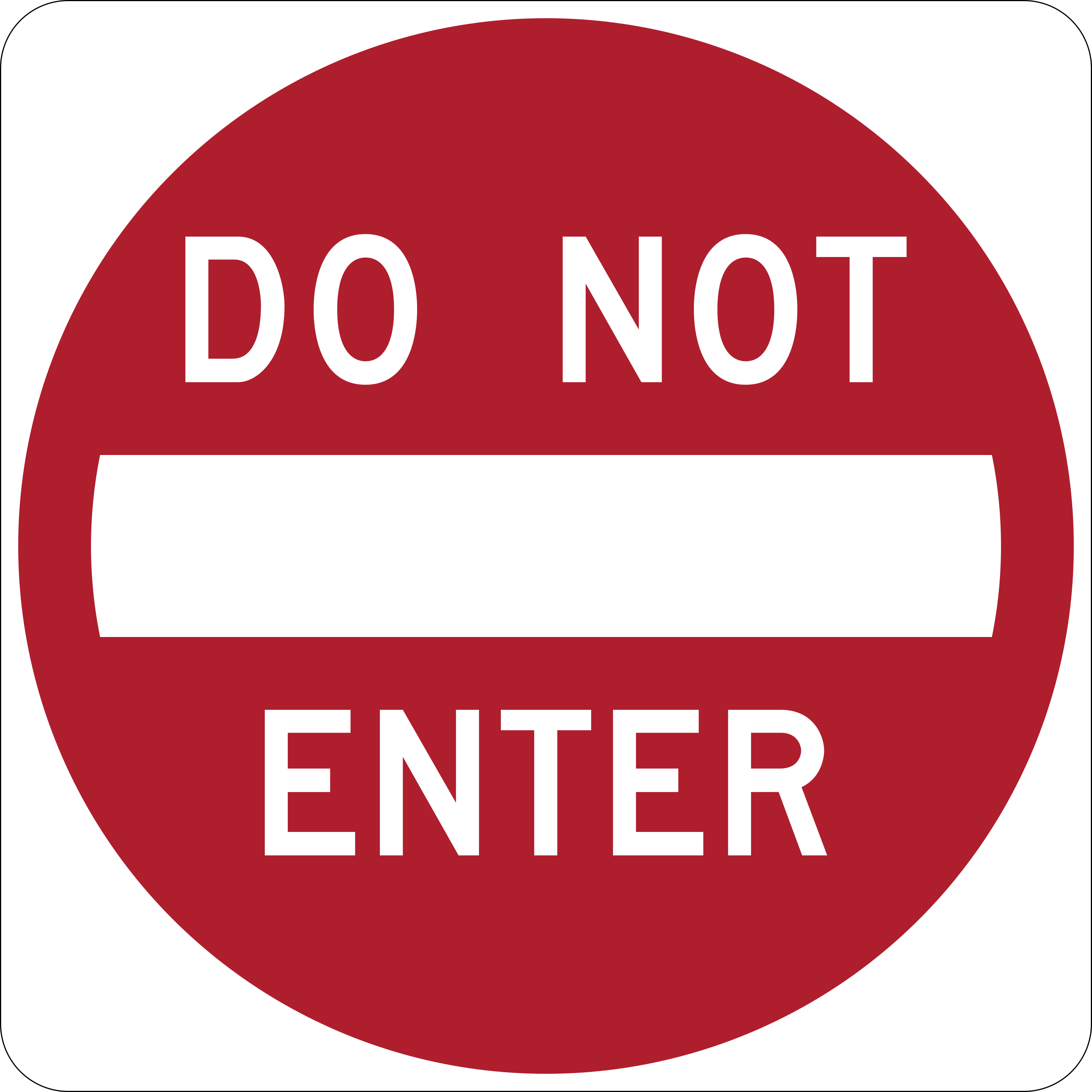
14. What roadway condition is indicated by this DO NOT ENTER sign?
- Traffic may enter after yielding to pedestrians
- The road is open only to vehicles making right turns
- A parking area begins immediately beyond the sign
- The road ahead is one-way in the opposing direction, or vehicle traffic is prohibited
Show answer
The road ahead is one-way in the opposing direction, or vehicle traffic is prohibited. The square DO NOT ENTER sign warns that the road ahead is a one-way roadway in the direction opposite the driver, or that vehicles are not permitted there at all. It is not a turn restriction limited to right turns, and it does not identify a parking area. Yielding to pedestrians cannot authorize entry where the sign prohibits vehicular movement. The useful driving cue is to stop the intended entry and find the permitted route instead of trying to use an empty lane or a brief gap in traffic.
Study this in the handbook: Road signs by shape and color
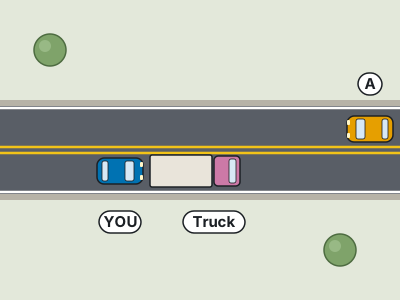
15. What does a double solid yellow centerline mean for passing?
- Both directions may pass when visibility is good
- Only traffic traveling uphill may pass
- Neither direction may pass across the lines
- Passing is allowed if the horn is used
Show answer
Neither direction may pass across the lines. Two solid yellow lines separate opposing traffic where passing is restricted for both directions. Montana permits crossing a solid yellow line for a left-turn maneuver, and its lane-marking guidance also allows a safe turn into certain lots, driveways, or roadways. That exception is not permission to overtake. Good visibility and a horn do not change the marking. Read the entire lane pattern before deciding whether a turn, rather than a pass, is allowed.
Study this in the handbook: Lane lines and pavement markings
16. What is the earliest a Montana driver can renew a license before it expires?
- Three months before expiration
- Nine months before expiration
- Six months before expiration
- Twelve months before expiration
Show answer
Six months before expiration. Montana allows renewal up to six months before the expiration date. Three months is the grace period after expiration, during which a driver can still renew without retesting, so it describes the other side of the window. Nine or twelve months early is outside the allowed period. An expired license is not valid for driving, even during the grace period, and a license more than three months expired means reapplying as a new driver and passing all applicable tests.
Study this in the handbook: Your Montana license, renewal and insurance
17. A Montana applicant pays for a license and begins testing. How many tries does the receipt allow to pass all required exams?
- Three attempts within one year
- Unlimited attempts for one year
- One attempt, then a new fee
- Two attempts within six months
Show answer
Three attempts within one year. A Montana driver license receipt is valid for one year, and for applicants who are testing it covers three attempts within that year to pass every required exam. Unlimited tries overstates it, while one attempt or two attempts in six months understate it. Receipts are not renewable. If the applicant does not finish the licensing process within the year, the applicant must reapply and start over, so plan study time before booking tests.
Study this in the handbook: Your Montana license, renewal and insurance
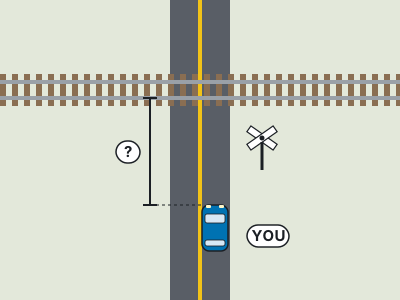
18. How far from the nearest rail must a driver stop when a train warning requires a railroad crossing stop?
- At least 50 feet from the crossing sign
- Exactly 5 feet from the nearest rail
- Not less than 15 feet from the nearest rail
- Only after the vehicle reaches the first rail
Show answer
Not less than 15 feet from the nearest rail. When a train warning requires a stop, the vehicle must be positioned as close as practicable to the crossing but at least 15 feet from the nearest rail. Five feet is too close, and the 50-foot choice confuses a parking restriction with the stopping rule. Reaching the rail before stopping defeats the safety purpose. Leave room for the train, watch every track, and cross only when the route beyond is clear.
Study this in the handbook: Traffic signals, roundabouts and railroad crossings
19. When following a motorcycle, what spacing does Montana advise because a fall may occur?
- Use extra distance, often a four-second gap
- Follow within one second so the motorcycle stays visible
- Leave less space on wet pavement to prevent merging
- Use the same fixed distance as behind a truck
Show answer
Use extra distance, often a four-second gap. A motorcycle can fall suddenly, and the rider needs room that a following driver may not need behind an ordinary vehicle. Montana identifies following motorcycles as a situation that can require a four-second following distance, especially when pavement is wet or icy, roads are gravel, or surfaces are metal. One second sharply reduces recovery time. Cutting space on slippery pavement reverses the safety response. A fixed distance ignores speed and surface conditions. Use a landmark and count four seconds when the motorcycle passes it, then increase space if visibility or traction deteriorates.
Study this in the handbook: Following distance, merging and passing
20. What does a steady yellow traffic signal tell a driver?
- The signal is about to turn red, so enter cautiously
- The driver has an unrestricted right of way through the intersection
- The driver must reverse to the previous intersection
- The signal grants permission to accelerate before cross traffic moves
Show answer
The signal is about to turn red, so enter cautiously. A steady yellow signal means caution and warns that the light is about to turn red. Enter only if stopping safely is no longer practical. It does not grant unrestricted priority, require backing up, or invite acceleration. The useful decision is based on stopping distance: if you can stop safely, do so; if you are already too close, clear the intersection carefully without creating a new conflict.
Study this in the handbook: Traffic signals, roundabouts and railroad crossings
QualitySpace is expanding to Montana
We are a California-based independent insurance brokerage working on licensing in more states. We cannot help with Montana insurance yet. Leave your email and we will let you know when we can.
Every question is written from the official Montana Driver Manual. Need paper? Printable MT practice test with answer key.
Last verified 2026-10-05. How we check every question · Study all 212 as flashcards
Frequently asked questions
How many questions are on this Montana practice test?
This fixed set has 20 questions. It is test 2 of 10 from the 212 question Montana bank.
How does this fixed test relate to the full Montana bank?
Each numbered test is a fixed set of questions in a fixed order, so you can retake the same test later and compare. Every test mixes road signs and the other topics in about the same proportion as the full bank. Tests 1 to 10 together cover 200 of the 212 questions in the Montana bank, each once. The full practice page mixes the whole bank at random.
Last verified 2026-10-05. See the Montana DMV facts page for sourced state details.