
Test 7 of 25 · 20 questions · Free 2026
TN Permit Practice Test 7
Jump to the test ↓A fixed 20 question set from the Tennessee bank with answers and plain English explanations. The real TN exam is 30 questions, 80 percent to pass; take the full length version on the main practice page.
Question 1 of 20 · 0 right so far
All 20 questions in test 7
Every question below comes from the Tennessee question bank on this page. Open a question to see the correct answer and the explanation. Nothing here is hidden behind a signup.
1. What maximum speed may Tennessee law set for interstate highways?
- 65 mph
- 55 mph
- 70 mph
- 80 mph
Show answer
70 mph. Tennessee law permits a maximum interstate speed of 70 mph. That figure is the ceiling authorized by the passage, not a guarantee that every interstate segment displays 70. Variable limits can reduce the number, particularly in congested urban areas, and the driver must still adjust for conditions. The 55 mph choice describes some urban sections rather than the statewide legal maximum. Check the sign where you are driving, then reduce further when weather, traffic, visibility, or roadway conditions make the maximum unsafe.
Study this in the handbook: Speed limits and the Basic Speed Rule
2. Which type of medication does Tennessee include in its warning about driving under the influence?
- Prescription drugs
- Only vitamins and mineral supplements
- Only medication taken in a hospital
- Prescription drugs are always safe for driving
Show answer
Prescription drugs. Tennessee's discussion of impaired driving expressly includes prescription drugs among substances that can affect a driver's ability. The warning is not limited to illegal substances, and a prescription does not guarantee that operating a vehicle is safe. The choices about vitamins, hospital-only medication, and automatic safety add limits that the passage does not state. Read the label and consider drowsiness, slowed reactions, or impaired judgment before starting the engine. If there is any doubt about the ability to drive, arrange another ride instead of testing the medication's effects on the road.
Study this in the handbook: How alcohol and drugs affect driving
3. What does an advisory speed plate beneath a warning sign provide?
- The minimum speed required on the entire roadway
- The recommended maximum safe speed for the condition ahead
- The speed at which every vehicle must travel regardless of conditions
- The legal speed limit for all roads in that county
Show answer
The recommended maximum safe speed for the condition ahead. An advisory speed plate supplements a warning sign by giving a recommended maximum safe speed for the upcoming condition. It is not a universal minimum, a command to maintain one exact speed, or a countywide speed limit. The driver still has to assess weather, visibility, traffic, and the road surface. A curve may require an even lower speed when conditions make the displayed recommendation too fast.
Study this in the handbook: Warning, railroad, work zone and guide signs
4. What background color does Tennessee use for warning signs and school signs?
- White
- Green
- Blue
- Yellow, except where orange is specified
Show answer
Yellow, except where orange is specified. Yellow is the warning color. Curve, intersection, pedestrian and animal crossing signs sit on a yellow field, and school signs use yellow or its fluorescent yellow green variant. Orange replaces yellow only in construction and maintenance zones. White backgrounds belong to regulatory signs, green to guide signs with directions and distances, and blue to motorist services. Reading color first lets you sort a sign into warn, command or inform from far away.
Study this in the handbook: Sign colors, shapes and regulatory signs
5. Your high beams are on and you are following another vehicle at night in Tennessee. Within what distance must you dim them?
- Within 100 feet
- Within 1,000 feet
- Within 500 feet
- Only when the other driver flashes the headlights
Show answer
Within 500 feet. Tennessee uses the same 500 foot distance for following as for meeting traffic: once you are within 500 feet of a vehicle ahead, lower your beams. The manual explains why. Glare from your high beams reflects in the other driver's rear view mirror and can blind that driver, including a motorcyclist. Waiting until you are 100 feet behind is far too late, and you do not need a signal from the other driver to dim.
Study this in the handbook: Headlights, night driving and bad weather
6. You want to park across the street from a fire station driveway in Tennessee. How far from the driveway must you stay?
- 75 feet
- 20 feet
- 15 feet
- Parking across the street has no limit
Show answer
75 feet. Tennessee sets two distances around a fire station driveway. On the same side of the street, you may not park within 20 feet of the driveway. On the opposite side of the street, the limit grows to 75 feet. Twenty feet is therefore the same side figure only, and 15 feet is the fire hydrant rule. The manual also says to yield to an emergency vehicle backing into a fire station driveway.
Study this in the handbook: Lane use, passing and parking
7. At a T intersection where one road dead-ends into another, who must yield?
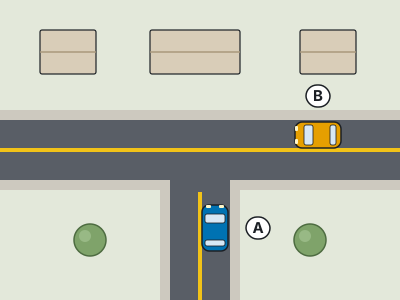
- Vehicles on the road that ends
- The vehicle that arrives second, regardless of road
- Vehicles on the main road that continues
- The vehicle traveling at the lower speed only
Show answer
Vehicles on the road that ends. At a T intersection, traffic on the road that ends must yield to traffic traveling on the main crossing roadway. The through road has the continuing path, while the dead-end approach must wait for a safe opening. Arrival order does not transfer priority to the terminating road, and speed alone is not the rule. Look in both directions along the main road before entering and yield until the movement is safe.
Study this in the handbook: Right of way, turns and emergency vehicles
8. When passing a horseback rider on a Tennessee roadway, a driver should:
- Sound the horn repeatedly to warn the horse
- Rev the engine so the rider knows the car is nearby
- Pass as close as possible before the horse moves
- Use a reasonable speed and distance without sounding the horn or revving the engine
Show answer
Use a reasonable speed and distance without sounding the horn or revving the engine. Horseback riders are protected by the rules of the road, and horses can react unpredictably to loud sounds or a close vehicle. Approach and pass at a reasonable speed and distance. The horn and a revved engine can startle the animal, while crowding the rider leaves little recovery space if the horse shifts. Slow down before reaching the rider, leave room, and avoid sudden noise until safely past.
Study this in the handbook: Pedestrians, bicycles, motorcycles and slow vehicles
9. During which hours is a Tennessee Intermediate Restricted driver barred from driving unless a listed exception, such as a parent or guardian in the car, applies?
- 10 P.M. to 6 A.M.
- 11 P.M. to 6 A.M.
- 9 P.M. to 5 A.M.
- Midnight to 5 A.M.
Show answer
11 P.M. to 6 A.M.. Tennessee keeps a driver at the first intermediate level off the road from 11 P.M. through 6 A.M. The manual lists exceptions to that window, such as riding with a parent or guardian, riding with a licensed driver 21 or older whom the parent has designated in writing, or heading to or from hunting or fishing between 4 A.M. and 6 A.M. with a valid license. The other time ranges shift the starting or ending hour and therefore describe a different restriction. Midnight is especially misleading because the limitation begins earlier in the evening, and the 10 P.M. start belongs to the learner permit stage.
10. How does Tennessee classify a fourth or subsequent DUI conviction?
- Class A misdemeanor
- Class C felony
- Class E felony
- Civil violation only
Show answer
Class E felony. The penalty table identifies a fourth or subsequent DUI conviction as a Class E felony. Class A misdemeanor and Class C felony are different classifications, and a civil-only label ignores the criminal offense. The word subsequent matters because the rule continues beyond exactly four convictions. The Tennessee Department of Safety now lists an eight-year license revocation for a fourth or later DUI, replacing the older five-years-to-indefinite wording in printed charts. Treat the offense as a felony with a long revocation, not as an ordinary traffic ticket.
Study this in the handbook: DUI law, implied consent and penalties
11. How soon must a Tennessee driver report a change of address to the Department of Safety?
- Within 30 days
- Within 60 days
- Within 10 days
- At the next renewal
Show answer
Within 10 days. A new address must be reported to the Department of Safety within ten days, online, by letter, or with a change of address form at a Driver License Service Center. The new address may not appear on the license until a new card is issued, but the official file must be correct. Thirty and sixty days are too long, and waiting for renewal can mean missing notices and even getting a ticket.
Study this in the handbook: Points, suspensions and keeping your license
12. When a school bus is stopped to load or unload children at an intersection, what must drivers do?
- Drivers may continue after slowing to 10 miles per hour
- Only traffic behind the bus must stop
- Drivers may pass if no child is visible
- Drivers from all directions must stop until the bus resumes motion
Show answer
Drivers from all directions must stop until the bus resumes motion. The school bus stop law requires drivers from all directions to stop when a bus is stopped at an intersection to load or unload children. They must remain stopped until the bus resumes motion. Visibility of a child does not change the duty, and slowing without stopping is insufficient. The divided-road exception applies only when separate roadways are divided by a median or barrier unsuitable for vehicles, not to an ordinary center turn lane.
Study this in the handbook: Braking, following distance and required stops
13. Which action involving a fire truck responding to a fire alarm or other emergency is against the law in Tennessee?
- Stopping for a red signal before entering the intersection
- Listening for directions from its loudspeaker
- Yielding to the emergency vehicle at an intersection
- Following it as it responds to the emergency
Show answer
Following it as it responds to the emergency. Tennessee prohibits following a fire truck or another emergency vehicle that is responding to a fire alarm or other emergency. The prohibition is different from yielding to that vehicle, which is required. A driver should not trail it through traffic or use its cleared path as an advantage. Stopping at a red light, yielding, and listening for instructions are appropriate parts of safely sharing the road with emergency responders.
Study this in the handbook: Right of way, turns and emergency vehicles
14. At a railroad crossing with electric or mechanical signal devices, how close may a vehicle stop to the nearest rail?
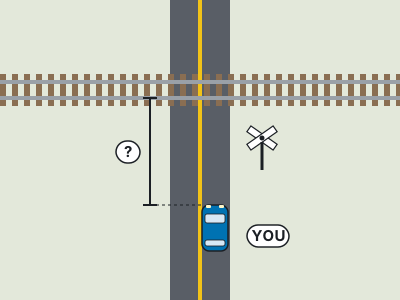
- No closer than 5 feet
- No closer than 15 feet
- No closer than 50 feet
- No closer than 30 feet
Show answer
No closer than 15 feet. A vehicle approaching a railroad crossing with electric or mechanical signals must come to a complete stop within 50 feet of the crossing, but no closer than 15 feet from the nearest rail, and shall not proceed until it is safe. Choosing 5 feet leaves too little room, while 30 and 50 feet confuse the outer stopping limit with the required minimum distance. Think of the rule as a stopping range between 15 and 50 feet from the nearest rail, then wait until the crossing is safe before moving.
Study this in the handbook: Trucks, school buses, work zones and trains
15. What does Tennessee's No Refusal law, passed in 2012, allow officers to do?
- Skip the arrest and issue only a warning
- Require every driver to carry a breath tester
- Seek search warrants for blood samples from suspected impaired drivers
- Suspend a license without any test or evidence
Show answer
Seek search warrants for blood samples from suspected impaired drivers. The No Refusal law lets law enforcement seek search warrants for blood samples when a driver is suspected of impaired driving. The goal is to deter impaired driving and cut crashes and deaths. It does not replace arrests with warnings, require drivers to carry testers, or allow suspension without evidence. Refusing a requested test can still bring a twelve month suspension.
Study this in the handbook: How alcohol and drugs affect driving
16. What do traffic signals control at some intersections and crosswalks?
- Vehicle drivers and pedestrians
- Only vehicles traveling on interstates
- Only emergency vehicles
- Only pedestrians at railroad crossings
Show answer
Vehicle drivers and pedestrians. Traffic signals assign right of way and control both vehicle drivers and pedestrians at some intersections and crosswalks. They are not limited to interstate traffic, emergency vehicles, or railroad users. A driver should still inspect the intersection, follow the displayed phase, and yield when another rule requires it. The signal organizes movement, but it does not make an unsafe path safe. Look for people already crossing, vehicles still clearing the intersection, and any officer or worker giving a different traffic direction.
Study this in the handbook: Warning, railroad, work zone and guide signs
17. Which Tennessee signs use red as their background color?
- All regulatory signs
- Guide signs to parks and services
- Warning signs for curves
- STOP, DO NOT ENTER and WRONG WAY signs and Interstate route markers
Show answer
STOP, DO NOT ENTER and WRONG WAY signs and Interstate route markers. Red backgrounds are reserved for a short list of high consequence messages: STOP, the FOUR WAY and ALL WAY plates under it, DO NOT ENTER, WRONG WAY, and Interstate route markers. Most regulatory signs use a white background with black or red legend, curve warnings are yellow, and park and service guide signs are brown or blue. The manual adds that red Wrong Way and Do Not Enter signs facing you mean you are on the wrong side of the road.
Study this in the handbook: Sign colors, shapes and regulatory signs
18. When may a driver turn right at a red traffic signal in Tennessee?
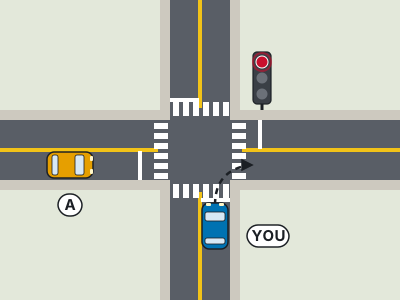
- Before stopping if the lane appears empty
- After a complete stop and when no pedestrians or cross traffic are present, unless otherwise posted
- Only when a green arrow is displayed
- Whenever the driver signals, even with pedestrians present
Show answer
After a complete stop and when no pedestrians or cross traffic are present, unless otherwise posted. Tennessee generally permits a right turn on red only after the driver has made a complete stop and confirmed that no pedestrians or cross traffic are present. A driver must also obey any sign that prohibits the turn. A signal alone does not replace the stop, and an empty-looking lane is not enough if a pedestrian or conflicting vehicle is present. Stop behind the crosswalk or line, scan carefully, then turn only when the movement is lawful and safe.
Study this in the handbook: Warning, railroad, work zone and guide signs
19. What action should a driver prepare for when approaching the pedestrian-crossing warning sign?

- Slow down and watch for people crossing
- Move onto the shoulder to bypass the crossing
- Accelerate before pedestrians reach the road
- Ignore the sign unless a signal is present
Show answer
Slow down and watch for people crossing. A pedestrian warning sign alerts you to people who may be crossing ahead. Slow down, scan the crossing and be prepared to yield or stop. Accelerating reduces the time available to react, while using the shoulder creates a separate hazard and may endanger people outside the travel lane. A traffic signal is not required for the warning to matter. Look for pedestrians, bicycles, and children near the roadway before continuing.
Study this in the handbook: Warning, railroad, work zone and guide signs
20. What does the sharp right-angle arrow warn you to prepare for?

- A T-intersection controlled by a stop sign
- A rather sharp turn with a recommended speed of 30 mph or less
- A one-way street beginning at the next block
- A lane reserved for turning trucks
Show answer
A rather sharp turn with a recommended speed of 30 mph or less. The turn sign is used for a sharper change in direction than an ordinary curve and carries a recommended speed of 30 mph or less. Slow before the turn and follow any advisory speed plaque. It does not itself identify a T-intersection, one-way street, or truck-only lane. The tight arrow is the visual cue to enter with reduced speed, controlled steering, and enough room for the roadway alignment.
Study this in the handbook: Warning, railroad, work zone and guide signs
QualitySpace is expanding to Tennessee
We are a California-based independent insurance brokerage working on licensing in more states. We cannot help with Tennessee insurance yet. Leave your email and we will let you know when we can.
Every question is written from the official Tennessee Comprehensive Driver License Manual. Need paper? Printable TN practice test with answer key.
Last verified 2026-10-05. How we check every question · Study all 500 as flashcards
Frequently asked questions
How many questions are on this Tennessee practice test?
This fixed set has 20 questions. It is test 7 of 25 from the 500 question Tennessee bank. The real TN exam asks 30 questions and you need 24 correct.
What is the passing score for the real Tennessee test?
A minimum score of 80% is required to pass That figure comes from the official Tennessee source cited on the DMV facts page.
How does this fixed test relate to the full Tennessee bank?
Each numbered test is a fixed set of questions in a fixed order, so you can retake the same test later and compare. Every test mixes road signs and the other topics in about the same proportion as the full bank. Tests 1 to 25 together cover every question in the Tennessee bank once. The full practice page mixes the whole bank at random.
Last verified 2026-10-05. See the Tennessee DMV facts page for sourced state details.
Return to the full Tennessee practice test · Study road signs