
Test 8 of 25 · 20 questions · Free 2026
TN Permit Practice Test 8
Jump to the test ↓A fixed 20 question set from the Tennessee bank with answers and plain English explanations. The real TN exam is 30 questions, 80 percent to pass; take the full length version on the main practice page.
Question 1 of 20 · 0 right so far
All 20 questions in test 8
Every question below comes from the Tennessee question bank on this page. Open a question to see the correct answer and the explanation. Nothing here is hidden behind a signup.
1. How far from a crosswalk must you stay when parking in Tennessee?
- 5 feet
- 10 feet
- 15 feet
- 20 feet
Show answer
20 feet. Tennessee bars parking in a marked crosswalk area and within 20 feet of a crosswalk. Fifteen feet is the fire hydrant distance, and shorter gaps of 5 or 10 feet do not appear on the no parking list at all. The same list sets 30 feet from a traffic signal or stop sign and 50 feet from a railroad crossing. When you see a crosswalk near your space, plan on leaving 20 feet of clear curb.
Study this in the handbook: Lane use, passing and parking
2. When may a Tennessee driver get a regular Class D license without the Intermediate level?
- Only at age 21
- At 18, or on graduating from high school or earning a GED, whichever is sooner
- At 17 after any six months of driving
- At 16 after passing the road test
Show answer
At 18, or on graduating from high school or earning a GED, whichever is sooner. A Class D regular license is available at 18 or when the driver graduates from high school or receives a GED, whichever comes first. The license still carries Under 21 indicators. Twenty-one is the alcohol age, not the regular license age. Sixteen is the Intermediate Restricted age and 17 the Intermediate Unrestricted age, so neither gives a regular license. A driver who keeps the Intermediate card may use it until its five-year renewal.
Study this in the handbook: The learner permit
3. Under Tennessee's Implied Consent Law, a driver under arrest for DUI refuses the officer's request for a test. What suspension does the handbook say is the likely result?
- Twelve months
- 30 days
- 90 days
- Six months
Show answer
Twelve months. The handbook says that if you are placed under arrest and refuse an officer's request to take the test, it will likely result in the court suspending your driving privileges for twelve months. Thirty days, ninety days and six months are all shorter than that stated period. By driving in Tennessee you have already given consent to be tested. The No Refusal law, passed in 2012, also lets officers seek search warrants for blood samples, so refusing may not prevent a test.
Study this in the handbook: How alcohol and drugs affect driving
4. During which hours may a Tennessee driver under 18 with a learner permit not drive?
- 11 p.m. to 6 a.m.
- Midnight to 5 a.m.
- 10 p.m. to 6 a.m.
- 9 p.m. to 5 a.m.
Show answer
10 p.m. to 6 a.m.. A Tennessee learner permit holder under 18 may not drive between 10 p.m. and 6 a.m. The 11 p.m. to 6 a.m. window belongs to the next step, the Intermediate Restricted License, so it is a common mix-up. Midnight and 9 p.m. start times are not Tennessee rules. When driving, the permit holder needs a licensed driver 21 or older in the front seat, everyone must be belted, and handheld devices are banned.
Study this in the handbook: The learner permit
5. Under normal conditions, what minimum speed does Tennessee identify for the right interstate lanes?
- 35 mph
- 45 mph
- 55 mph
- 70 mph
Show answer
45 mph. The manual identifies 45 mph as the minimum speed limit in the right interstate lane or lanes under normal driving conditions. This is different from the 55 mph minimum mentioned for the leftmost lane and from the 70 mph maximum allowed on some interstate sections. Traffic congestion and safe flow can change what is practical, so the number should not be treated as a demand to drive too fast for conditions. If you cannot safely maintain the applicable minimum, the manual advises using another road.
Study this in the handbook: Speed limits and the Basic Speed Rule
6. A Tennessee driver has two DUI convictions in five years. How long must the driver use an ignition interlock after reinstatement?
- 30 days
- Six months
- Two years
- It is never required
Show answer
Six months. A person with 2 DUIs in a five-year period must drive a vehicle with an ignition interlock device for six months after driving privileges are reinstated. Separately, an interlock restricted license can run six months to one year for a first offense, up to three years for a second, and up to 10 years for a third or later. Thirty days and two years are not the post-reinstatement period, and saying it is never required is wrong.
Study this in the handbook: DUI law, implied consent and penalties
7. According to the Tennessee manual, what is the Basic Speed Rule?
- A general safety principle rather than a Tennessee law
- The minimum speed required on interstates
- A law that sets 55 mph on every state highway
- The fine schedule for work zone speeding
Show answer
A general safety principle rather than a Tennessee law. The manual says plainly that the Basic Speed Rule is not a Tennessee law. It is a safety principle that says the posted number is a ceiling for ideal conditions and that rain, fog, curves and traffic can make a lower speed the only reasonable one. It is not the 55 mph highway default, which is a real posted limit, and it has nothing to do with interstate minimums or work zone fines. The manual adds that driving at a speed unsafe for existing conditions violates the basic rule even below the posted limit.
Study this in the handbook: Speed limits and the Basic Speed Rule
8. When may you enter an intersection while waiting to turn?
- When you can stop within the crosswalk
- Whenever the traffic signal is green
- Whenever the vehicle ahead has entered it
- Only when you can clear it without stopping
Show answer
Only when you can clear it without stopping. A driver should not enter an intersection unless there is enough room to get through without stopping. A green light does not excuse blocking the crossing, and following the vehicle ahead does not prove that your own path will remain open. Stopping in the crosswalk is also not a safe substitute for clearing the intersection. Wait behind the line until traffic ahead moves far enough to create a complete route through. This cue is especially important in congested traffic, where entering on green can leave your vehicle stranded when the signal changes.
Study this in the handbook: Right of way, turns and emergency vehicles
9. What color is used for school-zone signs in Tennessee?
- Orange
- Fluorescent yellow-green
- Brown
- Blue
Show answer
Fluorescent yellow-green. Fluorescent yellow-green identifies school zones and is also used for other pedestrian traffic areas such as crosswalks. The bright color is intended to stand out in low light and fog or rain, so drivers should actively watch for children, bicyclists, and crossing traffic. Orange is for construction, brown guides toward recreation, and blue identifies motorist services. When this color appears, reduce distraction and expect school-related movement around the roadway.
Study this in the handbook: Sign colors, shapes and regulatory signs
10. During what period are car headlights required at night?
- Only between midnight and dawn
- From one hour after sunset until one hour before sunrise
- From 30 minutes after sunset until 30 minutes before sunrise
- Only when another vehicle is within 500 feet
Show answer
From 30 minutes after sunset until 30 minutes before sunrise. The manual gives a specific night-use period: headlights must be on from 30 minutes after sunset until 30 minutes before sunrise. The one-hour and midnight choices change the stated boundaries, while the 500-foot distance concerns dimming high beams around other vehicles. Drivers may need headlights outside this period when visibility or weather requires them, but the required night-use window remains the half-hour rule.
Study this in the handbook: Headlights, night driving and bad weather
11. A Tennessee driver revoked for DUI wants to keep driving on an ignition interlock restricted license. What is the minimum interlock requirement?
- At least 365 days
- Exactly 30 days
- Two weeks to three months
- No interlock is required for a first DUI
Show answer
At least 365 days. The Tennessee Department of Safety says a driver who continues driving during a DUI revocation must use the interlock for the entire revocation and must complete at least a 365-day ignition interlock requirement. A longer revocation, such as six years for a third DUI, stretches the requirement further. Thirty days and a few weeks are far too short, and a first DUI does not escape the device. Time only counts while the driver holds a valid restricted or regular license, and violations in the final 120 days restart that window.
12. What is the smaller speed plate mounted beneath a Tennessee warning sign?
- A regulatory speed limit enforceable by ticket
- A minimum speed for the curve
- An advisory speed plate that supplements the warning sign
- A truck only speed restriction
Show answer
An advisory speed plate that supplements the warning sign. The little sign under a curve or turn warning is an advisory speed plate. It supplements the warning above it by giving the recommended maximum safe speed. It is not a posted regulatory limit, so it does not replace the black and white speed limit sign, and it is certainly not a minimum. It applies to every vehicle, not only trucks. When weather or visibility is poor, the Basic Speed Rule still calls for a speed that suits conditions.
Study this in the handbook: Warning, railroad, work zone and guide signs
13. What following-distance range does the manual describe as a safe distance for drivers to maintain?
- Exactly one second in every traffic situation
- One car length regardless of speed
- About two to four seconds, adjusted for conditions
- No time interval is useful for judging space
Show answer
About two to four seconds, adjusted for conditions. The manual describes a safe following distance as ranging from two to four seconds, with the driver increasing the interval when visibility, speed, weather, or nighttime conditions make reaction more difficult. A fixed car length changes meaning as speed changes, and one second leaves little room to respond. Use a stationary object to measure the gap, then slow slightly and repeat the check until the time cushion is adequate. The goal is time to see and react, not merely a visual number of feet.
Study this in the handbook: Braking, following distance and required stops
14. After a crash in which a vehicle is on fire, what should people in the vehicle do?
- Remain inside until the flames reach the passenger compartment
- Move the vehicle farther into traffic before getting out
- Stand behind the vehicle while the engine continues running
- Leave the vehicle and move away from it
Show answer
Leave the vehicle and move away from it. A fire creates a risk of further injury and possible explosion, so occupants should be helped out and moved away from the vehicle. Remaining inside delays escape, and placing people behind the vehicle does not create a dependable safe area. Moving a burning vehicle into traffic adds danger to everyone nearby. Call emergency services, warn approaching traffic if it can be done safely, and stay clear of smoke and flames.
Study this in the handbook: What to do after a crash
15. What does this yellow diamond turn sign tell a driver to expect?

- A mandatory stop at the sign
- A lane reserved for buses
- A sharp turn that may require reduced speed
- A railroad crossing with no road change
Show answer
A sharp turn that may require reduced speed. Tennessee's turn sign warns of a rather sharp turn ahead, so the driver should prepare to reduce speed before entering it. The manual notes that this sign is used to mark turns with a recommended speed of 30 miles per hour or less, while the separate curve sign marks gentler curves in the 30 to 55 mph range. That recommendation is a cue for a safe approach, not a command to stop at the sign. It also is not a bus lane or railroad message. Brake before the turn, keep the vehicle in its lane, and avoid entering faster than visibility and traction allow.
Study this in the handbook: Warning, railroad, work zone and guide signs
16. What action is normally appropriate when you see a yellow diamond warning sign?
- Continue at the same speed because it gives route information
- Watch for a hazardous or unexpected condition and consider slowing
- Stop immediately at the sign even when the road is clear
- Treat it as a regulation that sets a mandatory speed
Show answer
Watch for a hazardous or unexpected condition and consider slowing. A yellow diamond sign warns of a condition ahead that may require caution, reduced speed, or another safe response. It is not automatically a stop command and does not by itself establish a mandatory speed. A route information sign serves a different purpose. The driver should read the symbol or message, scan the roadway, and adjust early rather than braking abruptly at the sign. Curves, intersections, merging traffic, and other unexpected conditions are examples of why this warning shape deserves attention.
Study this in the handbook: Sign colors, shapes and regulatory signs
17. A driver is being followed too closely on a road with a right lane. What is the safer response?
- Move over to the right and let the following driver pass
- Accelerate beyond the speed limit to create distance
- Block both lanes until the other driver stops
- Brake sharply to make the other driver back away
Show answer
Move over to the right and let the following driver pass. When a tailgater is behind you and a right lane is available, move over so that driver can pass. Sharp braking increases the chance of being struck from behind, while speeding creates a separate violation and may not solve the conflict. Blocking lanes turns another driver’s poor judgment into a confrontation. Keep your own speed controlled, signal early, and create room for the impatient vehicle to go around legally.
Study this in the handbook: Defensive driving and road rage
18. What should a driver do when strong crosswinds become a problem?
- Drive close to a large truck for protection
- Speed up so the vehicle spends less time in the wind
- Release the steering wheel briefly to let the vehicle self-correct
- Slow down and be ready for wind to push the vehicle sideways
Show answer
Slow down and be ready for wind to push the vehicle sideways. Strong crosswinds can reduce control, especially for a light vehicle, a recreational vehicle, or a vehicle towing a trailer. Slowing down gives the driver more time to correct direction and respond to a gust. Speeding up reduces that margin, and releasing the wheel removes needed control. A large truck can create additional air movement, so following it closely is not a safeguard. Watch open areas and adjust smoothly.
19. A new resident under 18 has an out-of-state permit. What must be true before an Intermediate Restricted License can be issued?
- The Tennessee permit has been held 30 days at any age
- Only a certified school record is needed
- The out-of-state permit automatically converts immediately
- A permit has been held 180 total days and the applicant is 16
Show answer
A permit has been held 180 total days and the applicant is 16. A new resident who is fifteen receives a Tennessee learner permit even when a prior state issued a valid permit. Eligibility for the Intermediate Restricted License requires a total permit period of 180 days and turning sixteen. Time from the former state may count when supported by a certified driving record issued within the required recent period. Thirty days is not enough, a school record addresses a different issue, and automatic conversion ignores Tennessee’s age and experience requirements.
Study this in the handbook: The learner permit
20. What does the red circle and slash over the left-turn arrow tell a Tennessee driver?
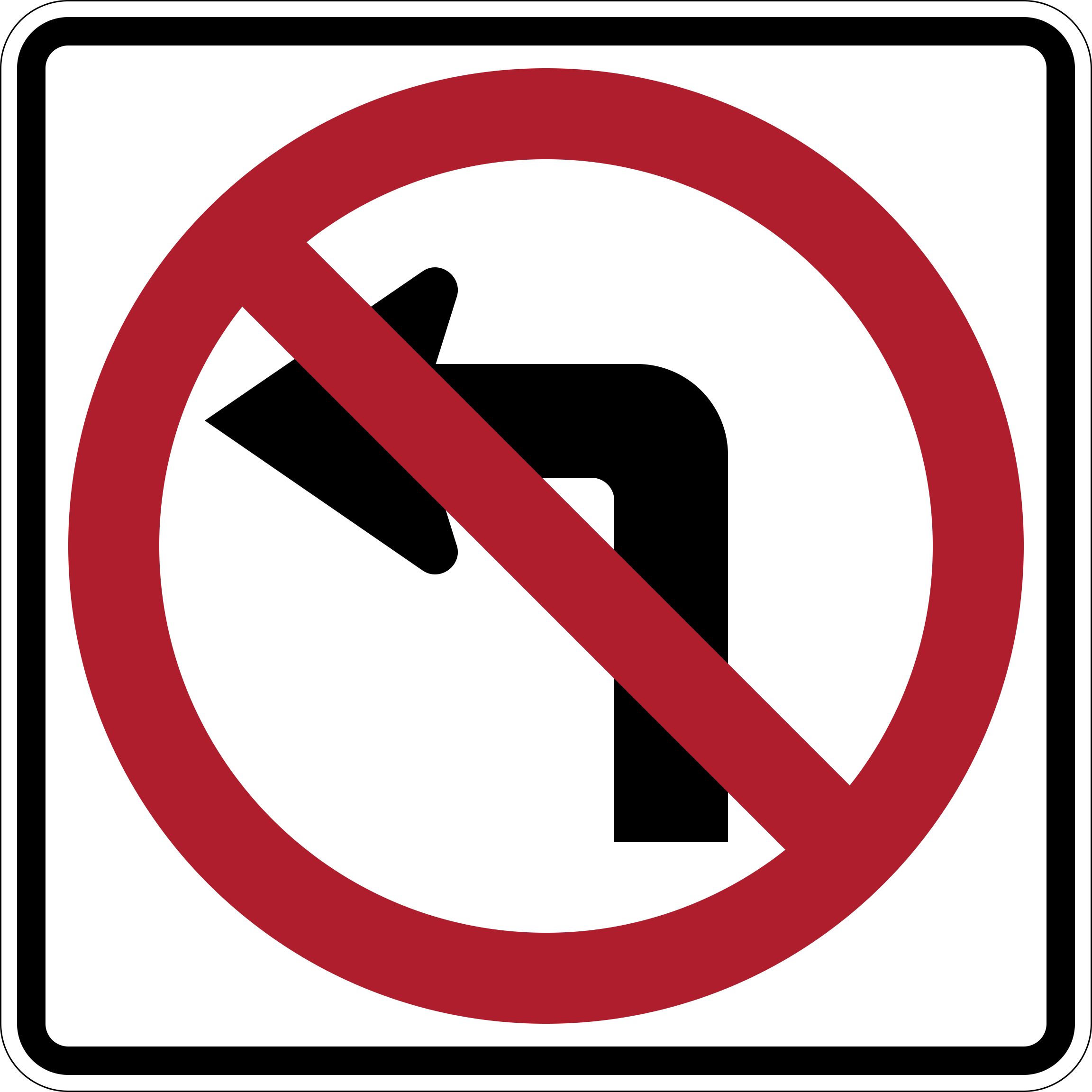
- Left turns are prohibited where the sign is posted
- Left turns are required at the next intersection
- Only trucks may turn left there
- The left lane ends ahead
Show answer
Left turns are prohibited where the sign is posted. A red circle with a diagonal slash marks the pictured action as prohibited, so this sign bars a left turn at its location. It does not require a turn, reserve the maneuver for trucks, or announce a lane ending. Treat the restriction as applying to the movement shown by the arrow, and continue only in a permitted direction. A useful roadside cue is to read the symbol inside the slash before reacting to the sign’s color or shape.
Study this in the handbook: Sign colors, shapes and regulatory signs
QualitySpace is expanding to Tennessee
We are a California-based independent insurance brokerage working on licensing in more states. We cannot help with Tennessee insurance yet. Leave your email and we will let you know when we can.
Every question is written from the official Tennessee Comprehensive Driver License Manual. Need paper? Printable TN practice test with answer key.
Last verified 2026-10-05. How we check every question · Study all 500 as flashcards
Frequently asked questions
How many questions are on this Tennessee practice test?
This fixed set has 20 questions. It is test 8 of 25 from the 500 question Tennessee bank. The real TN exam asks 30 questions and you need 24 correct.
What is the passing score for the real Tennessee test?
A minimum score of 80% is required to pass That figure comes from the official Tennessee source cited on the DMV facts page.
How does this fixed test relate to the full Tennessee bank?
Each numbered test is a fixed set of questions in a fixed order, so you can retake the same test later and compare. Every test mixes road signs and the other topics in about the same proportion as the full bank. Tests 1 to 25 together cover every question in the Tennessee bank once. The full practice page mixes the whole bank at random.
Last verified 2026-10-05. See the Tennessee DMV facts page for sourced state details.
Return to the full Tennessee practice test · Study road signs