
Test 5 of 25 · 20 questions · Free 2026
TN Permit Practice Test 5
Jump to the test ↓A fixed 20 question set from the Tennessee bank with answers and plain English explanations. The real TN exam is 30 questions, 80 percent to pass; take the full length version on the main practice page.
Question 1 of 20 · 0 right so far
All 20 questions in test 5
Every question below comes from the Tennessee question bank on this page. Open a question to see the correct answer and the explanation. Nothing here is hidden behind a signup.
1. Who has the right-of-way when a driver approaches railroad tracks?
- The vehicle that reaches the crossing first
- The vehicle traveling faster
- The train
- The driver closest to the center line
Show answer
The train. Tennessee requires drivers to yield the right-of-way to trains because a train cannot stop or swerve like a passenger vehicle. Reaching the crossing first, traveling faster, or being positioned near the center line does not change that priority. Slow well before the tracks, look and listen, and never race a train to the crossing. The large difference in stopping ability is the safety reason behind the rule, not a suggestion to negotiate.
Study this in the handbook: Trucks, school buses, work zones and trains
2. Which phone activity does Tennessee specifically prohibit while driving?
- Hearing an incoming call through a vehicle speaker
- Following directions that were entered before the trip
- Recording or broadcasting video on a cellphone or mobile device
- Keeping a cellphone stored in a closed bag
Show answer
Recording or broadcasting video on a cellphone or mobile device. Tennessee's listed hands-free prohibitions include recording or broadcasting video on a cellphone or mobile device while driving. The rule targets the active video function, not merely carrying a stored phone or hearing audio through the vehicle. Pre-entered navigation also does not involve the same recording act, though any distraction can still be unsafe. Do not try to capture a crash, post, or live stream from behind the wheel. If video is needed, park in a safe location and handle the device only after the vehicle is stopped.
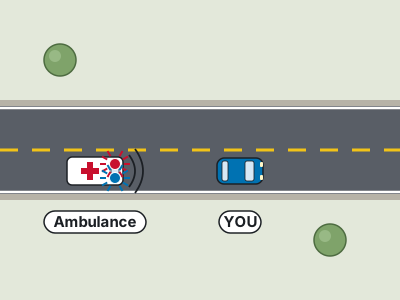
3. What should you do when an emergency vehicle approaches using a siren, air horn, or red or blue flashing light?
- Stop in the middle of the intersection
- Follow it closely to get through traffic faster
- Continue through a green light without checking for it
- Yield the right of way and move close to the right edge or curb until it passes
Show answer
Yield the right of way and move close to the right edge or curb until it passes. Tennessee requires traffic meeting or being overtaken by an emergency vehicle to yield and move parallel to, and as close as possible to, the right edge or curb. Remain stopped until the vehicle passes or an officer directs movement. Following the emergency vehicle is unlawful, and a green signal does not cancel the duty to yield. If already in an intersection, clear it before pulling over so the emergency path is not blocked. Watch for additional emergency vehicles before resuming travel.
Study this in the handbook: Right of way, turns and emergency vehicles
4. When are Tennessee school-zone speed limits regulated?
- At every hour, including school holidays
- Only during the first hour of the school day
- When children travel to or from school or during school recess
- Only when a police vehicle is parked nearby
Show answer
When children travel to or from school or during school recess. Tennessee regulates school-zone speed limits when children are going to or from school or during a school recess hour. The rule is tied to those school-related periods, not a blanket every-hour schedule. It also does not depend on a police vehicle being visible. Slow before reaching the zone, look for the posted limit and any warning flasher, and remain within that limit while the condition is active. The phrase school recess is an important extra trigger beyond morning arrival and afternoon departure.
Study this in the handbook: Speed limits and the Basic Speed Rule
5. How many crashes each year are linked to cell phone use while driving, according to the Tennessee manual?
- 1.6 million
- About 100
- About 50 million
- About 10,000
Show answer
1.6 million. Cell phone use while driving leads to 1.6 million crashes every year, and distracted driving killed 3,142 people in 2019. In Tennessee a distracted driving crash happens every 26 minutes and 13 seconds. The state's Hands Free law makes it illegal to hold a phone while driving, and teens with learner or intermediate licenses may not use a phone at all. Sending a text takes the eyes off the road for several seconds at a time.
Study this in the handbook: Seat, mirrors, steering and the hands free law
6. How often has Tennessee placed interstate reference markers along heavily traveled urban interstates?
- Every 1,000 feet
- Every mile
- Every 600 feet
- Every five miles
Show answer
Every 1,000 feet. On busy urban stretches of interstate, Tennessee added reference markers every 1,000 feet so a stranded driver can tell a dispatcher exactly where the vehicle is. Ordinary mile markers are a mile apart, which can leave emergency crews searching a long stretch of highway. The 600 foot figure belongs to the reverse turn sign, and five mile spacing describes nothing in the manual. The markers show the route number, direction of travel, and log mile, so giving that information when you call helps emergency personnel respond more rapidly.
Study this in the handbook: Warning, railroad, work zone and guide signs
7. A stop sign is partly hidden by snow. How does a Tennessee driver still know what it requires?
- By waiting for another driver to stop first
- By treating it as a yield sign until it is cleared
- It cannot be known, so proceed at normal speed
- By its octagonal shape and red color, which always mean stop
Show answer
By its octagonal shape and red color, which always mean stop. Tennessee gives the stop sign a unique combination that survives dirt, limbs and snow: it is the only eight sided sign, and it is red. The shape alone tells you to stop even when the word is unreadable. Treating it as a yield is wrong because a yield sign is triangular, and copying another driver or ignoring the sign hands your safety to luck. This is why sign shapes are tested; you are expected to read the silhouette from a distance and stop completely.
Study this in the handbook: Sign colors, shapes and regulatory signs
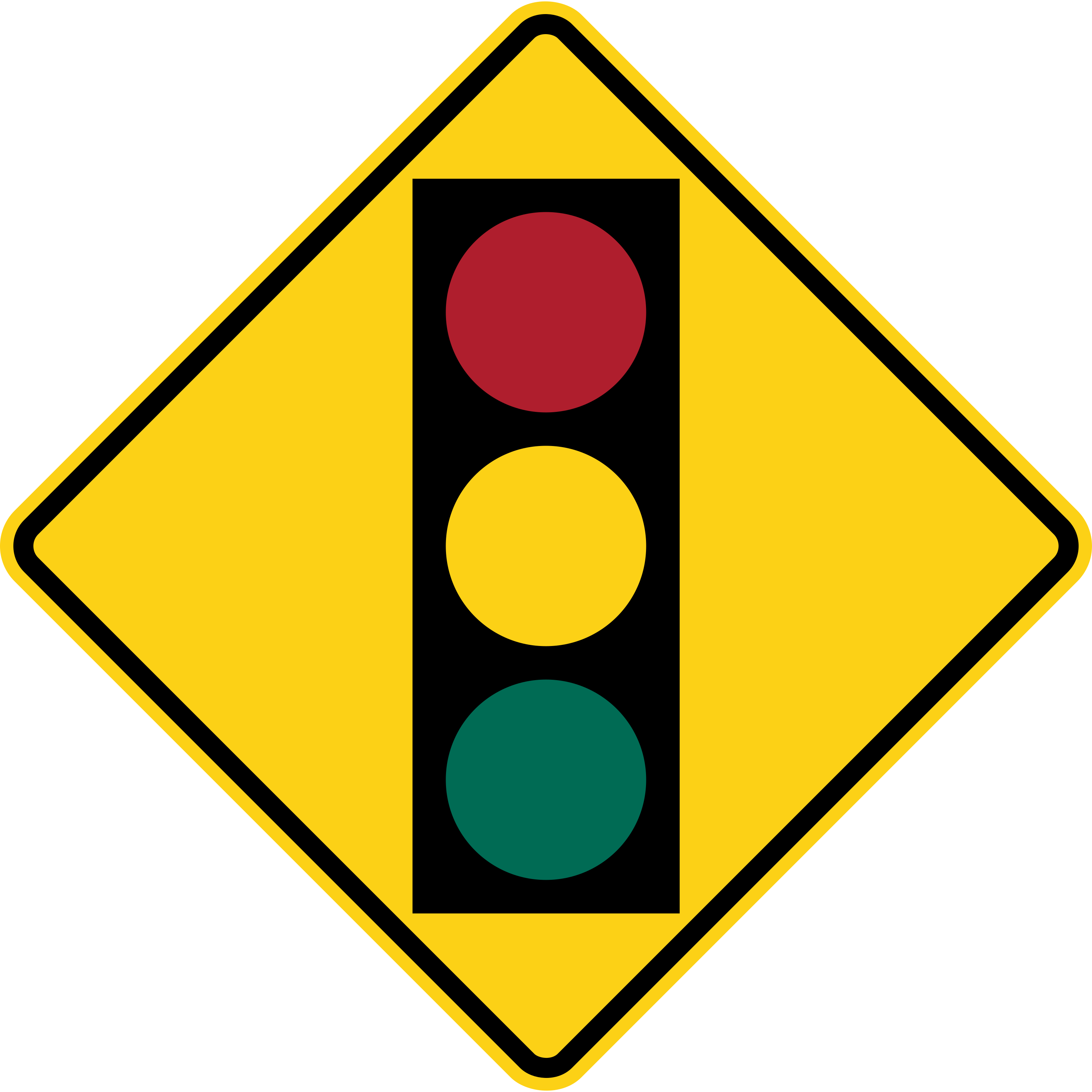
8. What does the traffic-signal warning sign indicate?
- The next intersection has no controls
- Streetlights are out and the road is closed
- A police checkpoint is immediately ahead
- A traffic signal is ahead, so prepare to obey it
Show answer
A traffic signal is ahead, so prepare to obey it. The warning symbol showing a traffic light means a signal is ahead, sometimes one hidden by a curve or other roadway feature. Prepare by checking traffic, reducing speed as needed, and watching for the signal’s indications. The sign does not announce a closure, police checkpoint, or uncontrolled intersection. Early recognition matters because a driver who waits to react at the signal may approach too quickly to stop smoothly.
Study this in the handbook: Warning, railroad, work zone and guide signs
9. When turning left at an intersection without a protected green arrow, a driver must yield to:
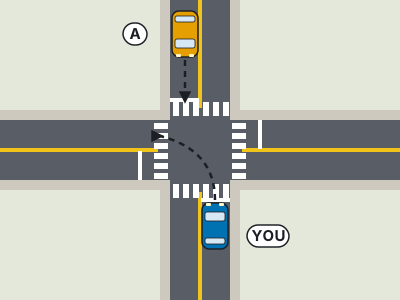
- Oncoming vehicles proceeding straight or turning right
- Only vehicles approaching from behind
- No vehicles because the turn signal gives priority
- Vehicles entering from a driveway behind the turn
Show answer
Oncoming vehicles proceeding straight or turning right. A left turn crosses the path of oncoming traffic, so the turning driver must yield to an oncoming vehicle going straight or turning right unless a protected green arrow controls the movement. A turn signal announces intent but does not grant priority. The driver should wait in the intersection only as permitted, watch for pedestrians, and complete the turn when the opposing path is clear.
Study this in the handbook: Right of way, turns and emergency vehicles
10. What license consequence does the Tennessee manual list for an under-21 impaired driving conviction?
- Losing the license for one month
- Losing the license for one year
- Receiving only a written warning
- Receiving a permanent lifetime revocation
Show answer
Losing the license for one year. For the under-21 impaired driving conviction described in the manual, the listed license consequence is loss of the license for one year. The same passage also names a $250 fine and sometimes public service work. A one-month suspension is too short, while a warning does not reflect the stated penalty. The manual does not describe this provision as an automatic lifetime revocation. Remember the one-year period together with the lower .02 BAC trigger, since the combination distinguishes this youth offense from the ordinary adult threshold.
Study this in the handbook: Alcohol laws for drivers under 21
11. What fine does Tennessee list for an underage driving while impaired conviction?
- $50
- $250
- $350
- $1,000
Show answer
$250. A driver at least 16 but under 21 found driving with a BAC of .02 percent, or under the influence of alcohol or another intoxicant, is convicted of underage driving while impaired. The penalties are a one-year loss of license, a $250 fine, and sometimes public service work. Three hundred fifty dollars is the low end of the adult first DUI fine. Fifty dollars is the teen cell phone fine, and $1,000 is the child endangerment minimum.
Study this in the handbook: How alcohol and drugs affect driving
12. How does Tennessee define dropping out of school for purposes of a minor losing driving privileges?
- 10 consecutive or 15 total days of unexcused absences in a semester
- Missing one day without a note
- Failing a single class
- 30 absences of any kind in a year
Show answer
10 consecutive or 15 total days of unexcused absences in a semester. Drivers under 18 can lose driving privileges for dropping out of school, defined as 10 consecutive or 15 total days of unexcused absences in a semester. They can also lose them for failing to make satisfactory progress, generally passing three subjects per grading period, or for carrying weapons on school property. One missed day or one failed class is not the definition, and 30 absences of any kind is not the measure.
Study this in the handbook: Points, suspensions and keeping your license
13. According to the Tennessee manual, sending or reading a text takes your eyes off the road for at least how long?
- About 1 second
- A minimum of 5 seconds
- About 2 seconds
- At least 10 seconds
Show answer
A minimum of 5 seconds. The manual puts a hard number on texting so drivers stop guessing. Reading or sending a text takes your eyes off the road for a minimum of five seconds, and the manual compares that at 55 mph to driving the length of a football field with your eyes closed. One or two seconds falls well short of the minimum the manual states. Ten seconds overstates it. The practical lesson is that no message is short enough to be safe while the vehicle is moving, so the phone stays down until you are stopped somewhere off the travel lanes.
Study this in the handbook: Seat, mirrors, steering and the hands free law
14. How must a driver treat an intersection when its traffic signal is not working?
- As an uncontrolled intersection where the fastest vehicle goes first
- As a green signal for the road with more traffic
- As a flashing yellow signal in every direction
- As an all-way stop, stopping in every direction before proceeding safely
Show answer
As an all-way stop, stopping in every direction before proceeding safely. Tennessee law treats a malfunctioning traffic signal as an all-way stop intersection. Drivers should stop as they would at stop signs in all directions and proceed only when the movement is safe. The failed signal does not give priority to the busier road, the fastest vehicle, or a favored direction. After stopping, drivers still apply ordinary right-of-way rules and watch for pedestrians and other vehicles.
Study this in the handbook: Traffic signals and pavement markings
15. About how far from a railroad crossing are trains required to sound their horn?
- About 100 feet
- About 500 feet
- About 5,000 feet
- About 1,500 feet
Show answer
About 1,500 feet. The Tennessee manual lists a train horn as one sign that a train is near, and it states that trains must signal with the horn when they are roughly 1,500 feet from the crossing. When you hear it, stop between 15 and 50 feet from the tracks and wait until the train has passed and it is safe to cross. Other warnings include flashing lights on the crossbuck, a lowered gate, and a human flagger.
Study this in the handbook: Braking, following distance and required stops
16. If you pass several vehicles at once in Tennessee, you must be back in the right lane before coming within how far of a no passing marking or an oncoming vehicle?
- 10 feet
- 100 feet
- 25 feet
- Any distance, as long as you finish the pass
Show answer
100 feet. Passing more than one vehicle is not illegal in Tennessee, but the manual calls it generally unsafe. It should only be considered on a straight, level road with excellent visibility, and only if you can pass every vehicle and be safely back in the right lane before coming within 100 feet of the no passing markings or any oncoming vehicle. If you cannot keep that 100 foot margin, stay in your lane.
Study this in the handbook: Lane use, passing and parking
17. What fine range does Tennessee list for a first DUI conviction?
- $350 to $1,500
- $50 to $250
- $600 to $3,500
- $3,000 to $15,000
Show answer
$350 to $1,500. The first DUI conviction fine ranges from $350 to $1,500, with at least 48 hours in jail and a one-year license revocation. The $600 to $3,500 range belongs to a second conviction, and $3,000 to $15,000 to a fourth or later conviction, a Class E felony. Fifty to 250 dollars is far below the law. Court costs, bond, attorney fees and higher insurance add thousands more.
Study this in the handbook: DUI law, implied consent and penalties
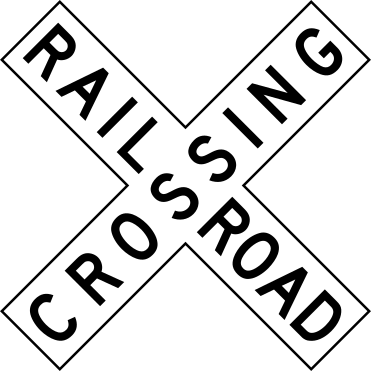
18. What is the broad X shaped sign mounted at a Tennessee railroad crossing called?
- A pennant
- A crossbuck
- A route marker
- An advisory plate
Show answer
A crossbuck. The broad X shaped sign is the crossbuck. It is placed at all railroad grade crossings and shows exactly where the tracks are located, rather than warning in advance of them. A pennant marks a no passing zone, route markers identify highways, and advisory plates ride under warning signs. Smaller signs on the post below the crossbuck show the number of tracks, which matters because when there are two or more tracks, one passing train might hide the approach of a train from the other direction.
Study this in the handbook: Sign colors, shapes and regulatory signs
19. At what age may Tennessee issue a Class H hardship license to a minor?
- 15 years old
- 16 years old
- 14 years old
- 17 years old
Show answer
14 years old. The hardship license is Tennessee's narrow exception to the normal age ladder. A minor who is 14 and can show a genuine hardship, which the manual limits to cases of family hardship and specific needs, may be issued a Class H license to drive a passenger vehicle, a motorcycle or both. Fifteen is the learner permit age, sixteen is the age for the intermediate restricted license, and seventeen is when the intermediate unrestricted stage begins. If the hardship license is granted less than six months before the sixteenth birthday, the teen must still renew a learner permit when it expires.
Study this in the handbook: Getting a license and taking the tests
20. What condition does the skidding-car warning sign identify?

- A racing area begins ahead
- Loose gravel is guaranteed across the lane
- The pavement may be slippery when wet
- A tire inspection station is nearby
Show answer
The pavement may be slippery when wet. The skidding car symbol is the SLIPPERY WHEN WET warning. The manual explains that some road surfaces are more slippery than others when wet, and these roads usually have warning signs. Rainy weather calls for slower speed, greater stopping distance, and braking well in advance of a stop. The sign does not mark a racing area, guarantee gravel, or identify a service station. If it starts to rain on a hot day, the pavement can be very slippery for the first few minutes because heat brings oil in the asphalt to the surface.
Study this in the handbook: Headlights, night driving and bad weather
QualitySpace is expanding to Tennessee
We are a California-based independent insurance brokerage working on licensing in more states. We cannot help with Tennessee insurance yet. Leave your email and we will let you know when we can.
Every question is written from the official Tennessee Comprehensive Driver License Manual. Need paper? Printable TN practice test with answer key.
Last verified 2026-10-05. How we check every question · Study all 500 as flashcards
Frequently asked questions
How many questions are on this Tennessee practice test?
This fixed set has 20 questions. It is test 5 of 25 from the 500 question Tennessee bank. The real TN exam asks 30 questions and you need 24 correct.
What is the passing score for the real Tennessee test?
A minimum score of 80% is required to pass That figure comes from the official Tennessee source cited on the DMV facts page.
How does this fixed test relate to the full Tennessee bank?
Each numbered test is a fixed set of questions in a fixed order, so you can retake the same test later and compare. Every test mixes road signs and the other topics in about the same proportion as the full bank. Tests 1 to 25 together cover every question in the Tennessee bank once. The full practice page mixes the whole bank at random.
Last verified 2026-10-05. See the Tennessee DMV facts page for sourced state details.
Return to the full Tennessee practice test · Study road signs