
Test 9 of 25 · 20 questions · Free 2026
TN Permit Practice Test 9
Jump to the test ↓A fixed 20 question set from the Tennessee bank with answers and plain English explanations. The real TN exam is 30 questions, 80 percent to pass; take the full length version on the main practice page.
Question 1 of 20 · 0 right so far
All 20 questions in test 9
Every question below comes from the Tennessee question bank on this page. Open a question to see the correct answer and the explanation. Nothing here is hidden behind a signup.
1. What penalty applies when someone drives under the influence of drugs, including prescription drugs?
- A lesser penalty than for alcohol
- Only a warning for a first occurrence
- No penalty if the drug was prescribed
- The same penalties as for alcohol
Show answer
The same penalties as for alcohol. Tennessee treats driving under the influence of drugs, even prescription drugs, as carrying the same penalties as driving under the influence of alcohol. A prescription does not create a defense, and the absence of alcohol does not turn the conduct into a warning-only matter. The lesser-penalty choice reverses the manual’s comparison. When a medicine may affect alertness or control, read its warnings and do not drive if impairment is possible. The key study cue is equal DUI treatment for alcohol and drugs.
Study this in the handbook: How alcohol and drugs affect driving
2. What does Tennessee require when a driver uses high beams and an oncoming vehicle is within 500 feet?
- Dim or lower the high beam headlights
- Sound the horn and keep high beams on
- Switch to parking lights only
- Turn off every exterior light
Show answer
Dim or lower the high beam headlights. High beams must be dimmed or lowered when an oncoming vehicle is within 500 feet, approximately one city block. The purpose is to prevent glare from impairing the other driver's vision. Turning off every light or using only parking lights would reduce visibility, while a horn does not solve the glare problem. The same 500-foot rule also applies when following another vehicle. Scan ahead and use the low-beam setting early enough that the approaching driver is not blinded.
Study this in the handbook: Safety belts, child seats and air bags
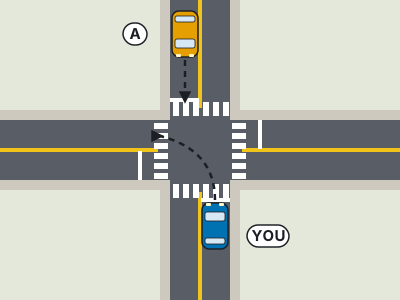
3. When turning left at an intersection, what must you do if an oncoming vehicle is going straight?
- Turn first because left turns have priority
- Stop and wait for the oncoming vehicle to turn left
- Yield to the oncoming vehicle
- Accelerate so the oncoming vehicle must brake
Show answer
Yield to the oncoming vehicle. A driver making a left turn must yield to an oncoming vehicle that is proceeding straight or turning right, unless a protected green arrow authorizes the turn. The left-turning vehicle crosses the oncoming path, so entering first would create the conflict. The choice that says to wait for an oncoming left turn adds a condition that is not required by this rule. Before turning, check the signal indication and the path of approaching traffic. A green arrow changes the analysis; an ordinary green light does not provide the same protection.
Study this in the handbook: Right of way, turns and emergency vehicles
4. A Tennessee traffic officer directs you to stop while your signal is green. What must you do?
- Proceed because the green signal has priority
- Stop and follow the officer's direction
- Ignore the officer if no warning sign is present
- Stop only if another vehicle also stops
Show answer
Stop and follow the officer's direction. Tennessee says you must obey traffic officers at all times. There will be times when an officer instructs you to do something that would ordinarily be a violation of traffic regulations, and the manual's common example is a police officer holding up traffic at a green light while a funeral procession continues through a red light. A green signal therefore does not override the officer, and the officer's direction applies to you whatever other vehicles do.
Study this in the handbook: Headlights, night driving and bad weather
5. How close to a fire hydrant may you park in Tennessee?
- No closer than 5 feet
- No closer than 15 feet
- No closer than 30 feet
- No closer than 50 feet
Show answer
No closer than 15 feet. Tennessee lists parking within 15 feet of a fire hydrant as illegal, and parking within a fire lane is banned as well. Each object on the no parking list has its own distance: 20 feet from a crosswalk, 30 feet from a traffic signal or stop sign, and 50 feet from a railroad crossing. Five feet is far too close, and 30 or 50 feet belong to other objects on the list, so match the distance to the object.
Study this in the handbook: Lane use, passing and parking
6. When is covering the brake an appropriate driving practice?
- When a hazard is developing and a quicker response may be needed
- Whenever the driver wants to make the brake lights stay on
- While resting the foot on the brake during every mile of travel
- Only after the vehicle has already begun to skid
Show answer
When a hazard is developing and a quicker response may be needed. Covering the brake means hovering the foot over the brake or between the brake and gas pedals so response time is shorter. It is useful near intersections, crosswalks, school or residential areas, brake lights, and heavy slow traffic. Resting pressure on the pedal is riding the brake, which causes wear and can falsely signal a stop. Cover the pedal when risk is developing, then brake smoothly if needed.
Study this in the handbook: Avoiding collisions and keeping your vehicle safe
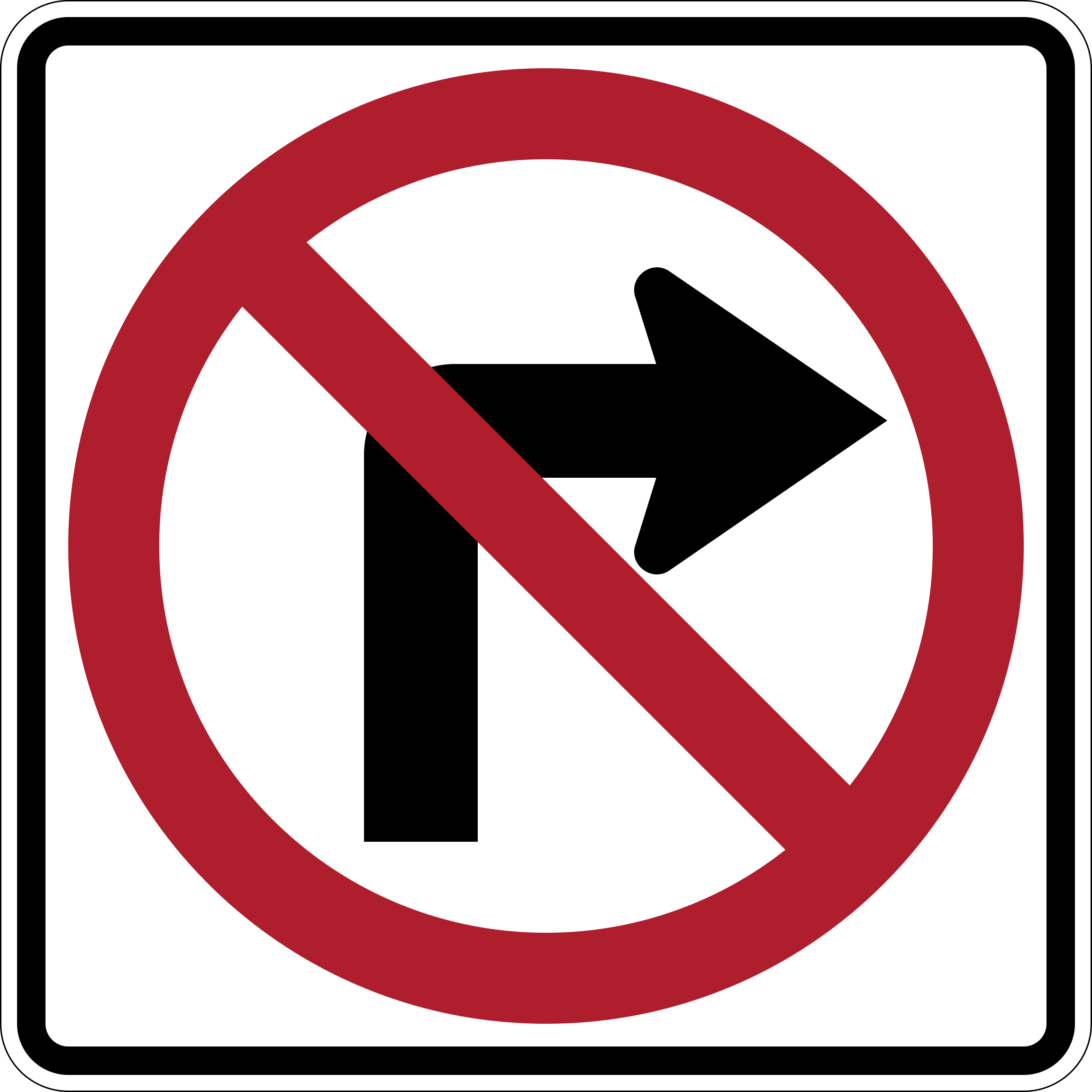
7. What movement is prohibited by this red-slash sign over a right-turn arrow?
- Parking on either side of the street
- Driving straight through the intersection
- Turning left from the far-left lane
- Turning right at the posted location
Show answer
Turning right at the posted location. The arrow identifies the movement that the prohibition covers, so a crossed right-turn arrow means do not turn right at that point. It does not ban straight travel, create a left-turn requirement, or establish a parking restriction. Scan for a different route or permitted movement, especially before entering the intersection. The practical cue is simple: match the slash to the arrow beneath it rather than treating every red symbol as a stop command.
Study this in the handbook: Right of way, turns and emergency vehicles
8. What does a fluorescent yellow-green sign identify?
- A construction detour
- A recreational area
- A school zone
- A motorist service facility
Show answer
A school zone. The manual calls fluorescent yellow-green the color for school zones, and it is also used in other pedestrian areas such as crosswalks. The color is highly visible and cues drivers to watch carefully for school traffic, including children, pedestrians, and bicyclists. Orange points to construction and maintenance, brown relates to recreational or cultural guide information, and blue identifies motorist services. When this bright yellow-green color appears, reduce distractions, watch the roadside, and be ready for children crossing or vehicles entering the area.
Study this in the handbook: Sign colors, shapes and regulatory signs
9. What hazard does the merge warning sign identify?

- Traffic may blend into your lane ahead
- Your lane is reserved for emergency vehicles
- All merging traffic must stop before entering
- The roadway becomes a no-passing zone immediately
Show answer
Traffic may blend into your lane ahead. A merge warning means traffic may blend into the main stream ahead. Check mirrors and the area behind you, then adjust position or speed when safe so the merging motorist has a clear path. It does not reserve the lane, require every entering vehicle to stop, or by itself establish a passing ban. The key cue is to anticipate interaction with another stream of traffic before the lanes actually meet.
Study this in the handbook: Warning, railroad, work zone and guide signs
10. At a yield sign, what must the driver do when other vehicles are approaching?
- Accelerate through before the other vehicles arrive
- Stop only after entering the intersection
- Slow down or stop to avoid a crash with oncoming traffic
- Assume the other vehicles must yield instead
Show answer
Slow down or stop to avoid a crash with oncoming traffic. A yield sign requires the approaching driver to slow down or stop when necessary to avoid a collision with oncoming traffic. It does not authorize rushing into the intersection, waiting until the vehicle is already in conflict, or shifting the duty to the other driver. The word yield describes the priority relationship, not merely a suggestion to reduce speed. Check both directions, give conflicting traffic room, and enter only when the movement is safe.
Study this in the handbook: Right of way, turns and emergency vehicles
11. What color background identifies temporary highway work-zone signs?
- Blue
- Brown
- Orange
- Fluorescent yellow-green
Show answer
Orange. Temporary work-zone signs use an orange background with black letters or symbols. Orange signals road work and tells the driver to slow down, watch for changing lanes, and follow the instructions of signs and flaggers. Blue identifies motorist services, brown relates to recreation, and fluorescent yellow-green marks school zones and other pedestrian areas. Spotting orange should trigger attention to workers, barriers, lane shifts, and a potentially reduced speed limit.
Study this in the handbook: Trucks, school buses, work zones and trains
12. What is the minimum time an applicant must wait after failing a Tennessee knowledge test?
- Thirty days after the first failure
- One hour before returning to the same center
- Seven days for every failed knowledge test
- One day before attempting the knowledge test again
Show answer
One day before attempting the knowledge test again. A failed knowledge test triggers a mandatory one-day waiting period before the applicant may return and try again. The rule is not an hourly pause, a seven-day requirement for every failure, or an automatic thirty-day delay. Use the waiting day to study Section B of the manual, as it urges, and correct the topics that caused difficulty. The same waiting period applies between later retesting attempts when the applicant still has not passed.
Study this in the handbook: Getting a license and taking the tests
13. How often does a crash involving a distracted driver occur in Tennessee, according to the state's crash network?
- Once a day
- Every 26 minutes and 13 seconds
- Every 5 hours
- Once a week
Show answer
Every 26 minutes and 13 seconds. According to Tennessee's integrated traffic analysis network, known as Titan, a crash involving a distracted driver in Tennessee occurs every 26 minutes and 13 seconds. The manual adds that cell phone use while driving leads to 1.6 million crashes every year. It treats even picking up the phone to call someone back as distracted driving, since it only takes a few seconds of distraction to result in a crash. Its advice is simple: put your phone down and pay attention to your driving.
Study this in the handbook: Seat, mirrors, steering and the hands free law
14. What phone rule applies to a Tennessee driver with a learner permit or intermediate license?
- The driver may not use a cell phone while driving
- The driver may use any phone after dark
- The driver may make hands-free calls without restriction
- The driver may text when traffic is stopped
Show answer
The driver may not use a cell phone while driving. Tennessee prohibits a learner permit or intermediate license holder from using a cell phone while driving on any Tennessee roadway. The manual's teen rule is broader than a ban on holding the device, so switching to hands-free calling does not create the unrestricted exception offered by one choice. Darkness and stopped traffic do not authorize texting. The cue is the license category: permit and intermediate drivers should keep the phone unused while the vehicle is being driven, regardless of the particular phone function.
Study this in the handbook: Teen penalties, phones and school rules
15. How far ahead does Tennessee law require your headlights to let you see a person on the highway?
- At least 50 feet
- At least 200 feet
- At least 1,000 feet
- Only as far as the next street light
Show answer
At least 200 feet. Tennessee law requires headlights that let you clearly see any person on the highway at least 200 feet ahead of your car. The manual notes that headlight effectiveness drops quickly as distance grows, so lamps must be in good order to meet this standard. They must also be accurately aimed, with clean lenses and a clean windshield. Fifty feet is far too short, and street lighting does not replace working headlights.
Study this in the handbook: Headlights, night driving and bad weather
16. What is the minimum age for a Tennessee learner permit?
- 14
- 15 and a half
- 16
- 15
Show answer
15. A Tennessee learner permit requires the applicant to be 15 years old and pass the written exams and a vision screening. Fourteen is the minimum age for a Class H hardship license, which is a different license. Sixteen is the age for the Intermediate Restricted License, and 15 and a half is not a Tennessee threshold. The permit must then be held for 180 days before moving up.
Study this in the handbook: The learner permit
17. A Tennessee driver is convicted of DUI with a 12-year-old in the car. What added penalty applies?
- A $50 fine
- An extra 48 hours in jail only
- No added penalty unless the child is hurt
- A mandatory minimum 30 days in jail and a $1,000 minimum fine
Show answer
A mandatory minimum 30 days in jail and a $1,000 minimum fine. Under the Drunk Driving Child Protection Act, a DUI with a child under 18 in the vehicle adds a mandatory minimum 30 days in jail and a mandatory minimum $1,000 fine on top of all other penalties. The penalty applies even if the child is unhurt. If the child suffers serious bodily injury the offense becomes a Class D felony, and if the child dies it is a Class C felony. A $50 fine or 48 hours understates it.
Study this in the handbook: DUI law, implied consent and penalties
18. How many points within 12 months bring a Tennessee driver under 18 a notice of proposed suspension?
- 3 or more
- 6 or more
- 12 or more
- 15 or more
Show answer
6 or more. Juvenile drivers under 18 who accumulate 6 or more points within 12 months receive a notice of proposed suspension, and those with 1 to 5 points get an advisory letter. Twelve is the adult threshold. Three and fifteen are not Tennessee figures. Six points can come from as little as one cell phone conviction for a permit or intermediate license holder, or about two minor traffic citations.
Study this in the handbook: Points, suspensions and keeping your license
19. On a multi-lane highway, what does Tennessee’s Move Over guidance require near a stationary emergency vehicle with flashing lights?
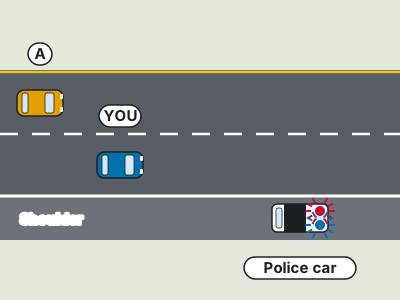
- Change to a lane that is not adjacent when safe, or slow and proceed cautiously
- Maintain speed because the emergency vehicle is off the roadway
- Stop in the lane next to the emergency vehicle
- Pass on the shoulder without reducing speed
Show answer
Change to a lane that is not adjacent when safe, or slow and proceed cautiously. The Move Over requirement protects people working beside a highway. When safety and traffic conditions allow, change into a lane that is not adjacent to the stationary emergency vehicle. If that cannot be done safely, reduce speed and proceed with caution at a safe speed for the conditions. Stopping beside the vehicle, using the shoulder to pass, or keeping full speed leaves workers exposed and removes the intended buffer.
Study this in the handbook: Interstate driving
20. Before entering a reversible lane, a driver should first:
- Enter only when the lane has a solid white line
- Assume the lane is always open in both directions
- Check which lanes are open for that direction at that time
- Use the lane to pass traffic traveling in either direction
Show answer
Check which lanes are open for that direction at that time. A reversible lane changes its permitted direction at different times. Drivers must check the signs, overhead signals, or other controls to determine whether the lane is available for their direction before entering. Assuming it is always open or using it for passing ignores the time-specific control. If the indication is unclear, remain in a regular lane until the direction of travel is plainly established.
Study this in the handbook: Lane use, passing and parking
QualitySpace is expanding to Tennessee
We are a California-based independent insurance brokerage working on licensing in more states. We cannot help with Tennessee insurance yet. Leave your email and we will let you know when we can.
Every question is written from the official Tennessee Comprehensive Driver License Manual. Need paper? Printable TN practice test with answer key.
Last verified 2026-10-05. How we check every question · Study all 500 as flashcards
Frequently asked questions
How many questions are on this Tennessee practice test?
This fixed set has 20 questions. It is test 9 of 25 from the 500 question Tennessee bank. The real TN exam asks 30 questions and you need 24 correct.
What is the passing score for the real Tennessee test?
A minimum score of 80% is required to pass That figure comes from the official Tennessee source cited on the DMV facts page.
How does this fixed test relate to the full Tennessee bank?
Each numbered test is a fixed set of questions in a fixed order, so you can retake the same test later and compare. Every test mixes road signs and the other topics in about the same proportion as the full bank. Tests 1 to 25 together cover every question in the Tennessee bank once. The full practice page mixes the whole bank at random.
Last verified 2026-10-05. See the Tennessee DMV facts page for sourced state details.
Return to the full Tennessee practice test · Study road signs