
Test 1 of 25 · 20 questions · Free 2026
TN Permit Practice Test 1
Jump to the test ↓A fixed 20 question set from the Tennessee bank with answers and plain English explanations. The real TN exam is 30 questions, 80 percent to pass; take the full length version on the main practice page.
Question 1 of 20 · 0 right so far
All 20 questions in test 1
Every question below comes from the Tennessee question bank on this page. Open a question to see the correct answer and the explanation. Nothing here is hidden behind a signup.
1. Besides YIELD, which other message may Tennessee display on a triangular sign?
- Railroad crossing ahead
- School zone
- No Passing Zone
- Stop
Show answer
No Passing Zone. The downward pointing triangle is the yield sign, but Tennessee also says a triangular No Passing Zone sign can be used. These signs are yellow or orange and placed on the left side of the roadway, and no passing signs tell you where passing is not permitted. Railroad advance warnings are round, school signs are pentagons, and stop is the octagon. When you see the pennant shaped sign on your left, stay behind the vehicle ahead until you reach a place where passing is allowed.
Study this in the handbook: Sign colors, shapes and regulatory signs
2. When turning left on a green circular signal, whom must you yield to?
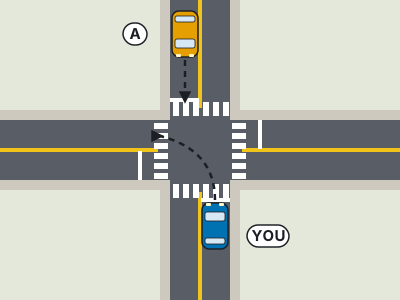
- Only vehicles approaching from the left
- Oncoming vehicles and pedestrians when they have the right-of-way
- No one, because a green signal makes every turn protected
- Only a vehicle that is larger than yours
Show answer
Oncoming vehicles and pedestrians when they have the right-of-way. A green circular signal permits movement when the intersection is clear, but it does not create a protected left turn. The turning driver must yield to oncoming vehicles and pedestrians entitled to proceed. The signal does not eliminate the need to check either direction, and vehicle size has no role in this rule. A green arrow, rather than a plain green circle, is the indication associated with a protected turn direction.
Study this in the handbook: Warning, railroad, work zone and guide signs
3. When should Tennessee drivers turn on their headlights even during daylight?
- When windshield wipers are in use
- Only when parked on a shoulder
- Never during daylight hours
- Only when following another vehicle within 500 feet
Show answer
When windshield wipers are in use. Tennessee requires headlights when windshield wipers are in use, including conditions involving rain, mist, snow, or other precipitation. Daylight does not remove the requirement. Turning lights on helps oncoming drivers and pedestrians see the vehicle, while waiting for darkness misses the rule's weather trigger. The 500-foot distance is associated with dimming high beams, not deciding whether headlights are needed. Make the habit automatic: if the wipers are operating continuously, switch on the headlights and keep them on until conditions no longer require the wipers.
Study this in the handbook: Safety belts, child seats and air bags
4. On an undivided road, a school bus is stopped with red warning lights flashing and its stop arm extended. What must approaching drivers do?
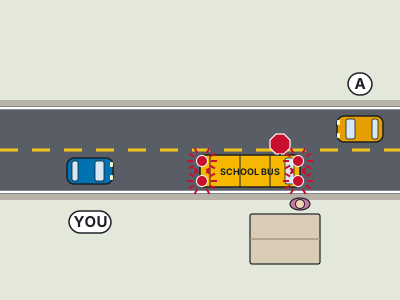
- Slow down and pass carefully on the left
- Pass if no children are visible
- Stop only when approaching from behind
- Come to a complete stop and remain stopped until the arm is pulled back and the bus moves
Show answer
Come to a complete stop and remain stopped until the arm is pulled back and the bus moves. Red flashing lights and an extended stop arm mean the bus has stopped and children are getting on or off. On an undivided road, drivers coming from either direction must stop and remain stopped until the arm is pulled back and the bus resumes motion. Visibility of children does not change the obligation, and passing on either side is unsafe. Only on a highway with separate roadways divided by median space or a barrier may opposing traffic proceed with caution, and a center turn lane is not such a barrier. Watch the bus signals, not just the roadway around it.
Study this in the handbook: Braking, following distance and required stops
5. As a condition of probation after a Tennessee DUI conviction, what litter removal must the offender do?
- One four-hour shift in plain clothes
- Ten shifts at any state park
- Three eight-hour shifts while wearing an I am a DRUNK DRIVER vest
- No litter removal for a first offense
Show answer
Three eight-hour shifts while wearing an I am a DRUNK DRIVER vest. Every DUI conviction requires litter pick-up for three eight-hour shifts as a condition of probation, and the offender must wear a vest or other clothing that says I am a DRUNK DRIVER. Tennessee residents do the work in their home county. The rule applies to any DUI conviction, first or not, so a first offense is not exempt. One shift in plain clothes or ten park shifts are not the stated terms.
Study this in the handbook: How alcohol and drugs affect driving
6. What minimum jail time does Tennessee list for a third DUI conviction?
- 48 hours
- 45 days
- 120 days
- 150 days
Show answer
120 days. The Tennessee DUI penalty table sets jail for a third conviction at 120 days to 11 months 29 days, with a fine of $1,100 to $10,000, and the vehicle is subject to seizure and forfeiture. Forty-eight hours is the first conviction minimum and 45 days the second. One hundred fifty days is the minimum for a fourth or later conviction, which is a Class E felony. Each repeat conviction brings sharply longer jail time and bigger fines.
Study this in the handbook: DUI law, implied consent and penalties
7. What happens if a Tennessee driver does not surrender a suspended or revoked license?
- Nothing, the license just expires
- A $5 late fee
- An automatic lifetime revocation
- A $75 fine on top of other fines and costs
Show answer
A $75 fine on top of other fines and costs. A suspended or revoked license must be turned in to the Department of Safety within 20 days, at a Highway Patrol office, a Driver License Service Center, or by mail. Failing to surrender it means a $75 fine in addition to any other fines and costs. The license does not simply lapse without consequence, a $5 fee understates it, and lifetime revocation is not the penalty.
Study this in the handbook: Points, suspensions and keeping your license
8. At what distance must a driver dim high beams for an oncoming vehicle?
- Within 100 feet
- Within 500 feet
- Within 200 feet
- Within 1,000 feet
Show answer
Within 500 feet. Tennessee requires high beams to be lowered when an oncoming vehicle is within 500 feet. The same 500-foot distance also applies when following another vehicle, because glare reflected in its mirror can impair that driver's vision. The 100-, 200-, and 1,000-foot choices change the legal trigger and should not be used as substitutes. Watch for approaching headlights and begin the change before the vehicles are close together. Dimmed lights help preserve the other driver's ability to see while you continue to see the roadway ahead.
Study this in the handbook: Headlights, night driving and bad weather
9. What does the yellow pennant-shaped sign mark?
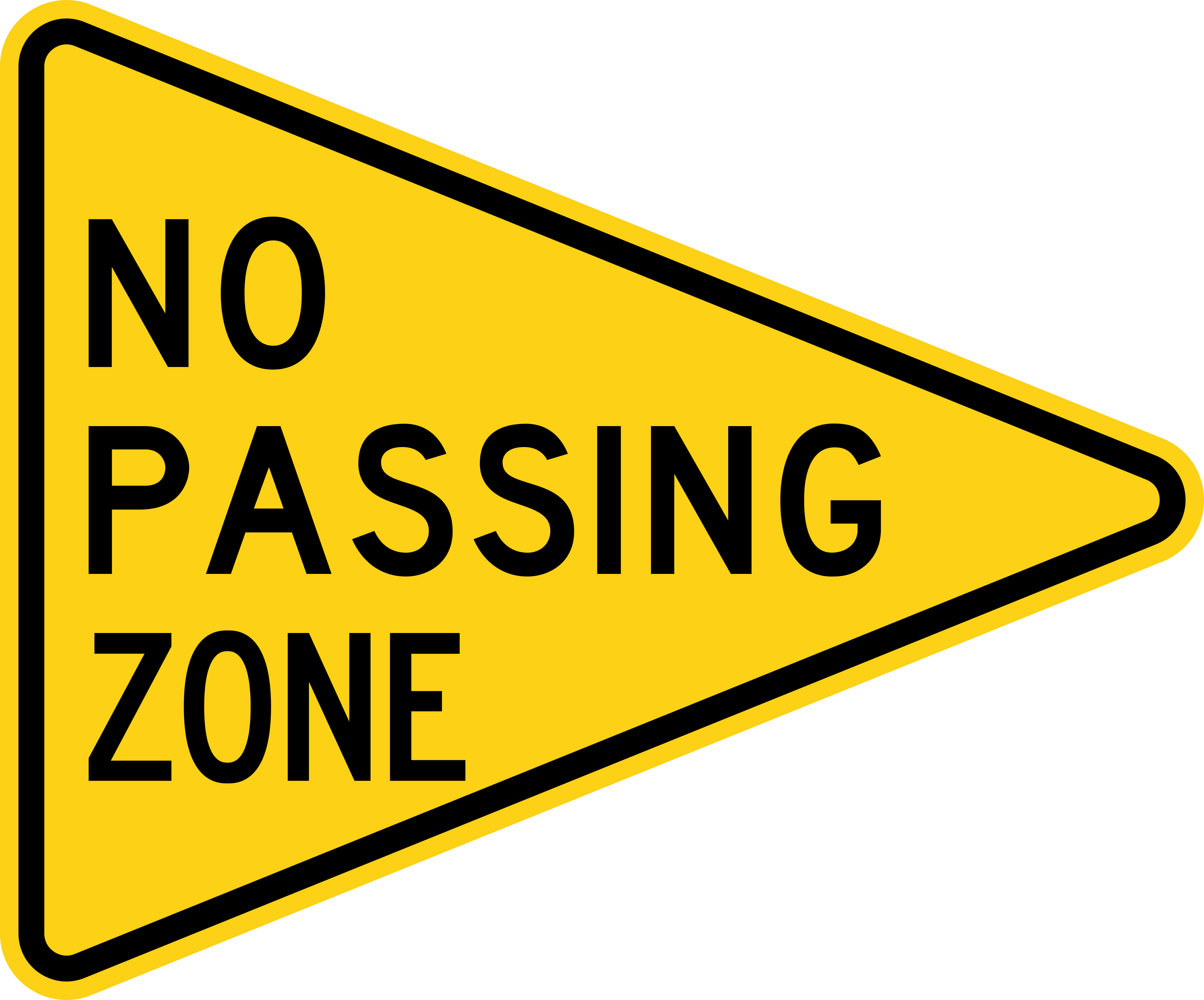
- A zone where passing is not permitted
- A lane where passing is required
- A picnic or recreation area
- A lane reserved for emergency vehicles
Show answer
A zone where passing is not permitted. The yellow pennant is the triangular No Passing Zone sign, and Tennessee places it on the left side of the roadway. No passing signs tell you where passing is not permitted, and passing areas are based on how far you can see ahead, considering unseen hazards such as hills, curves, intersections, and driveways. The sign does not require a pass, identify recreation, or create an emergency lane. When you see it, stay behind the vehicle ahead until you reach a lawful passing area.
Study this in the handbook: Sign colors, shapes and regulatory signs
10. What should you expect after seeing the curved-arrow warning sign?

- A curve ahead with a recommended speed between 30 and 55 mph
- A mandatory turn at an intersection
- A work-zone detour requiring the shoulder
- A straight roadway with no change in alignment
Show answer
A curve ahead with a recommended speed between 30 and 55 mph. The curve sign identifies a bend to the right and is used for curves with recommended speeds from 30 to 55 mph. Reduce speed before entering the bend so steering remains controlled. It is not a mandatory intersection direction and does not announce a detour or a straight section. Treat any advisory speed as a cue to evaluate weather, traffic, and visibility rather than as a target that must be reached.
Study this in the handbook: Warning, railroad, work zone and guide signs
11. What do yellow backgrounds generally communicate on Tennessee highway signs?
- A route marker for an interstate
- A warning about a condition or hazard
- A motorist service location
- A construction instruction only
Show answer
A warning about a condition or hazard. Yellow is the background color used for warning signs, except where orange is specified, and it is also used for school signs. A yellow sign alerts the driver to prepare for a roadway condition or potential hazard. Green identifies guide information, blue identifies motorist services, and orange is reserved for construction and maintenance warnings. The color is an early cue to reduce speed and scan for the condition ahead.
Study this in the handbook: Sign colors, shapes and regulatory signs
12. Whose directions must drivers obey even when those directions differ from a traffic signal?
- Only another driver who has a vehicle larger than yours
- No one, because the signal always controls
- Only a passenger who is familiar with the road
- A law enforcement officer, highway worker, or school crossing guard controlling traffic
Show answer
A law enforcement officer, highway worker, or school crossing guard controlling traffic. Traffic control may be provided by authorized people as well as by signs and signals. A law enforcement officer, highway construction person, or school crossing guard may direct traffic, and drivers must follow that direction even when the light or sign appears to say something else. The size of another vehicle and a passenger's opinion have no controlling authority. Slow down, identify the person giving directions, and comply smoothly. This rule prevents a driver from following a signal into a work area or crossing movement being managed by a person.
Study this in the handbook: Sign colors, shapes and regulatory signs
13. Which of these adds 90 days to the wait for a Tennessee Intermediate Unrestricted License?
- A single parking ticket
- Driving with a sibling as a passenger
- A second seat belt violation
- Renewing the license by mail
Show answer
A second seat belt violation. A teen becomes ineligible for 90 more days beyond the one year minimum if the driver has 6 or more points, contributes to a traffic crash, or is convicted of a second seat belt violation. A parking ticket is not a moving violation. A sibling passenger is allowed under the passenger rules, and renewing by mail has nothing to do with GDL progress. Six points equals about two minor traffic citations.
Study this in the handbook: Teen penalties, phones and school rules
14. On an undivided road, when may a driver pass a school bus or church bus in Tennessee?
- Not while its flashing lights operate and its stop arm is extended
- Only after sounding the horn twice
- Whenever the driver can see around the bus
- Whenever the bus has pulled partly onto the shoulder
Show answer
Not while its flashing lights operate and its stop arm is extended. Passing is prohibited while a school bus or church bus has its flashing lights operating and stop arm extended. The bus's position, a clear sightline, or a horn signal does not override the warning equipment. A bus pulled partly onto the shoulder still blocks the view of children who may be crossing, and the lights and arm remain the stated restriction. On an undivided road this applies to traffic from both directions. Stop and wait until the warning condition ends, watching for children who may be crossing near the bus.
Study this in the handbook: Lane use, passing and parking
15. What is the farthest you may travel in a shared center turn lane in Tennessee?
- Any distance, as long as your signal is on
- 1,000 feet
- Half a mile
- 300 feet
Show answer
300 feet. A shared center turn lane, also called a two way left turn lane, is reserved for vehicles turning left in either direction. Tennessee says it may not be used for passing and may not be used for travel farther than 300 feet. Enter it just before your turn; entering too soon can interfere with other drivers who need the lane. Keeping the signal on does not make longer travel in the lane legal.
Study this in the handbook: Lane use, passing and parking
16. When constant windshield-wiper use is required by rain or other precipitation, what lighting rule applies?
- Parking lights alone are sufficient
- Headlights must be turned on
- Headlights are required only after sunset
- Hazard flashers replace the headlight requirement
Show answer
Headlights must be turned on. Tennessee requires headlights when rain, mist, snow, or other precipitation makes constant windshield-wiper use necessary. The rule does not depend on whether the driver personally thinks visibility remains adequate, and parking lights alone are not a substitute. Waiting until sunset ignores the daylight inclement-weather provision. Hazard flashers serve a different warning purpose. Tie the requirement to the wipers: if precipitation demands their constant use, turn on the headlights so the vehicle is easier for others to see.
Study this in the handbook: Headlights, night driving and bad weather
17. What roadway direction does the ONE WAY sign shown here communicate?
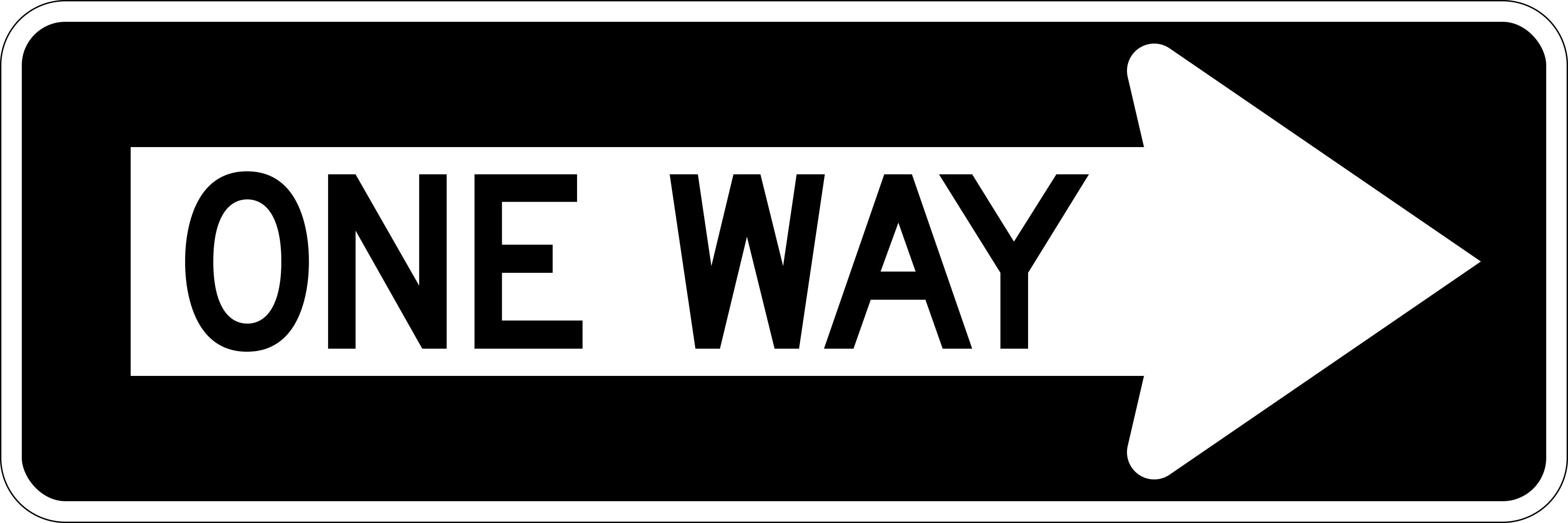
- Traffic may travel either way after yielding
- Traffic on the street moves only in the arrow’s direction
- Only buses may travel in the arrow’s direction
- The arrow marks a required U-turn
Show answer
Traffic on the street moves only in the arrow’s direction. A ONE WAY sign communicates that the street’s traffic flow runs in the direction shown by its arrow. It does not make two-way travel acceptable, reserve the road for buses, or require a U-turn. Follow the arrow and watch for additional lane markings or turn instructions before moving. This sign is a direction-control message, so the key visual cue is the single arrow paired with the words ONE WAY. Enter only if your intended travel matches that indicated flow.
Study this in the handbook: Lane use, passing and parking
18. Which action is prohibited when traveling behind a properly identified funeral procession?
- Driving between vehicles in the procession
- Allowing the procession to continue ahead
- Obeying a traffic officer directing the procession
- Following the procession at a safe distance
Show answer
Driving between vehicles in the procession. A driver may not drive between vehicles in a properly identified funeral procession unless a traffic officer directs that movement. Cutting into the line breaks its protected movement and can create conflicts with vehicles entering or leaving the procession. The safe response is patience, a suitable following distance, and obedience to any officer managing the intersection. Do not use a gap in the line as an invitation to merge through it.
Study this in the handbook: Speed limits and the Basic Speed Rule
19. At an all-way stop, two vehicles arrive at different times. Who should proceed first?
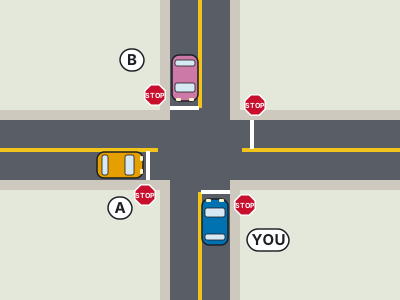
- The vehicle approaching from the widest road
- The vehicle that arrived second
- The vehicle with more passengers
- The vehicle that reached the intersection first
Show answer
The vehicle that reached the intersection first. At an all-way stop, every vehicle must stop, and the first vehicle to reach the intersection gets to go first. The order of arrival controls the normal sequence, not the number of occupants or the width of the road. If two vehicles stop at the same time, the vehicle on the right has priority instead. The tempting second-arrival choice is backward because it would ignore the manual's arrival-order rule. Stop fully, observe the other vehicles, and move only when the intersection is safe.
Study this in the handbook: Right of way, turns and emergency vehicles
20. When should a driver use a turn signal even if no other vehicle is visible?
- Only when turning across a traffic lane
- Only after another driver begins to approach
- Whenever changing direction, including a lane change or turn
- Only at intersections controlled by traffic lights
Show answer
Whenever changing direction, including a lane change or turn. Tennessee’s defensive driving guidance says to signal whenever you plan to change directions. That includes changing lanes, turning, entering an interstate, pulling away from a curb, or moving off the side of the road. Waiting until another vehicle appears defeats the warning purpose because a cyclist, pedestrian, or driver may be outside the first glance. Signal early enough for others to understand the intended movement.
Study this in the handbook: Defensive driving and road rage
QualitySpace is expanding to Tennessee
We are a California-based independent insurance brokerage working on licensing in more states. We cannot help with Tennessee insurance yet. Leave your email and we will let you know when we can.
Every question is written from the official Tennessee Comprehensive Driver License Manual. Need paper? Printable TN practice test with answer key.
Last verified 2026-10-05. How we check every question · Study all 500 as flashcards
Frequently asked questions
How many questions are on this Tennessee practice test?
This fixed set has 20 questions. It is test 1 of 25 from the 500 question Tennessee bank. The real TN exam asks 30 questions and you need 24 correct.
What is the passing score for the real Tennessee test?
A minimum score of 80% is required to pass That figure comes from the official Tennessee source cited on the DMV facts page.
How does this fixed test relate to the full Tennessee bank?
Each numbered test is a fixed set of questions in a fixed order, so you can retake the same test later and compare. Every test mixes road signs and the other topics in about the same proportion as the full bank. Tests 1 to 25 together cover every question in the Tennessee bank once. The full practice page mixes the whole bank at random.
Last verified 2026-10-05. See the Tennessee DMV facts page for sourced state details.
Return to the full Tennessee practice test · Study road signs