
Test 2 of 25 · 20 questions · Free 2026
TN Permit Practice Test 2
Jump to the test ↓A fixed 20 question set from the Tennessee bank with answers and plain English explanations. The real TN exam is 30 questions, 80 percent to pass; take the full length version on the main practice page.
Question 1 of 20 · 0 right so far

All 20 questions in test 2
Every question below comes from the Tennessee question bank on this page. Open a question to see the correct answer and the explanation. Nothing here is hidden behind a signup.
1. What does the lane-ending warning require a driver to anticipate?
- A new lane will open on the right
- The lane will end and traffic should merge left
- The right lane is reserved for slow vehicles
- Passing is required before the lane narrows
Show answer
The lane will end and traffic should merge left. The lane-ending sign warns that the marked lane will disappear and directs drivers to merge left. Signal your intention, check the adjacent lane, and merge when a safe gap is available. It does not announce a new lane, establish a slow-vehicle lane, or require a pass. Waiting until the pavement ends can force an abrupt movement, so use the warning distance to communicate and find space early.
Study this in the handbook: Warning, railroad, work zone and guide signs
2. Where does the X-shaped crossbuck sign identify the railroad tracks?
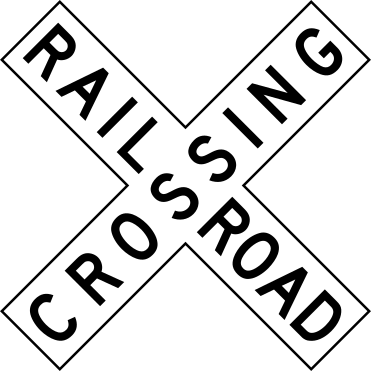
- Only at a hospital entrance
- At the beginning of a school zone
- At the railroad grade crossing itself
- On the far side of a construction detour
Show answer
At the railroad grade crossing itself. The crossbuck is placed at the railroad grade crossing and shows where the tracks are located. It is not a medical, school, or construction marker. A smaller plaque can show the number of tracks, which is important because one train can hide another approaching on a second track. Reduce speed, look and listen, and never assume the first visible train is the only rail hazard before crossing.
Study this in the handbook: Sign colors, shapes and regulatory signs
3. How many points within 12 months bring a Tennessee adult driver a notice of proposed suspension?
- 6 or more
- 8 or more
- 12 or more
- 18 or more
Show answer
12 or more. Adult drivers 18 or older with 12 or more points in a 12-month period receive a notice of proposed suspension, and those with 6 to 11 points get an advisory letter. Six points is the threshold for juvenile drivers under 18, a separate rule. Eight and eighteen are not Tennessee thresholds. A defensive driving course can help avoid or shorten a suspension, but only once in five years.
Study this in the handbook: Points, suspensions and keeping your license
4. In which direction does traffic travel around a Tennessee roundabout or traffic circle?
- To the left, clockwise around the circle
- Straight across the center island
- Either direction, whichever lane is open
- To the right, counterclockwise around the circle
Show answer
To the right, counterclockwise around the circle. Because right hand traffic is the rule in Tennessee, drivers stay on the right side of the road and turn right when going around traffic circles, roundabouts, or town squares, which carries them counterclockwise around the circle. Going to the left would put you head on into circulating traffic, and there is never a choice of direction no matter how empty the circle looks. Cutting across the center island is not a movement at all. Inside a roundabout, proceed at a slower speed and exit at the street you want.
Study this in the handbook: Headlights, night driving and bad weather
5. What does one solid white line between lanes of traffic mean in Tennessee?
- The lanes carry traffic in opposite directions
- You should stay in your lane and not cross the line to pass
- Passing is required before the line ends
- The lane is reserved for vehicles turning left
Show answer
You should stay in your lane and not cross the line to pass. White lane markings separate traffic moving in the same direction. A single solid white line signals that the driver should remain in the lane and should not cross it to pass, except when an emergency requires a lane change. The opposite-direction choice describes yellow markings, not white ones. Treat the solid line as a boundary that discourages routine movement across it, even when the adjacent lane looks open.
Study this in the handbook: Traffic signals and pavement markings
6. Two vehicles reach an intersection without signs or signals at the same time. Which driver must yield?
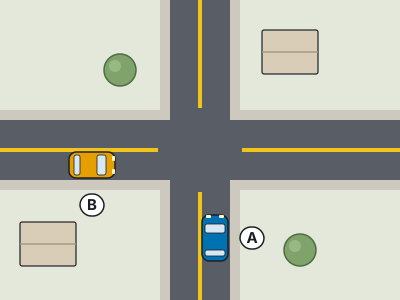
- The driver on the left
- The vehicle traveling faster
- The driver on the right
- The vehicle that is turning right
Show answer
The driver on the left. When two vehicles arrive together at an intersection with no stop signs or signals, Tennessee assigns the yield duty to the driver on the left, who yields to the vehicle coming at the same time on the right. The vehicle on the right may proceed first, but that driver still needs to confirm the path is clear. Choosing the right-hand driver reverses the state rule. Vehicle speed and turning direction do not decide this situation. A useful scan is to identify whether another vehicle arrived at the same time, then locate that vehicle relative to your own position before moving.
Study this in the handbook: Right of way, turns and emergency vehicles
7. How long must a Tennessee learner permit be held before moving to the intermediate restricted license step?
- 180 days
- 90 days
- One year
- 30 days
Show answer
180 days. A Tennessee learner permit must be held for 180 days before the driver can advance to the Intermediate Restricted License step. Thirty days is far shorter than that holding period. Ninety days and one year are also different periods that do not replace the permit holding interval. Treat the 180 days as a minimum experience period, not as permission to skip the required supervised driving conditions. Keep the permit valid and complete the other licensing requirements before seeking the next level.
Study this in the handbook: The learner permit
8. A car at 55 mph can stop in about 240 feet. About how far does a truck at the same speed need to stop?
- About 120 feet
- About 240 feet, the same as a car
- About 450 feet or more
- About 2,000 feet
Show answer
About 450 feet or more. The Tennessee manual's sharing the road section warns that trucks take much longer to stop than cars. At 55 mph a car can stop in about 240 feet, but a truck at the same speed needs about 450 feet or more, nearly twice as far. That is why cutting in front of a truck and then slowing is so dangerous: the truck driver may not be able to stop in the space you left.
Study this in the handbook: Trucks, school buses, work zones and trains
9. On a multi-lane road, where can a stationary vehicle covered by Tennessee’s Move Over Law be located?
- Along either the left or right roadside in the driver’s direction
- Only on the left shoulder
- Only on the right shoulder
- Only in the median, never along the roadside
Show answer
Along either the left or right roadside in the driver’s direction. The Move Over requirement applies to stationary vehicles along the roadside in the direction the driver is traveling. That wording covers either side of a multi-lane roadway, so limiting the rule to the left shoulder is incorrect. A median-only interpretation also misses the roadside condition. The driver still needs two or more lanes moving in the same direction and must respond to flashing lights. Look for the stationary vehicle and its warning lights on either roadside, then change lanes or slow safely.
10. Which traffic-sign message is represented by the triangular shape shown here?
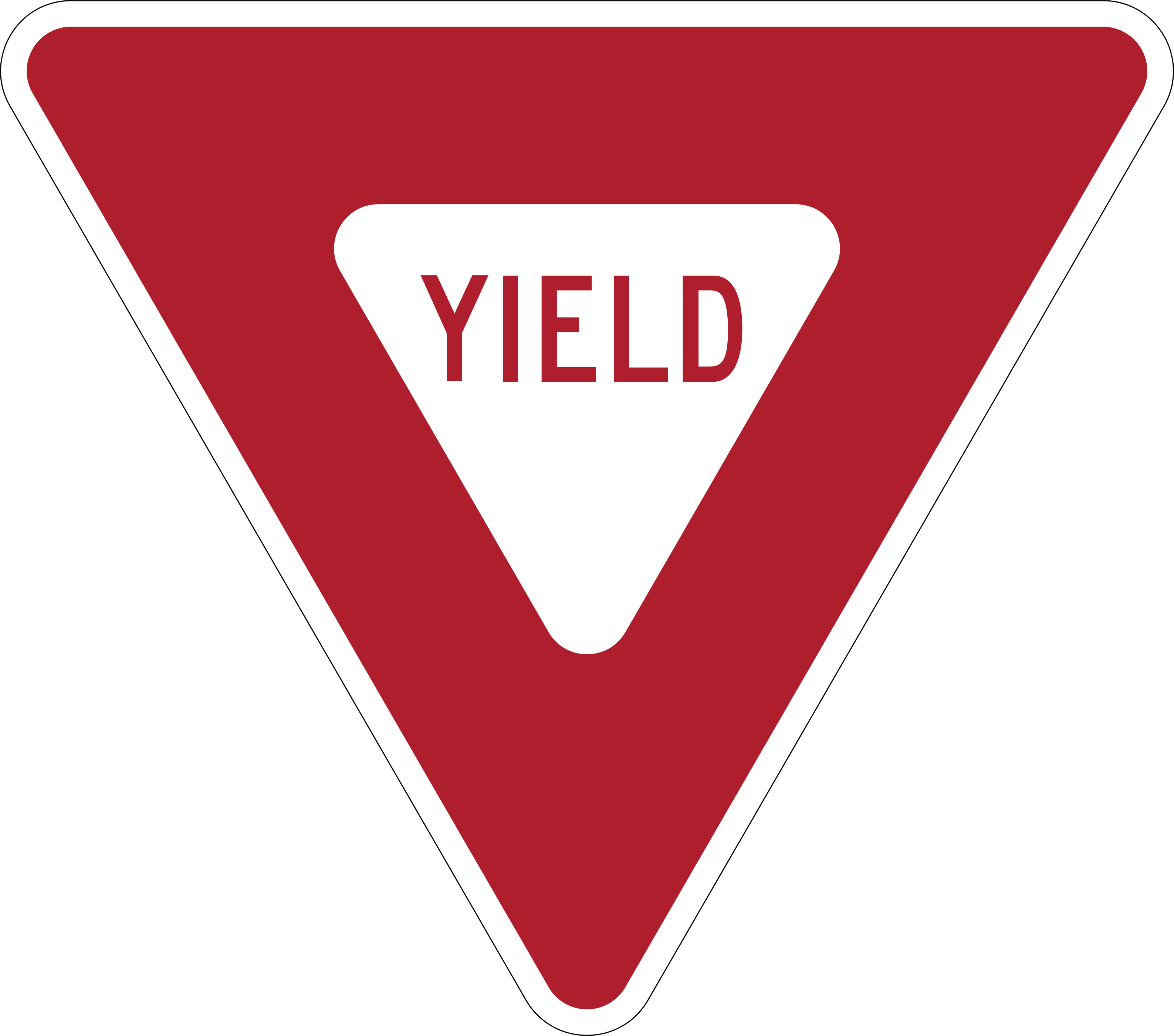
- Stop
- Yield
- Railroad crossing here
- Route direction
Show answer
Yield. The triangular shape identifies a yield sign. It tells the driver to reduce speed and give right-of-way as needed, stopping when necessary for conflicting traffic or pedestrians. An octagon carries the stop meaning, while railroad warnings use round or crossbuck shapes in the manual. Route direction belongs to guide signs, not this shape. A useful visual cue is the inverted triangle with its point down: it signals that other roadway users may have priority and that the approach must be controlled.
Study this in the handbook: Sign colors, shapes and regulatory signs
11. What license revocation period applies to a first DUI conviction in Tennessee?
- 6 months
- 1 year
- 2 years
- 6 years
Show answer
1 year. The Tennessee Department of Safety lists a one-year license revocation, 365 days, for a first DUI. A second DUI brings a two-year revocation, a third brings six years, and a fourth or later brings eight years. Six months is not a listed DUI revocation period. Older printed charts that show three to ten years for a third offense no longer match the Department's current schedule. Keep revocation separate from jail time, fines, and the ignition interlock requirement, which runs at least 365 days for a driver who wants a restricted license.
Study this in the handbook: DUI law, implied consent and penalties
12. When entering a Tennessee roundabout, to whom must you yield?
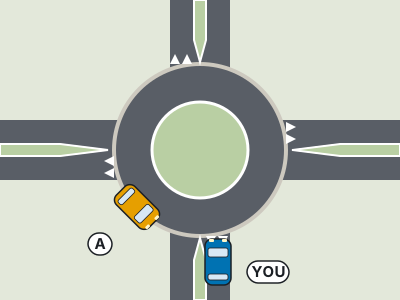
- Vehicles waiting behind you at the entrance
- Only vehicles approaching from the left
- Vehicles already circulating in the roundabout
- No vehicles, because entering traffic has priority
Show answer
Vehicles already circulating in the roundabout. Drivers entering a roundabout must yield to vehicles already within the circulating traffic. Enter only when a gap is available, then continue around the circle without stopping unless a sign, signal, or traffic officer directs otherwise. The entrance does not give priority, and the rule is not limited to vehicles approaching from one side. Reduce speed before the circle, identify traffic already inside, and choose a safe gap. Within the roundabout, proceed at a slower speed, usually posted at 15 to 25 mph, and exit at the intended street.
Study this in the handbook: Right of way, turns and emergency vehicles
13. What license revocation period applies to a second DUI conviction in Tennessee?
- 1 year
- 6 months
- 2 years
- 10 years
Show answer
2 years. A second DUI conviction brings 45 days to 11 months 29 days in jail, a fine of $600 to $3,500, a two-year license revocation, and possible seizure and forfeiture of the vehicle. One year is the first conviction revocation. Six months is too short, and 10 years is far beyond the second conviction period. Drivers with two DUIs within five years must also use an ignition interlock after reinstatement.
Study this in the handbook: DUI law, implied consent and penalties
14. What do Tennessee's yellow diamond shaped warning signs tell drivers to expect?
- A place where passing is required
- A change in the legal speed limit
- The distance to the next town
- A condition ahead that may call for reduced speed or a safety action
Show answer
A condition ahead that may call for reduced speed or a safety action. Diamond warning signs exist to give you time. They flag a curve, an intersection, a crossing or a change in the road surface so you can slow or prepare before you reach it. They never change the legal speed limit, which is set by white regulatory signs, and distances to towns are on green guide signs. No sign ever requires you to pass. When a diamond appears, ease off the accelerator, look for the hazard it names, and have a plan before you arrive.
Study this in the handbook: Warning, railroad, work zone and guide signs
15. A Tennessee Intermediate Restricted driver is convicted of carrying a forged permission letter to drive during curfew. What happens?
- The license is revoked and only a learner permit is issued until age 18
- A $50 fine only
- A 90-day delay before the unrestricted license
- Nothing if the letter was never used
Show answer
The license is revoked and only a learner permit is issued until age 18. A driver convicted of having a forged or fraudulent letter or statement loses the Intermediate Restricted License, and only a learner permit is reissued until the driver turns 18. That is far harsher than a $50 fine or a 90-day delay, which are penalties for other GDL problems. Being convicted of having the forged letter is enough, so the idea that nothing happens is wrong.
Study this in the handbook: The learner permit
16. If the broken yellow line is on your side beside a solid yellow line, you may:
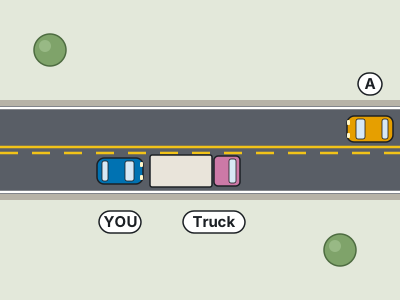
- Pass only after crossing the solid line first
- Use the opposing lane until reaching the next intersection
- Never cross the lines under any circumstance
- Pass when it is safe and return before the passing zone ends
Show answer
Pass when it is safe and return before the passing zone ends. A broken yellow line on your side identifies the passing zone, but it does not guarantee that a pass is safe. Check sight distance, oncoming traffic, and other hazards before moving left. You must return to your side before the passing zone ends. The solid-line choice reverses the meaning of the marking, while staying in the opposing lane for a long distance creates a head-on risk.
Study this in the handbook: Lane use, passing and parking
17. How far from a traffic signal, stop sign, or other traffic control device is parking prohibited?
- Within 10 feet
- Within 30 feet
- Within 15 feet
- Within 50 feet
Show answer
Within 30 feet. Tennessee prohibits parking within 30 feet of a traffic signal, stop sign, or other traffic control device. Fifteen feet is the fire hydrant distance, 20 feet is used for a crosswalk, and 50 feet applies near a railroad crossing. The same list also bars parking on a sidewalk, on a bridge, or within a tunnel. Identify the nearby object first, then apply its matching clearance instead of using one universal parking distance.
Study this in the handbook: Lane use, passing and parking
18. What does the orange triangle on the rear of a slow-moving vehicle indicate?
- The vehicle may be passed without checking traffic
- The vehicle has priority to make any sudden lane change
- The vehicle is carrying hazardous materials
- The vehicle is moving slowly and requires caution from following drivers
Show answer
The vehicle is moving slowly and requires caution from following drivers. The fluorescent or reflective orange triangle identifies a slow-moving vehicle, such as farm equipment or construction machinery. It warns following drivers to expect a much lower speed and to prepare early, especially near hills and curves. The emblem grants no special right to turn or change lanes, says nothing about hazardous cargo, and never makes passing automatic. Reduce speed, keep a safe distance, and pass only where it is legal and the road ahead is clear.
Study this in the handbook: Pedestrians, bicycles, motorcycles and slow vehicles
19. What does a solid yellow line on your side of the center marking mean?
- You may not cross the center line to pass
- You must cross it before turning left
- Passing is required before the line ends
- You may pass if you sound the horn
Show answer
You may not cross the center line to pass. A solid yellow line on the driver's side marks a no-passing condition, so the center line may not be crossed to overtake another vehicle. Sounding the horn does not remove the restriction, and the line does not require a driver to cross it. A left turn into an alley, intersection, private road, or driveway can be a separate permitted movement, but that exception is not a passing maneuver. Keep the vehicle in its lane until the restriction ends.
Study this in the handbook: Lane use, passing and parking
20. How many people were killed by distracted driving in 2019, according to NHTSA figures in the Tennessee manual?
- About 100
- About 50,000
- About 800
- 3,142
Show answer
3,142. According to the National Highway Traffic Safety Administration, 3,142 people were killed by distracted driving in 2019, and cell phone use while driving leads to 1.6 million crashes every year. Tennessee's Hands Free law bars holding a phone while driving, and texting has been prohibited for teen and adult drivers since July 1, 2009. Put the phone away before you start.
Study this in the handbook: Safety belts, child seats and air bags
QualitySpace is expanding to Tennessee
We are a California-based independent insurance brokerage working on licensing in more states. We cannot help with Tennessee insurance yet. Leave your email and we will let you know when we can.
Every question is written from the official Tennessee Comprehensive Driver License Manual. Need paper? Printable TN practice test with answer key.
Last verified 2026-10-05. How we check every question · Study all 500 as flashcards
Frequently asked questions
How many questions are on this Tennessee practice test?
This fixed set has 20 questions. It is test 2 of 25 from the 500 question Tennessee bank. The real TN exam asks 30 questions and you need 24 correct.
What is the passing score for the real Tennessee test?
A minimum score of 80% is required to pass That figure comes from the official Tennessee source cited on the DMV facts page.
How does this fixed test relate to the full Tennessee bank?
Each numbered test is a fixed set of questions in a fixed order, so you can retake the same test later and compare. Every test mixes road signs and the other topics in about the same proportion as the full bank. Tests 1 to 25 together cover every question in the Tennessee bank once. The full practice page mixes the whole bank at random.
Last verified 2026-10-05. See the Tennessee DMV facts page for sourced state details.
Return to the full Tennessee practice test · Study road signs