
Test 10 of 25 · 20 questions · Free 2026
TN Permit Practice Test 10
Jump to the test ↓A fixed 20 question set from the Tennessee bank with answers and plain English explanations. The real TN exam is 30 questions, 80 percent to pass; take the full length version on the main practice page.
Question 1 of 20 · 0 right so far
All 20 questions in test 10
Every question below comes from the Tennessee question bank on this page. Open a question to see the correct answer and the explanation. Nothing here is hidden behind a signup.
1. When does a Tennessee driver have a duty to yield to a pedestrian in a crosswalk?
- Only when the crosswalk has painted stripes
- Only when a crossing guard is present
- Only after the pedestrian reaches the center line
- When the pedestrian is in a marked or unmarked crosswalk
Show answer
When the pedestrian is in a marked or unmarked crosswalk. Tennessee's pedestrian rule applies when a pedestrian is in a crosswalk, whether that crossing is marked or unmarked. Painted lines are not the only cue, so the painted-stripes-only answer would leave people unprotected at lawful but unpainted crossings. A crossing guard and the pedestrian's location at the center line are not prerequisites. Slow early, watch both sides of the roadway, and be prepared to stop before the crosswalk. The driver must also account for pedestrians approaching closely enough from the opposite half of the road to be in danger.
Study this in the handbook: Right of way, turns and emergency vehicles
2. What does a flashing yellow left arrow permit?
- A left turn without slowing or yielding
- A left turn after yielding to oncoming traffic, bicyclists, and pedestrians
- A straight movement only until the arrow turns green
- A complete stop followed by a right turn only
Show answer
A left turn after yielding to oncoming traffic, bicyclists, and pedestrians. A flashing yellow left arrow is permissive. The driver may turn left only after yielding to oncoming vehicles, bicyclists, and pedestrians in the crosswalk, and must wait for a safe gap. It is not a protected movement and does not remove the need to slow and assess traffic. The straight-only and right-turn choices change the indicated movement. Use the practical cue that flashing yellow means yield first, then turn when the opposing path and crosswalk are clear.
Study this in the handbook: Warning, railroad, work zone and guide signs
3. What should you do when a steady yellow light appears and stopping can be done safely?
- Accelerate so the vehicle enters before red
- Prepare to stop and stop rather than speeding up to beat the light
- Treat yellow as permission to turn without checking
- Stop only when a pedestrian signal is also red
Show answer
Prepare to stop and stop rather than speeding up to beat the light. A steady yellow signal warns that the red stop signal will appear immediately afterward. The driver should adjust speed for a smooth stop and must stop when it is safe to do so. Accelerating to beat the light increases conflict risk and is specifically discouraged. If the vehicle is already in the intersection, continue through carefully rather than stopping in the travel path. Check the stop line, crosswalk, and traffic behind you as you decide, but do not turn the warning into an invitation to rush.
Study this in the handbook: Traffic signals and pavement markings
4. What background color do Tennessee regulatory and guide signs normally use?
- White, except the red STOP sign
- Yellow
- Orange
- Brown
Show answer
White, except the red STOP sign. White is the workhorse background in Tennessee. Speed limits, turn restrictions, route markers and many guide signs are printed on white with a dark legend, and the one regulatory sign that breaks the pattern is STOP with its red field. White is also the lettering color on brown, green, blue, black and red signs. Yellow means warning, orange means work zone, and brown means recreation. Because guide signs and route markers also use white, read the legend to tell a rule from directions.
Study this in the handbook: Sign colors, shapes and regulatory signs
5. In fog so dense that you cannot see the road's edge, what does the Tennessee manual tell you to do?
- Pull off as far to the right as possible, out of the traffic lane, and turn on the emergency flashers
- Continue slowly using the center line as a guide
- Speed up to get through the fog quickly
- Stop in your lane and turn on the high beams
Show answer
Pull off as far to the right as possible, out of the traffic lane, and turn on the emergency flashers. When fog erases the edge of the road you are driving blind, and the manual treats that as an emergency. Get the vehicle completely out of the traffic lane, as far right as the shoulder allows, and switch on the emergency flashers so the next driver has some chance of seeing you. Stopping in the lane invites a rear end crash, high beams reflect off fog and make things worse, and speeding up only shortens the time you have to react to whatever is hidden ahead.
Study this in the handbook: Headlights, night driving and bad weather
6. What should a pedestrian do when a signal displays DON'T WALK or a raised hand?
- Begin crossing if the nearest lane is clear
- Wait until the signal permits crossing
- Stand in the roadway until the next green light
- Cross only after waving to approaching drivers
Show answer
Wait until the signal permits crossing. A DON'T WALK message or raised hand means it is not safe to begin crossing the street or intersection. The choice allowing a crossing merely because one lane appears empty ignores traffic that may arrive from another direction. Wait for the pedestrian indication that permits movement, then check traffic while crossing. The raised hand is the visual cue that the crossing phase has ended for people who have not started.
Study this in the handbook: Traffic signals and pavement markings
7. What should a driver do after recognizing drowsiness while driving?
- Open a window and continue until the next town
- Drive faster to reach the destination sooner
- Quit driving and take a break
- Stare straight ahead to maintain concentration
Show answer
Quit driving and take a break. The manual identifies drowsiness as the first step toward falling asleep and advises drivers to quit driving when they are drowsy. A window, extra speed, or staring ahead cannot reliably restore alertness and may leave the vehicle moving while the driver loses awareness. The safer plan is to stop at a suitable location, get out, refresh yourself, and resume only after you are fit to drive.
Study this in the handbook: Interstate driving
8. On a multi-lane highway, what should a driver do when approaching a stationary emergency vehicle with flashing lights?
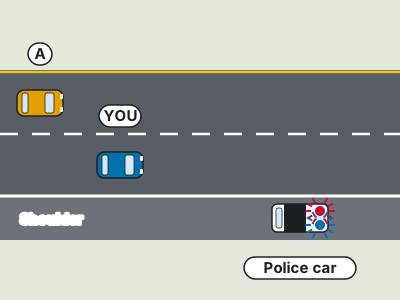
- Keep the same speed in the lane next to it
- Stop in the lane beside the emergency vehicle regardless of traffic
- Change into a lane not adjacent to it when possible, or slow down if changing lanes is unsafe
- Pass the vehicle on the shoulder to create more space
Show answer
Change into a lane not adjacent to it when possible, or slow down if changing lanes is unsafe. Tennessee's Move Over Law calls for yielding the lane closest to a stationary emergency, maintenance, recovery, or other covered vehicle when the highway has the required multi-lane configuration. If safety and traffic allow, move into a lane that is not adjacent. If that change would be impossible or unsafe, use due caution, reduce speed, and maintain a safe speed for conditions. Holding speed beside the vehicle defeats the protective space the law is designed to create.
Study this in the handbook: Interstate driving
9. What kind of sign is a white sign with black lettering that states a speed limit?
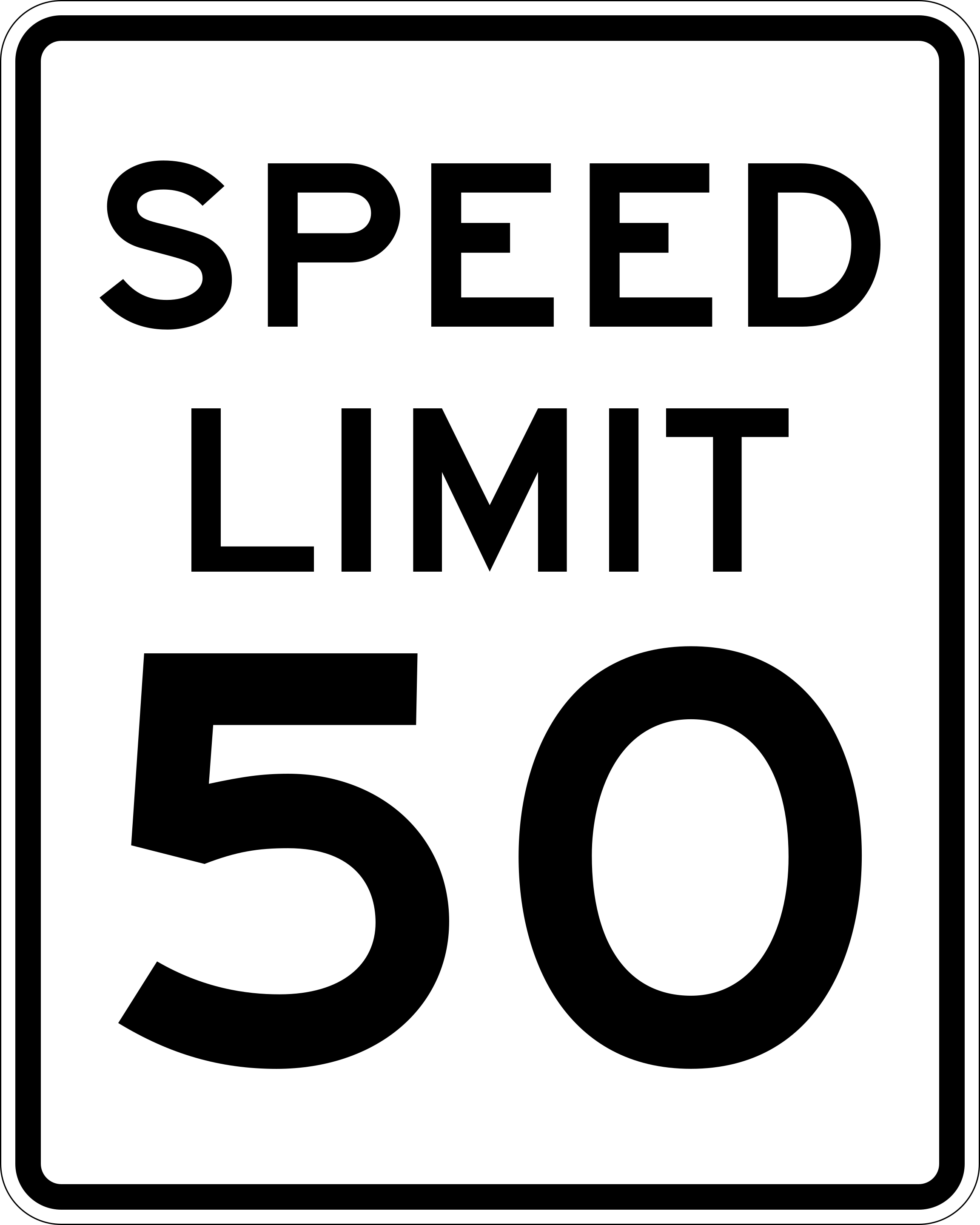
- A regulatory sign stating a legal speed requirement
- An orange construction warning sign
- A brown recreational guide sign
- A blue motorist-services sign
Show answer
A regulatory sign stating a legal speed requirement. A speed-limit sign is regulatory because it communicates a traffic law rather than merely suggesting a route or warning of a condition. White and black are used for regulatory messages, while brown identifies recreation, orange marks construction and maintenance, and blue points to motorist services. Read the posted number and adjust for weather or traffic when necessary. The sign’s plain rectangular appearance is a reminder that the instruction carries legal force.
Study this in the handbook: Sign colors, shapes and regulatory signs
10. When you must drive around an obstruction or a crash in the road, which side does the Tennessee manual say to use whenever possible?
- The left shoulder, to stay clear of the obstruction
- Straddle both lanes so either side stays open
- The right side of the obstruction
- Whichever side has less traffic at the moment
Show answer
The right side of the obstruction. Tennessee lists driving to the left of center to pass an obstruction as one of the exceptions to keeping right, but it advises that whenever possible you should always drive around obstructions or crashes to the right side. Going around on the right avoids the possibility of becoming involved in a head-on collision with traffic coming the other way. The left shoulder moves you toward that conflict, the manual says never to straddle lanes, and picking whichever side looks quieter ignores the rule. Slow down, check traffic, and pass on the right.
Study this in the handbook: Right of way, turns and emergency vehicles
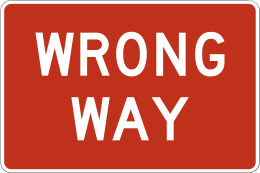
11. If this WRONG WAY sign faces a driver, what does it indicate?
- A rough road requires reduced speed
- Trucks must use the lane
- A passing zone begins ahead
- The vehicle is traveling against the permitted direction
Show answer
The vehicle is traveling against the permitted direction. A WRONG WAY sign warns that the vehicle is traveling in a direction that is not permitted. The manual says that if you see red Wrong Way and Do Not Enter signs, you are on the wrong side of the road. It is not a pavement warning about roughness, a truck only instruction, or a signal that passing may begin. The immediate priority is to avoid continuing into opposing traffic: turn off a one-way street or get into the proper lane of a two-way street immediately, and pull over at once on a wrong ramp.
Study this in the handbook: Lane use, passing and parking
12. When you park beside a Tennessee road outside city limits, from how far in each direction must your vehicle be visible?
- At least 50 feet
- At least 1,000 feet
- At least 200 feet
- At least 100 feet
Show answer
At least 200 feet. A vehicle parked along a rural road has to be seen by approaching drivers. Tennessee requires that it be visible for at least 200 feet in either direction, which the manual compares to a bit more than the width of a football field. The same rule asks you to get all four wheels off the pavement when possible and to leave at least 18 feet of road width for passing traffic. Fifty or 100 feet falls short of the requirement.
Study this in the handbook: Lane use, passing and parking
13. Which action is prohibited by Tennessee's hands-free law?
- Using a mounted device without touching it
- Holding a cellphone or mobile device with any part of the body
- Listening to turn-by-turn directions already set before driving
- Using a hands-free mode when otherwise permitted
Show answer
Holding a cellphone or mobile device with any part of the body. Tennessee's hands-free law makes it illegal for a driver to hold a cellphone or mobile device with any part of the body. A mounted device or previously configured navigation system is not the same physical act, although the driver still must keep attention on the road. The hands-free wording does not make every phone-related distraction safe. The practical cue is contact: do not support the phone with a hand, shoulder, lap, or another body part while driving. Pull over safely if the device must be handled.
14. What are the consequences for a Tennessee teen with a learner permit convicted of using a cell phone while driving?
- A warning only
- A $500 fine and jail
- Only a letter to the parents
- A Class C misdemeanor, a $50 fine, 6 points and a 90-day delay in eligibility
Show answer
A Class C misdemeanor, a $50 fine, 6 points and a 90-day delay in eligibility. Tennessee bans any learner permit or intermediate license holder from using a cell phone while driving. A conviction is a Class C misdemeanor with a $50 fine, 6 points on the minor's record, and a 90-day delay in eligibility for the Intermediate Restricted License. Six points is also the level that triggers a proposed suspension for juvenile drivers. A warning or letter understates the penalty, and $500 with jail overstates it.
Study this in the handbook: Teen penalties, phones and school rules
15. What does a flashing arrow panel in a temporary traffic control area warn drivers about?
- A required stop at every intersection
- A railroad crossing with two tracks
- A hospital entrance nearby
- A lane closure ahead
Show answer
A lane closure ahead. A flashing arrow panel warns approaching drivers that a lane is closing and that they need to merge into an open lane. It is a mobile traffic control device used around construction, special directions, road closures, or weather hazards. The railroad, hospital, and universal-stop choices describe unrelated signs or controls. Treat the arrow as advance notice, check mirrors and blind spots, signal, and merge well before the closure leaves you with less room.
Study this in the handbook: Warning, railroad, work zone and guide signs
16. How many passengers may a Tennessee Intermediate Restricted License holder normally carry?
- No passengers at all
- Only one other passenger
- Up to two passengers
- Up to three passengers under 21
Show answer
Only one other passenger. An Intermediate Restricted driver may have only one other passenger unless one or more passengers is 21 or older with a valid unrestricted license, or the passengers are siblings living in the same home and the driver carries a parent's letter for school trips. No passengers at all is stricter than the law. Two or three passengers exceed the limit without an exception. The passenger rule lifts at the Intermediate Unrestricted level.
Study this in the handbook: Intermediate Restricted and Unrestricted licenses
17. When does Tennessee’s Move Over lane-change requirement apply based on roadway layout?
- On every one-lane road with a marked shoulder
- Only on a divided road with three lanes total
- Only where traffic moves in opposite directions in one lane
- On a multi-lane road with at least two lanes moving in the same direction
Show answer
On a multi-lane road with at least two lanes moving in the same direction. The lane-change requirement is tied to a multi-lane roadway having two or more lanes of traffic moving in the same direction. That arrangement gives the driver another lane to use when safely separating from the stopped vehicle. A one-lane road cannot offer the required adjacent alternative, and the rule is not limited to a three-lane divided design. Opposing traffic in one shared lane does not meet the stated layout. Count same-direction lanes first, then choose the safe response.
18. When may a Tennessee road test not be administered?
- Only on Saturdays and Sundays
- Only when the applicant is under 18
- During extreme weather or after dark in winter months
- Whenever the applicant uses a family vehicle
Show answer
During extreme weather or after dark in winter months. Road tests are not administered during extreme weather, including heavy rain or snow, and they are not given after dark during winter months. The rule is based on testing conditions, not the applicant’s age or the vehicle’s ownership. Weekend-only and family-vehicle restrictions invent limits absent from the manual. Before scheduling, think about whether visibility, pavement, and daylight allow a fair skills evaluation. Weather and seasonal darkness are the two cues that identify this exception.
Study this in the handbook: Getting a license and taking the tests
19. When may Tennessee seize a driver’s vehicle because of DUI convictions within five years?
- After two convictions, both occurring after January 1997
- After one conviction occurring at any time
- After three convictions, regardless of dates
- Only when all convictions occurred in one calendar year
Show answer
After two convictions, both occurring after January 1997. The manual gives two conditions for this vehicle seizure rule: there must be two DUI convictions within five years, and both events must have happened after January 1997. One conviction is insufficient, while three convictions and a single-calendar-year requirement add conditions the passage does not state. Treat the date phrase as part of the rule, not background history. A useful memory cue is two convictions, five years, and both after the January 1997 cutoff.
Study this in the handbook: DUI law, implied consent and penalties
20. When can a vehicle be seized after a driver’s license was revoked because of a DUI conviction?
- When the driver is charged with driving on that revoked license
- Only when the revocation came from a non-DUI offense
- Never, because vehicle seizure is not authorized
- Only after a 24-hour impoundment expires
Show answer
When the driver is charged with driving on that revoked license. A vehicle can be seized when a driver is charged with operating on a license already revoked because of a DUI conviction. The rule is triggered by the new driving charge and the prior DUI-based revocation, not by a temporary twenty-four-hour hold. A non-DUI revocation does not match the condition described here, and saying seizure is never authorized ignores the stated consequence. When reviewing DUI sanctions, separate the event that caused revocation from the later act of driving while revoked.
Study this in the handbook: DUI law, implied consent and penalties
QualitySpace is expanding to Tennessee
We are a California-based independent insurance brokerage working on licensing in more states. We cannot help with Tennessee insurance yet. Leave your email and we will let you know when we can.
Every question is written from the official Tennessee Comprehensive Driver License Manual. Need paper? Printable TN practice test with answer key.
Last verified 2026-10-05. How we check every question · Study all 500 as flashcards
Frequently asked questions
How many questions are on this Tennessee practice test?
This fixed set has 20 questions. It is test 10 of 25 from the 500 question Tennessee bank. The real TN exam asks 30 questions and you need 24 correct.
What is the passing score for the real Tennessee test?
A minimum score of 80% is required to pass That figure comes from the official Tennessee source cited on the DMV facts page.
How does this fixed test relate to the full Tennessee bank?
Each numbered test is a fixed set of questions in a fixed order, so you can retake the same test later and compare. Every test mixes road signs and the other topics in about the same proportion as the full bank. Tests 1 to 25 together cover every question in the Tennessee bank once. The full practice page mixes the whole bank at random.
Last verified 2026-10-05. See the Tennessee DMV facts page for sourced state details.
Return to the full Tennessee practice test · Study road signs