
Test 3 of 25 · 20 questions · Free 2026
TN Permit Practice Test 3
Jump to the test ↓A fixed 20 question set from the Tennessee bank with answers and plain English explanations. The real TN exam is 30 questions, 80 percent to pass; take the full length version on the main practice page.
Question 1 of 20 · 0 right so far
All 20 questions in test 3
Every question below comes from the Tennessee question bank on this page. Open a question to see the correct answer and the explanation. Nothing here is hidden behind a signup.
1. What is an accepted Tennessee practice for oncoming traffic meeting a funeral procession?
- Pass the procession on the shoulder
- Pull to the side of the roadway as a sign of respect
- Drive between vehicles in the procession
- Stop in the travel lane and leave the vehicle
Show answer
Pull to the side of the roadway as a sign of respect. Tennessee describes oncoming traffic pulling to the side of the roadway as a common and accepted sign of respect when meeting a funeral procession. Passing on the shoulder is not the courtesy described, and driving between procession vehicles is prohibited unless a traffic officer directs it. Leaving a vehicle stopped in the travel lane creates a hazard. Notice that the accepted practice concerns opposing traffic meeting the procession, while separate rules govern vehicles traveling with or behind it.
Study this in the handbook: Speed limits and the Basic Speed Rule
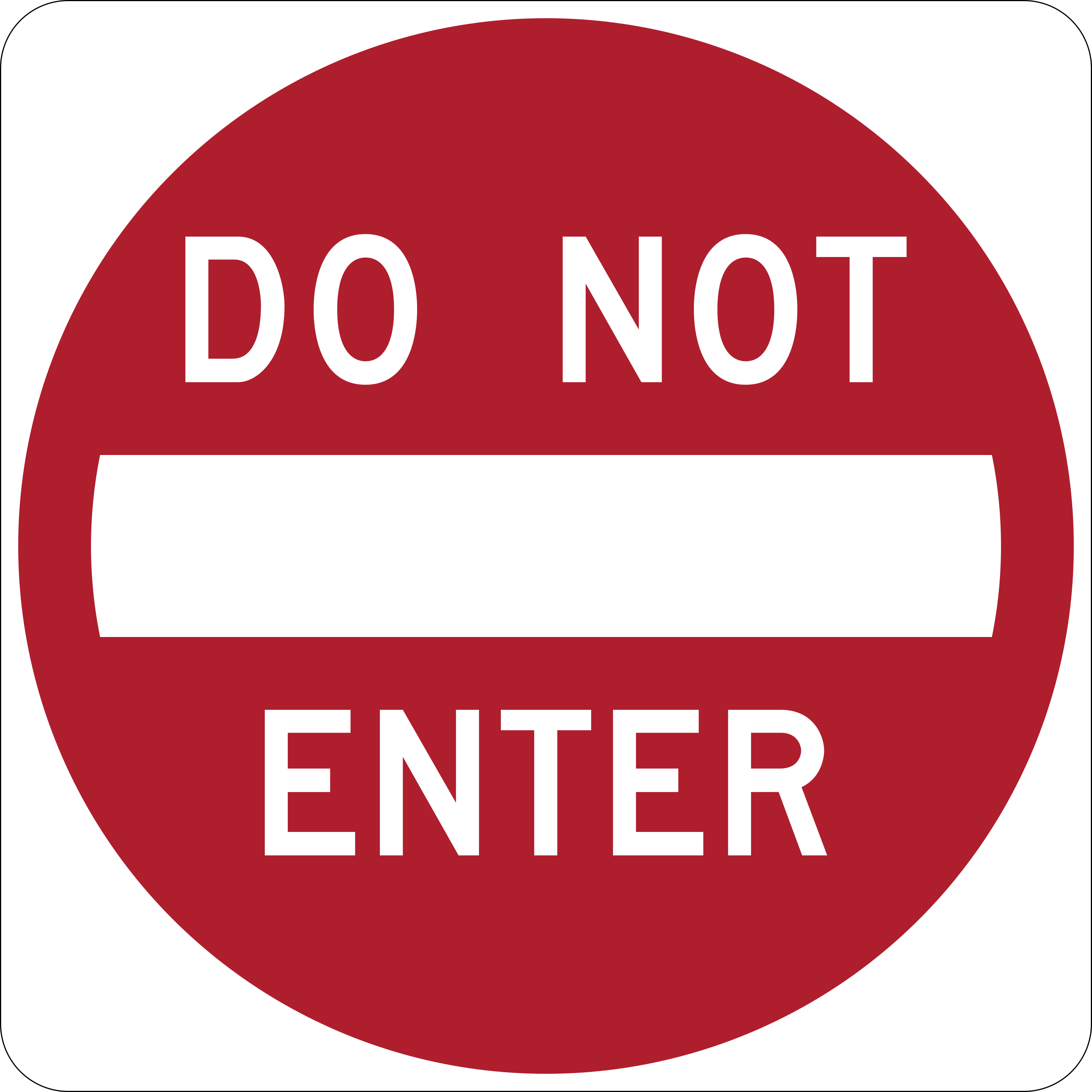
2. What action is required when a driver faces a DO NOT ENTER sign?
- Use the lane only for a U-turn
- Enter after slowing if no vehicles are visible
- Park beside the sign until traffic clears
- Do not enter that roadway or ramp
Show answer
Do not enter that roadway or ramp. The DO NOT ENTER sign tells you that you are approaching a one-way street and that you must not enter from the direction you are traveling. The absence of visible traffic does not cancel the prohibition, so cautiously entering remains wrong. Parking beside the sign can create a hazard, and the sign does not grant a special U-turn lane. Treat the message as an immediate direction to stay out. If you do pass red Do Not Enter signs, you are on the wrong side of the road and must get out of that roadway immediately.
Study this in the handbook: Sign colors, shapes and regulatory signs
3. What information do black and white regulatory signs provide?
- Only directions to parks and cultural attractions
- Selected traffic laws, regulations, or instructions
- Temporary warnings about construction workers
- Motorist service locations such as rest areas
Show answer
Selected traffic laws, regulations, or instructions. Black and white regulatory signs communicate selected traffic laws or regulations and may instruct drivers about matters such as speed limits or lane use. They are not limited to recreation, construction, or services. The background and message help identify the sign category, but the driver must still read the instruction shown. Treating a regulatory sign as optional can lead directly to an illegal lane movement or speed choice.
Study this in the handbook: Sign colors, shapes and regulatory signs
4. A Tennessee 15-year-old has a second conviction for possessing alcohol. How long is the driving privilege suspended?
- Two years or until age 18, whichever is longer
- One year or until age 17, whichever is longer
- 90 days
- Until age 16 only
Show answer
Two years or until age 18, whichever is longer. Juveniles 13 to 17 found to have possessed, consumed or sold alcohol or drugs lose the privilege for one year or until 17, whichever is longer, on a first conviction. A second conviction brings two years or until 18, whichever is longer. The one year or 17 choice is the first offense rule. Ninety days and age 16 are not the stated terms. A teen who has never been licensed can still lose the privilege.
Study this in the handbook: How alcohol and drugs affect driving
5. How many reckless driving violations within 12 months can cost a Tennessee driver the license?
- One
- Four
- Six
- Two
Show answer
Two. Tennessee lists two reckless driving violations within 12 months among the grounds for revoking or suspending a license, alongside drag racing, DUI, leaving the scene of an injury crash, and habitual moving violations. One reckless driving violation alone is not the listed trigger. Four and six are not the figures in this rule. Other grounds include driving away from a gas station without paying for fuel.
Study this in the handbook: Points, suspensions and keeping your license
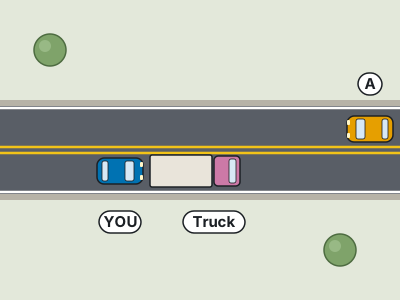
6. What do two solid yellow lines between opposing lanes mean?
- Cross them whenever no oncoming vehicle is visible
- Use them as a center lane for left turns
- Do not cross them to pass from either direction
- Cross them to pass only during daylight
Show answer
Do not cross them to pass from either direction. Two solid yellow lines separate opposing traffic and prohibit crossing from either direction to pass, even when no oncoming vehicle is visible. The marking is not a shared center lane and does not become permissive in daylight. A driver may cross a solid yellow line to turn into a driveway or side road when that movement is safe, but a turn is different from overtaking another vehicle. Read the pavement before changing lanes and keep the vehicle on its proper side of the roadway.
Study this in the handbook: Traffic signals and pavement markings
7. What does a yield sign require when other vehicles are approaching?
- Speed up so the driver enters before the other vehicles
- Continue without checking because the sign is only advisory
- Stop and wait until the approaching traffic has passed safely
- Turn around before reaching the intersection
Show answer
Stop and wait until the approaching traffic has passed safely. The triangular yield sign requires the driver to stop and wait when other vehicles are approaching from the right or left on the intersecting roadway. It is not merely a suggestion, and entering quickly can create a conflict. A driver may proceed without stopping only after slowing and confirming that no traffic or pedestrian movement creates a hazard. The sign never calls for turning around as a routine response.
Study this in the handbook: Sign colors, shapes and regulatory signs
8. When you stop for a crosswalk on a multi-lane road in Tennessee, about how far back should you stop?
- About 30 feet before the crosswalk
- Right on the crosswalk line
- About 5 feet before the crosswalk
- About 100 feet before the crosswalk
Show answer
About 30 feet before the crosswalk. On a road with more than one lane in your direction, a car stopped right at the crosswalk can hide a crossing pedestrian from drivers in the next lane, who may keep going. Tennessee's safety tip is to stop about 30 feet before the crosswalk so drivers in the other lanes can still see the people crossing. Stopping on the line or only a few feet back does not open that sight line.
Study this in the handbook: Lane use, passing and parking
9. The Tennessee reverse turn warning sign marks two turns in opposite directions that are how far apart?
- More than one mile
- Any distance, as long as both turns are sharp
- Exactly 1,000 feet
- Less than 600 feet
Show answer
Less than 600 feet. The reverse turn sign tells you that you must turn right, then left. Tennessee uses it to mark two turns in opposite directions that are less than 600 feet apart, so the second turn comes up soon after the first. Turns a mile apart fall far outside the spacing this sign marks, and the sign is defined by that spacing rather than by how sharp the turns are. The 1,000 foot figure belongs to interstate reference markers, not this sign. Slow down before the first turn.
Study this in the handbook: Warning, railroad, work zone and guide signs
10. If a vehicle begins to skid, which response is recommended?
- Stamp on the brake and lock the wheels
- Stay off the brake and steer where you want the car to go
- Turn the wheel opposite the desired path and accelerate hard
- Close your eyes and wait for the tires to regain grip
Show answer
Stay off the brake and steer where you want the car to go. During a skid, braking can make the loss of traction worse until the vehicle slows. Keep off the brake, steer in the direction you want the car to go, and continue correcting as the vehicle straightens. The opposite steering choice can send the vehicle into another slide, while hard acceleration adds another force the tires may not handle. Slow down for conditions before a skid develops and avoid abrupt inputs.
Study this in the handbook: Avoiding collisions and keeping your vehicle safe
11. What does a solid white line along the right edge of a traffic lane identify?
- The centerline separating opposing traffic
- A mandatory passing lane
- The right edge of the traffic lane
- A railroad crossing stop position
Show answer
The right edge of the traffic lane. A solid white line at the side of the roadway marks the right edge of the traffic lane. It helps the driver recognize the pavement boundary, especially when visibility is poor or the roadway is unfamiliar. Yellow lines identify the left edge of traffic moving in your direction and commonly separate opposing flows. Do not confuse an edge line with a centerline or treat it as an invitation to leave the lane.
Study this in the handbook: Traffic signals and pavement markings
12. What does the yellow plus-shaped warning sign identify?

- A hospital entrance
- A place where all turns are prohibited
- A crossroad ahead
- A railroad crossing with no intersecting road
Show answer
A crossroad ahead. The plus shaped black lines represent a crossroad. The manual says this sign tells you that you are approaching an intersection, and the black lines show just what kind of intersection it is. Slow enough to scan the intersecting roadway and be ready for vehicles approaching from either direction. The symbol does not identify a hospital, prohibit every turn, or describe a railroad crossing by itself. Diamond shaped warning signs like this one call for caution and usually for a slower speed.
Study this in the handbook: Sign colors, shapes and regulatory signs
13. What does a red circle and diagonal bar on a white sign mean?
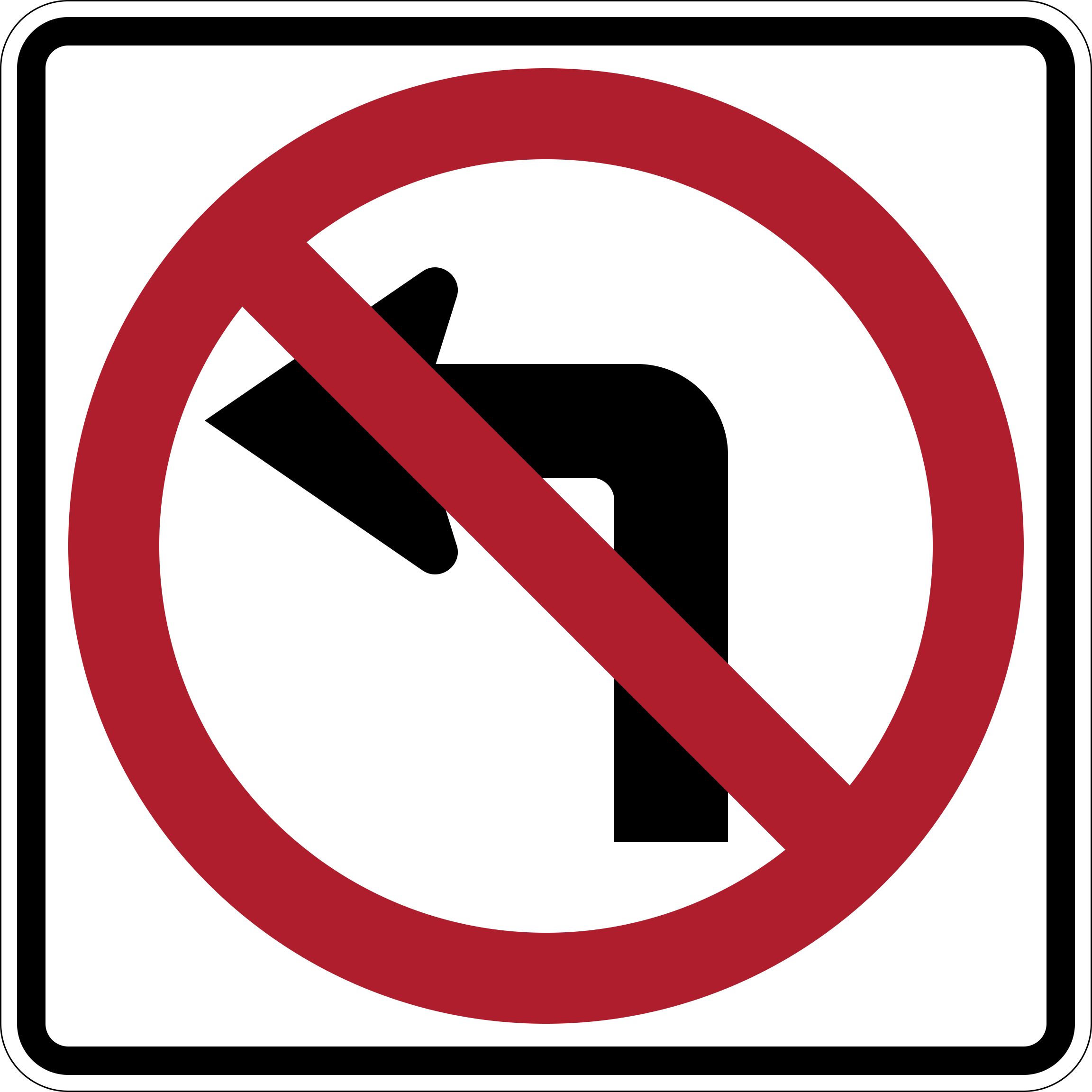
- The action shown is prohibited
- The action shown is permitted only at night
- The action shown is required before turning
- The action shown is recommended
Show answer
The action shown is prohibited. A white sign carrying a red circle and diagonal bar means no to the symbol displayed behind it. For example, the marking can prohibit trucks, bicycles, a left turn, or a U-turn. It is not a recommendation, a nighttime permission, or a required turning step. Read the symbol inside the prohibition mark rather than focusing only on its color. If the displayed movement is crossed out, choose another lawful path or maneuver.
Study this in the handbook: Sign colors, shapes and regulatory signs
14. Unless another limit is posted, what speed limit applies on Tennessee primary and secondary state and federal highways?
- 45 miles per hour
- 55 miles per hour
- 60 miles per hour
- 70 miles per hour
Show answer
55 miles per hour. The manual gives 55 miles per hour as the default limit for primary and secondary state and federal highways unless a different limit is posted. The number is not a universal limit for every Tennessee road. Interstate highways and urban areas can have different posted limits, and road conditions may require a slower speed even when the sign permits more. Read each posted sign and reduce speed for curves, slippery pavement, fog, traffic, or other hazards. The key cue is the road classification plus the phrase unless otherwise posted.
Study this in the handbook: Speed limits and the Basic Speed Rule
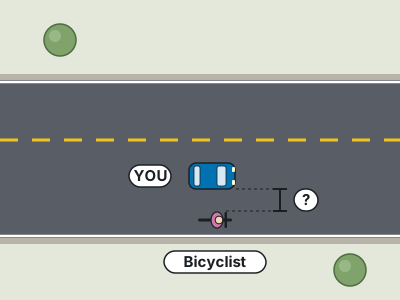
15. How much clearance must a driver leave when passing a bicyclist traveling in the same direction?
- At least 1 foot
- At least 3 feet
- At least 2 feet
- At least 6 feet
Show answer
At least 3 feet. When overtaking a bicyclist traveling in the same direction, Tennessee requires the driver to pass slowly and leave at least 3 feet of space. The clearance must continue until the vehicle is safely past the bicycle. One or two feet leaves little room for a wobble or wind effect, while six feet is not the stated minimum. Slow before moving alongside, check for oncoming traffic, and do not force the rider toward parked vehicles.
Study this in the handbook: Pedestrians, bicycles, motorcycles and slow vehicles
16. Can a Tennessee driver be charged with DUI for driving under the influence of an intoxicant other than alcohol?
- Yes, driving under the influence of any intoxicant is unlawful
- No, only alcohol can support a charge
- Yes, but only on an interstate highway
- No, unless the driver is under 21
Show answer
Yes, driving under the influence of any intoxicant is unlawful. Tennessee's DUI rule covers driving or being in physical control while under the influence of an intoxicant, marijuana, narcotic drug, or drugs producing stimulating effects on the central nervous system. Alcohol is only one part of that rule. The interstate-only and under-21 limitations add restrictions that the manual does not impose. A driver should consider prescription and nonprescription substances as well as alcohol before driving. If a substance affects judgment, coordination, alertness, or other driving functions, choosing to drive can create both danger and criminal exposure.
Study this in the handbook: How alcohol and drugs affect driving
17. How far should children stay from a school bus when they are outside it?
- Twenty feet
- Two feet
- Five feet
- Ten feet
Show answer
Ten feet. The school-bus danger zone surrounds the bus, so children should stay ten feet away and never go behind it. The distance creates space from the bus's blind areas and moving traffic. Five giant steps are described as a practical way for children to escape the zone, but that is not the same figure as the ten-foot rule. Drivers should stop far enough away to preserve that safety space and watch for children retrieving belongings.
Study this in the handbook: Trucks, school buses, work zones and trains
18. At a railroad crossing, what should a driver do before crossing when a train is approaching?
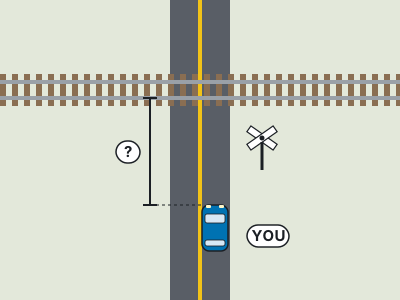
- Drive around a lowered gate when no train is visible
- Stop on the tracks so the train can be seen more easily
- Cross quickly if the nearest track appears clear
- Stop between 15 and 50 feet from the tracks and wait until every track is clear
Show answer
Stop between 15 and 50 feet from the tracks and wait until every track is clear. When a train is coming, the vehicle must stop 15 to 50 feet from the railroad tracks and wait until it has passed and it is safe to cross. Stopping on the tracks creates a direct collision risk, and a clear nearest track may hide a train on another track. A lowered gate is a stop command, not an obstacle to drive around. Reduce speed early, identify all tracks, and remain behind the required stopping distance until the crossing is completely clear.
Study this in the handbook: Braking, following distance and required stops
19. What minimum age and test are required for Tennessee's Intermediate Restricted License?
- Age 15 and a passed vision screening only
- Age 17 and a passed written exam only
- Age 16 and a passed driving skills test
- Age 18 and no test
Show answer
Age 16 and a passed driving skills test. The first intermediate level requires the applicant to be 16 years old and pass the driving skills test, also called the road test. A learner permit at 15 and a vision screening are not enough to reach this level. The 17-year-old choice points toward later advancement, while an 18-year-old no-test option skips the graduated process described here. Think of this license as the stage after supervised permit experience. Confirm both the age and road-test requirements before scheduling the application.
Study this in the handbook: Intermediate Restricted and Unrestricted licenses
20. A Tennessee Intermediate Restricted driver wants to drive to go hunting at 4:30 a.m. When is that allowed?
- Between 4 a.m. and 6 a.m. with a valid hunting or fishing license in hand
- Never, because the curfew has no exceptions
- Only with a note from a teacher
- Any time after 3 a.m. with a parent's phone call
Show answer
Between 4 a.m. and 6 a.m. with a valid hunting or fishing license in hand. The Intermediate Restricted curfew runs from 11 p.m. to 6 a.m., but a teen may drive to or from hunting or fishing between 4 a.m. and 6 a.m. while carrying a valid hunting or fishing license. Other exceptions include a parent or guardian in the car, a designated licensed driver 21 or older, work with written permission, and school events with written permission. The curfew does have exceptions, and a teacher's note or a phone call is not one of them.
Study this in the handbook: The learner permit
QualitySpace is expanding to Tennessee
We are a California-based independent insurance brokerage working on licensing in more states. We cannot help with Tennessee insurance yet. Leave your email and we will let you know when we can.
Every question is written from the official Tennessee Comprehensive Driver License Manual. Need paper? Printable TN practice test with answer key.
Last verified 2026-10-05. How we check every question · Study all 500 as flashcards
Frequently asked questions
How many questions are on this Tennessee practice test?
This fixed set has 20 questions. It is test 3 of 25 from the 500 question Tennessee bank. The real TN exam asks 30 questions and you need 24 correct.
What is the passing score for the real Tennessee test?
A minimum score of 80% is required to pass That figure comes from the official Tennessee source cited on the DMV facts page.
How does this fixed test relate to the full Tennessee bank?
Each numbered test is a fixed set of questions in a fixed order, so you can retake the same test later and compare. Every test mixes road signs and the other topics in about the same proportion as the full bank. Tests 1 to 25 together cover every question in the Tennessee bank once. The full practice page mixes the whole bank at random.
Last verified 2026-10-05. See the Tennessee DMV facts page for sourced state details.
Return to the full Tennessee practice test · Study road signs