
Key points
At 55 mph a car can stop in 240 feet, but a truck takes about 450 feet or more.
Source: Handbook p. 109
“A car traveling at 55 MPH can stop in 240 feet however a truck traveling at the same speed of 55 MPH, takes about 450+ feet to stop.”
Tennessee Comprehensive Driver License Manual, Handbook p. 109If you cannot see the truck's mirror, the truck driver cannot see you.
Source: Handbook p. 109
“If you can’t see the truck’s mirror, the driver cannot see YOU.”
Tennessee Comprehensive Driver License Manual, Handbook p. 109Never move into the open space on a truck's right if it may be turning right.
Source: Handbook p. 110
“Do NOT move into that space or try to pass a truck if it might be making a right turn.”
Tennessee Comprehensive Driver License Manual, Handbook p. 110Children should stay 10 feet away from a school bus and never go behind it.
Source: Handbook p. 111
“Children should stay ten feet away from the school bus and NEVER go behind the bus.”
Tennessee Comprehensive Driver License Manual, Handbook p. 111Speeding in a work zone where workers are present can bring a fine of up to $500.
Source: Handbook p. 112
“Under Tennessee law, speed violations that occur in the work zones where the speed has been reduced and where employees of the Department of Transportation as well as other construction workers are present, will result in a fine up to a maximum of $500 dollars.”
Tennessee Comprehensive Driver License Manual, Handbook p. 112Drivers must always yield the right of way to trains; it is the law.
Source: Handbook p. 113
“Drivers must ALWAYS yield the right of way to trains because IT’S THE LAW.”
Tennessee Comprehensive Driver License Manual, Handbook p. 113A train going 55 mph takes a full mile to stop.
Source: Handbook p. 113
“A train traveling at 55 miles per hour takes a full mile to stop.”
Tennessee Comprehensive Driver License Manual, Handbook p. 113If you are on the tracks when the lights start flashing or the gates come down, keep moving.
Source: Handbook p. 114
“If you are crossing the tracks and the warning lights begin flashing or the gates start coming down, don’t stop. KEEP MOVING!”
Tennessee Comprehensive Driver License Manual, Handbook p. 114If your vehicle stalls on the tracks, everyone should get out right away, even if no train is in sight.
Source: Handbook p. 114
“If your vehicle stalls on the tracks, all occupants should exit the vehicle immediately and get away from the tracks even if you do not see a train.”
Tennessee Comprehensive Driver License Manual, Handbook p. 114If a train is coming, run toward the train at a 45 degree angle to stay away from and behind the point of impact.
Source: Handbook p. 114
“If a train is approaching, run toward the train at a 45 degree angle. This allows you to be away from and behind the point of impact, to prevent injury.”
Tennessee Comprehensive Driver License Manual, Handbook p. 114
Numbers to know
| Number | What it means | Manual |
|---|---|---|
| 240 and 450 feet at 55 mph | stopping distance of a car and a truck | Handbook p. 109 |
| 10 feet | distance children should stay from a school bus | Handbook p. 111 |
| $500 | maximum fine for work zone speeding | Handbook p. 112 |
| A full mile at 55 mph | stopping distance of a train | Handbook p. 113 |
| 45 degrees | angle to run toward an approaching train | Handbook p. 114 |
Recognize these signs
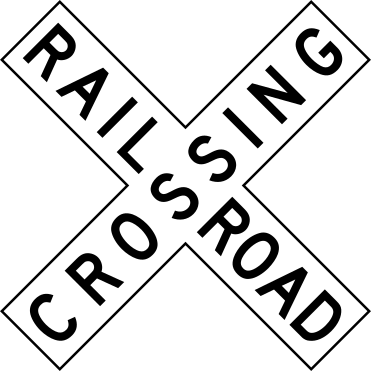
Railroad crossbuck
3 questions from the Tennessee practice test
1. Who has the right-of-way when a driver approaches railroad tracks?
- The vehicle that reaches the crossing first
- The vehicle traveling faster
- The train
- The driver closest to the center line
Show answer
The train. Tennessee requires drivers to yield the right-of-way to trains because a train cannot stop or swerve like a passenger vehicle. Reaching the crossing first, traveling faster, or being positioned near the center line does not change that priority. Slow well before the tracks, look and listen, and never race a train to the crossing. The large difference in stopping ability is the safety reason behind the rule, not a suggestion to negotiate.
2. How far should children stay from a school bus when they are outside it?
- Twenty feet
- Two feet
- Five feet
- Ten feet
Show answer
Ten feet. The school-bus danger zone surrounds the bus, so children should stay ten feet away and never go behind it. The distance creates space from the bus's blind areas and moving traffic. Five giant steps are described as a practical way for children to escape the zone, but that is not the same figure as the ten-foot rule. Drivers should stop far enough away to preserve that safety space and watch for children retrieving belongings.
3. In a Tennessee work zone where the reduced speed is posted and workers are present, what maximum fine can apply to a speeding violation?
- $100
- $1,000
- $250
- $500
Show answer
$500. Tennessee permits a fine of up to $500 for a speed violation in a work zone when the speed has been reduced and Department of Transportation or other construction workers are present. The amount is tied to the active work-zone conditions, not merely to seeing orange signs. The $100 and $250 choices understate the stated maximum, while $1,000 doubles it. Slow before entering the zone and follow the reduced limit whenever workers may be nearby.
Practice this topic
Lock it in with emergencies questions from the free Tennessee practice test. Every answer comes with a plain English explanation.
Source: the Tennessee Comprehensive Driver License Manual, Chapter C-3: Sharing the Road Safely. This lesson is a plain English summary, not the law itself; where it differs, the manual and the statute govern. Last checked 2026-09-27.