
Key points
With antilock brakes, press firmly and steadily and never pump the pedal.
Source: Handbook p. 48
“When slowing or stopping, apply firm, steady pressure to the brake pedal. Never pump the pedal with ABS.”
Tennessee Comprehensive Driver License Manual, Handbook p. 48Without antilock brakes, if you skid, take your foot off the brake and steer in the direction of the skid.
Source: Handbook p. 48
“As a general rule for vehicles without anti-lock brakes, if the car starts to skid, take your foot off the brake and turn the steering wheel in the direction of the skid;”
Tennessee Comprehensive Driver License Manual, Handbook p. 48Follow no closer than 2 seconds behind the vehicle ahead.
Source: Handbook p. 49
“Repeat this exercise until you are following no closer than two seconds.”
Tennessee Comprehensive Driver License Manual, Handbook p. 49In bad weather, at higher interstate speeds, at night and behind a motorcycle, allow at least 4 seconds.
Source: Handbook p. 49
“However, during inclement weather, interstate highway driving at higher speeds and night driving, the two-second rule should be increased to allow for improved visibility. A minimum of four seconds should allow for better reaction time and a safer space cushion under these conditions including following a motorcycle.”
Tennessee Comprehensive Driver License Manual, Handbook p. 49At 70 mph it takes 1.16 seconds to see a hazard and reach the brake, covering 128 feet, then 290 feet to brake on a good road in good weather.
Source: Handbook p. 49
“It will take 1.16 seconds for you to see the deer and move your foot to the brake. Before you even start to brake, you will have traveled 128 feet. If you’re on a good road in good weather, the braking distance at 70 m.p.h. will be 290 feet.”
Tennessee Comprehensive Driver License Manual, Handbook p. 49At a stop sign, stop before the nearest side of the crosswalk or at a marked stop line.
Source: Handbook p. 49
“Every driver approaching a stop sign shall stop before entering the nearest side of a crosswalk, or stop at a clearly marked stop line.”
Tennessee Comprehensive Driver License Manual, Handbook p. 49Not stopping for a stopped school bus is a Class A misdemeanor with a fine of $250 to $1,000.
Source: Handbook p. 51
“It is a Class A misdemeanor and the driver can be fined between $250 and $1,000 for not stopping for a stopped school bus.”
Tennessee Comprehensive Driver License Manual, Handbook p. 51When a train is coming, stop between 15 and 50 feet from the tracks, never on them.
Source: Handbook p. 50
“When you approach a railroad crossing and a train is coming, you must stop between 15 and 50 feet from the railroad tracks. Never stop on the railroad crossing tracks.”
Tennessee Comprehensive Driver License Manual, Handbook p. 50When a school bus stops at an intersection to load or unload children, drivers from all directions must stop until it moves.
Source: Handbook p. 51
“When a school bus is stopped at an intersection to load and unload children, drivers from ALL directions are required to stop until the bus resumes motion”
Tennessee Comprehensive Driver License Manual, Handbook p. 51On a highway divided by a median or barrier, you need not stop for a school bus on the other side, but go with caution.
Source: Handbook p. 51
“When driving on a highway with separate roadways for traffic in opposite directions, divided by median space or a barrier not suitable for vehicular traffic, the driver need not stop, but should proceed with caution.”
Tennessee Comprehensive Driver License Manual, Handbook p. 51
Numbers to know
| Number | What it means | Manual |
|---|---|---|
| 2 seconds | minimum following distance | Handbook p. 49 |
| 4 seconds | minimum following distance in harder conditions | Handbook p. 49 |
| 1.16 seconds, 128 feet | reaction time and distance at 70 mph | Handbook p. 49 |
| 290 feet at 70 mph | braking distance at 70 mph | Handbook p. 49 |
| 15 to 50 feet | where to stop when a train is coming | Handbook p. 50 |
| $250 to $1,000 | fine for not stopping for a stopped school bus | Handbook p. 51 |
Recognize these signs
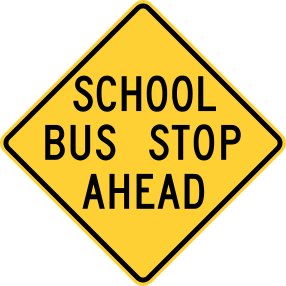
School bus stop ahead
3 questions from the Tennessee practice test
1. At a railroad crossing, what should a driver do before crossing when a train is approaching?
- Drive around a lowered gate when no train is visible
- Stop on the tracks so the train can be seen more easily
- Cross quickly if the nearest track appears clear
- Stop between 15 and 50 feet from the tracks and wait until every track is clear
Show answer
Stop between 15 and 50 feet from the tracks and wait until every track is clear. When a train is coming, the vehicle must stop 15 to 50 feet from the railroad tracks and wait until it has passed and it is safe to cross. Stopping on the tracks creates a direct collision risk, and a clear nearest track may hide a train on another track. A lowered gate is a stop command, not an obstacle to drive around. Reduce speed early, identify all tracks, and remain behind the required stopping distance until the crossing is completely clear.
2. On an undivided road, a school bus is stopped with red warning lights flashing and its stop arm extended. What must approaching drivers do?
- Slow down and pass carefully on the left
- Pass if no children are visible
- Stop only when approaching from behind
- Come to a complete stop and remain stopped until the arm is pulled back and the bus moves
Show answer
Come to a complete stop and remain stopped until the arm is pulled back and the bus moves. Red flashing lights and an extended stop arm mean the bus has stopped and children are getting on or off. On an undivided road, drivers coming from either direction must stop and remain stopped until the arm is pulled back and the bus resumes motion. Visibility of children does not change the obligation, and passing on either side is unsafe. Only on a highway with separate roadways divided by median space or a barrier may opposing traffic proceed with caution, and a center turn lane is not such a barrier. Watch the bus signals, not just the roadway around it.
3. How should a driver use anti-lock brakes during an emergency stop?
- Press firmly and steadily while steering around hazards
- Pump the brake pedal repeatedly and release it before stopping
- Use the parking brake alone to avoid wheel lock
- Take both hands off the wheel once braking begins
Show answer
Press firmly and steadily while steering around hazards. With anti-lock brakes, the manual says to apply firm, steady pressure and continue steering around hazards while keeping the foot on the brake until the vehicle stops. Pumping the pedal can disengage the anti-lock system, and the parking brake is not a substitute for the service brake in an emergency. Steering remains important because braking alone does not remove an obstacle from the vehicle path.
Practice this topic
Lock it in with emergencies questions from the free Tennessee practice test. Every answer comes with a plain English explanation.
Source: the Tennessee Comprehensive Driver License Manual, Section B-4: Rules of the Road. This lesson is a plain English summary, not the law itself; where it differs, the manual and the statute govern. Last checked 2026-09-27.