
Test 6 of 25 · 20 questions · Free 2026
TN Permit Practice Test 6
Jump to the test ↓A fixed 20 question set from the Tennessee bank with answers and plain English explanations. The real TN exam is 30 questions, 80 percent to pass; take the full length version on the main practice page.
Question 1 of 20 · 0 right so far
All 20 questions in test 6
Every question below comes from the Tennessee question bank on this page. Open a question to see the correct answer and the explanation. Nothing here is hidden behind a signup.
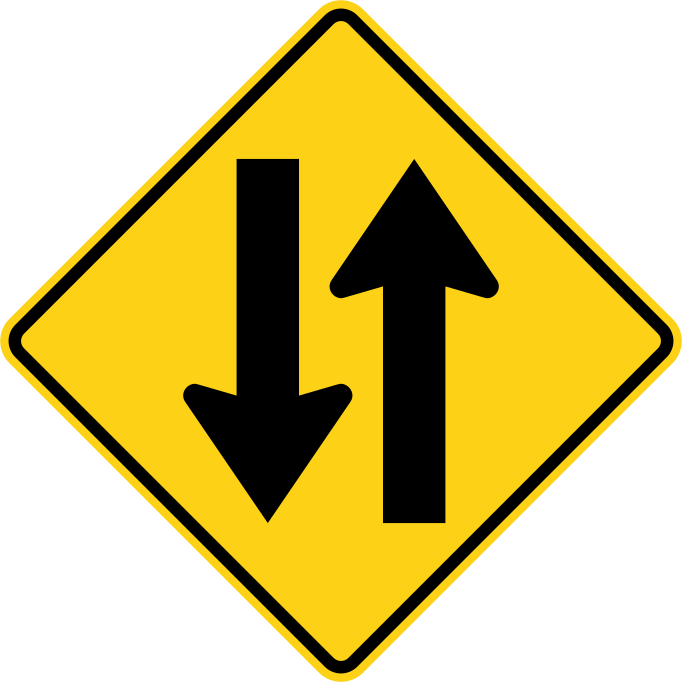
1. What kind of traffic message does this yellow diamond sign provide?
- A regulatory order that applies only to trucks
- A warning about a roadway condition ahead
- A motorist-services sign for a rest area
- A guide sign for a recreational destination
Show answer
A warning about a roadway condition ahead. The yellow diamond is a warning sign, so it alerts drivers to a roadway condition that may require caution or a slower speed. It is not a regulatory order, a recreation guide, or a motorist-services marker. The arrows still deserve attention because they show opposing traffic, but the sign’s category tells you how to respond: anticipate a hazard, scan ahead, and adjust before reaching it.
Study this in the handbook: Sign colors, shapes and regulatory signs
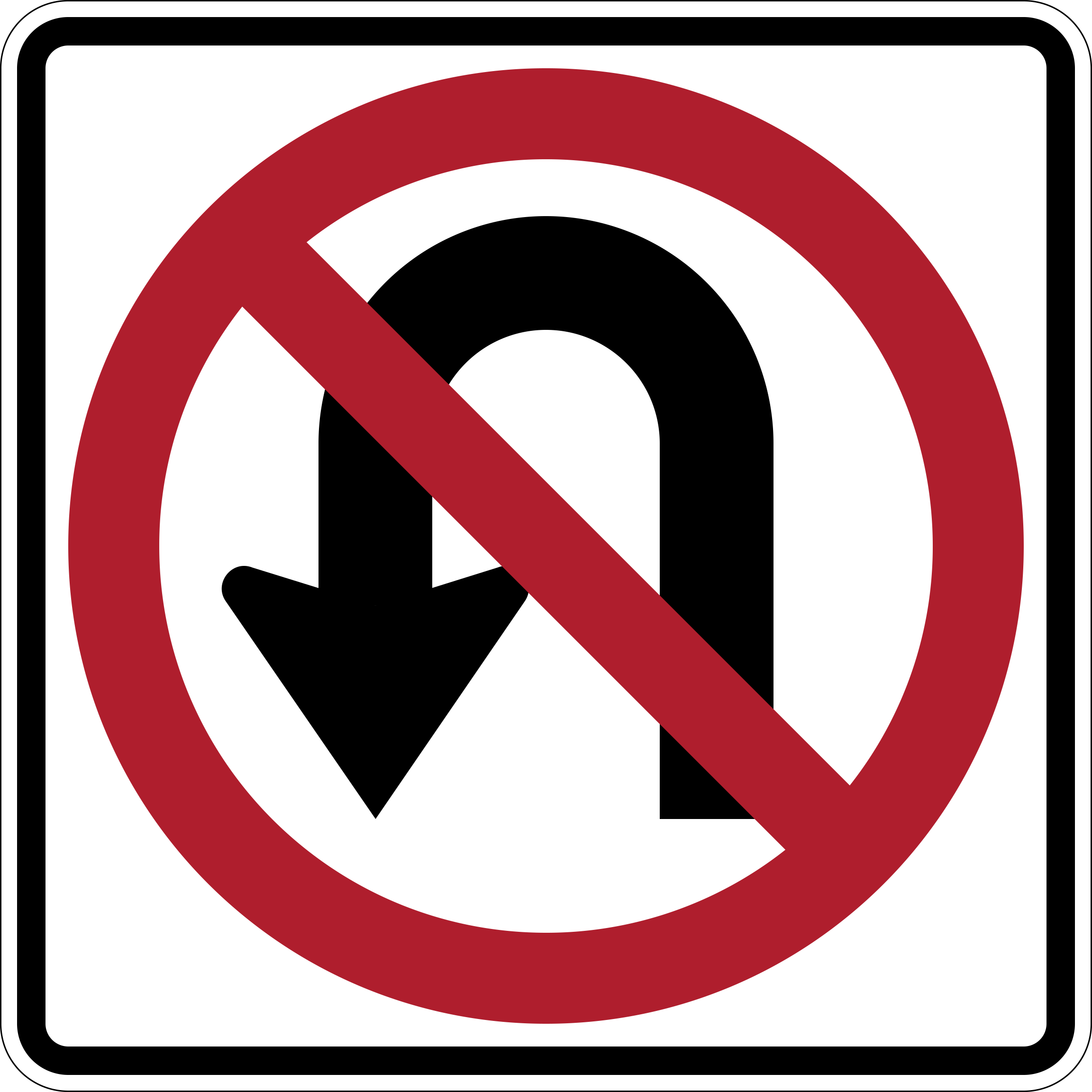
2. What movement is prohibited by the sign shown here?
- Making every left turn
- Making a U-turn
- Turning into any driveway
- Passing another vehicle
Show answer
Making a U-turn. The displayed symbol is the regulatory message that U-turns are prohibited at that location. It does not ban every left turn, forbid passing everywhere, or make driveway turns illegal. Read the crossed U-shaped arrow as a direct movement restriction, then continue in the permitted direction and look for a legal place to change course. Signs regulate particular actions at particular locations, so the prohibition should be obeyed even when the roadway appears clear.
Study this in the handbook: Right of way, turns and emergency vehicles
3. A Tennessee teen holding an Intermediate Restricted License has accumulated more than 6 points. What happens to the move to the unrestricted license?
- Nothing changes as long as the teen is 17
- The license is revoked until age 18
- The teen must retake the knowledge test only
- The restricted license must be held for an additional 90 days
Show answer
The restricted license must be held for an additional 90 days. Points are the brake on Tennessee's graduated licensing. A teen who collects more than six points on the driving record while on the Intermediate Restricted License must hold that restricted license for an extra 90 days before applying for the unrestricted step, even after turning 17. Age alone does not override the point rule, the license is not revoked outright by that point total, and a knowledge retest is not the remedy. The manual also drops a teen back to the restricted license for 90 days for certain violations at the unrestricted stage.
Study this in the handbook: The learner permit
4. What does the octagon shape of this traffic sign identify?
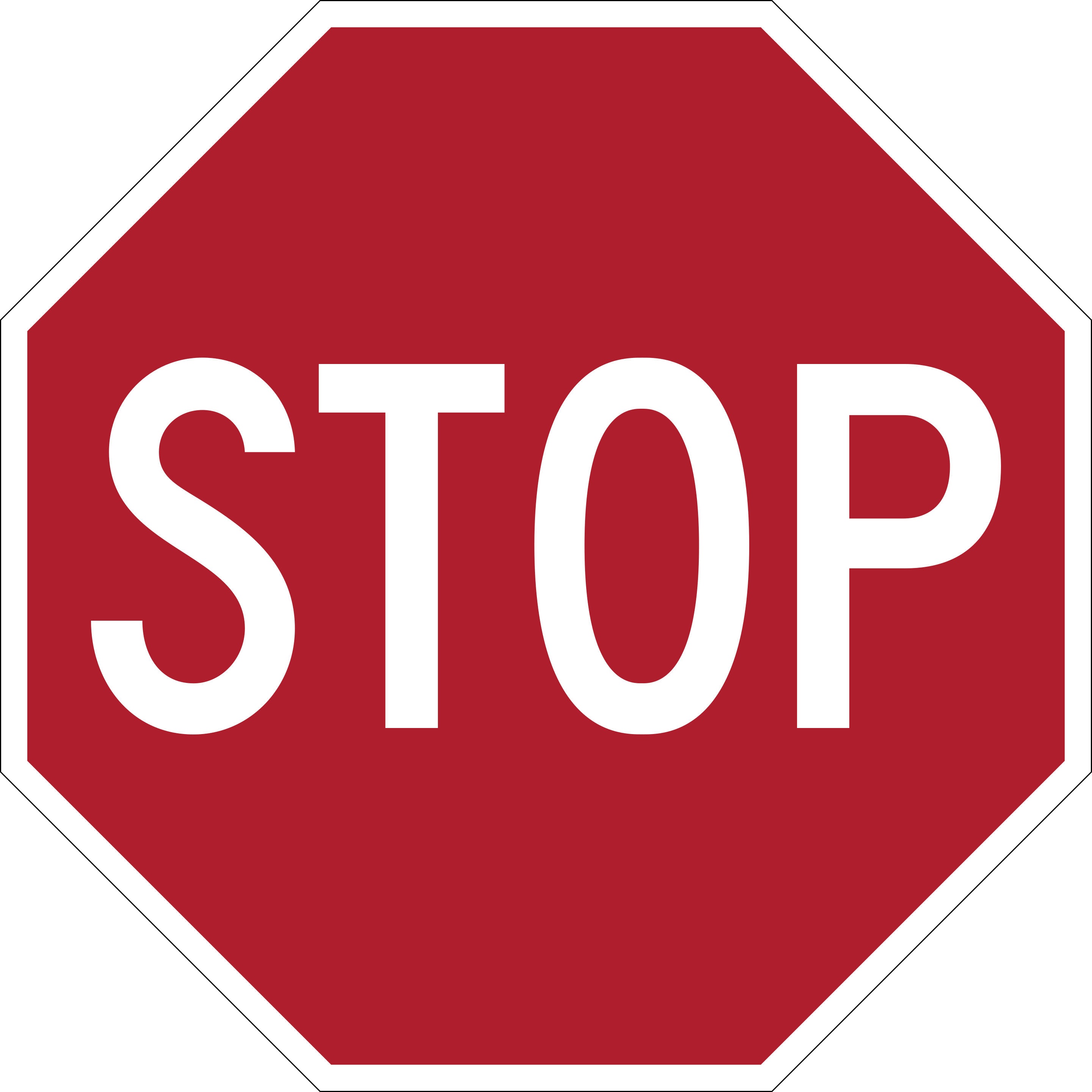
- Stop
- Yield
- Railroad crossing ahead
- A hazardous condition ahead
Show answer
Stop. The manual assigns the octagon shape to the stop message. Shape recognition lets a driver identify the required response even before the lettering is fully readable. A triangle is used for yield, a round sign warns of a railroad ahead, and a diamond warns of a hazardous or unusual condition. Do not confuse the red stop sign with those other silhouettes. When the eight-sided outline appears, prepare for a complete stop at the required stopping position and then follow the right-of-way rule.
Study this in the handbook: Sign colors, shapes and regulatory signs
5. What does Tennessee's Implied Consent Law require when an officer asks for an alcohol or drug test?
- The driver must submit to a vehicle inspection every month
- The driver automatically admits guilt to DUI
- The driver gives permission for a random home search
- The driver will take a test to determine alcohol or drug content in the blood
Show answer
The driver will take a test to determine alcohol or drug content in the blood. Implied consent means that by driving in Tennessee you have already given consent to be tested to determine the alcohol or drug content of your blood. It is not a monthly vehicle inspection program, an automatic admission of DUI guilt, or permission for a home search. The test is given at the request of a law enforcement officer who has reasonable grounds to believe you have been driving under the influence of an intoxicant or drug. Agreeing to the test is separate from the later question of whether impairment is proved.
Study this in the handbook: DUI law, implied consent and penalties
6. After a solid green turn arrow appears, what may the driver do?
- Turn in any direction without checking pedestrians
- Turn only in the arrow direction after yielding to those already in the intersection
- Proceed straight because arrows do not control lanes
- Remain stopped until the arrow becomes yellow
Show answer
Turn only in the arrow direction after yielding to those already in the intersection. A green protected arrow gives permission to drive only in the arrow’s direction, but the driver must first yield to vehicles and pedestrians already in the intersection. It does not authorize an unrelated movement, erase the duty to check the intersection, or require waiting for yellow. The phrase protected turn describes the permitted movement, not permission to ignore people already crossing. Scan the intersection before moving, then follow the arrow rather than the general green-light meaning.
Study this in the handbook: Warning, railroad, work zone and guide signs
7. For a driver age 21 or older operating a noncommercial vehicle in Tennessee, what is the lowest BAC covered by the general alcohol per se threshold?
- 0.10 percent or higher
- 0.02 percent or higher
- 0.05 percent or higher
- 0.08 percent or higher
Show answer
0.08 percent or higher. Tennessee identifies an alcohol concentration of .08 percent or higher in an operator's blood or breath as unlawful for the general DUI rule. The lower .02 figure belongs to the separate underage driving while impaired provision for qualifying drivers under 21. The .05 and .10 choices do not match the threshold stated here. Do not use a personal feeling of sobriety to estimate legality. Alcohol can impair judgment before the listed threshold, and any observed impairment can still create serious legal and safety consequences.
Study this in the handbook: DUI law, implied consent and penalties
8. What does Tennessee's Basic Speed Rule require a driver to consider?
- The posted number regardless of weather or visibility
- The speed of the fastest vehicle nearby
- Current driving conditions, rather than only the posted limit
- A fixed 35 mph maximum on every road
Show answer
Current driving conditions, rather than only the posted limit. The Basic Speed Rule is a safety principle that limits speed according to current conditions and does not set one exact number. A posted limit is not permission to maintain that speed when darkness, rain, fog, traffic, or the road surface makes it unsafe. Matching the fastest nearby vehicle can compound the danger, and Tennessee does not impose a universal 35 mph maximum through this rule. Use the posted limit as an upper boundary, then reduce speed when the conditions or the available stopping distance require it.
Study this in the handbook: Speed limits and the Basic Speed Rule
9. What minimum jail time does Tennessee set for a first DUI conviction with a BAC of 0.20 percent or more?
- 48 hours
- 30 days
- 45 days
- 7 days
Show answer
7 days. A first DUI conviction brings 48 hours in jail, rising to 7 days when the BAC is 0.20 percent or more, along with a fine of $350 to $1,500 and a one-year revocation. Forty-eight hours is the minimum below 0.20. Forty-five days is the second conviction minimum, and 30 days is the added minimum when a child under 18 is in the vehicle. A high BAC is treated much more severely.
Study this in the handbook: DUI law, implied consent and penalties
10. When may a driver turn left on a red light in Tennessee?
- From a one-way street onto another one-way street, after stopping and yielding
- From any street onto a two-way street without stopping
- Only when a police officer is not watching
- Never, even between two one-way streets
Show answer
From a one-way street onto another one-way street, after stopping and yielding. Tennessee permits a left turn on red in the limited situation of turning from a one-way street into another one-way street, after the driver stops and yields to traffic, pedestrians, and bicyclists. The rule does not authorize a rolling turn or a left turn onto a two-way street. Check for a prohibition sign, stop completely at the proper location, and proceed only when the movement is clear.
11. An angry driver is honking and making hostile gestures. Which action best reduces the danger?
- Tailgate the vehicle so it cannot move ahead
- Join the confrontation by gesturing back
- Give the angry driver plenty of space and avoid joining in
- Race the driver to the next intersection
Show answer
Give the angry driver plenty of space and avoid joining in. Road rage can turn a minor traffic problem into a dangerous encounter. The manual advises drivers not to join the confrontation, even through honking or glaring, and to give an angry driver plenty of space. Gestures, tailgating, and racing communicate escalation rather than control. Keep attention on escape space, maintain a lawful speed, and let the aggressive driver get farther away instead of trying to teach a lesson.
Study this in the handbook: Defensive driving and road rage
12. How close to a railroad crossing may you park in Tennessee?
- No closer than 15 feet
- No closer than 50 feet
- No closer than 20 feet
- No closer than 500 feet
Show answer
No closer than 50 feet. Tennessee lists parking within 50 feet of a railroad crossing as illegal. Do not confuse this with the stopping rule: when a train is coming, you must stop between 15 and 50 feet from the tracks, so 15 feet is the closest stopping point, not a parking distance. Twenty feet is the crosswalk parking rule, and 500 feet is not on the list. Sidewalks, bridges, and tunnels are also no parking areas.
Study this in the handbook: Lane use, passing and parking
13. How far before a turn does Tennessee require you to turn on your turn signal?
- At least 50 feet before the turn
- At least 10 feet before the turn
- Only once the vehicle has entered the intersection
- At least 300 feet before the turn
Show answer
At least 50 feet before the turn. Tennessee drivers must switch on the turn signal at least 50 feet before turning, so other road users have time to see the planned move and react. A signal given only a few feet ahead, or only after entering the intersection, gives almost no warning. The manual adds that the same 50 foot rule applies to lane changes, and that you should signal every time you change direction, even when no one seems to be around.
Study this in the handbook: Right of way, turns and emergency vehicles
14. How long must a Tennessee teen hold the Intermediate Restricted License before applying for the Intermediate Unrestricted License?
- 90 days
- At least one year
- 180 days
- Two years
Show answer
At least one year. Teens must hold the Intermediate Restricted License for at least one year, and must be 17, before applying for the Intermediate Unrestricted License, which costs a $2 application fee. One hundred eighty days is the learner permit holding period. Ninety days is the added delay when a teen has 6 or more points, contributes to a crash, or gets a second seat belt violation. Two years is not a Tennessee requirement.
Study this in the handbook: The learner permit
15. How should a driver use anti-lock brakes during an emergency stop?
- Press firmly and steadily while steering around hazards
- Pump the brake pedal repeatedly and release it before stopping
- Use the parking brake alone to avoid wheel lock
- Take both hands off the wheel once braking begins
Show answer
Press firmly and steadily while steering around hazards. With anti-lock brakes, the manual says to apply firm, steady pressure and continue steering around hazards while keeping the foot on the brake until the vehicle stops. Pumping the pedal can disengage the anti-lock system, and the parking brake is not a substitute for the service brake in an emergency. Steering remains important because braking alone does not remove an obstacle from the vehicle path.
Study this in the handbook: Braking, following distance and required stops
16. In a Tennessee work zone where the reduced speed is posted and workers are present, what maximum fine can apply to a speeding violation?
- $100
- $1,000
- $250
- $500
Show answer
$500. Tennessee permits a fine of up to $500 for a speed violation in a work zone when the speed has been reduced and Department of Transportation or other construction workers are present. The amount is tied to the active work-zone conditions, not merely to seeing orange signs. The $100 and $250 choices understate the stated maximum, while $1,000 doubles it. Slow before entering the zone and follow the reduced limit whenever workers may be nearby.
Study this in the handbook: Trucks, school buses, work zones and trains
17. What fine range does Tennessee law set for violating the posted speed limit in an active work zone?
- $500 minimum and up to $1,000 maximum
- $25 minimum and up to $50 maximum
- $250 minimum and up to $500 maximum
- No fine applies when workers are not visible
Show answer
$250 minimum and up to $500 maximum. Tennessee law mandates a fine of at least $250 and no more than $500 for violating the posted speed limit in an active work zone. The smaller range and the larger range change the figures given in the manual. A driver cannot rely on not seeing workers, because a work zone is identified by its signs, devices, equipment, and changing traffic pattern. The safe response is to obey the reduced limit and watch the lane guidance.
Study this in the handbook: Speed limits and the Basic Speed Rule
18. Why should a driver maintain a space cushion around the vehicle?
- It guarantees that the vehicle ahead cannot change lanes
- It permits the driver to ignore the posted speed limit
- It provides room and time to brake or avoid hazards
- It allows the driver to use a phone without distraction
Show answer
It provides room and time to brake or avoid hazards. A space cushion gives a driver more time to see and react when another driver makes a mistake or a hazard develops. Following closely blocks the view of traffic and road conditions and leaves less room for braking. The cushion does not control the vehicle ahead, excuse speeding, or make phone use safe. The practical cue is to increase the gap whenever speed, weather, visibility, or traffic makes stopping more difficult.
Study this in the handbook: Defensive driving and road rage
19. What do orange traffic signs generally warn drivers about?
- Construction and maintenance
- Motorist services
- Recreational and cultural sites
- School zones
Show answer
Construction and maintenance. Orange is reserved as the background color for construction and maintenance signs. It signals a temporary or changing roadway condition that may require lower speed, lane changes, or careful attention to workers and equipment. Blue signs provide motorist services, brown signs guide toward recreation, and fluorescent yellow-green identifies school zones. The color matters even when the words are hard to read, because it gives an early warning to prepare for road work.
Study this in the handbook: Sign colors, shapes and regulatory signs
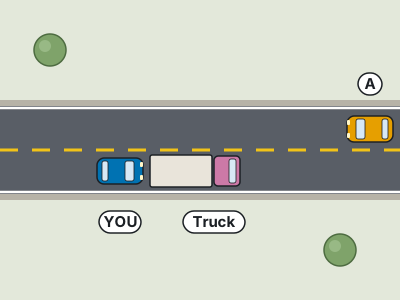
20. A two-lane road has a broken yellow line between opposing traffic. When may you cross it to pass?
- Whenever the vehicle ahead is traveling below the speed limit
- Only after another driver signals permission
- When no oncoming traffic is present and the maneuver is safe
- Never, because every yellow line prohibits crossing
Show answer
When no oncoming traffic is present and the maneuver is safe. A broken yellow center line allows a driver to cross for passing when the opposing lane is clear and the maneuver can be completed safely. A slower vehicle alone does not make passing legal, and another driver cannot grant permission to ignore traffic conditions. A solid yellow marking has different restrictions, so treating every yellow line alike is too broad. Before crossing, check sight distance, oncoming traffic, hills, curves, and intersections. The practical cue is simple: broken yellow may permit a pass, but safety still controls the decision.
Study this in the handbook: Lane use, passing and parking
QualitySpace is expanding to Tennessee
We are a California-based independent insurance brokerage working on licensing in more states. We cannot help with Tennessee insurance yet. Leave your email and we will let you know when we can.
Every question is written from the official Tennessee Comprehensive Driver License Manual. Need paper? Printable TN practice test with answer key.
Last verified 2026-10-05. How we check every question · Study all 500 as flashcards
Frequently asked questions
How many questions are on this Tennessee practice test?
This fixed set has 20 questions. It is test 6 of 25 from the 500 question Tennessee bank. The real TN exam asks 30 questions and you need 24 correct.
What is the passing score for the real Tennessee test?
A minimum score of 80% is required to pass That figure comes from the official Tennessee source cited on the DMV facts page.
How does this fixed test relate to the full Tennessee bank?
Each numbered test is a fixed set of questions in a fixed order, so you can retake the same test later and compare. Every test mixes road signs and the other topics in about the same proportion as the full bank. Tests 1 to 25 together cover every question in the Tennessee bank once. The full practice page mixes the whole bank at random.
Last verified 2026-10-05. See the Tennessee DMV facts page for sourced state details.
Return to the full Tennessee practice test · Study road signs