
Test 8 of 10 · 20 questions · Free 2026
AZ Permit Practice Test 8
Jump to the test ↓A fixed 20 question set from the Arizona bank with answers and plain English explanations. The real AZ exam is 30 questions, 80 percent to pass; take the full length version on the main practice page.
Question 1 of 20 · 0 right so far
All 20 questions in test 8
Every question below comes from the Arizona question bank on this page. Open a question to see the correct answer and the explanation. Nothing here is hidden behind a signup.
1. What does a white painted curb mean in Arizona?
- No stopping at any time
- You may stop only long enough to pick up or drop off passengers
- Loading zone for trucks
- Parking for disabled placard holders
Show answer
You may stop only long enough to pick up or drop off passengers. A white curb means you may stop only long enough to pick up or drop off passengers. The manual explains that a painted curb means special rules apply to parking there, and each color has its own meaning. A yellow curb, for example, allows a stop only long enough to load or unload, with the driver staying with the car, while a red curb means no stopping, standing, or parking.
Study this in the handbook: Parking rules, hills and painted curbs
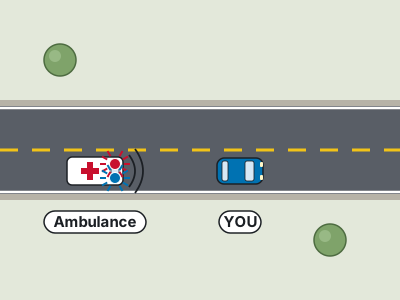
2. When a fire engine, police car, or ambulance with warning equipment approaches, what must an Arizona driver do?
- Continue straight while holding the lane
- Yield, move to the right, and stop until it passes
- Turn left immediately into the nearest street
- Follow it closely to get through traffic
Show answer
Yield, move to the right, and stop until it passes. An approaching emergency vehicle, such as police, fire or ambulance, with flashing lights or an audible signal requires the driver to yield the right-of-way, move to the right, and stop until the emergency vehicle has passed. Continuing straight in the lane or following closely does not yield, and the manual adds that you must stay at least 500 feet behind a responding fire vehicle and 300 feet behind a responding police vehicle. Turning left into the nearest street is not the listed response. Move right, stop, and stay stopped until the vehicle is past.
Study this in the handbook: Emergency vehicles, Move Over and school buses
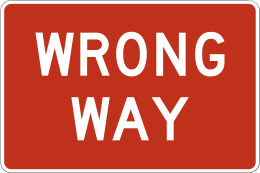
3. What broad function does the Wrong Way sign shown perform?
- It regulates traffic and directs speed or direction
- It marks a railroad crossing
- It recommends a curve speed
- It warns of a possible danger ahead
Show answer
It regulates traffic and directs speed or direction. The Wrong Way sign is rectangular, and Arizona describes rectangular signs as regulatory. Regulatory signs control traffic and direct the driver’s speed and direction, so this sign gives a movement instruction rather than a general hazard warning. A yellow diamond warns of possible danger, a circle-shaped sign warns of an approaching railroad crossing, and a small yellow square may show a safe speed for a curve. Treat the Wrong Way message as an immediate direction to stop the prohibited movement and find the legal route.
Study this in the handbook: Traffic signs, railroad crossings and work zones
4. What does a flashing yellow arrow permit when the roadway is clear?
- A turn with priority over all approaching traffic
- A cautious turn after yielding to oncoming vehicles and pedestrians
- A mandatory stop until a green arrow appears
- A straight movement from any lane
Show answer
A cautious turn after yielding to oncoming vehicles and pedestrians. A flashing yellow arrow permits the indicated turn only with caution. Before turning, yield the right-of-way to every oncoming vehicle or pedestrian, and proceed only when the roadway is clear. The signal does not give priority over approaching traffic, so moving immediately would reverse its meaning. It also differs from a red arrow, which prohibits the turn until a green signal appears. Stay in the proper lane, check the crossing path, and remember that flashing yellow means caution plus yielding, not protected movement.
Study this in the handbook: Traffic signals and red light running
5. For a second or subsequent standard DUI offense, what minimum jail term does the Arizona manual list?
- 10 days
- 180 days
- 30 days
- 90 days
Show answer
90 days. For second and subsequent standard DUI offenses, the manual lists jail for not less than 90 days and a 12-month license revocation. The 10-day figure belongs to a first standard offense, and 30 days is associated with a first Extreme DUI. The 180-day number appears for a repeat Extreme DUI at an alcohol concentration of 0.20 or higher, not every repeat standard offense. Compare both the offense category and the number before selecting a penalty, because the manual separates standard DUI, Extreme DUI, and aggravated DUI consequences.
Study this in the handbook: Alcohol, drugs and DUI penalties
6. In a severe Arizona dust storm, what should a stopped driver do with the vehicle's lights?
- Use high beams and keep the brake pedal pressed
- Flash the headlights continuously
- Turn off the lights and take a foot off the brake
- Leave the headlights on and sound the horn
Show answer
Turn off the lights and take a foot off the brake. During a severe dust storm, the manual lists a fixed set of steps: reduce speed, drive completely off the highway, stop as far to the right as possible, and avoid stopping in the travel lane or the emergency lane. Once stopped, turn off your lights and take your foot off the brake. High beams, continuous flashing, headlights left on, or a pressed brake pedal all contradict that listed step. Then stay in the vehicle with your seat belts buckled and wait until the dust storm has passed.
Study this in the handbook: Dust storms, blowouts, fires and brake failure
7. According to the Arizona manual, which children should never ride in the front seat of a car?
- Only children under age 2
- Only children under 40 pounds
- Children age 12 and under
- Children under 16 who are not belted
Show answer
Children age 12 and under. Air bags can save lives, but the Arizona manual warns they are unsafe for children under 12. For that reason it says children age 12 years and under should never ride in the front seat of a car. If a child truly must ride up front, turn the passenger side air bag off when the vehicle has a switch. Infants and small children are included, but the guidance reaches through age 12, not only toddlers or lighter children.
Study this in the handbook: Vehicle equipment, seat belts and child seats
8. Another Arizona driver is following you too closely. What does the manual recommend?
- Brake sharply to warn them
- Speed up to get away
- Pull onto the shoulder immediately
- Gradually slow down and give additional cushion between you and the vehicle ahead
Show answer
Gradually slow down and give additional cushion between you and the vehicle ahead. If another driver is following too closely, the manual says to gradually slow down and give additional cushion between you and the vehicle in front of you. That extra space lets you brake more slowly, which gives the tailgating driver time to react and brake. When it is safe, you can move to another lane to encourage the tailgater to pass. Braking sharply or speeding up works against that advice, because what you do affects the driver behind you, especially if you must stop suddenly.
Study this in the handbook: Defensive driving, scanning and following distance
9. What does a red arrow at a light rail intersection mean?
- Turn after yielding
- Do not turn
- Proceed if no train is visible
- Turn only from the right lane
Show answer
Do not turn. At light rail crossings, the manual gives a simple instruction for a red arrow: do not turn. The absence of a visible train does not override the signal, and yielding does not convert a prohibited movement into a permitted one. Wait for the signal to authorize the movement, then check both directions before crossing the tracks. Never stop or park on the light rail tracks while waiting.
10. What civil penalty does Arizona law set for a first violation of the handheld phone ban while driving?
- At least $75 but not more than $149
- $25 flat
- $400
- $1,000 and a license suspension
Show answer
At least $75 but not more than $149. Arizona's statute on portable wireless devices sets a civil penalty of at least $75 and no more than $149 for a first violation, and $400 for a second or later violation. An extra $150 applies if the violation causes a crash with a motorcycle. So $400 is the repeat amount, and $25 is below the range. Except as provided in section 28-3312, a state agency may not use these violations to decide whether to suspend or revoke a license, which rules out the suspension choice.
11. An Arizona driver who is 19 is convicted of driving with spirituous liquor in the body. What does the manual require?
- Nothing, because the driver is over 18
- Only a written warning
- A new vision test only
- A Certified Ignition Interlock Device
Show answer
A Certified Ignition Interlock Device. Arizona lists a conviction for operating a vehicle at age 18 to 20 with spirituous liquor in the body among the offenses that require a Certified Ignition Interlock Device. The same applies to drivers under 18 convicted of DUI or of having liquor in the body. Being over 18 does not help, since the drinking age is 21. A warning or vision test is not the required action.
12. When should low-beam headlights be used because another driver may be approaching?
- Only when the road has no streetlights
- Whenever a following vehicle is within 500 feet
- Whenever an oncoming vehicle is within 500 feet
- Only after midnight
Show answer
Whenever an oncoming vehicle is within 500 feet. Arizona says to use high beams on highways only when no vehicle is coming toward you within 500 feet, and to switch to low beams when meeting oncoming traffic. The 500-foot boundary protects the other driver's vision from glare. Streetlighting and the clock do not determine this particular change, and the following-distance figure for low beams is different. As headlights approach, dim yours before the vehicles meet and keep the roadway visible without blinding anyone.
Study this in the handbook: Stopping distance, bad weather and night driving
13. What are Arizona's minimum bodily injury liability limits for a private passenger vehicle?
- $15,000 and $30,000
- $25,000 for one person and $50,000 for two or more persons
- $10,000 per crash
- $50,000 and $100,000
Show answer
$25,000 for one person and $50,000 for two or more persons. Minimum levels of financial responsibility for private passenger vehicles in Arizona are $25,000 bodily injury liability for one person and $50,000 for two or more persons, plus property damage coverage. The policy must be an Arizona based policy reflecting where the vehicle is predominantly operated, and you must have proof of current insurance in the vehicle whenever you drive it.
14. If your vehicle catches fire, what should you do first?
- Open the hood and pour water onto burning gasoline
- Keep driving until you reach a service station
- Remain inside while the smoke clears
- Pull quickly off the road, shut off the ignition, and get all passengers away
Show answer
Pull quickly off the road, shut off the ignition, and get all passengers away. A vehicle fire demands immediate separation from both traffic and the flames. The manual directs the driver to pull quickly off the road, shut off the ignition to cut electrical power, and get every passenger away from the car. The manual warns not to use water if gasoline is burning, since that spreads the flames; an ABC rated dry chemical extinguisher is best for vehicle fires. Continuing to drive keeps occupants beside the hazard. Move away promptly, call 911, and stay clear if the fire may be beyond control.
Study this in the handbook: Dust storms, blowouts, fires and brake failure
15. What does a broken white line between two lanes traveling in the same direction indicate?
- Traffic must remain in the original lane
- You may cross it for a lane change after signaling and checking that it is safe
- The line separates opposing traffic
- Passing is prohibited until the line becomes yellow
Show answer
You may cross it for a lane change after signaling and checking that it is safe. A broken white line separates lanes traveling in the same direction and may be crossed for a lane change after the driver signals and confirms that the movement is safe. It does not divide opposing traffic, which is the role of yellow lane lines. A broken line also does not grant an automatic right to move over. Check mirrors and the blind spot, signal early, and cross only after the target lane is clear.
Study this in the handbook: Parking rules, hills and painted curbs
16. On an unposted designated open highway in Arizona, what speed limit must be observed?
- 65 mph
- 55 mph
- 75 mph
- 25 mph
Show answer
65 mph. The unposted limit for a designated open highway is 65 mph. Arizona assigns different numbers to nearby categories: 25 mph in a business or residential district, 55 mph on an open highway or city freeway, and 75 mph on a rural freeway. The word designated matters because it points to the specific highway category in the list. Do not select the rural freeway figure simply because both settings are outside a town. Match the road type exactly.
Study this in the handbook: Speed limits and work zones
17. What does Arizona require of a vehicle's windshield and wipers?
- A windshield without cracks and wipers in good working condition
- Tint on the windshield
- Wipers only on vehicles newer than 1990
- A windshield only on convertibles
Show answer
A windshield without cracks and wipers in good working condition. Vehicles must have a windshield without cracks and windshield wipers that are in good working condition. The rule applies to every vehicle, not only convertibles or newer models, and tint is not a requirement: the manual says sun screening tint on windows and windshields is legal only within certain limits. The same equipment section requires a muffler in good working condition and in constant operation, and an exhaust emissions system on vehicles of the 1967 model year and newer. Check the glass and the wipers before you drive.
Study this in the handbook: Vehicle equipment, seat belts and child seats
18. Why should motorists use extreme care near a stopped school bus?
- The bus may turn into any lane without warning
- The bus always hides a railroad crossing
- A stopped bus permits passing on either side
- A child may dart from the front or rear
Show answer
A child may dart from the front or rear. Arizona urges extreme care near any stopped school bus because a child may dart from the front or the rear of the bus. The warning applies even when the driver cannot immediately see a child. A bus does not gain unrestricted lane changes, conceal a railroad crossing by rule, or make passing automatically lawful. Slow down, obey the bus’s flashing lights and stop arm, watch both sides, and be prepared for a child to emerge suddenly from behind the vehicle.
Study this in the handbook: Right of way, pedestrians and roundabouts
19. After a flashing red pedestrian signal, when may you proceed?
- Immediately, because the signal is flashing
- Only when the pedestrian turns away from your vehicle
- After stopping and after the pedestrian finishes crossing your half of the roadway
- After reversing beyond the crosswalk
Show answer
After stopping and after the pedestrian finishes crossing your half of the roadway. A flashing red pedestrian signal requires a stop first. After the pedestrian finishes crossing the driver's half of the roadway, movement may continue with caution. Treating the flashing signal as permission to continue skips the required stop. The rule does not depend on whether the person approaches your vehicle, and backing up creates a new hazard near a crosswalk. Look across your half of the road, wait for it to clear, then check again before moving.
Study this in the handbook: Signaling, passing and U turns
20. When making a left turn from a two-way road, which lane should your car use?
- In the lane nearest the right curb
- On the shoulder outside the travel lanes
- In the traffic lane nearest the center line
- In whichever lane has the fastest traffic
Show answer
In the traffic lane nearest the center line. For a left turn from a two-way road, the approach belongs in the traffic lane nearest the center line. That position makes the intended path predictable and keeps the turning vehicle aligned with the intersection. The right curb lane is associated with a right-turn approach, while the shoulder is not a normal turning lane. Traffic speed does not determine the proper approach. Signal, reduce speed, check for people and bicycles, and turn only when the path is clear.
Study this in the handbook: Traffic signals and red light running
QualitySpace is expanding to Arizona
We are a California-based independent insurance brokerage working on licensing in more states. We cannot help with Arizona insurance yet. Leave your email and we will let you know when we can.
Every question is written from the official Arizona Driver License Manual. Need paper? Printable AZ practice test with answer key.
Last verified 2026-10-05. How we check every question · Study all 202 as flashcards
Frequently asked questions
How many questions are on this Arizona practice test?
This fixed set has 20 questions. It is test 8 of 10 from the 202 question Arizona bank. The real AZ exam asks 30 questions and you need 24 correct.
What is the passing score for the real Arizona test?
A score of 80% or higher is required to pass That figure comes from the official Arizona source cited on the DMV facts page.
How does this fixed test relate to the full Arizona bank?
Each numbered test is a fixed set of questions in a fixed order, so you can retake the same test later and compare. Every test mixes road signs and the other topics in about the same proportion as the full bank. Tests 1 to 10 together cover 200 of the 202 questions in the Arizona bank, each once. The full practice page mixes the whole bank at random.
Last verified 2026-10-05. See the Arizona DMV facts page for sourced state details.