
Test 1 of 10 · 20 questions · Free 2026
AZ Permit Practice Test 1
Jump to the test ↓A fixed 20 question set from the Arizona bank with answers and plain English explanations. The real AZ exam is 30 questions, 80 percent to pass; take the full length version on the main practice page.
Question 1 of 20 · 0 right so far
All 20 questions in test 1
Every question below comes from the Arizona question bank on this page. Open a question to see the correct answer and the explanation. Nothing here is hidden behind a signup.
1. What is the best way to prevent hydroplaning in Arizona?
- Brake hard on wet pavement
- Slow down
- Accelerate across standing water
- Make rapid steering corrections
Show answer
Slow down. The manual identifies slowing down as the best way to prevent hydroplaning, which occurs when tires ride on a film of water and lose contact with the road. Braking hard can reduce control once traction is limited, and accelerating across standing water does not remove the water film. Rapid steering corrections can also create a skid. Reduce speed before reaching deep or flowing water, keep the wheel steady, and maintain tires in good condition with proper inflation and tread. If hydroplaning begins, do not brake and avoid steering changes until the tires grip again.
Study this in the handbook: Stopping distance, bad weather and night driving
2. A tire blows out while you are driving. Which immediate response follows the manual?
- Hold the wheel tightly, keep straight, and ease off the gas
- Release the wheel so the tire can settle
- Brake hard and turn toward the shoulder
- Accelerate until the damaged tire clears the roadway
Show answer
Hold the wheel tightly, keep straight, and ease off the gas. If a tire blowout occurs, the manual says to hold the steering wheel tightly and keep the vehicle going straight, then ease off the gas pedal and not apply the brakes. Let the vehicle slow down until it is almost stopped. Just before it stops, turn on your signal, pull off the roadway, and then apply the brakes. Releasing the wheel gives up the steering you need to stay straight, braking hard goes against the do not brake instruction, and accelerating is the opposite of easing off the gas.
Study this in the handbook: Dust storms, blowouts, fires and brake failure
3. At a steady red light, when may you make a right turn where signs do not prohibit it?
- After slowing without stopping if no car is visible
- After a complete stop, when motor and pedestrian traffic are clear
- Immediately if the cross street is empty
- Only after the light changes to yellow
Show answer
After a complete stop, when motor and pedestrian traffic are clear. A steady red signal requires a complete stop before the intersection, stop line, or crosswalk. If a sign does not prohibit the movement, a right turn may follow that stop only when motor traffic and pedestrians are clear. Slowing without stopping does not satisfy the signal, and an empty-looking cross street does not remove the required stop. Waiting for yellow is unnecessary and may create a new conflict. Stop first, scan for people and vehicles, then turn only when the intersection is open and the movement is allowed.
Study this in the handbook: Traffic signals and red light running
4. What must you do at a flashing red traffic signal before proceeding?
- Slow only and continue without stopping
- Wait for a green arrow in every case
- Come to a full stop, then proceed cautiously when clear
- Yield without making a complete stop
Show answer
Come to a full stop, then proceed cautiously when clear. A flashing red light has the same meaning as a stop sign. Come to a full stop, then proceed with caution only after the roadway is clear. Merely slowing leaves the stop requirement unmet, and a green arrow is not required for every movement after the stop. Treating the signal like a yield sign also understates the rule. Use the stop line or crosswalk as the stopping reference, look for conflicting traffic and pedestrians, and then continue when the intersection offers a safe opening.
Study this in the handbook: Traffic signals and red light running
5. When entering a roadway from an Arizona alley or driveway, where must the driver stop?
- After crossing the roadway
- Only at the nearest traffic signal
- At the edge of the opposite lane
- Before reaching the sidewalk
Show answer
Before reaching the sidewalk. A driver coming from an alley or driveway must stop before reaching the sidewalk, then yield to pedestrians and approaching vehicles. Stopping after crossing the roadway places the vehicle too far into the traffic area and can endanger people using the sidewalk. A traffic signal is not required for this duty, and the opposite lane is well beyond the required stopping point. Treat the sidewalk as the first boundary to clear safely, not as a place to roll across without stopping.
Study this in the handbook: Signaling, passing and U turns
6. At an Arizona intersection with no traffic lights, stop signs, or yield signs, how should a driver treat the intersection?
- As an uncontrolled crossing where stopping is optional
- As a four-way stop
- As a signalized intersection with green-light priority
- As a freeway merge where entering traffic yields
Show answer
As a four-way stop. Arizona directs drivers to treat an intersection without traffic lights, stop signs, or yield signs as a four-way stop. The driver must make a complete stop before entering and proceed only when the roadway is clear. Calling it uncontrolled does not make stopping optional, and a nonexistent green signal cannot establish priority. A freeway merge uses a different rule because traffic entering the freeway yields to vehicles already there. When approaching an unsigned intersection, stop first, scan all directions, and then apply the four-way-stop sequence.
Study this in the handbook: Signaling, passing and U turns
7. Can an Arizona driver be found guilty of driving while intoxicated when the measured BAC is less than 0.08 percent?
- No, because 0.08 percent is required in every case
- Yes, but only when the driver is under 21
- No, unless the driver refused the test
- Yes, if other evidence establishes intoxication
Show answer
Yes, if other evidence establishes intoxication. A BAC below 0.08 percent does not automatically prevent a guilty finding for driving while intoxicated. The manual expressly says intoxication may still be established at a lower measurement, so a guilty finding remains possible when other evidence shows intoxication. The 0.08 percent figure is an important threshold for the immediate license consequence, but it is not a guarantee that lower readings are lawful. Age and test refusal do not create the condition described here. Treat 0.08 percent as a threshold, not a safe harbor.
Study this in the handbook: Alcohol, drugs and DUI penalties
8. If an Arizona teen skips an approved driver education program and has not completed Traffic Survival School or a Defensive Driving course, how much supervised practice must a parent certify?
- At least 50 hours, including 10 at night
- At least 20 hours, all in daylight
- At least 30 hours, including at least 10 at night
- At least 40 hours, including 5 at night
Show answer
At least 30 hours, including at least 10 at night. Instead of an MVD-approved driver education program, a parent or guardian can certify in writing that the teen completed at least 30 hours of supervised practice, with at least 10 hours at night. A reduced 20 hours with 6 at night applies only if the minor completed Traffic Survival School or a defensive driving course, so 20 daylight hours is wrong. Fifty and forty hour totals are not the Arizona requirement.
Study this in the handbook: Instruction permits and the graduated license
9. What additional information may appear below a turn or curve warning?

- A white rectangle changing the legal maximum everywhere
- A circular railroad symbol showing the crossing location
- A pentagon indicating that children may cross
- A small yellow square showing a safe speed for the curve
Show answer
A small yellow square showing a safe speed for the curve. Arizona says that small yellow square signs may appear below turn, curve, and winding-road warnings to indicate the safe speed for driving through the curve. That advisory value helps the driver choose a controlled speed for the roadway shape, but it is not the same as a new legal maximum everywhere. The railroad circle and school pentagon are distinct sign forms with different meanings. A useful cue is the pairing: the arrow warns about the geometry, and the small yellow square gives a recommended speed for handling that geometry safely.
Study this in the handbook: Traffic signs, railroad crossings and work zones
10. When does Arizona require headlights, and what caution does the manual add?
- From sunset to sunrise, remembering other drivers may not have turned theirs on
- Only when it rains
- From one hour after sunset
- Only after full darkness
Show answer
From sunset to sunrise, remembering other drivers may not have turned theirs on. You must use headlights from sunset to sunrise, but be aware that another driver may not have turned on their headlights. Watch for unlit vehicles as daylight fades, since the other driver may have forgotten the lights. The manual also calls headlights a poor substitute for daylight and warns never to drive so fast that you cannot stop within the distance you can see ahead with your lights.
Study this in the handbook: Stopping distance, bad weather and night driving
11. If you cannot safely move over when passing a vehicle with flashing lights pulled to the side of the road, what must you do?
- Keep the posted speed without changing lanes
- Slow down and use caution
- Stop beside the vehicle
- Sound the horn and accelerate
Show answer
Slow down and use caution. Arizona's Move Over Law pairs a lane change with a fallback when changing lanes is unsafe or impossible. In that circumstance, slow down and pass with caution. Maintaining the posted speed does not provide the added margin needed near a stopped vehicle, and stopping beside it exposes both vehicles to traffic. Scan early for a safe lane, but if that opening is unavailable, reduce speed before reaching the flashing lights and give the roadside activity room.
Study this in the handbook: Right of way, pedestrians and roundabouts
12. After an Arizona traffic citation, what program might make a driver eligible for a course instead of simply handling the citation through the usual process?
- The federal commercial vehicle review program
- The highway construction safety program
- A private vehicle inspection referral
- The Arizona Supreme Court’s Defensive Driving Program
Show answer
The Arizona Supreme Court’s Defensive Driving Program. The manual says a driver who receives a citation may be eligible to attend the Arizona Supreme Court’s Defensive Driving Program. Eligibility is not described as automatic, and the program is not a vehicle inspection or a federal commercial licensing process. The phrase may be eligible is important because the citation information should be read carefully for the available options. When a citation arrives, review its instructions rather than assuming every violation qualifies for the same course.
Study this in the handbook: Points, suspensions, aggressive driving and traffic school
13. For a driver of a noncommercial vehicle in Arizona, which alcohol concentration triggers the immediate loss of driving privilege after a DUI stop?
- 0.04 percent or more
- 0.15 percent or more
- 0.08 percent or more
- Any reading below 0.08 percent
Show answer
0.08 percent or more. For a regular, noncommercial vehicle, an alcohol concentration of 0.08 percent or more causes the driver to lose the driving privilege on the spot after a DUI stop and test. The 0.04 percent figure belongs to a commercial vehicle that requires a commercial driver license, so it is the tempting but narrower threshold. A reading of 0.15 percent describes the beginning of the extreme DUI category, not the ordinary immediate threshold. Keep the vehicle type in view: regular vehicle means 0.08 percent, commercial vehicle means 0.04 percent.
Study this in the handbook: Alcohol, drugs and DUI penalties
14. A flashing arrow panel appears ahead in an Arizona work zone. What should you do?
- Slow down and prepare to merge in the direction of the arrow
- Speed up to pass the panel before the lane ends
- Stop until a flagger waves you through
- Ignore it unless it is nighttime
Show answer
Slow down and prepare to merge in the direction of the arrow. Flashing arrow panels are used in work zones both day and night to give advance warning that drivers must move right or left into another lane. The correct response is to slow down and prepare to merge in the direction the arrow points. Speeding up to beat the lane closure raises the risk of a rear end crash, which the manual names as common in work zones. The panel does not require a full stop, and it applies in daylight too.
Study this in the handbook: Speed limits and work zones
15. What do turn, curve, and winding-road signs warn drivers about?

- A complete stop at a railroad crossing
- The maximum legal speed for the road
- A restriction on making a U-turn
- Changes or turns in the roadway
Show answer
Changes or turns in the roadway. Turn, curve, and winding-road signs warn of changes in the roadway ahead. A yellow advisory speed plaque below a curve warning recommends a safe speed through that curve. It is different from a white regulatory speed-limit sign, which states the maximum legal speed. Slow before the bend, look through the turn, and reduce speed further when weather, visibility, or pavement conditions make the advisory speed unsafe.
Study this in the handbook: Traffic signs, railroad crossings and work zones
16. Why does the Arizona manual warn drivers not to cut in front of large trucks?
- Trucks are required to drive below 25 mph
- Trucks take twice as long to stop
- Trucks cannot use their mirrors at night
- Trucks always have the right-of-way
Show answer
Trucks take twice as long to stop. Large trucks need far more room to stop than cars. The Arizona manual says it takes trucks twice as long to stop, so if you move into the space ahead of a truck and then brake suddenly, you cut its available stopping distance in half. That puts you and your passengers in danger. The rule has nothing to do with a special truck speed limit or automatic right-of-way; it is about giving a heavy vehicle the space it needs.
Study this in the handbook: Freeway and highway driving
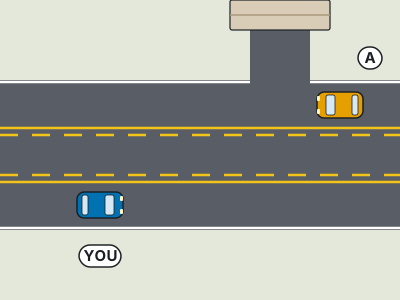
17. What is a two-way left turn lane intended for?
- Passing slower traffic through the center of the road
- Driving straight until the next intersection
- Vehicles turning left in either direction
- Accelerating to merge with through traffic
Show answer
Vehicles turning left in either direction. A center lane bordered by yellow lines and marked for two-way left turns is reserved for vehicles preparing to turn left from either direction. The manual specifically excludes passing, through traffic, and accelerating to merge from that lane. Enter it only after signaling, move completely into the lane, and remain alert for another driver approaching from the opposite side. Use it to slow and organize the turn, then leave it for the intended destination.
Study this in the handbook: Pavement markings and turning lanes
18. During an Arizona traffic stop, when should you get out of your vehicle?
- As soon as you stop, to show cooperation
- When the officer approaches
- Only if the officer directs you to exit
- After you have found your documents
Show answer
Only if the officer directs you to exit. Stay in your vehicle unless directed by the officer to exit. If the officer does ask you to exit, keep your hands visible and stand where the officer directs. Pull over promptly to a safe spot, turn on the interior light at night, keep your hands visible, and tell the officer before reaching for documents. If you believe the officer acted inappropriately, you may contact the officer's agency afterward and request to speak to a supervisor.
Study this in the handbook: Crashes, wrong way drivers and traffic stops
19. Which age group has the highest rate of alcohol involvement in vehicle crashes, according to the Arizona manual?
- Ages 16 to 20
- Ages 45 to 60
- Ages 65 and older
- Ages 21 to 34
Show answer
Ages 21 to 34. Alcohol involvement in vehicle crashes reaches its highest rate for those between the ages of 21 and 34. The manual places this right after noting that youthful drivers are substantially over represented in motor vehicle crashes compared to all other age groups, and it adds survey data showing adults between 21 and 29 are the most likely to drive after drinking. Ages 16 to 20, 45 to 60, and 65 and older are not the peak group the manual names. Remember the range as 21 to 34 for crash involvement.
Study this in the handbook: Crashes, wrong way drivers and traffic stops
20. What must an Arizona driver pay to reinstate a license after a suspension, and what may also be required?
- The application fee plus a $20 reinstatement fee, and possibly an SR-22 certificate of insurance
- A $500 fee only
- Nothing, reinstatement is automatic
- A new road test fee only
Show answer
The application fee plus a $20 reinstatement fee, and possibly an SR-22 certificate of insurance. To reinstate, you will be required to pay the appropriate application fee and a $20 reinstatement fee, and you may be required to file a Certificate of Insurance, commonly known as an SR-22. A written, vision and road test may also be required depending on the case. After a revocation period ends, the privilege stays revoked until an investigation confirms that all withdrawal actions have ended and all statutory requirements are met.
Study this in the handbook: Points, suspensions, aggressive driving and traffic school
QualitySpace is expanding to Arizona
We are a California-based independent insurance brokerage working on licensing in more states. We cannot help with Arizona insurance yet. Leave your email and we will let you know when we can.
Every question is written from the official Arizona Driver License Manual. Need paper? Printable AZ practice test with answer key.
Last verified 2026-10-05. How we check every question · Study all 202 as flashcards
Frequently asked questions
How many questions are on this Arizona practice test?
This fixed set has 20 questions. It is test 1 of 10 from the 202 question Arizona bank. The real AZ exam asks 30 questions and you need 24 correct.
What is the passing score for the real Arizona test?
A score of 80% or higher is required to pass That figure comes from the official Arizona source cited on the DMV facts page.
How does this fixed test relate to the full Arizona bank?
Each numbered test is a fixed set of questions in a fixed order, so you can retake the same test later and compare. Every test mixes road signs and the other topics in about the same proportion as the full bank. Tests 1 to 10 together cover 200 of the 202 questions in the Arizona bank, each once. The full practice page mixes the whole bank at random.
Last verified 2026-10-05. See the Arizona DMV facts page for sourced state details.