
Test 10 of 10 · 20 questions · Free 2026
AZ Permit Practice Test 10
Jump to the test ↓A fixed 20 question set from the Arizona bank with answers and plain English explanations. The real AZ exam is 30 questions, 80 percent to pass; take the full length version on the main practice page.
Question 1 of 20 · 0 right so far
All 20 questions in test 10
Every question below comes from the Arizona question bank on this page. Open a question to see the correct answer and the explanation. Nothing here is hidden behind a signup.
1. How long must an Arizona teen hold an instruction permit before applying for a graduated license?
- At least 6 months
- At least 30 days
- At least 3 months
- At least 12 months
Show answer
At least 6 months. An applicant for a graduated license must have held an Arizona instruction permit for at least 6 months, and the permit must still be valid on the day of application. Arizona gives credit for time spent holding a permit in another state. Thirty days and three months are too short. Twelve months is how long the permit itself stays valid, not the holding period.
Study this in the handbook: Instruction permits and the graduated license
2. How are reversible lanes commonly marked so drivers can identify their changing direction of use?
- By a single solid white line with no signs
- By blue curb paint at the roadway edge
- By double-dashed yellow lines and signs showing which lanes are available
- By double solid red lines that always close the lane
Show answer
By double-dashed yellow lines and signs showing which lanes are available. Reversible lanes change direction according to the time or traffic plan, so drivers must identify which lanes are active before entering. Arizona describes double-dashed yellow lines as the usual marking and says signs may appear beside the road or overhead. A single solid white line separates lanes moving in the same direction, not reversible lanes. Blue curb paint does not communicate lane direction, and double solid red lines are not the marking described here. Check the signs at that moment because lane availability can change during the day.
Study this in the handbook: Parking rules, hills and painted curbs
3. When may an Arizona driver park on the shoulder of a freeway?
- Only in case of emergency
- Whenever traffic is light
- To make a phone call
- To take a photo
Show answer
Only in case of emergency. Parking on the shoulder of the freeway is prohibited, except in case of emergency. Light traffic, a phone call, or taking a photo is not an emergency. If you do need assistance, the manual says to pull over onto the right shoulder as far as possible, avoid stopping on or near freeway ramps, and signal for help by turning on your emergency flashers or raising the hood. After dark, turn on your inside dome light or set out flares, wait for help, and do not walk along the freeway.
Study this in the handbook: Parking rules, hills and painted curbs
4. You miss your exit on an Arizona freeway. What must you do?
- Back up on the shoulder to the exit
- Continue to the next exit
- Make a U turn through the median
- Stop and wait for a gap to reverse
Show answer
Continue to the next exit. If you miss your exit, the manual says do not stop, never back up on a highway, and get off at the next exit, then look for signs showing you how to rejoin the road in the other direction. Backing up on the shoulder or stopping to wait for a gap to reverse both break that rule. The freeway restrictions also say not to drive over or across any median or make a U turn on the freeway. Plan your lane changes early so you reach the exit lane in time.
Study this in the handbook: Freeway and highway driving
5. According to the Arizona manual, how long does it take an average person to perceive a threat and react to it?
- About 0.25 seconds
- About 4 seconds
- About 1.5 seconds
- About 10 seconds
Show answer
About 1.5 seconds. It takes an average of 1.5 seconds for a person to perceive a threat in the roadway and react to that threat. That covers seeing the hazard, recognizing it and moving your foot to the brake, before any braking distance is added. The manual splits that total into an average perception time of 0.75 seconds and an average reaction time of 0.75 seconds, and it notes that actual stopping distance also depends on pavement, tires, vehicle weight, and brakes.
Study this in the handbook: Stopping distance, bad weather and night driving
6. After passing a vehicle on an Arizona road, when may you begin returning to the right lane?
- As soon as your rear bumper clears its front bumper
- When the other driver flashes the high beams
- After counting one second from pulling alongside
- When you can see the entire front or both headlights of the passed vehicle in your rearview mirror
Show answer
When you can see the entire front or both headlights of the passed vehicle in your rearview mirror. Returning too soon after passing can clip the vehicle you just passed or force it to brake. Arizona tells drivers to wait until they can see the entire front, or both headlights, of the passed vehicle in the rearview mirror. Then look over your shoulder to confirm the lane is clear, signal the lane change, and move back to the right. The same steps apply when passing slow motorcycles, bicycles, and mopeds. Clearing the bumper alone leaves too little room.
Study this in the handbook: Signaling, passing and U turns
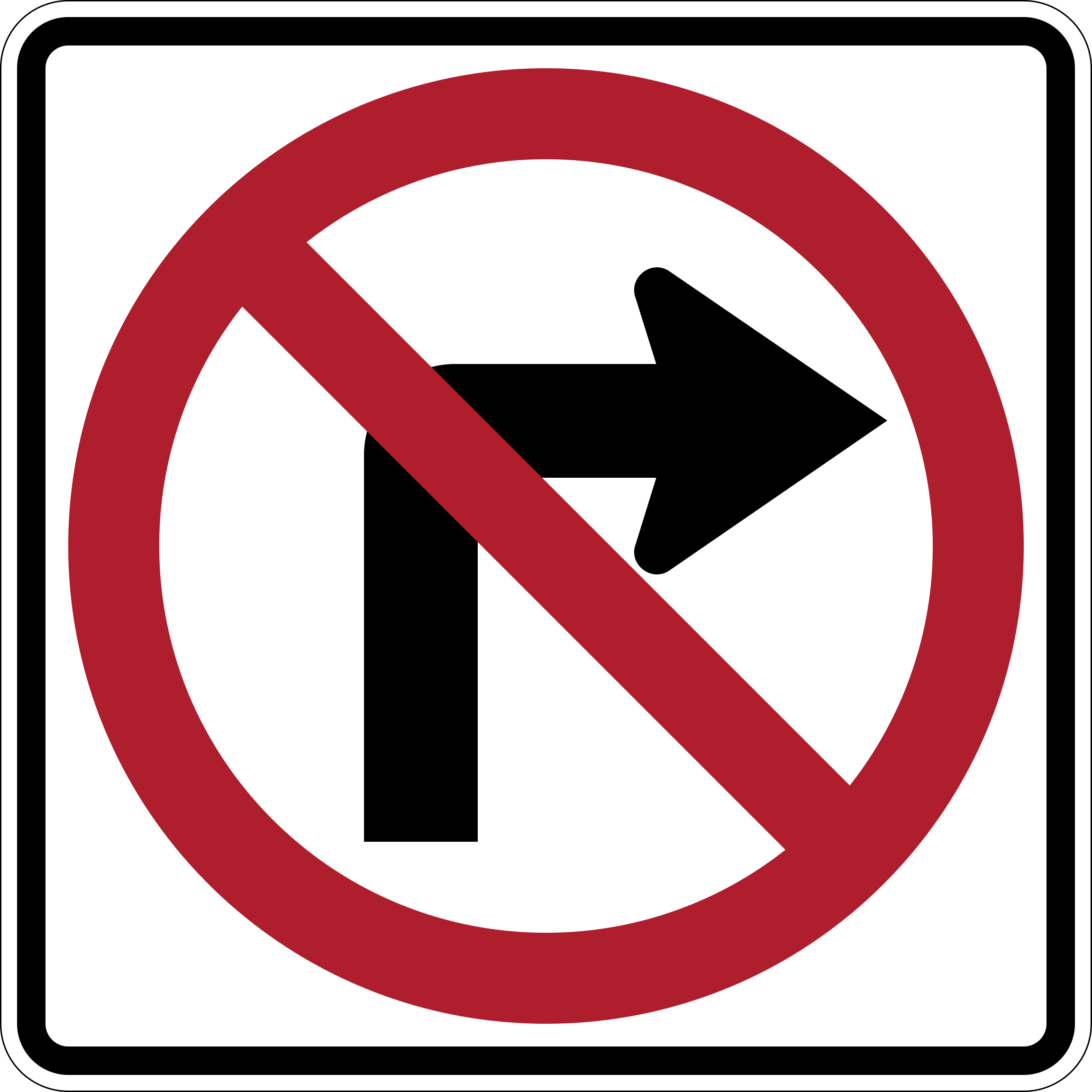
7. When visibility is poor, what part of a traffic sign may a driver be able to make out first?
- Only the exact speed limit
- Only the sign’s shape
- Only the installer’s name
- Only the lane width
Show answer
Only the sign’s shape. In heavy rain, dust storms, or fog, a driver may be able to make out only the shape of a particular sign. Recognizing that outline can provide an early warning before the wording is readable. The sign’s shape does not reveal an installer’s name, lane width, or an exact speed limit by itself. Slow down in poor visibility, use the outline as a clue, and continue looking for the full sign message before deciding how to proceed.
Study this in the handbook: Speed limits and work zones
8. At a controlled intersection in Arizona, what should a driver do before proceeding on a green indication?
- Check for traffic and pedestrians
- Wait for a police officer at every signal
- Proceed without looking because the signal grants absolute priority
- Yield only to vehicles approaching from the left
Show answer
Check for traffic and pedestrians. A green indication does not remove the need to check for traffic and pedestrians. Arizona's manual says drivers must obey signals and signs, yield as directed, and avoid assuming that it is safe to proceed merely because they have the right-of-way. The no-look option is therefore unsafe, and neither a police officer nor a left-side-only check is required by this passage. Scan the intersection before moving, especially for people or vehicles already within it.
Study this in the handbook: Signaling, passing and U turns
9. Which situation is listed in Arizona's aggravated DUI category?
- A first parking violation near a driveway
- A DUI while the driving privilege is suspended or revoked
- A speeding ticket below the posted limit
- A vehicle inspection with an expired registration
Show answer
A DUI while the driving privilege is suspended or revoked. Arizona lists committing a DUI while the driving privilege is suspended or revoked as an aggravated DUI situation. The same passage also mentions a third DUI within seven years and a DUI with a person under 15 in the vehicle. Parking, ordinary speeding, and inspection paperwork do not create the aggravated DUI category described here. The practical cue is to notice the prior license status: a DUI combined with a suspended or revoked privilege is treated more seriously than a routine first offense.
Study this in the handbook: Alcohol, drugs and DUI penalties
10. What do orange signs with black letters indicate near a curve, grade, or other special condition?
- The legal maximum speed
- A mandatory stop
- A recommended safe speed
- A railroad crossing ahead
Show answer
A recommended safe speed. Orange signs with black letters indicate a recommended safe speed because of curvature, grade, or another special condition. That recommendation differs from the legal maximum displayed by white speed-limit signs. An orange sign does not command a stop and does not identify a railroad crossing. The manual advises drivers to slow down until they are sure the location can be navigated safely. When studying sign colors, connect orange with a cautionary speed suggestion tied to road geometry rather than a general posted limit.
Study this in the handbook: Speed limits and work zones
11. What is the Arizona Traffic Survival School Program designed to do?
- Change or modify risky or unsafe driving behavior
- Provide vehicle repair inspections
- Replace every driver license road test
- Issue commercial driver licenses
Show answer
Change or modify risky or unsafe driving behavior. Traffic Survival School is intended to change or modify risky or unsafe driving behavior. The manual connects the program with serious violations, accumulated points, or risk of a suspended driving privilege. It is not a licensing test, a repair inspection, or a commercial credential service. A useful memory cue is behavior correction: the program addresses how a person drives after serious risk appears on the record. Its purpose is improvement and safer future decisions, not vehicle administration.
12. If a vehicle without antilock brakes suddenly loses braking power, what should the driver try first?
- Release the steering wheel
- Turn off the ignition while moving
- Pump the brakes rapidly
- Pull the parking brake fully and hold it locked
Show answer
Pump the brakes rapidly. Many vehicles have antilock brakes, and the manual says not to pump anti-lock brakes. If a vehicle does not have antilock brakes and loses braking power, pump the brakes rapidly, because this may build up enough pressure to stop the vehicle. If pumping does not work, slowly apply the parking brake while holding the brake release so you can ease off if the rear wheels lock, shift to a lower gear, and look for a safe place to stop. Releasing the wheel, switching off the ignition, or holding the parking brake locked is not part of that sequence.
Study this in the handbook: Dust storms, blowouts, fires and brake failure
13. What is the minimum fine for a first extreme DUI offense in Arizona?
- $1,250
- $2,500
- $3,000
- $5,000
Show answer
$2,500. Extreme DUI applies at an alcohol concentration of 0.15 or higher. A first offense brings at least 30 consecutive days in jail and a fine of at least $2,500, plus screening, community service and a required ignition interlock. The $1,250 minimum is for a first standard DUI, and $3,000 is for a second standard DUI. Five thousand dollars is not the stated minimum.
Study this in the handbook: Alcohol, drugs and DUI penalties
14. For an Arizona road test, what belt rule applies to the vehicle you bring?
- Belts are optional for the test
- Belts are required only in vehicles newer than 2000
- Only the driver's belt must work
- A 1972 model or newer must have seat belts, properly fastened and adjusted
Show answer
A 1972 model or newer must have seat belts, properly fastened and adjusted. You must provide the vehicle used for the road test, show current registration and liability insurance, and if the vehicle is a 1972 model or newer it must be equipped with seat belts that are properly fastened and adjusted. Driver and passenger side windows must be operational, and all maneuvers must be performed manually without driver assist features. The vehicle also needs working brakes, brake lights, turn signals, and horn, and both doors must open and close properly.
15. How many points does Arizona assess for leaving the scene of a crash?
- 2 points
- 3 points
- 8 points
- 6 points
Show answer
6 points. Leaving the scene of a crash carries 6 points on the Arizona list. Eight points are for DUI, extreme DUI, reckless driving, racing, aggressive driving and aggravated DUI, so eight is too high for this offense. Two points cover most other moving violations, and three is not the value here. A driver in a crash must stop, help anyone injured and exchange information.
16. How should you respond when a disabled vehicle is ahead on a freeway?
- Maintain speed in the same lane
- Stop behind it in the travel lane
- Reduce speed, move over, and pass with caution
- Use the shoulder to pass without slowing
Show answer
Reduce speed, move over, and pass with caution. The freeway guidance calls for three linked actions: reduce speed, move over, and proceed around the disabled vehicle carefully. Staying at speed in the same lane leaves little room if the stopped driver or a person near the vehicle moves unexpectedly. Stopping in the travel lane creates another hazard, and using the shoulder without slowing ignores the need to scan for people and equipment. Treat any roadside vehicle as a reason to create space and lower your pace before passing.
Study this in the handbook: Freeway and highway driving
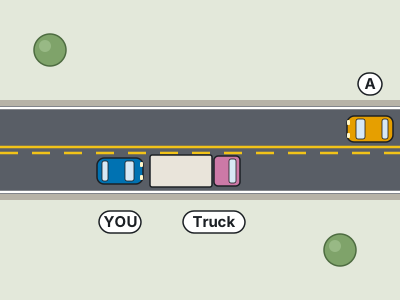
17. When a broken yellow line is beside a solid yellow line, when may you pass?
- Only after crossing both yellow lines
- Whenever the solid line is on your side
- In either direction whenever traffic is light
- Only when the broken line is on your side and the road ahead is clear
Show answer
Only when the broken line is on your side and the road ahead is clear. A paired broken and solid yellow line gives permission based on which marking is beside your lane. Passing is permitted in one direction when the broken line is on your side and the roadway ahead is clear. A solid line on your side prohibits the pass, regardless of light traffic. Before moving left, confirm the broken marking, check for oncoming vehicles, and return only when the maneuver can be completed safely.
Study this in the handbook: Pavement markings and turning lanes
18. Under what age must a child in Arizona ride in a child passenger restraint system?
- Less than 8 years old
- Less than 4 years old
- Less than 12 years old
- Less than 2 years old
Show answer
Less than 8 years old. A child less than 8 years old must be properly secured in a child passenger restraint system while being transported in a vehicle in Arizona. The seat must meet Department of Transportation safety standards and be used according to the seat maker's and the vehicle maker's instructions. If a child must ride in front, turn the passenger side air bag off where the vehicle has a switch.
Study this in the handbook: Vehicle equipment, seat belts and child seats
19. When driving at night, what should you remember about railroad crossing warning signs?
- They are always illuminated
- Some may not be lighted
- They are replaced by school signs
- They appear only after a train passes
Show answer
Some may not be lighted. The manual warns that railroad crossing signs may not be lighted at night, so darkness does not make a crossing warning disappear. Assuming every sign is illuminated could leave a driver unprepared for tracks or trains ahead. School signs serve a different warning purpose, and a train does not control whether a warning sign is present. At night, reduce speed when the route suggests a crossing, scan beyond the reach of headlights, and use the crossing signals, bells, and barricades as additional information.
20. What does a solid white line at the right edge of the roadway mark?
- The centerline separating opposing traffic
- A boundary that requires an immediate lane change
- A lane that must be used for passing
- The roadway edge, which should be crossed only for an emergency or road hazard
Show answer
The roadway edge, which should be crossed only for an emergency or road hazard. A solid white line can mark the right edge of the roadway. The manual says to cross that edge line only in an emergency or to avoid a road hazard, with a separate allowance when merging into or out of an HOV lane. It is not an opposing-traffic centerline, a passing lane, or an instruction to change lanes. Keep the vehicle inside the roadway, scan for hazards, and leave the edge only for the limited situations described.
Study this in the handbook: Parking rules, hills and painted curbs
QualitySpace is expanding to Arizona
We are a California-based independent insurance brokerage working on licensing in more states. We cannot help with Arizona insurance yet. Leave your email and we will let you know when we can.
Every question is written from the official Arizona Driver License Manual. Need paper? Printable AZ practice test with answer key.
Last verified 2026-10-05. How we check every question · Study all 202 as flashcards
Frequently asked questions
How many questions are on this Arizona practice test?
This fixed set has 20 questions. It is test 10 of 10 from the 202 question Arizona bank. The real AZ exam asks 30 questions and you need 24 correct.
What is the passing score for the real Arizona test?
A score of 80% or higher is required to pass That figure comes from the official Arizona source cited on the DMV facts page.
How does this fixed test relate to the full Arizona bank?
Each numbered test is a fixed set of questions in a fixed order, so you can retake the same test later and compare. Every test mixes road signs and the other topics in about the same proportion as the full bank. Tests 1 to 10 together cover 200 of the 202 questions in the Arizona bank, each once. The full practice page mixes the whole bank at random.
Last verified 2026-10-05. See the Arizona DMV facts page for sourced state details.