
Test 4 of 10 · 20 questions · Free 2026
AZ Permit Practice Test 4
Jump to the test ↓A fixed 20 question set from the Arizona bank with answers and plain English explanations. The real AZ exam is 30 questions, 80 percent to pass; take the full length version on the main practice page.
Question 1 of 20 · 0 right so far
All 20 questions in test 4
Every question below comes from the Arizona question bank on this page. Open a question to see the correct answer and the explanation. Nothing here is hidden behind a signup.
1. When no limit is posted, what is the speed limit on an Arizona open highway or city freeway?
- 45 mph
- 65 mph
- 75 mph
- 55 mph
Show answer
55 mph. Arizona's unposted limits are 15 mph near a school crosswalk, 25 mph in business or residential districts, 55 mph on open highways or city freeways, 65 mph on designated open highways, and 75 mph on rural freeways. So 65 applies only to designated open highways and 75 only to rural freeways. Forty-five mph is not on the list. Posted signs always control when present.
Study this in the handbook: Speed limits and work zones
2. When entering a roundabout, which road users already inside have priority?
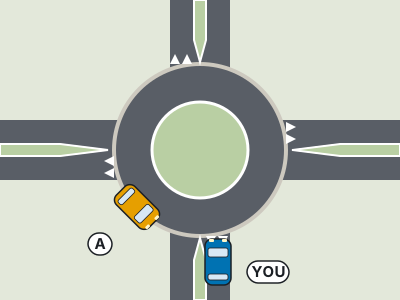
- Only vehicles approaching from the left
- The largest vehicle outside the roundabout
- Drivers entering from the fastest lane
- Vehicles already in the roundabout
Show answer
Vehicles already in the roundabout. Vehicles approaching an Arizona roundabout must yield to all vehicles already circulating in it. The same approach must yield to large vehicles entering at the same time, and drivers should also protect pedestrians and bicyclists crossing. Priority is not determined by vehicle speed or by which side a vehicle approaches from. Slow before the entrance, identify a safe gap, and enter to the right of the central island without stopping once inside unless safety requires it.
Study this in the handbook: Signaling, passing and U turns
3. Under Arizona law, which passengers must the driver require to buckle up?
- Only passengers under the age of 8
- Only front seat passengers over 18
- All passengers under the age of 16
- Only passengers on freeways
Show answer
All passengers under the age of 16. The operator of a motor vehicle must require all passengers under 16 to buckle up. Younger children also need a child restraint system, always under age 5 and from 5 to 8 until they reach four feet nine inches, so under 8 describes a narrower rule, not the belt duty. Front seat adults and freeway travel are not the limits of this law. A lap and shoulder belt together greatly lower the chance of serious injury in a crash.
Study this in the handbook: Vehicle equipment, seat belts and child seats
4. Your car begins to skid on a slippery roadway. Which steering response is recommended?
- Press the brake harder and hold the wheel still
- Turn opposite the intended path and accelerate
- Shift to park while the vehicle is moving
- Turn the wheel in the direction you want the vehicle to follow
Show answer
Turn the wheel in the direction you want the vehicle to follow. During a skid, the manual says not to press on the brake any further, because that only makes the skid worse, and to turn the wheel quickly in the direction you want the vehicle to follow. As the car begins to straighten out, turn the wheel quickly back the other way so it does not skid in the opposite direction, and keep turning back and forth as needed until the vehicle straightens to its normal path. Turning away from your intended path or shifting to park is not part of the steps the manual lists.
Study this in the handbook: Stopping distance, bad weather and night driving
5. What is prohibited when a railroad crossing barricade is lowered?
- Driving around or under the barricade
- Waiting until signals stop
- Stopping at least 15 feet away
- Looking for an approaching train
Show answer
Driving around or under the barricade. Arizona prohibits driving around or under a lowered railroad crossing barricade. The other actions are safety steps: stop at the required distance when a warning is present, wait until signals have stopped and the barricade is fully raised, and look for trains or other track equipment. Never treat an opening beside the gate as an invitation to cross. A lowered barricade means the crossing is protected and the vehicle must remain clear of the tracks until the warning ends.
Study this in the handbook: Speed limits and work zones
6. About how far apart are the mile posts set along Arizona state highways?
- About 100 feet
- About 5 miles
- About 1 mile
- About 10 miles
Show answer
About 1 mile. Arizona is one of the few states where every state highway has mileage markers. These posts stand 2 feet off the right shoulder and are about 1 mile apart. They are useful when you need to tell someone where you are after a crash, a mechanical problem, or running out of gas. If you have to stop, note the route you are on and roughly how far you are from the nearest post so responders can find you quickly.
7. What equipment does an Arizona school bus display while passengers are entering or leaving?
- A blue beacon and a lowered gate
- A steady green light and a raised white flag
- Alternating flashing lights and a mechanical stop-sign arm
- A single headlight and a turn signal
Show answer
Alternating flashing lights and a mechanical stop-sign arm. While passengers are entering or leaving, an Arizona school bus displays alternating flashing lights and extends a mechanical stop-sign arm. Those signals tell approaching drivers that the bus is actively loading or unloading and that stopping is required before reaching it. A green light, blue beacon, white flag, or single headlight is not the equipment identified in this rule. Watch the bus and its signals, stop at a safe distance, and remain alert for children near the front or rear.
Study this in the handbook: Right of way, pedestrians and roundabouts
8. On which roadway may you proceed when a school bus is stopped in the opposite direction?
- Any two lane road with painted stripes
- A divided roadway with a physical barrier
- A roadway with no center marking
- Any road wider than four lanes
Show answer
A divided roadway with a physical barrier. You may continue when the bus is traveling in the opposite direction only on a divided roadway separated by a physical barrier, such as fencing, curbing, or separated pavement. Painted striping alone does not create that separation. The width of a road is not the deciding test. Before moving, identify whether opposing traffic is physically divided; if the roadway lacks that barrier, prepare to stop for the bus even when you are approaching from the other direction.
Study this in the handbook: Right of way, pedestrians and roundabouts
9. What must Arizona drivers do when a funeral procession is led by an escort vehicle flashing a red or blue light?
- Stop and park until the procession ends
- Yield the right-of-way to vehicles in the procession
- Pass the procession on its left
- Follow the procession closely
Show answer
Yield the right-of-way to vehicles in the procession. Drivers must yield the right-of-way to vehicles that are part of a funeral procession led by a funeral escort vehicle flashing a red or blue light. The manual does not impose a universal requirement to park and remain stopped, so that choice adds a condition not stated. Passing or following closely would interfere with the procession and defeats the yielding duty. When the escort identifies the procession, slow down, create space, and let the group proceed safely before continuing.
Study this in the handbook: Right of way, pedestrians and roundabouts
10. At an uncontrolled T intersection in Arizona, which driver must yield?
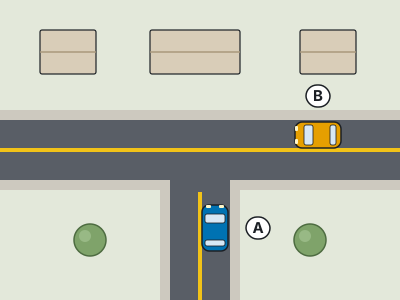
- The driver on the street that ends
- The driver traveling at the lower speed
- The driver on the cross street
- The driver who reaches the corner first
Show answer
The driver on the street that ends. At a T intersection, the street that ends does not continue through the junction. Its driver must yield to vehicles traveling on the cross street. The cross-street driver is not required to give way merely because another vehicle is approaching from the terminating road. Speed and arrival order do not replace this layout-based rule. Picture the stem of the T meeting its top bar: traffic on the stem waits, checks carefully, and yields before entering the through street.
Study this in the handbook: Right of way, pedestrians and roundabouts
11. How soon must an Arizona driver notify MVD of a name or address change?
- Within 10 days
- Within 60 days
- Within 30 days
- At the next renewal
Show answer
Within 10 days. You are required by law to notify MVD within 10 days of any change to your name or address. If you do not report a change, you may not receive renewal notices or other correspondence about your license or vehicle records, and you may be cited by law enforcement. A change of address updates your license record and every vehicle record on which you are the first registered owner.
Study this in the handbook: Points, suspensions, aggressive driving and traffic school
12. If braking is necessary on ice or another slippery surface, how should the driver apply the brakes?

- Press hard until the wheels lock
- Apply them gently and increase pressure as the tires grip
- Accelerate sharply while steering around the slick area
- Turn off the engine before touching the brake pedal
Show answer
Apply them gently and increase pressure as the tires grip. On ice or another slippery surface, Arizona advises applying the brakes gently and increasing pressure as the tires regain grip. Locking the wheels can reduce control, so the hard-braking choice is especially dangerous. Turning off the engine or accelerating sharply does not create reliable traction and can make steering more difficult. Ease off the accelerator before the slick area, leave extra space, and use smooth steering and braking. If the wheels begin to lock, reduce brake pressure briefly rather than forcing the pedal harder.
Study this in the handbook: Stopping distance, bad weather and night driving
13. Which situation makes a DUI an aggravated DUI in Arizona?
- A first DUI at 0.09
- A DUI with an adult passenger
- A DUI with a passenger under 15 in the vehicle
- A DUI discovered at a checkpoint
Show answer
A DUI with a passenger under 15 in the vehicle. Aggravated DUI covers a DUI committed while the license is suspended or revoked, a third DUI within 7 years, a DUI with a person under 15 in the vehicle, and a DUI by someone required to use an ignition interlock. A first DUI at 0.09 is a standard DUI. An adult passenger and a checkpoint stop do not raise the category. Aggravated DUI brings prison and a one-year revocation.
Study this in the handbook: Alcohol, drugs and DUI penalties
14. Besides the regular penalties, what can happen to an Arizona teen who violates the graduated license curfew or passenger limits?
- Fines and a mandatory extension of the 6-month restricted period
- Only a warning to the parents
- An automatic lifetime ban
- A reduction of the restricted period
Show answer
Fines and a mandatory extension of the 6-month restricted period. Curfew and passenger violations carry added penalties, including fines and a mandatory extension of the 6-month restricted driving period. A warning to parents understates this, and nothing here reduces the restricted period. A lifetime ban is not a listed penalty. A third conviction for curfew or passenger violations brings a suspension of the driving privilege. In practice, one broken curfew can keep a teen under the first six months of limits for longer than planned.
Study this in the handbook: Instruction permits and the graduated license
15. What action does the red octagonal sign require?

- Slow down and continue if clear
- Stop only when another vehicle is present
- Yield without stopping
- Come to a complete stop
Show answer
Come to a complete stop. The octagonal shape is reserved for stop signs, and the manual requires a complete stop. A driver should not treat the sign as a yield instruction or continue merely because the intersection appears empty. The shape remains a strong recognition cue when weather, darkness, or distance makes lettering hard to read. After stopping, the driver must observe the intersection and proceed only when it is safe and permitted. The requirement is a full stop, not a rolling pause or a conditional stop based on nearby traffic.
Study this in the handbook: Traffic signs, railroad crossings and work zones
16. What prison term and license action does Arizona list for aggravated DUI?
- Jail for 10 days and a 90-day suspension
- Prison for not more than 2 years and a 1-year revocation
- Jail for 30 days and no license action
- Prison for 10 years and a lifetime ban
Show answer
Prison for not more than 2 years and a 1-year revocation. A person convicted of aggravated DUI is sent to prison for not more than 2 years, and the license is revoked for 1 year, along with alcohol screening and a required ignition interlock. Ten days in jail with a 90-day suspension is the first standard DUI package. Thirty days with no license action misstates the law, and ten years with a lifetime ban overstates the manual.
Study this in the handbook: Alcohol, drugs and DUI penalties
17. What minimum distance must an Arizona driver allow when passing a bicyclist traveling in the same direction?
- 1 foot
- 2 feet
- 3 feet
- 6 feet
Show answer
3 feet. Arizona requires a minimum safe distance of 3 feet when passing a bicyclist traveling in the same direction. One and two feet are too close, and six feet is more than the stated minimum. Drivers should not honk while passing, because the sound can startle the rider into a crash. Bicyclists are often hard to see, so extra caution is needed.
Study this in the handbook: Bicycles, motorcycles, trucks and light rail
18. How old must an applicant be to receive an Arizona graduated instruction permit?
- At least 16 years and 6 months
- At least 15 years and 6 months
- At least 15 years
- At least 18 years
Show answer
At least 15 years and 6 months. Arizona allows a graduated instruction permit once the applicant reaches 15 years and 6 months. The age is younger than the 16-year threshold for a graduated driver license, while the 18-year figure applies to an operator permit. A useful study cue is to separate the half-year permit age from the later license age. The permit starts supervised practice, so reaching the qualifying birthday does not by itself authorize unsupervised driving. The applicant still has to follow the required supervision conditions and complete the licensing steps described elsewhere in the manual.
Study this in the handbook: Instruction permits and the graduated license
19. Arizona says you must not pass when a double solid line or a solid dividing line is on which lane?
- Only on the lane for oncoming traffic
- Between same-direction lanes marked with broken white lines
- Along the shoulder edge of the road
- On the lane in which you are driving
Show answer
On the lane in which you are driving. Arizona lists a double solid line or a solid dividing line on the lane in which you are driving as a place where you must not pass. The line that matters is the one on your own lane, so a rule limited to the oncoming lane misses the point. Broken white lines separate lanes of traffic going in the same direction and are not the solid line this rule describes, and a shoulder edge line is not part of it either. Check the marking beside your lane well ahead before you start any pass.
Study this in the handbook: Signaling, passing and U turns
20. Before entering an Arizona roundabout, what must the driver do?
- Stop in the circle and wait for every exit to clear
- Enter quickly to claim the central island
- Yield only to vehicles behind the driver
- Slow down and yield until there is a safe gap
Show answer
Slow down and yield until there is a safe gap. A driver should slow down while approaching a roundabout and yield until there is a safe gap before entering. Stopping inside the circle disrupts vehicles that already have priority, while accelerating to claim the island creates a conflict at the entry. The rule is not based on traffic behind the vehicle. Reduce speed before the entry point, look left for circulating traffic, and proceed only when the opening is large enough to merge smoothly.
QualitySpace is expanding to Arizona
We are a California-based independent insurance brokerage working on licensing in more states. We cannot help with Arizona insurance yet. Leave your email and we will let you know when we can.
Every question is written from the official Arizona Driver License Manual. Need paper? Printable AZ practice test with answer key.
Last verified 2026-10-05. How we check every question · Study all 202 as flashcards
Frequently asked questions
How many questions are on this Arizona practice test?
This fixed set has 20 questions. It is test 4 of 10 from the 202 question Arizona bank. The real AZ exam asks 30 questions and you need 24 correct.
What is the passing score for the real Arizona test?
A score of 80% or higher is required to pass That figure comes from the official Arizona source cited on the DMV facts page.
How does this fixed test relate to the full Arizona bank?
Each numbered test is a fixed set of questions in a fixed order, so you can retake the same test later and compare. Every test mixes road signs and the other topics in about the same proportion as the full bank. Tests 1 to 10 together cover 200 of the 202 questions in the Arizona bank, each once. The full practice page mixes the whole bank at random.
Last verified 2026-10-05. See the Arizona DMV facts page for sourced state details.