
Test 3 of 10 · 20 questions · Free 2026
AZ Permit Practice Test 3
Jump to the test ↓A fixed 20 question set from the Arizona bank with answers and plain English explanations. The real AZ exam is 30 questions, 80 percent to pass; take the full length version on the main practice page.
Question 1 of 20 · 0 right so far
All 20 questions in test 3
Every question below comes from the Arizona question bank on this page. Open a question to see the correct answer and the explanation. Nothing here is hidden behind a signup.
1. An Arizona driver is ordered to attend Traffic Survival School after a red light conviction but never completes it. What happens?
- A 30-day suspension
- An indefinite suspension of the driving privilege
- Nothing, if the fine was paid
- The points are doubled
Show answer
An indefinite suspension of the driving privilege. MVD must order Traffic Survival School for every red light conviction, points are assessed, and failing to complete the course results in an indefinite suspension. Paying the fine only accepts responsibility for the violation and does not replace the course. A 30-day suspension has a fixed end, which this does not. Doubled points are not the stated consequence. Completing the course ends the matter without another court appearance.
Study this in the handbook: Traffic signals and red light running
2. How far before a turn does Arizona require a driver to signal?
- Only after entering the intersection
- At least 25 feet before turning
- Only when another vehicle is close behind
- At least 100 feet before turning
Show answer
At least 100 feet before turning. Arizona requires a driver to signal at least 100 feet before turning. The signal gives people behind and beside the vehicle time to recognize the planned movement and adjust safely. Waiting until the intersection has been entered is late, and 25 feet provides less notice than the stated minimum. The duty does not depend on whether another vehicle is visibly close, because pedestrians and less obvious traffic also need predictable information. Signal before the turn, keep the indication active through the movement, and cancel it afterward when the vehicle straightens.
Study this in the handbook: Signaling, passing and U turns
3. Which Arizona website is MVD’s authorized online service site for motor vehicle and driver license transactions?
- azgohs.gov
- AZMVDNow.gov
- MoveOverAZ.org
- az511.com
Show answer
AZMVDNow.gov. AZMVDNow.gov is the Motor Vehicle Division’s authorized service website for a range of motor vehicle and driver license transactions. The Arizona Governor’s Office of Highway Safety uses azgohs.gov for safety information, while az511.com provides travel information such as traffic conditions and road closures. MoveOverAZ.org gives information about the Move Over Law. Match the website to its agency and purpose: MVD services belong with AZMVDNow.gov. This distinction helps separate credential and vehicle transactions from safety guidance and roadway updates.
4. On a four-lane highway, an emergency vehicle is approaching in your direction. What should you do when a lane change is safe?
- Stop beside the emergency vehicle
- Change into a lane not next to the emergency vehicle
- Drive onto the median to get farther away
- Accelerate past the emergency vehicle
Show answer
Change into a lane not next to the emergency vehicle. On a four-lane highway with at least two lanes moving in the same direction, Arizona directs traffic to yield by changing into a lane that is not adjacent to the emergency vehicle. This creates a safer margin while allowing the response vehicle to continue. Stopping beside it leaves the driver in the danger zone, and using a median is not the stated lane-change maneuver. Accelerating past the emergency vehicle can interfere with its path. Check the lane beside you, signal, move away when safe, and reduce speed if changing lanes cannot be done safely.
Study this in the handbook: Traffic signals and red light running
5. Before making a left turn in Arizona, which road users must the driver yield to?
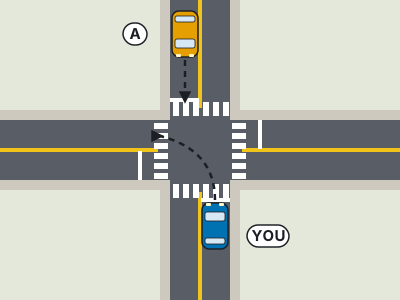
- Oncoming vehicles, bicycles, and pedestrians
- Vehicles behind the turning driver only
- No one when the turn signal is on
- Only oncoming cars, not bicycles or pedestrians
Show answer
Oncoming vehicles, bicycles, and pedestrians. A left-turning driver must yield to any oncoming vehicle, bicycle, or pedestrian. The rule protects all three categories, so the choice that names cars alone is incomplete. A signal communicates intent but does not cancel the duty to yield, and traffic behind the turning vehicle is not the group identified in this rule. Look straight through the turn path for approaching road users, wait until they are clear, and then complete the movement safely.
Study this in the handbook: Right of way, pedestrians and roundabouts
6. What equipment does the Arizona manual say a bicyclist needs when riding at night?
- A bell and a mirror
- Reflective tires
- A helmet only
- A white head lamp visible from 500 feet and a rear reflector
Show answer
A white head lamp visible from 500 feet and a rear reflector. When riding at night, a bicyclist should have a white head lamp visible from 500 feet and a rear reflector. Drivers should expect bicycles on the road after dark and look for that small white light and rear reflector, especially at intersections and driveways. Motorists must allow at least 3 feet when passing a bicyclist traveling in the same direction, and the manual also asks drivers to dim headlights at night as a courtesy to bicyclists.
Study this in the handbook: Bicycles, motorcycles, trucks and light rail
7. What does Arizona's right-of-way rule allow a driver to do when taking priority could cause a crash?
- Take priority because the rule guarantees protection
- Force the other vehicle to brake
- Yield instead of claiming priority if needed for safety
- Proceed whenever the driver reaches the intersection first
Show answer
Yield instead of claiming priority if needed for safety. The manual distinguishes between assigning a duty to yield and granting a driver permission to create danger. Even when a traffic rule appears to favor you, you must not take that advantage if doing so could cause a collision. The option about guaranteed protection changes a conditional safety rule into a license to force the movement. Reaching an intersection first is not a universal substitute for checking traffic, and making another driver brake is not a safe right-of-way strategy. Treat priority as a responsibility to avoid conflict, not as armor.
Study this in the handbook: Signaling, passing and U turns
8. How do flaggers in Arizona road work zones direct traffic?
- With green flags and white hard hats
- Only with hand signals from inside a vehicle
- With flashing blue lights on a patrol car
- With orange vests or jackets and red flags or stop/slow panels
Show answer
With orange vests or jackets and red flags or stop/slow panels. Flaggers are often used in Arizona work zones to stop, slow, or guide traffic safely through the area. They wear orange vests or jackets and use red flags or stop/slow panels to tell you what to do. Follow their directions just as you would a sign or signal, and drive carefully to protect workers on the roadway. Green flags, blue patrol lights, and signals from inside a vehicle are not how the manual describes flaggers.
Study this in the handbook: Speed limits and work zones
9. Which use of an Arizona two-way left turn lane is not allowed?
- Slowing before a left turn off the street
- Waiting there after turning left from a driveway
- Passing other vehicles
- Signaling before entering the lane
Show answer
Passing other vehicles. A two-way left turn lane is bordered by a broken inner yellow line and a solid outer yellow line, and it is only for vehicles turning left in either direction. You may slow there before turning left off the street or pull into it when turning left from a side street or driveway. Arizona says you must not use the lane for passing, for through traffic, or to accelerate to merge with through traffic. Signal before entering and move completely into it.
Study this in the handbook: Pavement markings and turning lanes
10. How much of a lane is a motorcycle entitled to use in Arizona?
- Only the right half of the lane
- Only the left third of the lane
- The full width of the lane
- Whatever space a car leaves beside it
Show answer
The full width of the lane. The Arizona manual says motorcycles are allowed the full width of a lane in which to maneuver, and you must never crowd into the same lane as a motorcycle. Riders shift within the lane to avoid oil, potholes, or debris and to stay visible, so they need the whole lane. When you pass a motorcycle, change lanes completely and do not return too soon, because cutting back early can force the rider to swerve into traffic or off the road.
Study this in the handbook: Bicycles, motorcycles, trucks and light rail
11. For a second standard DUI in Arizona, what fine and license action does the manual list?
- A fine of at least $3,000 and a 12-month revocation
- A fine of at least $1,250 and a 90-day suspension
- A fine of at least $500 and no license action
- A fine of at least $3,250 and a 6-month suspension
Show answer
A fine of at least $3,000 and a 12-month revocation. Second and later standard DUI offenses bring at least 90 days in jail, a fine of at least $3,000, and a 12-month license revocation. A $1,250 fine with a 90-day suspension describes a first offense. The $3,250 figure is the repeat extreme DUI fine, and six months is not the period. A $500 fine with no license action badly understates the penalty.
Study this in the handbook: Alcohol, drugs and DUI penalties
12. What penalty follows a third traffic conviction for an Arizona graduated license holder under 18?
- A 3-month suspension
- A 30-day suspension
- A 6-month suspension of the driving privilege
- Traffic Survival School only
Show answer
A 6-month suspension of the driving privilege. A third traffic conviction for a teen with a graduated license brings a 6-month suspension, and the violation is recorded. Three months is the second step and Traffic Survival School is the first. Thirty days is not on the ladder. A third curfew or passenger violation also leads to suspension, and alcohol related convictions bring suspension as well. Each conviction on the ladder is also recorded on the driving record.
Study this in the handbook: Instruction permits and the graduated license
13. How many points does Arizona assess for a DUI conviction?
- 8 points
- 2 points
- 4 points
- 6 points
Show answer
8 points. The Arizona point list gives 8 points each for DUI, extreme DUI, reckless driving, racing, aggressive driving and aggravated DUI. Leaving the scene of a crash is 6 points, so six belongs to a different offense. Two points apply to most other moving violations, and four is not the DUI value. Since 8 points in 12 months triggers Traffic Survival School, one DUI reaches that threshold by itself.
14. In Arizona, what should you do when a traffic signal shows a flashing yellow light?
- Stop and remain stopped until a green light appears
- Slow down and proceed with caution if the roadway is clear
- Speed up before cross traffic can enter
- Turn only in the direction shown by an arrow
Show answer
Slow down and proceed with caution if the roadway is clear. A flashing yellow light calls for reduced speed and careful movement only after checking that the roadway is clear. It is not a stop signal, so waiting for green would add a requirement that the manual does not give. A flashing yellow also does not restrict travel to an arrow direction, and accelerating removes the time needed to notice cross traffic or pedestrians. Approach with your foot ready over the brake, scan both sides, and continue only when the intersection is safe.
Study this in the handbook: Traffic signals and red light running
15. After an Arizona crash with no serious injury or fatality, what must be done with the vehicles?
- Leave them exactly where they stopped until police arrive
- Push them onto the sidewalk
- Drive them home immediately
- Remove them from the main traveled portions of the roadway
Show answer
Remove them from the main traveled portions of the roadway. In the event of a crash, provided there has been no serious physical injury or fatality, the vehicles involved shall be removed from the main traveled portions of the roadway. Any licensed driver may move a vehicle that is safely operable, as long as the move does not cause further damage or increase traffic hazards. Leaving the vehicles where they stopped or pushing them onto a sidewalk is not the rule, and you may not simply drive home: you must remain at the scene to help anyone injured and exchange information with the other drivers.
Study this in the handbook: Crashes, wrong way drivers and traffic stops
16. What are an Arizona driver's duties at the scene of a crash?
- Remain at the scene, provide assistance to anyone injured, and exchange information with the other drivers
- Leave to find a phone
- Wait in the car with the doors locked
- Move the vehicles and go home
Show answer
Remain at the scene, provide assistance to anyone injured, and exchange information with the other drivers. If you are involved in a crash, you are to remain at the scene to provide assistance to any person injured and to exchange information with the other drivers. The first action is to make sure you and your occupants are okay. When no one is seriously hurt, move the vehicles out of the traveled lanes. The manual adds that a conviction for failing to stop brings a suspension or revocation of the driving privilege.
Study this in the handbook: Crashes, wrong way drivers and traffic stops
17. Absent a sibling or qualified parent or guardian, how many passengers under 18 may a new graduated-license driver carry during the first six months?
- No more than one
- No more than two
- No more than three
- Any number if everyone wears a belt
Show answer
No more than one. The first six months of an Arizona graduated license allow no more than one passenger under age 18 unless the passenger is a sibling or a qualified parent or guardian occupies the front passenger seat. Two or three young passengers exceed the stated limit, and seat-belt use does not replace the graduated-license restriction. When counting passengers, focus on age and relationship rather than the total number of people in the vehicle. The exception is narrow, so do not treat a friend, older teenager, or unrelated adult as automatically qualifying.
Study this in the handbook: Instruction permits and the graduated license
18. The rectangular sign shown belongs to which broad Arizona sign category?
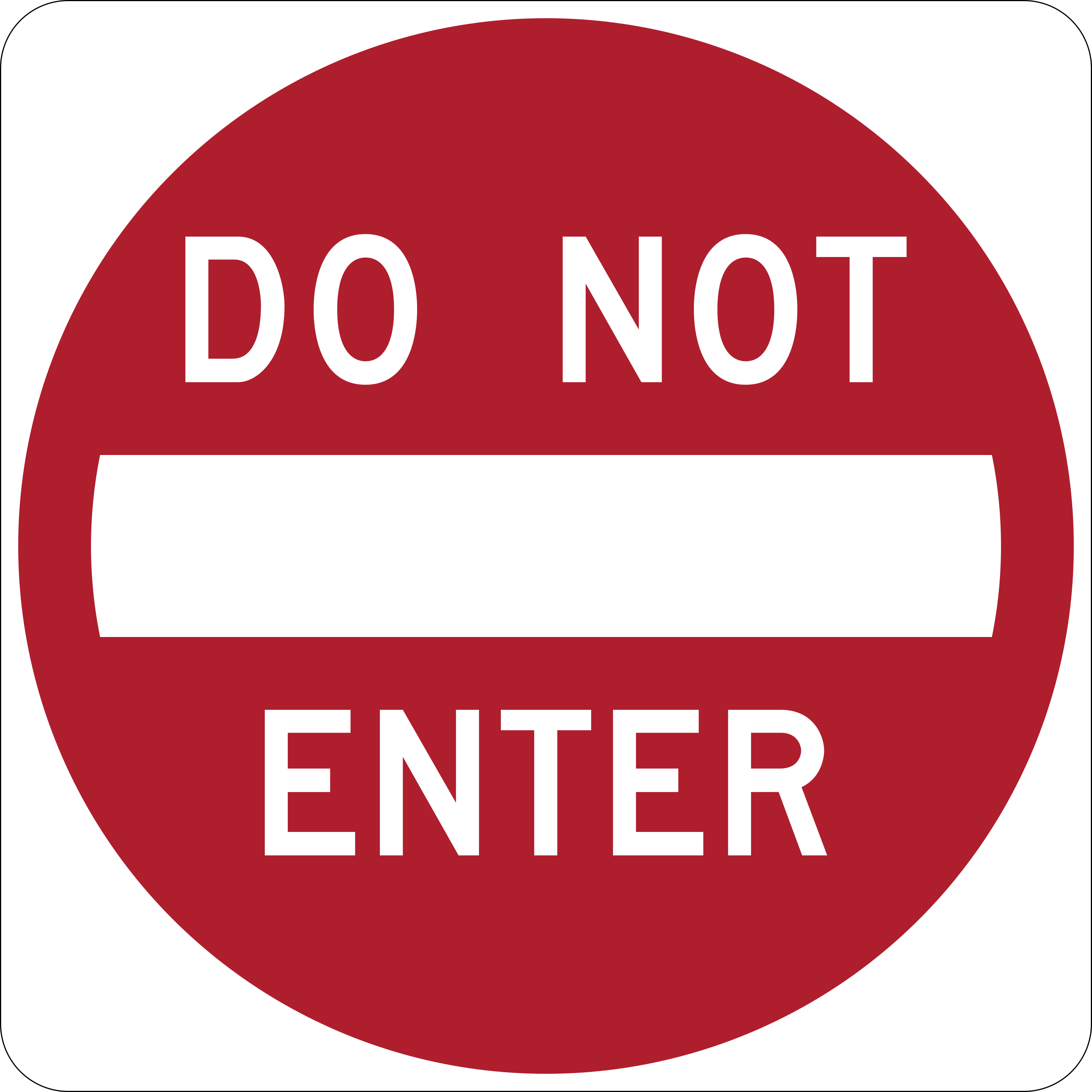
- A railroad warning sign that marks a crossing
- A curve sign that gives an advisory speed
- A school crossing sign that warns children may cross
- A regulatory sign that controls speed or direction
Show answer
A regulatory sign that controls speed or direction. Arizona describes rectangular signs as regulatory signs. Their job is to regulate traffic and direct the driver's speed and direction, which is why a rectangular restriction such as the one shown communicates a rule rather than a general danger warning. The railroad choice belongs to the circular railroad warning sign, and the school choice belongs to the permanent five-sided sign. Curve warnings are part of the turn, curve, and winding-road group and are shown as warning signs. When identifying an unfamiliar rectangular sign, read its wording as an instruction governing how traffic may move.
Study this in the handbook: Traffic signs, railroad crossings and work zones
19. What does the shape of the pedestrian warning sign help communicate?

- That the driver has reached a railroad crossing
- That pedestrians are prohibited from the roadway
- Important information about the sign's meaning
- That the displayed speed is only a suggestion
Show answer
Important information about the sign's meaning. Arizona says the shape of a traffic sign can provide as much information about its meaning as the color or wording. A pedestrian warning sign therefore uses its visual form to help drivers recognize the crossing message, especially when visibility is poor. Nothing about the sign automatically prohibits pedestrians, identifies a railroad crossing, or changes a legal speed into a suggestion. Those conclusions add rules that the sign does not state. A useful habit is to read the symbol, color, and shape together, then slow and prepare to yield where pedestrians may enter the crossing.
Study this in the handbook: Speed limits and work zones
20. When a large vehicle approaches an Arizona roundabout at the same time, what should the entering driver do?
- Accelerate to enter before the large vehicle
- Yield, slowing or stopping if necessary
- Pass the large vehicle on the left
- Stop inside the roundabout and wait
Show answer
Yield, slowing or stopping if necessary. Arizona tells drivers to yield when a large vehicle approaches the roundabout at the same time, slowing down or stopping if necessary. The manual adds that drivers approaching a roundabout must yield to large vehicles entering at the same time, and it warns not to try to pass large trucks in the roundabout. Accelerating to beat the vehicle creates a conflict, and stopping inside goes against the instruction that once inside, you do not stop. Approach slowly, spot the large vehicle early, and enter only when there is a gap.
Study this in the handbook: Signaling, passing and U turns
QualitySpace is expanding to Arizona
We are a California-based independent insurance brokerage working on licensing in more states. We cannot help with Arizona insurance yet. Leave your email and we will let you know when we can.
Every question is written from the official Arizona Driver License Manual. Need paper? Printable AZ practice test with answer key.
Last verified 2026-10-05. How we check every question · Study all 202 as flashcards
Frequently asked questions
How many questions are on this Arizona practice test?
This fixed set has 20 questions. It is test 3 of 10 from the 202 question Arizona bank. The real AZ exam asks 30 questions and you need 24 correct.
What is the passing score for the real Arizona test?
A score of 80% or higher is required to pass That figure comes from the official Arizona source cited on the DMV facts page.
How does this fixed test relate to the full Arizona bank?
Each numbered test is a fixed set of questions in a fixed order, so you can retake the same test later and compare. Every test mixes road signs and the other topics in about the same proportion as the full bank. Tests 1 to 10 together cover 200 of the 202 questions in the Arizona bank, each once. The full practice page mixes the whole bank at random.
Last verified 2026-10-05. See the Arizona DMV facts page for sourced state details.