
Test 2 of 10 · 20 questions · Free 2026
AZ Permit Practice Test 2
Jump to the test ↓A fixed 20 question set from the Arizona bank with answers and plain English explanations. The real AZ exam is 30 questions, 80 percent to pass; take the full length version on the main practice page.
Question 1 of 20 · 0 right so far
All 20 questions in test 2
Every question below comes from the Arizona question bank on this page. Open a question to see the correct answer and the explanation. Nothing here is hidden behind a signup.
1. Who must accompany an Arizona graduated or operator permit holder while practicing?
- A parent or guardian only, regardless of license class
- Any licensed driver at least 18 years old sitting anywhere in the vehicle
- A Class A, B, C, or D licensed driver at least 21 years old in the seat beside the permit holder
- A licensed motorcycle rider at least 16 years old in the back seat
Show answer
A Class A, B, C, or D licensed driver at least 21 years old in the seat beside the permit holder. An Arizona graduated or operator permit holder must practice with a Class A, B, C, or D licensed driver who is at least 21 years old and occupies the seat beside the permit holder. The companion must meet both the age and license-class conditions, and placement beside the learner matters. An 18-year-old anywhere in the vehicle, a parent without the required license, or a motorcycle rider in the back does not satisfy the stated rule. Before moving, confirm the qualified adult is seated next to you, not merely present as a passenger.
Study this in the handbook: Instruction permits and the graduated license
2. What is the minimum fine for a first standard DUI offense in Arizona?
- $250
- $2,500
- $1,250
- $3,000
Show answer
$1,250. The first offense minimum fine for a standard DUI is $1,250, alongside at least 10 consecutive days in jail and a 90 day minimum suspension. Two thousand five hundred dollars is the first offense minimum for extreme DUI, and $3,000 is the minimum for a second standard DUI. Two hundred fifty dollars is far too low. The court will also order community service and alcohol screening, education, or treatment for a first offense.
Study this in the handbook: Alcohol, drugs and DUI penalties
3. How long is an Arizona graduated or operator instruction permit valid?
- 6 months
- 12 months
- 7 months
- 24 months
Show answer
12 months. Graduated and operator permits are valid for 12 months, and the holder must drive with a Class A, B, C or D licensed driver at least 21 in the seat beside them. Seven months is the life of a motorcycle permit, a different permit. Six months is the minimum time a teen must hold the permit before a graduated license, not its validity. Twenty-four months is too long.
Study this in the handbook: Instruction permits and the graduated license
4. What alcohol concentration causes an Arizona commercial driver in a CDL vehicle to lose the driving privilege on the spot?
- 0.02 percent or more
- 0.08 percent or more
- 0.15 percent or more
- 0.04 percent or more
Show answer
0.04 percent or more. In a commercial vehicle that requires a commercial driver license, a test result of 0.04 percent or more after a DUI stop causes the driver to lose the driving privilege on the spot, half the 0.08 percent figure for other vehicles. The 0.15 figure is where extreme DUI starts, and 0.02 is not a number the manual gives for commercial vehicles. Drivers under 21 face a separate rule: the license may be suspended for any alcohol concentration. Match the vehicle type to the number before choosing.
Study this in the handbook: Alcohol, drugs and DUI penalties
5. Why does the Arizona manual tell drivers to have a plan for meeting a wrong-way driver?
- So you will not waste a moment taking emergency evasive action that could save your life
- So you can report the plate number
- So you can flash your lights first
- So you can stop in the lane
Show answer
So you will not waste a moment taking emergency evasive action that could save your life. Have a plan in mind so that if you encounter a wrong way driver you will not waste a moment taking emergency evasive action that could save your life. The manual notes that wrong way drivers are usually in the left or HOV lane and are often impaired, so their movements are unpredictable. If one approaches on a divided highway, ease off the gas, make sure no vehicle is beside you, steer away, then get to a safe place and call 911.
Study this in the handbook: Crashes, wrong way drivers and traffic stops
6. You plan to turn into a driveway just past an Arizona intersection. When should you signal?
- At least 100 feet before the intersection
- Only after you have completed the turn
- Never, because driveways do not require a signal
- Not until you are in the intersection
Show answer
Not until you are in the intersection. Arizona normally requires a signal at least 100 feet before a turn. When the turn comes just beyond an intersection, the manual says not to signal until you are in the intersection. Signaling earlier can make drivers waiting at the intersection think you are turning there, and they may pull into your path. Signals are still required for turns into driveways and alleys, and after any move be sure your turn signal goes off.
Study this in the handbook: Defensive driving, scanning and following distance
7. An Arizona motorcyclist may lane filter past vehicles stopped in the same lane only where the posted speed limit is no higher than what?
- 45 mph
- 25 mph
- 55 mph
- 65 mph
Show answer
45 mph. Arizona allows a motorcyclist to pass a vehicle stopped in the same direction and lane, called lane filtering, only when it can be done safely and several conditions are met. The street must have at least two adjacent lanes going the same way, the motorcycle may not go faster than 15 mph, and the posted speed limit must not exceed 45 miles per hour. Drivers should expect a filtering rider on such streets and check mirrors before moving within the lane.
Study this in the handbook: Bicycles, motorcycles, trucks and light rail
8. What is the average driver perception time given in the Arizona manual?
- 0.25 seconds
- 0.75 seconds
- 2 seconds
- 5 seconds
Show answer
0.75 seconds. Driver perception time is the length of time it takes to see and recognize a dangerous situation, and the manual gives the average as 0.75 seconds. Reaction time adds more before the brakes even begin to work, and the manual's stopping distance table assumes a three quarter second reaction. At highway speed a vehicle covers a long distance during that perception interval alone.
Study this in the handbook: Stopping distance, bad weather and night driving
9. When may a driver pass on the right because the vehicle ahead is turning?
- When the other driver is turning right and the shoulder is clear
- Whenever the other driver slows without signaling
- When the other driver is turning left and it is safe
- Only after crossing the center line
Show answer
When the other driver is turning left and it is safe. Arizona allows passing on the right when the other driver is turning left, but the maneuver must still be safe. Passing a vehicle turning right is not the listed condition, and a clear shoulder does not authorize leaving the paved or main roadway. Slowing without a signal gives no automatic permission to pass. Crossing the center line changes the maneuver and may create a head-on conflict. Look for the left-turn signal, confirm there is a lawful lane or marked roadway space, and proceed only with adequate room.
Study this in the handbook: Signaling, passing and U turns
10. An Arizona driver runs a red light and causes a crash that seriously injures another person. On a first conviction, what license action does ARS 28-672 require?
- A suspension of 30 days or less
- A one year revocation in every case
- Traffic Survival School only, with no license action
- A suspension or restriction of at least 90 days and not more than 180 days
Show answer
A suspension or restriction of at least 90 days and not more than 180 days. Running a red light and causing serious physical injury is the offense of causing serious physical injury or death by a moving violation under ARS 28-672, a class 1 misdemeanor. On a first conviction the court must order Traffic Survival School and direct MVD to suspend or restrict the driving privilege for at least 90 days and not more than 180 days. A crash that causes a death raises the range to at least 180 days and up to one year. The older manual figures of a $500 fine and a three month suspension no longer match the statute.
11. When entering an Arizona freeway from an on-ramp, what traffic must the entering driver yield to?
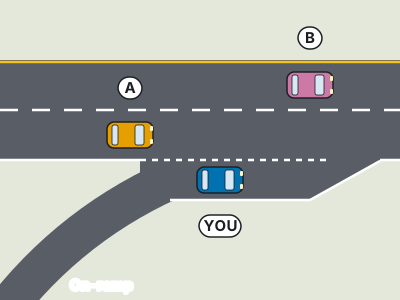
- Traffic already on the freeway
- Only vehicles in the left lane
- Vehicles behind on the ramp
- No traffic, because the ramp has priority
Show answer
Traffic already on the freeway. Traffic already traveling on the freeway has priority over a vehicle entering from an on-ramp. The entering driver is responsible for merging safely, matching the speed of traffic in the right lane, signaling, and checking surrounding vehicles. The left-lane-only option is too narrow because freeway traffic in the relevant roadway must be considered. Cars behind on the ramp do not erase the duty to yield. Build speed to fit the flow, but wait for a safe opening before merging.
Study this in the handbook: Parking rules, hills and painted curbs
12. At an intersection controlled by a green light, what should you do if another vehicle is already in the intersection?
- Enter first because green always gives priority
- Stop in the intersection to reserve your path
- Sound the horn and continue without checking
- Yield to that vehicle before entering
Show answer
Yield to that vehicle before entering. A green indication permits movement only when the way is clear. Arizona instructs drivers to yield to a vehicle already in the intersection when the signal changes. Green does not erase an existing conflict or guarantee that the intersection is open. Sounding the horn does not replace yielding, and stopping in the intersection can block other traffic. Before moving on green, scan left and right, identify vehicles already committed to the crossing, and let them clear. The light authorizes a safe movement, not an automatic claim over occupied space.
Study this in the handbook: Traffic signals and red light running
13. For a driver under 21 in Arizona, what alcohol finding can lead to a license suspension?
- Only a reading of 0.08 percent or higher
- Any alcohol concentration
- Only a reading of 0.15 percent or higher
- Alcohol only when combined with a moving violation
Show answer
Any alcohol concentration. Arizona may suspend the license of a driver under 21 if there is any alcohol concentration. No minimum numeric BAC is needed for this under-21 rule, so the 0.08 percent option incorrectly imports the adult threshold. The 0.15 percent choice is tied to extreme DUI and is much higher than the youth standard. Remember the quick cue for this question: under 21 plus any alcohol concentration can produce a suspension, even when the number is below the adult DUI benchmark.
Study this in the handbook: Alcohol, drugs and DUI penalties
14. For an adult Arizona driver not subject to novice-license restrictions, which routine phone use is permitted while the vehicle is moving?
- Only to report an emergency
- A hands-free voice conversation using a qualifying device
- To read a short text if traffic is light
- Holding the phone to your ear for a short routine call
Show answer
A hands-free voice conversation using a qualifying device. Arizona’s general law allows an adult driver to have a voice conversation through a qualifying hands-free device without holding or supporting the phone. It prohibits handheld use and most manual text communication while driving. Novice-driver restrictions have a different scope, so their emergency exception should not be generalized to every driver. The question concerns a moving vehicle and routine adult use. Even legal hands-free use can distract you; park safely before making a call when possible.
15. What shape are most signs used in highway and street work areas?
- Circle
- Octagon
- Diamond
- Pentagon
Show answer
Diamond. Arizona describes most construction and maintenance signs as diamond-shaped. This shape gives advance notice of a work area, where lanes, pavement, or traffic movement may change. An octagon is reserved for stop signs, while a circle warns that a railroad crossing is approaching. The pentagon identifies a school crossing and is unrelated to roadway repairs. When a diamond appears near workers or equipment, scan for changing conditions, reduce speed, and follow the temporary directions instead of assuming the normal lane will continue unchanged.
Study this in the handbook: Speed limits and work zones
16. What does a driver approaching a school crossing in Arizona have to do when the crosswalk is occupied by any person?
- Slow slightly and continue through
- Honk so the person clears the lane
- Come to a complete stop
- Pass another stopped vehicle if a lane is open
Show answer
Come to a complete stop. At a school crossing, the driver must make a complete stop when the crosswalk is occupied by any person. Merely reducing speed does not meet the stated requirement, and a horn cannot replace stopping. The manual also warns that passing a vehicle stopped for a pedestrian is prohibited, even if another lane or a green signal appears available. See a person in the crosswalk, stop fully, remain attentive, and move only when the crossing is clear.
Study this in the handbook: Signaling, passing and U turns
17. After discharge, how long may military personnel work in Arizona without getting an Arizona license?
- Up to one year
- Only 10 days
- Indefinitely
- Up to 90 days, if they hold a valid license from another state or country and meet the other conditions
Show answer
Up to 90 days, if they hold a valid license from another state or country and meet the other conditions. Upon discharge, military personnel may work in Arizona for up to 90 days without obtaining an Arizona driver license, provided all the listed conditions are met, including possessing a valid license issued by another state or country. Personnel based in Arizona who qualify under the Soldiers and Sailors Relief Act are treated separately as nonresidents. The other listed conditions are that the vehicle requires a Class D license and that the person works as an employee, agent or consultant of an organization operating in Arizona and at least one other state or country.
18. At an uncontrolled intersection, what must you do before entering?
- Slow to walking speed without stopping
- Make a complete stop, then proceed when the roadway is clear
- Enter first if you are on the wider street
- Stop only when another vehicle honks
Show answer
Make a complete stop, then proceed when the roadway is clear. Arizona treats an intersection without traffic lights, stop signs, or yield signs as a four-way stop. Every approach must make a complete stop before entering, followed by a careful check that the roadway is clear. Road width does not grant automatic priority, and a horn is not the condition that triggers the stop. If two vehicles arrive together, the driver on the left yields to the driver on the right after both have stopped.
Study this in the handbook: Signaling, passing and U turns
19. How should a driver treat a white speed-limit sign with black letters?
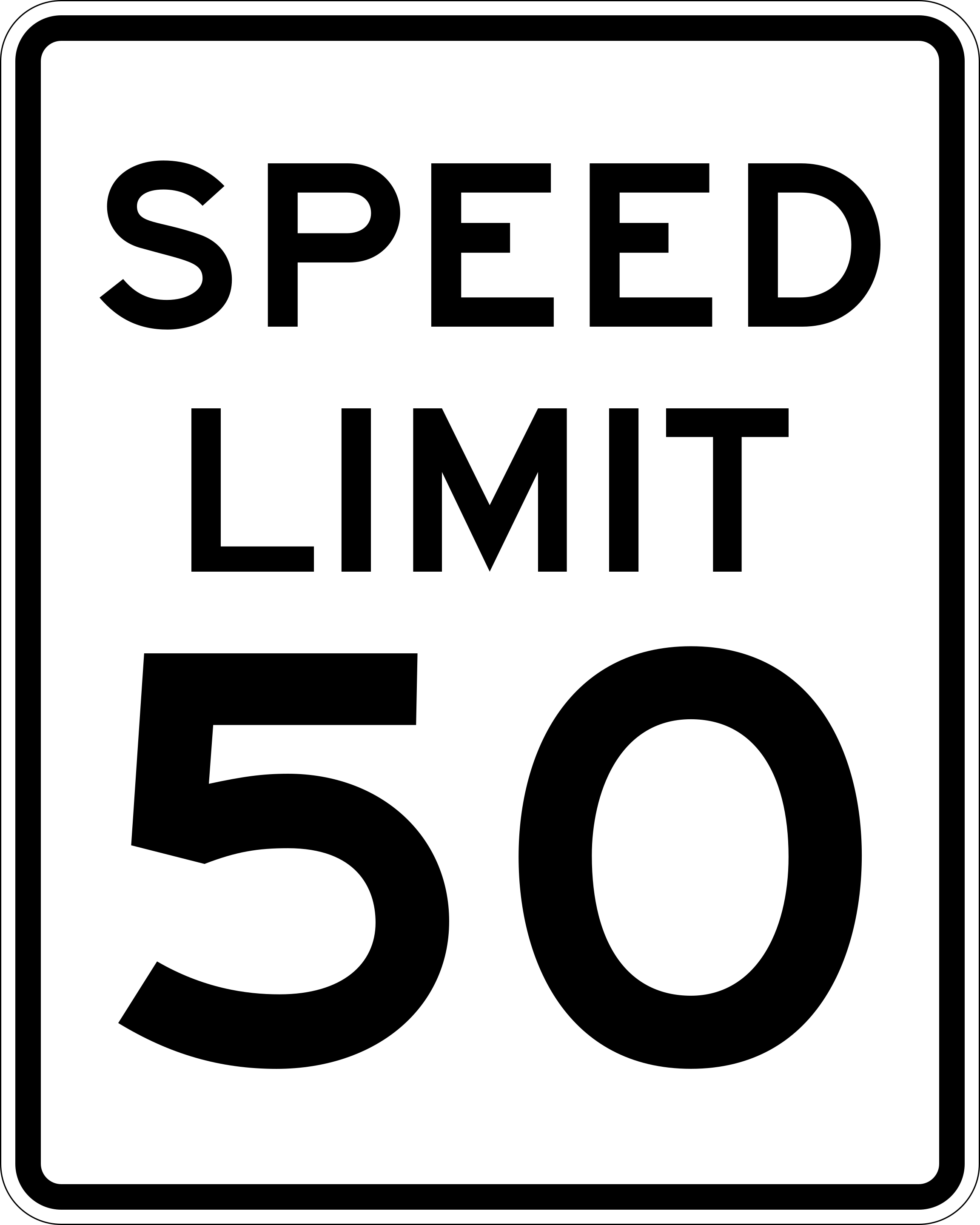
- As a regulatory maximum speed
- As a warning that a railroad crossing is near
- As a sign applying only to commercial vehicles
- As an optional suggestion only
Show answer
As a regulatory maximum speed. A white speed-limit sign with black letters is regulatory in Arizona. It identifies the maximum speed a driver may legally go, so treating it as an optional suggestion can lead to a violation. The manual gives the advisory role to a different sign: orange signs with black letters recommend safe speeds for curvature, grade, or another special condition. Railroad warnings use a circle-shaped sign, and nothing in the rule limits a white speed sign to commercial vehicles. A useful cue is color and wording together: white with black speed lettering sets the legal ceiling.
Study this in the handbook: Speed limits and work zones
20. At what location does the X-shaped railroad sign stand?
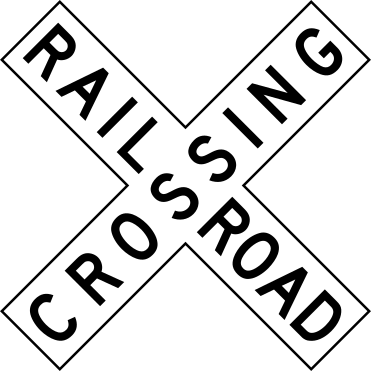
- At the railroad crossing itself
- At a school crossing
- Far before the crossing as a speed-limit sign
- At the start of a no-passing zone
Show answer
At the railroad crossing itself. The railroad crossing sign marks the location of the crossing itself. That placement differs from the circle-shaped railroad warning sign, which tells drivers they are approaching a crossing. The speed-limit choice describes neither railroad sign, and the school and no-passing choices belong to other sign groups. At the crossing, the driver must be ready to stop when the listed train warning conditions appear and must not drive around or under a lowered barricade. The practical cue is to distinguish advance warning from the crossbuck at the tracks: reaching the X-shaped sign means the crossing is immediately present.
Study this in the handbook: Speed limits and work zones
QualitySpace is expanding to Arizona
We are a California-based independent insurance brokerage working on licensing in more states. We cannot help with Arizona insurance yet. Leave your email and we will let you know when we can.
Every question is written from the official Arizona Driver License Manual. Need paper? Printable AZ practice test with answer key.
Last verified 2026-10-05. How we check every question · Study all 202 as flashcards
Frequently asked questions
How many questions are on this Arizona practice test?
This fixed set has 20 questions. It is test 2 of 10 from the 202 question Arizona bank. The real AZ exam asks 30 questions and you need 24 correct.
What is the passing score for the real Arizona test?
A score of 80% or higher is required to pass That figure comes from the official Arizona source cited on the DMV facts page.
How does this fixed test relate to the full Arizona bank?
Each numbered test is a fixed set of questions in a fixed order, so you can retake the same test later and compare. Every test mixes road signs and the other topics in about the same proportion as the full bank. Tests 1 to 10 together cover 200 of the 202 questions in the Arizona bank, each once. The full practice page mixes the whole bank at random.
Last verified 2026-10-05. See the Arizona DMV facts page for sourced state details.