
Test 9 of 10 · 20 questions · Free 2026
AZ Permit Practice Test 9
Jump to the test ↓A fixed 20 question set from the Arizona bank with answers and plain English explanations. The real AZ exam is 30 questions, 80 percent to pass; take the full length version on the main practice page.
Question 1 of 20 · 0 right so far
All 20 questions in test 9
Every question below comes from the Arizona question bank on this page. Open a question to see the correct answer and the explanation. Nothing here is hidden behind a signup.
1. What is the minimum age for an Arizona operator (Class D) instruction permit?
- 15 and a half
- 16
- 17
- 18
Show answer
18. Arizona issues graduated and motorcycle instruction permits at 15 years and 6 months, but an applicant must be at least 18 for an operator permit. So 15 and a half is the graduated permit age, and 16 is the graduated license age. Seventeen is not a threshold in this rule. Teens use the graduated route, and adults use the operator permit.
Study this in the handbook: Instruction permits and the graduated license
2. Which speed is listed as the unposted limit for a rural freeway in Arizona?
- 45 mph
- 55 mph
- 75 mph
- 65 mph
Show answer
75 mph. An Arizona rural freeway has an unposted limit of 75 mph in the manual's list of default speed limits. That number is higher than the 65 mph designated open-highway limit and the 55 mph open-highway or city-freeway limit. The 15 mph school-crosswalk figure belongs to a completely different setting. First classify the roadway as rural freeway, then select 75 mph. Posted signs still control, because the listed figures apply only when no limit is posted.
Study this in the handbook: Speed limits and work zones
3. What can happen to someone who parks in an Arizona space marked with the international symbol of access without authorization?
- It is allowed for up to 15 minutes
- It is illegal and may result in a fine
- It is allowed with flashers on
- Nothing, the spaces are advisory
Show answer
It is illegal and may result in a fine. The international symbol of access appears on reserved parking signs, placards and license plates for persons with disabilities. Spaces marked with it may be used only by a vehicle displaying a valid placard or plate with the symbol, and only when transporting the person who was issued it. It is illegal for anyone else to park in these spaces, and doing so may result in a fine. The manual gives no grace period, flashers do not make it legal, and the spaces are not advisory.
Study this in the handbook: Parking rules, hills and painted curbs
4. What following distance should you use in heavy rain?
- Exactly 3 seconds
- No more than 2 seconds
- The same gap used on dry pavement
- At least 6 seconds
Show answer
At least 6 seconds. During heavy rain, Arizona advises increasing the gap to at least six seconds. Water reduces visibility and traction, so the extra time helps you react if the vehicle ahead slows or a road hazard appears. Even in ordinary conditions the manual suggests a cushion of 3 to 6 seconds, so a 2 second gap or the usual dry pavement gap falls short here. Choose a fixed point on the road, count the interval after the lead vehicle passes it, and slow further when visibility or traction worsens.
Study this in the handbook: Stopping distance, bad weather and night driving
5. A roadway has a posted speed sign showing less than Arizona's unposted limit for that road. Which speed must you follow?
- The highest unposted limit for the road type
- The speed on the posted sign
- A speed selected by surrounding traffic
- The limit printed on the nearest route marker
Show answer
The speed on the posted sign. Arizona requires drivers to obey posted speed limits, even when the displayed number is lower than the default for that road. The unposted figures apply only when no limit is posted. The road type does not override a visible regulatory sign, and surrounding traffic cannot make a higher speed legal. A route marker identifies a road or route rather than setting its speed. When the sign and a remembered statutory number differ, use the number on the sign and adjust further if weather, traffic, or road conditions require a slower pace.
Study this in the handbook: Speed limits and work zones
6. What does Arizona require of a vehicle's muffler?
- It may be removed for racing
- It is optional on vehicles older than 1967
- It must be replaced every year
- It must be in good working condition and in constant operation to prevent excessive pollution or unusual noise
Show answer
It must be in good working condition and in constant operation to prevent excessive pollution or unusual noise. Every motor vehicle must have a muffler in good working condition and in constant operation to prevent excessive pollution or unusual noise. Cutouts and bypasses that let exhaust skip the muffler are illegal on public roads. Vehicles of the 1967 model year and newer must also have an exhaust emissions system, and the vehicle needs a windshield without cracks and working wipers.
Study this in the handbook: Vehicle equipment, seat belts and child seats
7. When should high beams be switched to low beams for oncoming traffic?
- Only after an oncoming driver flashes headlights
- Only within 200 feet of a vehicle ahead
- Whenever you meet oncoming traffic
- Only on city streets
Show answer
Whenever you meet oncoming traffic. Arizona directs drivers to switch to low beams whenever they meet oncoming traffic so the other driver is not blinded. The 200 foot distance belongs to following another car, not meeting one, and waiting for a headlight flash delays the courtesy and safety measure. City streets are not the only setting covered. Watch for approaching headlights, dim before the vehicles are close, and keep the low beams on through the meeting.
Study this in the handbook: Stopping distance, bad weather and night driving
8. After railroad crossing signals stop, when may a driver cross the tracks?
- When all signals have stopped and the barricade is fully up
- As soon as the flashing lights slow down
- When the barricade begins to rise
- After stopping beside the lowered barricade
Show answer
When all signals have stopped and the barricade is fully up. A driver must wait until every railroad signal has stopped and the crossing barricade is completely raised before crossing the tracks. Slowing lights are not the same as stopped signals, and a barricade that has only started rising still blocks the crossing. Waiting beside a lowered barricade leaves the vehicle in a dangerous position and does not satisfy the instruction. Use the full signal sequence as the cue: signals stop, the barricade comes up all the way, and only then may the vehicle proceed across.
Study this in the handbook: Speed limits and work zones
9. What do double solid yellow center lines mean?
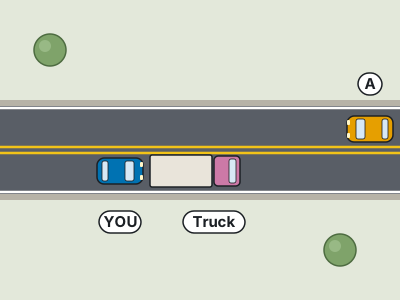
- Passing is allowed for traffic traveling north only
- Passing is not allowed in either direction, though a left turn may cross
- They separate lanes moving in the same direction
- They mark a parking lane beside the curb
Show answer
Passing is not allowed in either direction, though a left turn may cross. Double solid yellow lines prohibit passing in either direction. The manual allows crossing them for a left turn, but that limited exception does not turn the centerline into a passing area. The lines separate opposing traffic, not same-direction lanes, and they do not designate curbside parking. Treat the paired solid lines as a strong warning to remain behind slower traffic. Wait for a lawful passing area rather than crossing simply because the opposite lane looks open.
Study this in the handbook: Pavement markings and turning lanes
10. What happens to an Arizona driver's privilege when a DUI test shows an alcohol concentration of 0.08 percent or more?
- Only a warning is issued until court
- The driving privilege is lost on the spot
- The driver may continue until a second test
- The license is suspended for 30 days only
Show answer
The driving privilege is lost on the spot. The manual states that a test showing an alcohol concentration of 0.08 percent or more causes the driver to lose the driving privilege on the spot. That immediate consequence is different from waiting for a court result, receiving a warning, or continuing until another test, and the manual does not describe it as a 30 day suspension. The same passage identifies 0.04 for a commercial vehicle requiring a commercial driver license. Watch the vehicle category and the phrase on the spot: the loss begins as soon as the qualifying test result is in.
Study this in the handbook: Alcohol, drugs and DUI penalties
11. When registering to vote through Arizona MVD, how far before an election must registration be complete?
- 7 days before
- The day before the election
- 29 days before the election
- 90 days before
Show answer
29 days before the election. You must be registered to vote 29 days before an election in order to qualify to vote in the upcoming election. MVD offers voter registration with license transactions, online at AZMVDNow.gov, or through a separate form. If you change your address you must re register to vote, and submitting a false voter registration is a Class 6 felony. There is no fee to register to vote.
12. What do yellow, diamond-shaped Arizona signs warn drivers about?

- A mandatory stop at the next intersection
- A possible danger ahead
- The location of a railroad crossing
- The beginning of a restricted turn
Show answer
A possible danger ahead. Arizona uses yellow, diamond-shaped signs to warn drivers of a possible danger ahead. This warning category is different from a regulatory instruction such as No U Turn or One Way. A stop requirement comes from a stop sign, a railroad crossing is identified by a circle-shaped warning sign, and a turn restriction is posted as a regulatory sign. Use the diamond outline as an early caution cue, reduce speed when the roadway calls for it, and read the wording to identify the specific hazard.
Study this in the handbook: Traffic signs, railroad crossings and work zones
13. What should a driver do when a severe Arizona dust storm reduces visibility?
- Stop in the travel lane with headlights on
- Park in the emergency lane with hazard lights flashing
- Keep driving slowly with the lights on until visibility returns
- Pull completely off the highway, stop far right, turn off lights, and remain buckled in the vehicle
Show answer
Pull completely off the highway, stop far right, turn off lights, and remain buckled in the vehicle. For a severe dust storm, Arizona lists these steps: reduce your speed immediately, drive completely off the highway, stop as far to the right as possible, and do not stop in the travel lane or in the emergency lane. Then turn off your lights, take your foot off the brake, stay in the vehicle with your seat belts buckled, and wait until the dust storm has passed. Stopping in a lane, parking in the emergency lane with flashers on, or driving on with the lights on each breaks one of those listed steps.
Study this in the handbook: Stopping distance, bad weather and night driving
14. How many seconds of following distance should a driver use on slippery roads?
- Six seconds or more
- Two seconds
- One second
- Exactly three seconds
Show answer
Six seconds or more. The Arizona manual advises doubling the normal following cushion to 6 seconds or more on slippery roads. Wet, icy, or otherwise slick pavement needs extra distance for a driver to adjust speed and stop. Exactly three seconds is the ordinary minimum cited for most driving situations, so keeping that amount in a slippery condition leaves too little margin. Pick a fixed point, count the interval after the vehicle ahead passes it, and increase the gap before conditions deteriorate further.
Study this in the handbook: Stopping distance, bad weather and night driving
15. An Arizona driver runs a red light and causes a crash that kills another person. On a first conviction, what license action does ARS 28-672 require?
- A suspension or restriction of at least 180 days and not more than one year
- A $250 fine with no license action
- A suspension of at least 90 days and not more than 180 days
- Traffic Survival School only
Show answer
A suspension or restriction of at least 180 days and not more than one year. When a red light violation causes a crash that results in death, ARS 28-672 treats it as a class 1 misdemeanor. On a first conviction the court directs MVD to suspend or restrict the driving privilege for at least 180 days and not more than one year, and the driver must also complete Traffic Survival School. The 90 to 180 day range applies when the crash causes serious physical injury instead of death. The statute also allows the court to order community restitution.
16. At an intersection with an inoperative traffic signal, two vehicles arrive at about the same time. Who must yield?
- The driver on the right yields to the driver on the left
- The vehicle going straight yields to every turn
- The driver on the left yields to the driver on the right
- Neither driver needs to stop
Show answer
The driver on the left yields to the driver on the right. Both vehicles must stop first at a same-time arrival. The driver on the left yields, allowing the driver on the right to proceed when the path is clear. This rule is about position, not vehicle size, speed, or which driver entered the intersection more aggressively. A signal or stop sign still controls when one is present. Scan across the intersection, identify the vehicle to your right, and wait for that vehicle before continuing. Use a full stop and a clear view rather than relying only on eye contact or a horn.
Study this in the handbook: Traffic signals and red light running
17. When should a driver activate hazard warning signal lights?
- Whenever the vehicle is parked legally at home
- Only while passing another vehicle
- Only during a planned lane change
- Whenever the vehicle is stopped on the roadway or shoulder
Show answer
Whenever the vehicle is stopped on the roadway or shoulder. The manual advises activating emergency flashers whenever a vehicle is stopped on the roadway or shoulder. That warning helps approaching drivers recognize a stopped vehicle and gives them time to slow or move around it. Passing, a routine lane change, or parking at home does not describe the hazard situation in the rule. If a breakdown or other problem forces a stop, get as far out of traffic as possible and make the vehicle visible while arranging help.
Study this in the handbook: Vehicle equipment, seat belts and child seats
18. According to survey data in the Arizona manual, which adults are most likely to drive after drinking?
- Adults over 65
- Adults between the ages of 21 and 29
- Teens under 18
- Adults between 40 and 50
Show answer
Adults between the ages of 21 and 29. Survey data cited in the manual indicates that adults between the ages of 21 and 29 are the most likely to drive after they have been drinking, while alcohol involvement in crashes peaks between 21 and 34. The manual also warns that being under the legal limit of 0.08 does not mean it is legal or safe to drive, because studies prove alcohol impairs driving at levels substantially below 0.08. Adults over 65, teens under 18, and adults 40 to 50 are not the group the survey names.
Study this in the handbook: Alcohol, drugs and DUI penalties
19. How far behind a fire department vehicle responding to an emergency must an Arizona driver remain?
- At least 300 feet
- At least 100 feet
- At least 500 feet
- At least 1,000 feet
Show answer
At least 500 feet. Arizona requires at least 500 feet of distance behind a fire department vehicle responding to an emergency. The 300-foot figure applies to a police vehicle, while 100 feet and 1,000 feet are not the distances stated for this situation. This rule operates alongside the general instruction to yield, move right, and stop for an approaching emergency vehicle. Once the emergency vehicle is moving ahead, do not close the gap just because traffic appears open. Match the vehicle type to its specific following-distance requirement.
Study this in the handbook: Emergency vehicles, Move Over and school buses
20. Within what distance of a street crossing does Arizona prohibit passing?
- Within 100 feet
- Within 50 feet
- Within 200 feet
- Within 500 feet
Show answer
Within 100 feet. Passing is prohibited when approaching within 100 feet of a street crossing or a railroad crossing, and within 100 feet of a bridge, tunnel or underpass where the view is blocked. Two hundred and 500 feet are headlight dimming distances, not passing limits. Fifty feet is too short. Wait until you are past the crossing and the road ahead is clear before starting a pass.
Study this in the handbook: Signaling, passing and U turns
QualitySpace is expanding to Arizona
We are a California-based independent insurance brokerage working on licensing in more states. We cannot help with Arizona insurance yet. Leave your email and we will let you know when we can.
Every question is written from the official Arizona Driver License Manual. Need paper? Printable AZ practice test with answer key.
Last verified 2026-10-05. How we check every question · Study all 202 as flashcards
Frequently asked questions
How many questions are on this Arizona practice test?
This fixed set has 20 questions. It is test 9 of 10 from the 202 question Arizona bank. The real AZ exam asks 30 questions and you need 24 correct.
What is the passing score for the real Arizona test?
A score of 80% or higher is required to pass That figure comes from the official Arizona source cited on the DMV facts page.
How does this fixed test relate to the full Arizona bank?
Each numbered test is a fixed set of questions in a fixed order, so you can retake the same test later and compare. Every test mixes road signs and the other topics in about the same proportion as the full bank. Tests 1 to 10 together cover 200 of the 202 questions in the Arizona bank, each once. The full practice page mixes the whole bank at random.
Last verified 2026-10-05. See the Arizona DMV facts page for sourced state details.