
Key points
When an emergency vehicle approaches with a siren or lights, yield, move to the right and stop until it passes.
Source: Handbook p. 38
“approaches using a siren, lights or other warning devices, you must yield the right-of way. Move to the right side of the road and stop until the vehicle has passed.”
Arizona Driver License Manual and Customer Service Guide, Handbook p. 38Yield by changing into a lane that is not next to the emergency vehicle.
Source: Handbook p. 38
“Yield the right-of-way by making a lane change into a lane not adjacent to that of the emergency vehicle.”
Arizona Driver License Manual and Customer Service Guide, Handbook p. 38Stay at least 500 feet behind a fire vehicle and 300 feet behind a police vehicle responding to an emergency.
Source: Handbook p. 38
“The driver shall maintain a distance of at least 500 feet behind a fire department vehicle responding to an emergency and at least 300 feet behind a police vehicle responding to an emergency.”
Arizona Driver License Manual and Customer Service Guide, Handbook p. 38Do not drive into or park within the block where an emergency vehicle has stopped.
Source: Handbook p. 38
“Do not drive into or park your vehicle within the block where the emergency vehicle has stopped to respond to the emergency.”
Arizona Driver License Manual and Customer Service Guide, Handbook p. 38The Move Over Law covers all vehicles pulled over with flashing lights, including tow trucks and private vehicles.
Source: Handbook p. 39
“This law pertains to all vehicles pulled over with flashing lights, including emergencyresponse and law-enforcement vehicles, tow trucks, highway maintenance vehicles and private vehicles.”
Arizona Driver License Manual and Customer Service Guide, Handbook p. 39If you cannot safely move over, slow down and use caution.
Source: Handbook p. 39
“If it’s not safe or possible to move over, motorists must slow down and use caution.”
Arizona Driver License Manual and Customer Service Guide, Handbook p. 39You must stop for any school bus with flashing lights and its stop arm out.
Source: Handbook p. 39
“You must stop for any school bus with flashing lights if its stop-sign arm is out.”
Arizona Driver License Manual and Customer Service Guide, Handbook p. 39You need not stop for a school bus on the other side of a divided roadway, one separated by physical barriers such as a fence or curbing.
Source: Handbook p. 39
“You are not required to stop for a school bus on a divided roadway when traveling in the opposite direction. A divided roadway is one in which the road is separated by physical barriers such as a fence, curbing or separation of the pavement.”
Arizona Driver License Manual and Customer Service Guide, Handbook p. 39Use extreme care near a stopped school bus; a child may dart from the front or rear.
Source: Handbook p. 39
“Motorists should exercise extreme care when in the vicinity of any stopped school bus, as a child may dart from the front or the rear of the bus.”
Arizona Driver License Manual and Customer Service Guide, Handbook p. 39
Numbers to know
| Number | What it means | Manual |
|---|---|---|
| 500 feet | distance to stay behind a fire vehicle responding to an emergency | Handbook p. 38 |
| 300 feet | distance to stay behind a police vehicle responding to an emergency | Handbook p. 38 |
Recognize these signs
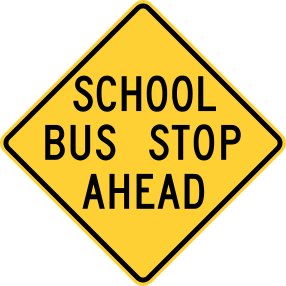
School bus stop ahead
3 questions from the Arizona practice test
1. How far behind a fire department vehicle responding to an emergency must an Arizona driver remain?
- At least 300 feet
- At least 100 feet
- At least 500 feet
- At least 1,000 feet
Show answer
At least 500 feet. Arizona requires at least 500 feet of distance behind a fire department vehicle responding to an emergency. The 300-foot figure applies to a police vehicle, while 100 feet and 1,000 feet are not the distances stated for this situation. This rule operates alongside the general instruction to yield, move right, and stop for an approaching emergency vehicle. Once the emergency vehicle is moving ahead, do not close the gap just because traffic appears open. Match the vehicle type to its specific following-distance requirement.
2. Arizona’s Move Over Law applies to which vehicles pulled over with flashing lights?
- Only highway maintenance vehicles
- Only police cars and ambulances
- Only tow trucks on freeways
- All such vehicles, including private vehicles
Show answer
All such vehicles, including private vehicles. Arizona’s Move Over Law covers every vehicle pulled over with flashing lights, not just a particular agency or roadway type. The manual names emergency-response and law-enforcement vehicles, tow trucks, highway maintenance vehicles, and private vehicles. That broad coverage is why a driver should scan the shoulder whenever flashing lights appear. Police cars and ambulances are included, but they are not the only protected vehicles. A tow truck is covered, but the rule is not limited to freeways or maintenance crews. Identify the lights first, then move over when safe or slow down and use caution.
3. When a fire engine, police car, or ambulance with warning equipment approaches, what must an Arizona driver do?
- Continue straight while holding the lane
- Yield, move to the right, and stop until it passes
- Turn left immediately into the nearest street
- Follow it closely to get through traffic
Show answer
Yield, move to the right, and stop until it passes. An approaching emergency vehicle, such as police, fire or ambulance, with flashing lights or an audible signal requires the driver to yield the right-of-way, move to the right, and stop until the emergency vehicle has passed. Continuing straight in the lane or following closely does not yield, and the manual adds that you must stay at least 500 feet behind a responding fire vehicle and 300 feet behind a responding police vehicle. Turning left into the nearest street is not the listed response. Move right, stop, and stay stopped until the vehicle is past.
Practice this topic
Lock it in with emergencies questions from the free Arizona practice test. Every answer comes with a plain English explanation.
Source: the Arizona Driver License Manual and Customer Service Guide, Section 3: Roadway and Vehicle Knowledge. This lesson is a plain English summary, not the law itself; where it differs, the manual and the statute govern. Last checked 2026-09-27.