
Key points
The law does not give the right of way to anyone; no one may take it if doing so could cause a crash.
Source: Handbook p. 36
“The law does not actually “give” the right-of-way to any particular motorist, it just states who must yield. No one is allowed to take the right-of-way if taking it means a crash may result.”
Arizona Driver License Manual and Customer Service Guide, Handbook p. 36Treat an intersection with no lights or signs as a 4 way stop.
Source: Handbook p. 36
“When approaching an intersection with an inoperative traffic control signal or no traffic lights, stop signs or yield signs, treat it as you would a 4way stop.”
Arizona Driver License Manual and Customer Service Guide, Handbook p. 36At a T intersection, the driver on the street that ends must yield.
Source: Handbook p. 35
“At a “T” intersection, the driver on the street which ends must yield the rightof-way to vehicles on the cross street.”
Arizona Driver License Manual and Customer Service Guide, Handbook p. 35Yield to pedestrians in any marked or unmarked crosswalk.
Source: Handbook p. 36
“You must yield the right-of-way to pedestrians crossing the street in any marked or unmarked crosswalk.”
Arizona Driver License Manual and Customer Service Guide, Handbook p. 36Stop completely at any school crossing when anyone is in the crosswalk.
Source: Handbook p. 36
“The law also requires vehicles to come to a complete stop at any school crossing when the crosswalk is occupied by any person.”
Arizona Driver License Manual and Customer Service Guide, Handbook p. 36When turning left, yield to any oncoming vehicle, bicycle or pedestrian.
Source: Handbook p. 37
“When you are preparing to turn left, you must yield the right-of-way to any oncoming vehicle, bicycle or pedestrian.”
Arizona Driver License Manual and Customer Service Guide, Handbook p. 37At a roundabout, yield to vehicles already inside and to large vehicles entering at the same time.
Source: Handbook p. 28
“Vehicles approaching the roundabout must yield to all vehicles already in the roundabout and must yield to large vehicles that are entering the roundabout at the same time.”
Arizona Driver License Manual and Customer Service Guide, Handbook p. 28Roundabouts are designed for 15 to 20 mph.
Source: Handbook p. 28
“roundabouts are designed for speeds of 15-20 mph.”
Arizona Driver License Manual and Customer Service Guide, Handbook p. 28Yield to a funeral procession led by an escort flashing a red or blue light.
Source: Handbook p. 39
“Drivers must yield the right-of-way to any vehicle that is part of a funeral procession being led by a funeral escort vehicle flashing a red or a blue light.”
Arizona Driver License Manual and Customer Service Guide, Handbook p. 39
Numbers to know
| Number | What it means | Manual |
|---|---|---|
| 15 to 20 mph | design speed of roundabouts | Handbook p. 28 |
| 4 way stop | how to treat an intersection with no lights or signs | Handbook p. 36 |
Recognize these signs
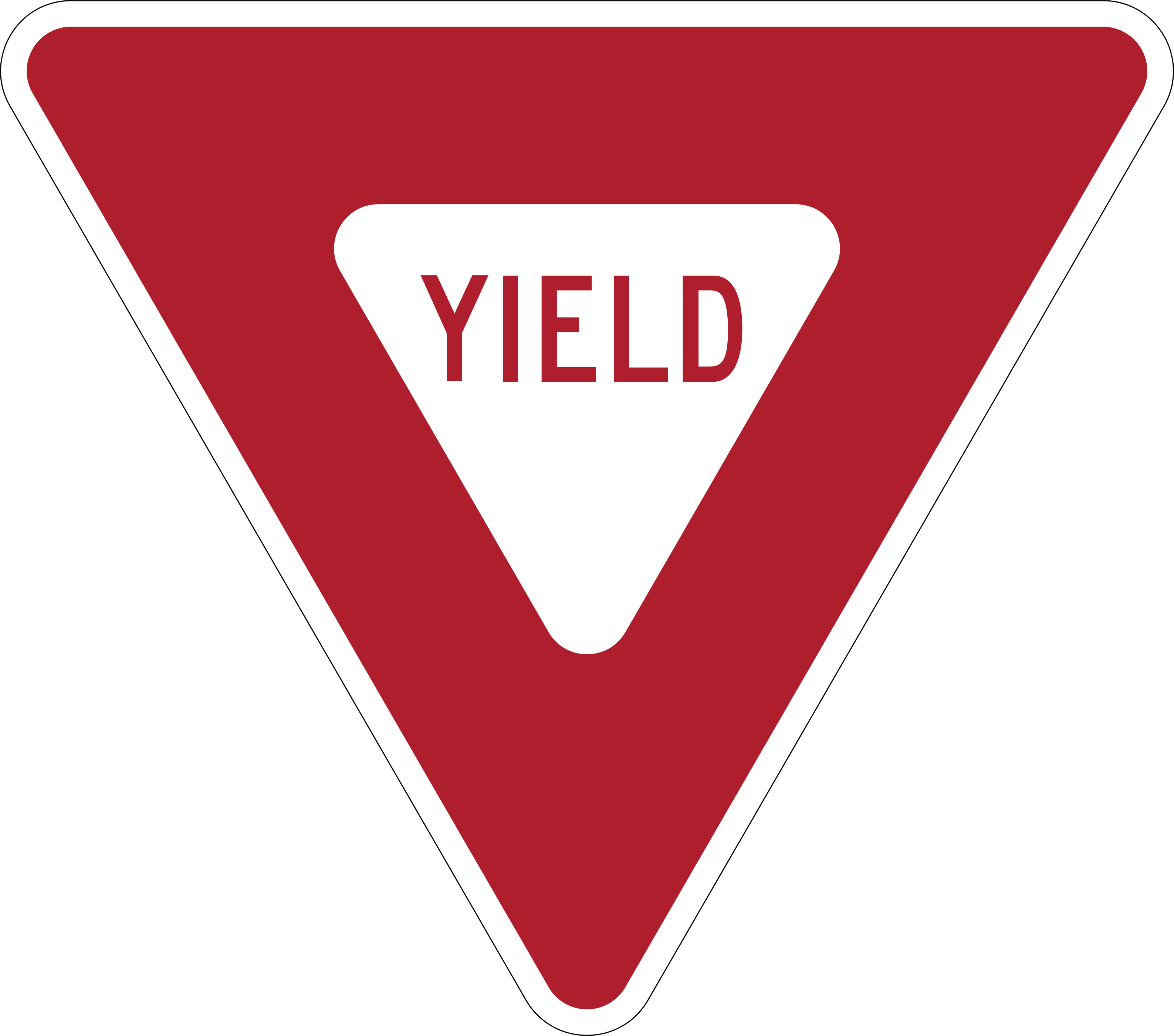
Yield 
Roundabout ahead 
Pedestrian crossing
3 questions from the Arizona practice test
1. At an uncontrolled T intersection in Arizona, which driver must yield?
- The driver on the street that ends
- The driver traveling at the lower speed
- The driver on the cross street
- The driver who reaches the corner first
Show answer
The driver on the street that ends. At a T intersection, the street that ends does not continue through the junction. Its driver must yield to vehicles traveling on the cross street. The cross-street driver is not required to give way merely because another vehicle is approaching from the terminating road. Speed and arrival order do not replace this layout-based rule. Picture the stem of the T meeting its top bar: traffic on the stem waits, checks carefully, and yields before entering the through street.
2. Where must an Arizona driver yield to a pedestrian crossing the street?
- Only at a painted crosswalk
- Only when a crossing guard is present
- Only when the pedestrian has a signal
- At any marked or unmarked crosswalk
Show answer
At any marked or unmarked crosswalk. Arizona requires drivers to yield to pedestrians crossing in any marked or unmarked crosswalk. Paint is not what creates the driver's duty, so limiting the rule to painted lines misses unmarked crossings. A crossing guard or pedestrian signal may add direction, but neither is required for the baseline crosswalk rule. Scan both sides of the street, reduce speed early, and leave the crossing clear. If someone is crossing, yielding is the safer response even when the light has changed for you.
3. Before making a left turn in Arizona, which road users must the driver yield to?
- Oncoming vehicles, bicycles, and pedestrians
- Vehicles behind the turning driver only
- No one when the turn signal is on
- Only oncoming cars, not bicycles or pedestrians
Show answer
Oncoming vehicles, bicycles, and pedestrians. A left-turning driver must yield to any oncoming vehicle, bicycle, or pedestrian. The rule protects all three categories, so the choice that names cars alone is incomplete. A signal communicates intent but does not cancel the duty to yield, and traffic behind the turning vehicle is not the group identified in this rule. Look straight through the turn path for approaching road users, wait until they are clear, and then complete the movement safely.
Practice this topic
Lock it in with right of way questions from the free Arizona practice test. Every answer comes with a plain English explanation.
Source: the Arizona Driver License Manual and Customer Service Guide, Section 3: Roadway and Vehicle Knowledge. This lesson is a plain English summary, not the law itself; where it differs, the manual and the statute govern. Last checked 2026-09-27.