
Test 6 of 10 · 20 questions · Free 2026
AZ Permit Practice Test 6
Jump to the test ↓A fixed 20 question set from the Arizona bank with answers and plain English explanations. The real AZ exam is 30 questions, 80 percent to pass; take the full length version on the main practice page.
Question 1 of 20 · 0 right so far
All 20 questions in test 6
Every question below comes from the Arizona question bank on this page. Open a question to see the correct answer and the explanation. Nothing here is hidden behind a signup.
1. What is the minimum age for an Arizona graduated driver license?
- 15 years and 6 months
- 17 years
- 18 years
- 16 years
Show answer
16 years. A Class G graduated license begins at age 16, provided the applicant meets the other requirements. The 15 years and 6 months choice is the threshold for an instruction permit, not the license itself. Seventeen is not the minimum, and 18 is the upper edge of the manual's stated graduated-license age range rather than the starting point. Remember the sequence as permit first, supervised experience next, and Class G eligibility at 16. The manual also says an applicant for a graduated license must have held an Arizona instruction permit for at least six months.
Study this in the handbook: Instruction permits and the graduated license
2. How long is the automatic loss of driving privilege for a first refusal or unsuccessful completion of a DUI test?
- 6 months
- 24 months
- 12 months
- 90 days
Show answer
12 months. A first refusal or unsuccessful completion of a requested DUI test produces an automatic 12-month loss of driving privilege under the manual. A second refusal within 84 months increases the period to 24 months. Six months and 90 days are not the first-refusal terms stated in this passage. The question turns on the number of refusals, not on whether the driver believes the test would have shown impairment. Remember the pair as one year for a first refusal and two years for the specified repeat refusal window.
Study this in the handbook: Alcohol, drugs and DUI penalties
3. What is the unposted speed limit in an Arizona business or residential district?
- 25 mph
- 15 mph
- 55 mph
- 75 mph
Show answer
25 mph. In a business or residential district with no posted limit, Arizona lists 25 mph as the required speed. The 15 mph figure applies when approaching a school crosswalk, while 55 mph applies to open highways or city freeways and 75 mph to rural freeways. Identify the road setting before choosing a number. A city district and an open or rural freeway do not share the same unposted limit, so the surroundings matter as much as the absence of a sign.
Study this in the handbook: Speed limits and work zones
4. Where may an Arizona driver not park after an emergency vehicle has stopped to respond to an emergency?
- Anywhere within five miles of the scene
- Within the block where the emergency vehicle has stopped
- Only directly behind the emergency vehicle
- Only on the opposite side of the street
Show answer
Within the block where the emergency vehicle has stopped. Arizona's manual says a driver must not drive into or park within the block where an emergency vehicle has stopped to respond. The restriction is broader than the space directly behind the vehicle, so parking at the far end of that block is still prohibited. It also is not a five-mile exclusion and does not depend on which side of the street the driver uses. Keep the emergency scene clear for responders, equipment, and people who may need to move around the vehicle.
Study this in the handbook: Traffic signals and red light running
5. What roadway arrangement does a divided-highway sign warn a driver to expect?

- Separate roadways for traffic in opposite directions
- A roadway where U-turns are always permitted across traffic
- A single roadway with no separation between directions
- A lane reserved exclusively for passing
Show answer
Separate roadways for traffic in opposite directions. A divided highway or freeway has separate roadways for traffic traveling in opposite directions, often with several lanes on each side. The sign warns the driver to anticipate a median or other separation and remain on the roadway serving the vehicle's direction. It does not promise that U-turns are permitted, remove lane rules, or identify a passing-only lane. Watch for the divider and lane arrangement early, then choose the proper lane before exits or intersections. The key distinction is physical separation between opposing flows of traffic.
Study this in the handbook: Parking rules, hills and painted curbs
6. Arizona’s Move Over Law applies to which vehicles pulled over with flashing lights?
- Only highway maintenance vehicles
- Only police cars and ambulances
- Only tow trucks on freeways
- All such vehicles, including private vehicles
Show answer
All such vehicles, including private vehicles. Arizona’s Move Over Law covers every vehicle pulled over with flashing lights, not just a particular agency or roadway type. The manual names emergency-response and law-enforcement vehicles, tow trucks, highway maintenance vehicles, and private vehicles. That broad coverage is why a driver should scan the shoulder whenever flashing lights appear. Police cars and ambulances are included, but they are not the only protected vehicles. A tow truck is covered, but the rule is not limited to freeways or maintenance crews. Identify the lights first, then move over when safe or slow down and use caution.
Study this in the handbook: Emergency vehicles, Move Over and school buses
7. What is prohibited when a crosswalk at a school crossing is occupied?
- Using a turn signal before entering the crossing
- Passing another vehicle stopped for a pedestrian
- Yielding to the person in the crosswalk
- Stopping before the crosswalk
Show answer
Passing another vehicle stopped for a pedestrian. Arizona prohibits passing another vehicle that is stopped for a pedestrian at a school crossing, even when the passing driver has a clear lane or a green signal. The remaining choices describe actions that can support safety or comply with the crossing rule. A green light does not erase the duty to protect a person already crossing. Look for the combination of a stopped vehicle and a pedestrian: that is the warning that passing is forbidden, not an invitation to use the open lane.
Study this in the handbook: Bicycles, motorcycles, trucks and light rail
8. What minimum jail term does Arizona set for a first standard DUI offense?
- 1 day
- 30 consecutive days
- 10 consecutive days
- 90 days
Show answer
10 consecutive days. A first standard DUI brings at least 10 consecutive days in jail, a license suspension of at least 90 days, a fine of at least $1,250, alcohol screening and treatment, community service, and possibly an ignition interlock. Thirty consecutive days is the first offense minimum for extreme DUI at 0.15 or higher. Ninety days of jail is the minimum for a second standard DUI. One day is well below the law.
Study this in the handbook: Alcohol, drugs and DUI penalties
9. How many points within 12 months require an Arizona driver to attend Traffic Survival School?
- 4 or more
- 8 or more
- 12 or more
- 18 or more
Show answer
8 or more. Each conviction or bail forfeiture for a moving violation adds points to the permanent record, and 8 or more points within any 12-month period requires Traffic Survival School or can lead to suspension. Four points is too low. Twelve and eighteen are higher than the Arizona threshold. A single DUI or reckless driving conviction alone carries 8 points. Points stay on the permanent driving record once assessed.
Study this in the handbook: Points, suspensions, aggressive driving and traffic school
10. At an uncontrolled intersection, what must both drivers do when they arrive at about the same time?
- Accelerate through together
- Proceed if one driver honks
- Reverse to the nearest curb
- Stop before entering the intersection
Show answer
Stop before entering the intersection. At an uncontrolled intersection, vehicles arriving at about the same time must both stop before entering. After stopping, the driver on the left yields to the driver on the right. The other choices create no lawful priority: accelerating together risks a collision, reversing is not the normal instruction, and a horn does not grant right-of-way. Approach slowly, check both directions, identify the other vehicle’s position, and remain stopped until the roadway is clear and the required yielding order has been observed.
Study this in the handbook: Signaling, passing and U turns
11. What is the safest adjustment when strong crosswinds make your vehicle harder to control?
- Increase speed to reduce the time in the wind
- Release the steering wheel so the vehicle can center itself
- Slow down and prepare for steering corrections
- Drive close beside a large truck for shelter
Show answer
Slow down and prepare for steering corrections. Strong crosswinds reduce vehicle control, especially when a driver moves from a protected area into an open space. Slowing down gives the tires and driver more time to manage a sideways push. Releasing the wheel removes control, and speeding up reduces reaction time. Wind is especially dangerous in a camper, a large recreational vehicle, or when towing a trailer, and lightweight vehicles are also harder to control. Keep both hands ready, watch the lane edges, and make smooth steering corrections as gusts change.
Study this in the handbook: Freeway and highway driving
12. In Arizona, a child between five and eight years old must stay in a child restraint system until reaching what height?
- Four feet, nine inches
- Four feet even
- Five feet, two inches
- Three feet, six inches
Show answer
Four feet, nine inches. Arizona law requires children under five to ride in a child restraint system. Children between five and eight must also stay in a child restraint system until they are at least four feet, nine inches tall. The manual notes that seat belts are not designed for children. Restraints must meet U.S. Department of Transportation safety standards and be used as the seat and vehicle manufacturers instruct. Age alone does not end the requirement for a child in this range; the height mark matters too.
Study this in the handbook: Vehicle equipment, seat belts and child seats
13. Where does the Arizona manual prohibit passing near a bridge, tunnel or underpass?
- Within 500 feet
- Within 100 feet of a bridge, tunnel or underpass where your view is blocked
- Within one mile
- Only inside the tunnel itself
Show answer
Within 100 feet of a bridge, tunnel or underpass where your view is blocked. You may not pass within 100 feet of a bridge, tunnel or underpass where your view is blocked. The same list bars passing on a double solid line or solid dividing line, approaching a curve or the top of a hill where you cannot see ahead to be sure of safe passing, and within 100 feet of a street crossing or a railroad crossing. The distance is 100 feet, not 500 feet or one mile, and it applies before the structure, not only inside a tunnel. Wait until your view ahead is clear.
Study this in the handbook: Signaling, passing and U turns
14. What does the pennant-shaped sign mark?
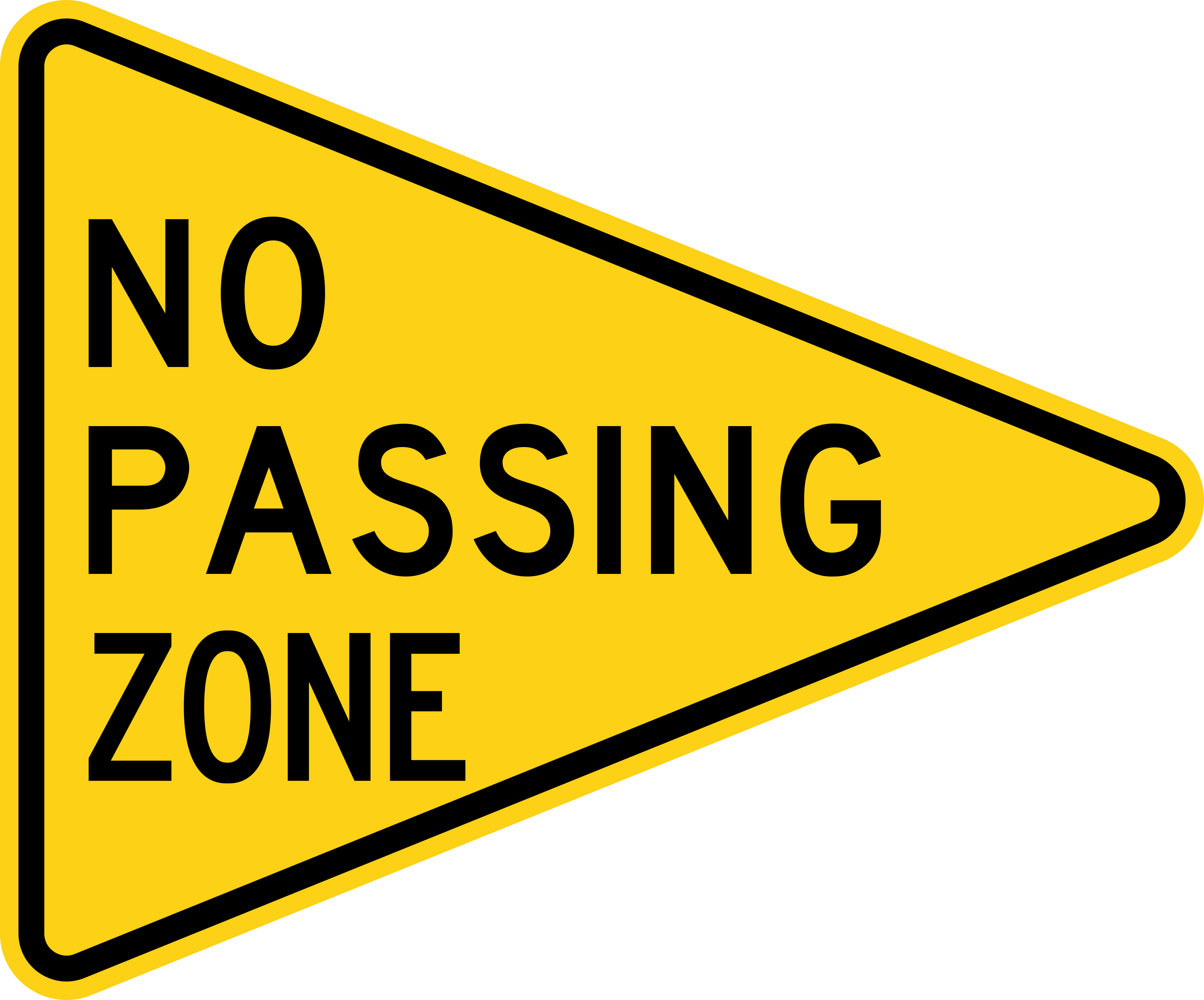
- A railroad crossing at the nearest track
- The end of a no-passing zone
- A school crossing where children may cross
- The beginning of a no-passing zone
Show answer
The beginning of a no-passing zone. Arizona uses the pennant shape to mark the beginning of a no-passing zone. The driver should remain behind the vehicle ahead until the restriction ends and passing is otherwise legal and safe. The end-of-zone choice reverses the sign's direction. A school crossing uses a five-sided sign, while a railroad crossing is identified by its own warning or crossbuck signs. The visual cue matters because the pennant can be recognized before its lettering is clear: when it points from the roadside, treat the upcoming roadway as a place where passing must not begin.
Study this in the handbook: Traffic signs, railroad crossings and work zones
15. How close to a crosswalk at an intersection may an Arizona driver park?
- No closer than 5 feet
- No closer than 20 feet
- No closer than 15 feet
- No closer than 50 feet
Show answer
No closer than 20 feet. Arizona bans parking on a crosswalk or within 20 feet of a crosswalk at an intersection. Fifteen feet is the hydrant distance and 50 feet is the railroad crossing distance, so those belong to other items. Five feet is far closer than the 20 foot rule allows. Parking inside the boundaries of an intersection or in front of a driveway is also prohibited.
Study this in the handbook: Parking rules, hills and painted curbs
16. Who may not use an Arizona freeway HOV lane at the posted times?
- Any vehicle without a permit
- Motorcycles
- A vehicle carrying fewer than two persons, including the driver, Monday through Friday
- Vehicles towing trailers
Show answer
A vehicle carrying fewer than two persons, including the driver, Monday through Friday. You may not drive a vehicle carrying fewer than two persons, including the driver, in an HOV lane at the posted times Monday through Friday. At those times, the HOV lanes are restricted to car pool vehicles, motorcycles or buses, so motorcycles are allowed, and the rule turns on how many people are in the vehicle, not a permit or a trailer. A motorist who violates this restriction is subject to substantial fines and penalties. Always signal and use caution when merging across the solid white line into and out of the HOV lane.
Study this in the handbook: Parking rules, hills and painted curbs
17. What is the best way to prevent hydroplaning during heavy rain?
- Brake hard as soon as water covers the roadway
- Accelerate to increase the tires' contact with the road
- Steer sharply toward the shoulder when rain intensifies
- Slow down before the tires lose contact with the road
Show answer
Slow down before the tires lose contact with the road. Hydroplaning happens when tires ride on a film of water and lose contact with the pavement. The manual identifies slowing down as the best prevention, so reduce speed before traction disappears. Hard braking can disturb control on a wet surface, while acceleration adds speed and does not restore tire contact. A sharp move toward the shoulder introduces an unnecessary steering change and may create another hazard. Watch for standing water, worn tires, and heavy rain, then ease off the accelerator early and leave extra space around your vehicle.
Study this in the handbook: Stopping distance, bad weather and night driving
18. If a child must ride in the front seat of a car, what does the Arizona manual ask you to do?
- Move the seat all the way forward
- Use the lap belt only
- Turn the front passenger side air bag off
- Recline the seat fully
Show answer
Turn the front passenger side air bag off. Air bags can save lives, but the Arizona manual warns they are unsafe for children under 12, and children age 12 and under should never ride in the front seat. If a child must ride up front anyway, the manual asks you to turn the front passenger side air bag off; most newer vehicles have an on and off switch for it. Moving the seat forward, using only the lap belt, or reclining the seat fully is not the instruction the manual gives. The one front seat step it names is switching that air bag off.
Study this in the handbook: Vehicle equipment, seat belts and child seats
19. When turning right on a red light in Arizona, where should the driver enter the new road?
- The left lane regardless of traffic
- The right lane unless signs direct otherwise
- Any lane after rolling through the turn
- The shoulder until the next intersection
Show answer
The right lane unless signs direct otherwise. After stopping and yielding, a right turn on red should enter the right lane unless a sign directs the driver otherwise. The left-lane choice conflicts with the normal lane placement and can interfere with traffic moving in the opposite direction. Turning without a full stop is unlawful, and using the shoulder is not a permitted substitute for entering a traffic lane. Before moving, check for pedestrians, bicyclists, and approaching traffic, then complete the turn smoothly into the lane nearest the right curb.
Study this in the handbook: Traffic signals and red light running
20. What does a solid yellow dividing line mean for passing?
- Do not pass from the side with the solid line
- Pass only after turning on hazard lights
- Pass whenever the vehicle ahead is slower
- The line separates lanes moving in the same direction
Show answer
Do not pass from the side with the solid line. When a solid yellow line runs beside a broken yellow line, passing is permitted in only one direction. If the solid yellow line is on your side, you may not pass; if the broken yellow line is on your side, you may pass when the roadway ahead is clear. Hazard lights and a slower vehicle ahead do not change that. Yellow center lines mark two way traffic flowing in both directions, so the line does not separate same direction lanes. Check which line is on your side before you start any pass.
Study this in the handbook: Pavement markings and turning lanes
QualitySpace is expanding to Arizona
We are a California-based independent insurance brokerage working on licensing in more states. We cannot help with Arizona insurance yet. Leave your email and we will let you know when we can.
Every question is written from the official Arizona Driver License Manual. Need paper? Printable AZ practice test with answer key.
Last verified 2026-10-05. How we check every question · Study all 202 as flashcards
Frequently asked questions
How many questions are on this Arizona practice test?
This fixed set has 20 questions. It is test 6 of 10 from the 202 question Arizona bank. The real AZ exam asks 30 questions and you need 24 correct.
What is the passing score for the real Arizona test?
A score of 80% or higher is required to pass That figure comes from the official Arizona source cited on the DMV facts page.
How does this fixed test relate to the full Arizona bank?
Each numbered test is a fixed set of questions in a fixed order, so you can retake the same test later and compare. Every test mixes road signs and the other topics in about the same proportion as the full bank. Tests 1 to 10 together cover 200 of the 202 questions in the Arizona bank, each once. The full practice page mixes the whole bank at random.
Last verified 2026-10-05. See the Arizona DMV facts page for sourced state details.