
Test 5 of 10 · 20 questions · Free 2026
AZ Permit Practice Test 5
Jump to the test ↓A fixed 20 question set from the Arizona bank with answers and plain English explanations. The real AZ exam is 30 questions, 80 percent to pass; take the full length version on the main practice page.
Question 1 of 20 · 0 right so far
All 20 questions in test 5
Every question below comes from the Arizona question bank on this page. Open a question to see the correct answer and the explanation. Nothing here is hidden behind a signup.
1. During the first six months of a graduated license, which overnight driving period is restricted unless an exception applies?
- 1:00 a.m. to 6:00 a.m.
- 10:00 p.m. to 6:00 a.m.
- 11:00 p.m. to 4:00 a.m.
- Midnight to 5:00 a.m.
Show answer
Midnight to 5:00 a.m.. For the first six months, an Arizona graduated-license driver may not drive between midnight and 5:00 a.m. unless a listed exception applies. Those exceptions include a qualified parent or guardian in the front passenger seat, or travel directly to or from certain school, work, religious, or family-emergency activities. The 10:00 p.m. and 11:00 p.m. choices begin too early, while 1:00 a.m. begins too late. Picture the restricted window as the five darkest hours around midnight, then check whether the trip fits an exception before driving.
Study this in the handbook: Instruction permits and the graduated license
2. After stopping at a red light, who must receive the right of way before a permitted right turn?
- Pedestrians, bicyclists, and oncoming traffic
- Only vehicles behind the turning driver
- Only pedestrians using a marked crosswalk
- No one if the driver signals the turn
Show answer
Pedestrians, bicyclists, and oncoming traffic. A right turn on red is allowed only after a complete stop and only when the movement does not conflict with a No Turn On Red sign or other traffic. Arizona specifically requires yielding to pedestrians, bicyclists, and oncoming traffic. A turn signal communicates intent but does not cancel another road user's priority. Check the crosswalk and both traffic directions, wait for the path to clear, and turn into the right lane unless signs direct otherwise.
Study this in the handbook: Traffic signals and red light running
3. When following another vehicle at night, at what distance must you switch from high beams to low beams?
- Within 100 feet
- Within 200 feet
- Only after the vehicle slows
- Within 300 feet
Show answer
Within 200 feet. Arizona requires low beams whenever your vehicle follows another car within 200 feet. The manual handles oncoming traffic separately: high beams are for highways when no vehicle is coming toward you within 500 feet, and you switch to low beams whenever you meet oncoming traffic to avoid blinding the other driver. The rule is about distance, not whether the car ahead slows, and 100 or 300 feet are not the stated figures. Make the change before the gap closes to 200 feet, then keep low beams on while you follow that closely.
Study this in the handbook: Stopping distance, bad weather and night driving
4. What does a yellow center line indicate about traffic on the roadway?
- All lanes travel in the same direction
- Traffic is flowing in both directions
- Passing is permitted without checking for oncoming traffic
- The roadway is reserved for emergency vehicles
Show answer
Traffic is flowing in both directions. Arizona uses yellow center lines to identify a roadway carrying traffic in opposite directions. That is the roadway condition represented by a two-way traffic warning, so the driver should expect oncoming vehicles beyond the center line. A same-direction lane arrangement is shown with white lane lines, and a yellow center line never removes the need to check whether passing is safe and legal. Emergency access is a separate matter. Treat the center line as a boundary, keep the vehicle in its lane, and watch for approaching traffic before any lateral movement.
Study this in the handbook: Pavement markings and turning lanes
5. Where must an Arizona driver yield to a pedestrian crossing the street?
- Only at a painted crosswalk
- Only when a crossing guard is present
- Only when the pedestrian has a signal
- At any marked or unmarked crosswalk
Show answer
At any marked or unmarked crosswalk. Arizona requires drivers to yield to pedestrians crossing in any marked or unmarked crosswalk. Paint is not what creates the driver's duty, so limiting the rule to painted lines misses unmarked crossings. A crossing guard or pedestrian signal may add direction, but neither is required for the baseline crosswalk rule. Scan both sides of the street, reduce speed early, and leave the crossing clear. If someone is crossing, yielding is the safer response even when the light has changed for you.
Study this in the handbook: Right of way, pedestrians and roundabouts
6. What happens to fines for speeding and other violations committed in an Arizona work zone?
- They are reduced by half
- They are unchanged unless workers are visible
- They are doubled
- They are waived during temporary work
Show answer
They are doubled. Fines double in Arizona work zones. The increased penalty applies to speeding and other violations, and it is connected to the need to protect drivers and highway workers. The manual ties the doubled fine to the posted work zone, not to whether a worker happens to be in view, so the unchanged-fine option is misleading. Temporary work areas are still work zones, and a reduced or waived fine is not the stated treatment. Watch orange devices, obey the posted limit, and expect sudden changes.
Study this in the handbook: Speed limits and work zones
7. What minimum property damage liability coverage must an Arizona private passenger vehicle carry?
- $15,000
- $5,000
- $10,000
- $25,000
Show answer
$15,000. Arizona requires $25,000 bodily injury liability for one person, $50,000 for two or more people, and $15,000 property damage liability. The $25,000 figure is the per person injury limit, not the property limit. Five and ten thousand dollars are below the Arizona minimum. Proof of current insurance must be in the vehicle whenever it is driven, and the policy must be an Arizona policy for where the vehicle is mainly operated.
8. What do rectangular traffic signs regulate and direct?
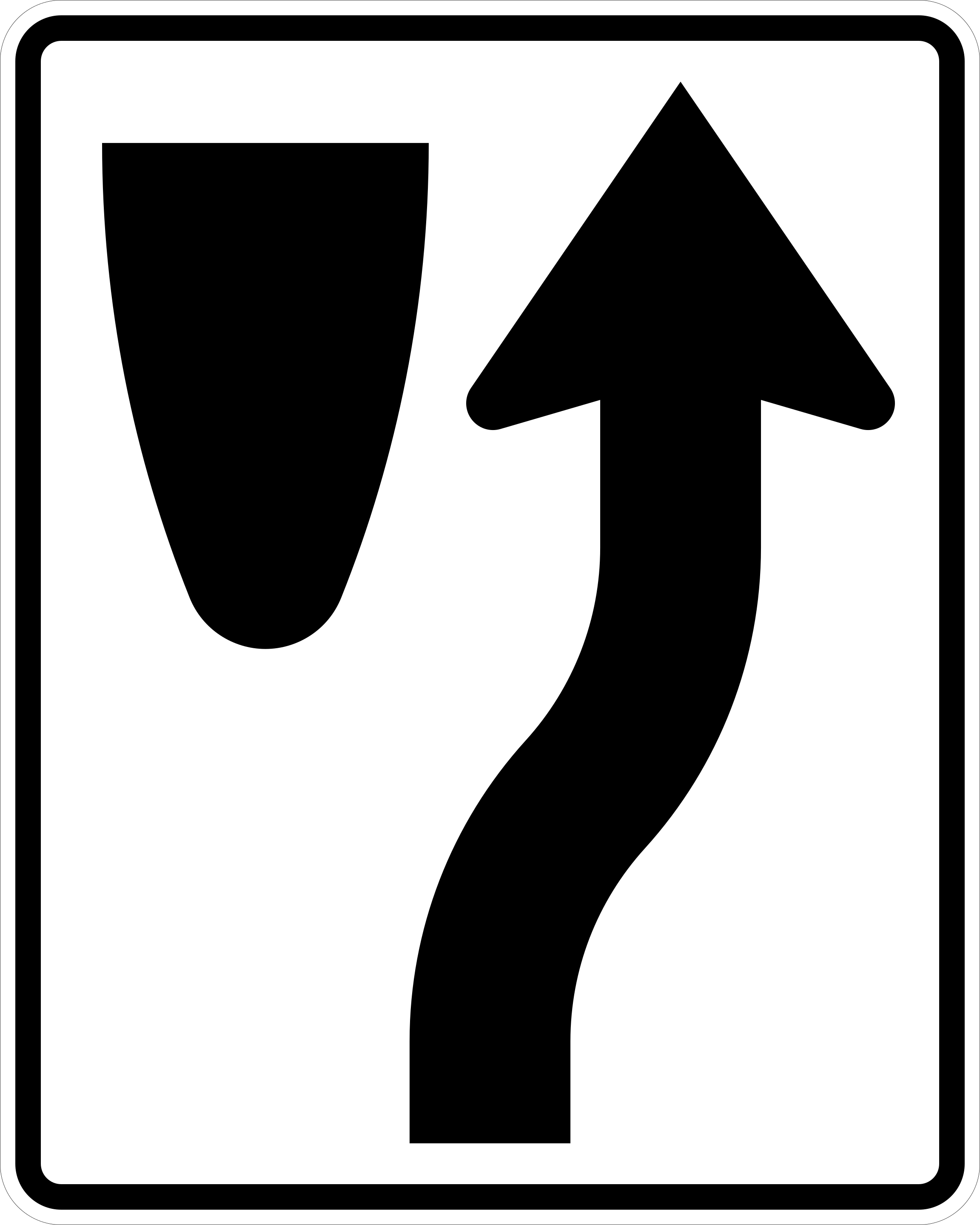
- Only the color of pavement markings
- Whether a vehicle must carry passengers
- The hours when railroad gates are lowered
- Traffic and the driver's speed and direction
Show answer
Traffic and the driver's speed and direction. Arizona classifies rectangular signs as regulatory signs. They regulate traffic and direct a driver's speed and direction, which includes instructions such as keeping to a particular side of an obstruction. The pavement choice concerns roadway markings, while railroad gates and passenger capacity are unrelated subjects. A rectangular sign may communicate a specific movement, speed, or lane instruction, so read its wording or symbol and follow the direction shown. Near a divider or obstruction, use the sign as an early positioning cue and check the roadway before moving around it.
Study this in the handbook: Traffic signs, railroad crossings and work zones
9. If changing lanes around an approaching emergency vehicle is unsafe, what should you do?
- Accelerate to pass before it arrives
- Stop beside the emergency vehicle
- Proceed with due caution and reduce your speed
- Drive onto the shoulder without checking
Show answer
Proceed with due caution and reduce your speed. On a four lane highway with at least two lanes going the same direction as an approaching emergency vehicle, the manual says to yield by changing into a lane not adjacent to it. If changing lanes is not possible or unsafe, proceed with due caution and reduce the speed of your vehicle. Accelerating to get past it, stopping beside it, or swinging onto the shoulder without checking is not the response the manual gives. When the emergency vehicle is approaching you, slow down, stay alert, and give it as much room as you safely can.
Study this in the handbook: Traffic signals and red light running
10. Where does Arizona's Move Over Law apply?
- Freeways only
- City streets only
- Freeways, other multiple-lane highways, city roads, and streets
- Two-lane rural roads only
Show answer
Freeways, other multiple-lane highways, city roads, and streets. Arizona's Move Over Law applies on freeways, other multiple-lane highways, city roads, and streets. It is not limited to rural freeways or to one type of roadway. When a vehicle with flashing lights is pulled to the side, scan ahead, prepare to create a safe margin, and slow down if a lane change cannot be made safely. A freeway-only choice misses the city-road coverage, while a city-streets-only choice leaves out highways. The road category helps determine where the rule applies, but the flashing lights and roadside position are the immediate cues for action.
Study this in the handbook: Right of way, pedestrians and roundabouts
11. What right-of-way instruction is represented by the triangular sign shown?
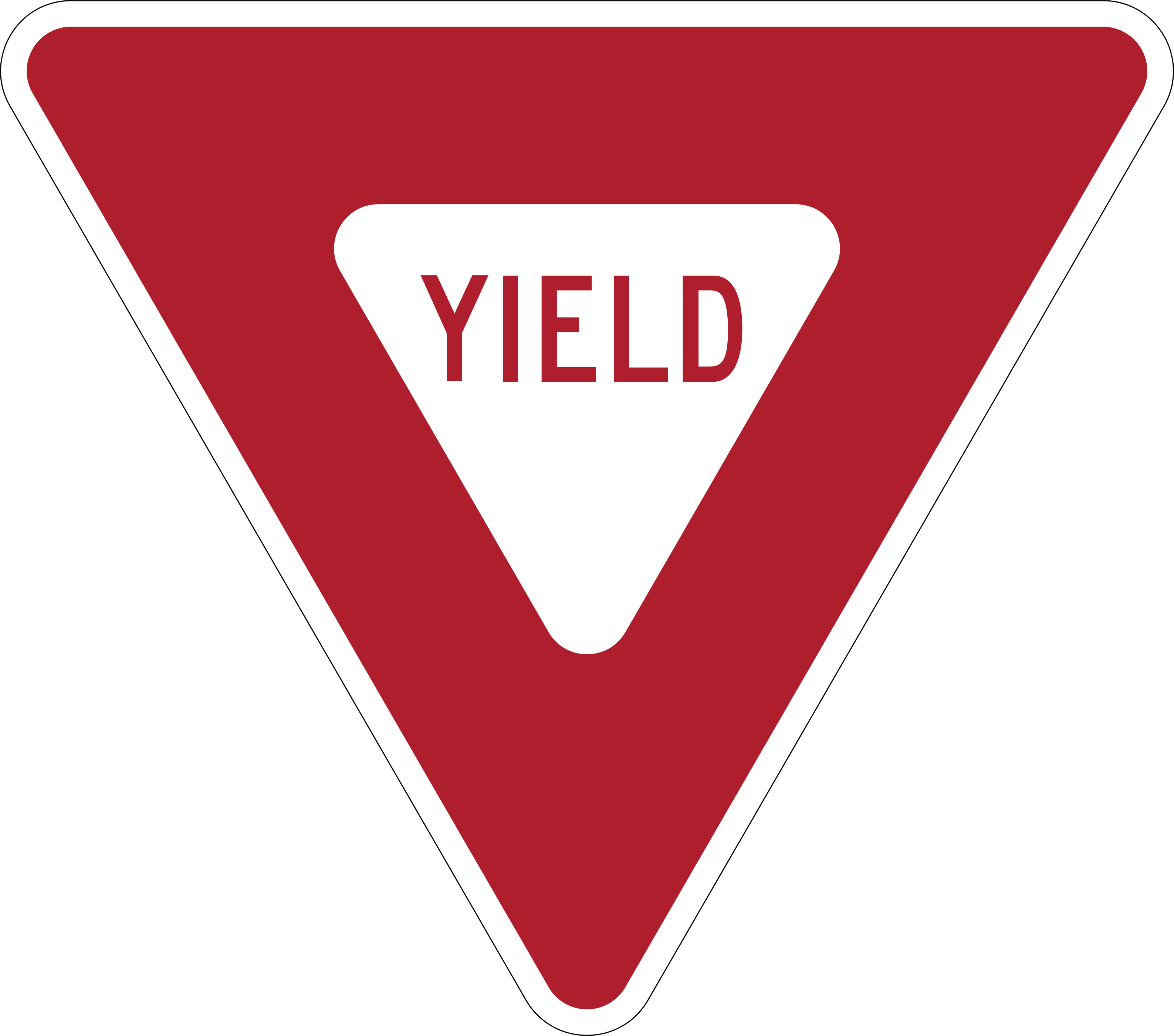
- Yield the right-of-way to cross traffic or merging traffic
- Continue without yielding because the road has priority
- Use the sign only to identify a school crossing
- Come to a complete stop before moving
Show answer
Yield the right-of-way to cross traffic or merging traffic. A triangle is the shape reserved for a yield instruction in Arizona's sign system. It tells the driver to give the right-of-way to traffic crossing the path or merging into it, then proceed only when the movement is safe. A full stop is not automatically required merely because the sign is triangular, although stopping may be necessary to yield safely. The choice about continuing without yielding reverses the sign's purpose, while the school-crossing choice confuses sign shape with a different warning category. A useful cue is the triangle: slow, check both directions, and give other road users priority when required.
Study this in the handbook: Traffic signs, railroad crossings and work zones
12. How should you adjust following distance when driving in bad weather?
- Keep the normal gap but use high beams
- Follow more closely to keep other vehicles out
- Double the distance from the vehicle ahead and reduce speed
- Use the posted limit without reducing speed
Show answer
Double the distance from the vehicle ahead and reduce speed. The manual gives a two-part response to bad weather: double the following distance and reduce speed appropriately. Wet pavement, snow, ice, and other conditions reduce the margin available for braking and control, so the normal gap is not enough. High beams do not replace extra space, tailgating removes reaction time, and a posted limit is not a target that must be maintained in unsafe conditions. Increase the cushion first, then choose a reasonable speed for what you can see and how much traction the roadway provides.
Study this in the handbook: Speed limits and work zones
13. What follows an Arizona conviction for running a red light or flashing red light?
- Required attendance at Traffic Survival School
- A written warning
- Automatic license revocation
- A vehicle impound
Show answer
Required attendance at Traffic Survival School. If you run a red light or a flashing red light and receive a citation, upon conviction you will be required to attend Traffic Survival School. The consequences climb when a crash results: under ARS 28-672, causing serious physical injury brings a suspension or restriction of 90 to 180 days, and causing a death brings 180 days to one year. A warning, automatic revocation, or impound is not the standard result of a simple red light conviction.
Study this in the handbook: Traffic signals and red light running
14. An Arizona driver's first extreme DUI involves an alcohol concentration of 0.20. What minimum jail term applies?
- 45 days, with no suspended sentence
- 10 consecutive days
- 30 consecutive days
- 180 days
Show answer
45 days, with no suspended sentence. A first extreme DUI normally means at least 30 consecutive days in jail, but at 0.20 or higher the minimum rises to 45 days with no chance of a suspended sentence. Ten days is the first standard DUI minimum. One hundred eighty days applies to a repeat extreme DUI at 0.20 or higher. The higher tier shows why Arizona separates 0.15 and 0.20 levels.
Study this in the handbook: Alcohol, drugs and DUI penalties
15. At what alcohol concentration does Arizona classify a DUI as extreme DUI?
- 0.08 percent or higher
- 0.10 percent or higher
- 0.15 percent or higher
- 0.20 percent only
Show answer
0.15 percent or higher. Arizona's extreme DUI category begins when a person has an alcohol concentration of 0.15 percent or higher. The 0.08 percent option is the ordinary noncommercial DUI threshold, while 0.20 percent is a higher level that can bring additional consequences within the extreme category. The question asks when the category starts, so use 0.15 percent, not the later 0.20 percent consequence. When reviewing BAC rules, separate the basic threshold from enhanced classifications and their added penalties.
Study this in the handbook: Alcohol, drugs and DUI penalties
16. When does Arizona's manual allow a driver to make a U-turn?
- Whenever the driver reaches a divided highway
- Only after stopping for five seconds
- Only at a traffic signal showing a green arrow
- When it is safe, does not interfere with traffic, and signs do not prohibit it
Show answer
When it is safe, does not interfere with traffic, and signs do not prohibit it. A U-turn is permitted when the movement can be made safely, does not interfere with other traffic, and is not prohibited by signs. The rule is conditional, so a driver cannot treat every divided highway, green arrow, or timed stop as automatic permission. The driver must also yield to approaching traffic and wait until the turn is safe. The study cue is a three-part check: safe movement, no interference, and no prohibiting sign, followed by a yield to approaching road users.
Study this in the handbook: Signaling, passing and U turns
17. What speed may farm machinery and other slow-moving vehicles usually travel at?
- 35 mph or less
- 25 mph or less
- 45 mph or less
- The posted limit in every case
Show answer
25 mph or less. Farm machinery and other slow-moving vehicles usually travel at 25 mph or less, so a driver should expect a large speed difference and allow extra following room. The higher figures in the other choices can make the vehicle seem closer to ordinary traffic speed than it really is. The posted limit does not guarantee that farm equipment can travel that fast. Reduce speed early, watch for a wide turn, and do not assume the machine can move aside quickly.
Study this in the handbook: Freeway and highway driving
18. What warning does the Arizona manual give about waiting to pull off during a dust storm?
- Wait until visibility is completely gone before leaving the lane
- Do not wait until poor visibility makes pulling off difficult
- Stop in the median whenever dust begins
- Remain on the pavement until another driver signals
Show answer
Do not wait until poor visibility makes pulling off difficult. The manual tells drivers to act early in a dust storm: immediately check traffic around the vehicle, begin slowing down, and do not wait until poor visibility makes it difficult to safely pull off the roadway. Waiting for visibility to disappear or for another driver to signal delays that exit. If the storm is severe, the listed steps are to drive completely off the highway and stop as far to the right as possible, so the median is not the place the manual sends you. Pull off as soon as possible while you can still see.
Study this in the handbook: Stopping distance, bad weather and night driving
19. An Arizona driver under 18 with a graduated license is convicted of a first traffic violation. What is the penalty?
- A 3-month suspension
- A 6-month suspension
- No penalty for a first violation
- Traffic Survival School, and the violation goes on the record
Show answer
Traffic Survival School, and the violation goes on the record. For a graduated license holder under 18, the first traffic conviction means mandatory Traffic Survival School and a violation on the driving record. A second conviction brings a 3-month suspension, and a third brings a 6-month suspension, so those belong to later steps. There is no free first violation. Curfew and passenger violations carry extra penalties on top of these. The ladder applies to drivers under 18 who hold a graduated license and are convicted of a traffic violation.
Study this in the handbook: Instruction permits and the graduated license
20. A licensed Arizona driver has a seizure. What does the manual say they must do?
- Wait 24 hours and resume driving
- Cease driving, notify MVD and have a medical exam
- Surrender the license permanently
- Nothing unless a doctor says so
Show answer
Cease driving, notify MVD and have a medical exam. A person who already has a driver license and who has a seizure or other medical condition is required to cease driving, notify MVD and have a medical exam. Any condition that could affect the ability to drive safely must be reported to MVD. The physician then submits the exam results to MVD. A person who had a seizure within 90 days of applying for a license must also report it.
Study this in the handbook: Points, suspensions, aggressive driving and traffic school
QualitySpace is expanding to Arizona
We are a California-based independent insurance brokerage working on licensing in more states. We cannot help with Arizona insurance yet. Leave your email and we will let you know when we can.
Every question is written from the official Arizona Driver License Manual. Need paper? Printable AZ practice test with answer key.
Last verified 2026-10-05. How we check every question · Study all 202 as flashcards
Frequently asked questions
How many questions are on this Arizona practice test?
This fixed set has 20 questions. It is test 5 of 10 from the 202 question Arizona bank. The real AZ exam asks 30 questions and you need 24 correct.
What is the passing score for the real Arizona test?
A score of 80% or higher is required to pass That figure comes from the official Arizona source cited on the DMV facts page.
How does this fixed test relate to the full Arizona bank?
Each numbered test is a fixed set of questions in a fixed order, so you can retake the same test later and compare. Every test mixes road signs and the other topics in about the same proportion as the full bank. Tests 1 to 10 together cover 200 of the 202 questions in the Arizona bank, each once. The full practice page mixes the whole bank at random.
Last verified 2026-10-05. See the Arizona DMV facts page for sourced state details.