
Test 9 of 25 · 20 questions · Free 2026
GA Permit Practice Test 9
Jump to the test ↓A fixed 20 question set from the Georgia bank with answers and plain English explanations. The real GA exam has a 20 question road sign section with 15 correct to pass, plus 20 knowledge questions with 15 correct to pass; take the full length version on the main practice page.
Question 1 of 20 · 0 right so far

All 20 questions in test 9
Every question below comes from the Georgia question bank on this page. Open a question to see the correct answer and the explanation. Nothing here is hidden behind a signup.
1. At this Georgia stop sign, where must the vehicle stop when a marked stop line is present?
- Past the crosswalk in the intersection
- Beside the sign post only
- At the marked stop line
- After entering the nearest travel lane
Show answer
At the marked stop line. An octagonal stop sign requires a complete stop at the marked stop line when one is provided. Stopping beside the sign post is not the governing location, and moving past the line or into the intersection defeats the protected stopping point. After stopping, the driver still waits for pedestrians to finish crossing and yields to closely approaching traffic. The cue is the painted line on the pavement, which identifies where the vehicle must halt.
Study this in the handbook: Sign shapes and what they mean
2. What does Georgia law say about littering on public or private property?
- It is unlawful to dump, deposit, throw, or leave litter on any public or private property or waters
- Only littering on interstates is illegal
- It is legal on private property with permission
- It is legal from a moving vehicle
Show answer
It is unlawful to dump, deposit, throw, or leave litter on any public or private property or waters. Georgia spends thousands of dollars cleaning litter from its streets and highways, and it is unlawful to dump, deposit, throw or leave litter on any public or private property in the state, or in any waters. The ban is not limited to interstates, and private land is covered as well. Individuals who litter harm the beauty of the state and the health, welfare and safety of others.
Study this in the handbook: Move Over law, school buses and emergency vehicles
3. At what speed may the tires in a standard passenger car lose all contact with the road?
- 35 mph
- 45 mph
- 65 mph
- 55 mph
Show answer
55 mph. In a standard passenger car, the manual says the tires may lose all contact with the road at 55 mph during hydroplaning. At that point there may be no friction available for braking, accelerating, or steering, so the vehicle can enter an unpredictable skid. The 35 mph figure describes the speed at which partial hydroplaning can begin, not complete loss of contact. The other speeds are not the figures given for this condition. When water is standing on the roadway, reduce speed well before reaching the range where tire contact and control can disappear.
Study this in the handbook: Hydroplaning, following distance and sharing the road
4. At a stop sign, where should a driver stop if there is no marked stop line?
- After entering the intersection
- Beside the nearest parked vehicle
- Before the crosswalk on the driver's side
- At the far side of the cross street
Show answer
Before the crosswalk on the driver's side. A stop sign requires a complete stop. The marked stop line is the first stopping point. When no line exists, the driver stops before the crosswalk on that side of the intersection. Entering the intersection first can put the vehicle into crossing traffic, and stopping at the far side gives up the protected position. Look for the line, then the crosswalk, before choosing a place where approaching traffic can be seen.
Study this in the handbook: Sign shapes and what they mean
5. According to the Georgia manual, what share of all crashes happen as the result of another crash?
- Thirty percent
- Five percent
- Fifty percent
- Ninety percent
Show answer
Thirty percent. The manual explains why the Move Over law matters with one statistic: thirty percent of all crashes occur as the result of another crash. Vehicles stopped at a scene, responders working beside traffic, and drivers slowing to look all create the conditions for a second collision. That is why you must move over a lane or slow down when approaching emergency, sanitation, utility or other authorized vehicles with flashing lights.
Study this in the handbook: Right of way, turns and passing
6. What should a driver do when a traffic signal is malfunctioning and flashing yellow?
- Stop and wait until an officer arrives
- Proceed with caution
- Treat the signal as a red light
- Ignore the signal and accelerate
Show answer
Proceed with caution. A malfunctioning signal that flashes yellow still permits the driver to proceed with caution. Nothing in the rule requires waiting for an officer, and treating the light as red adds the stop the manual requires only for a flashing red signal. Ignoring the display and accelerating is unsafe because cross traffic and pedestrians may still be present. Slow down, check every approach, and enter only after yielding where necessary. The cue is the flashing color: yellow means cautious movement, while red requires stopping and waiting until it is safe.
Study this in the handbook: Traffic signals and pavement markings
7. What does the pictured Georgia SPEED LIMIT sign communicate?
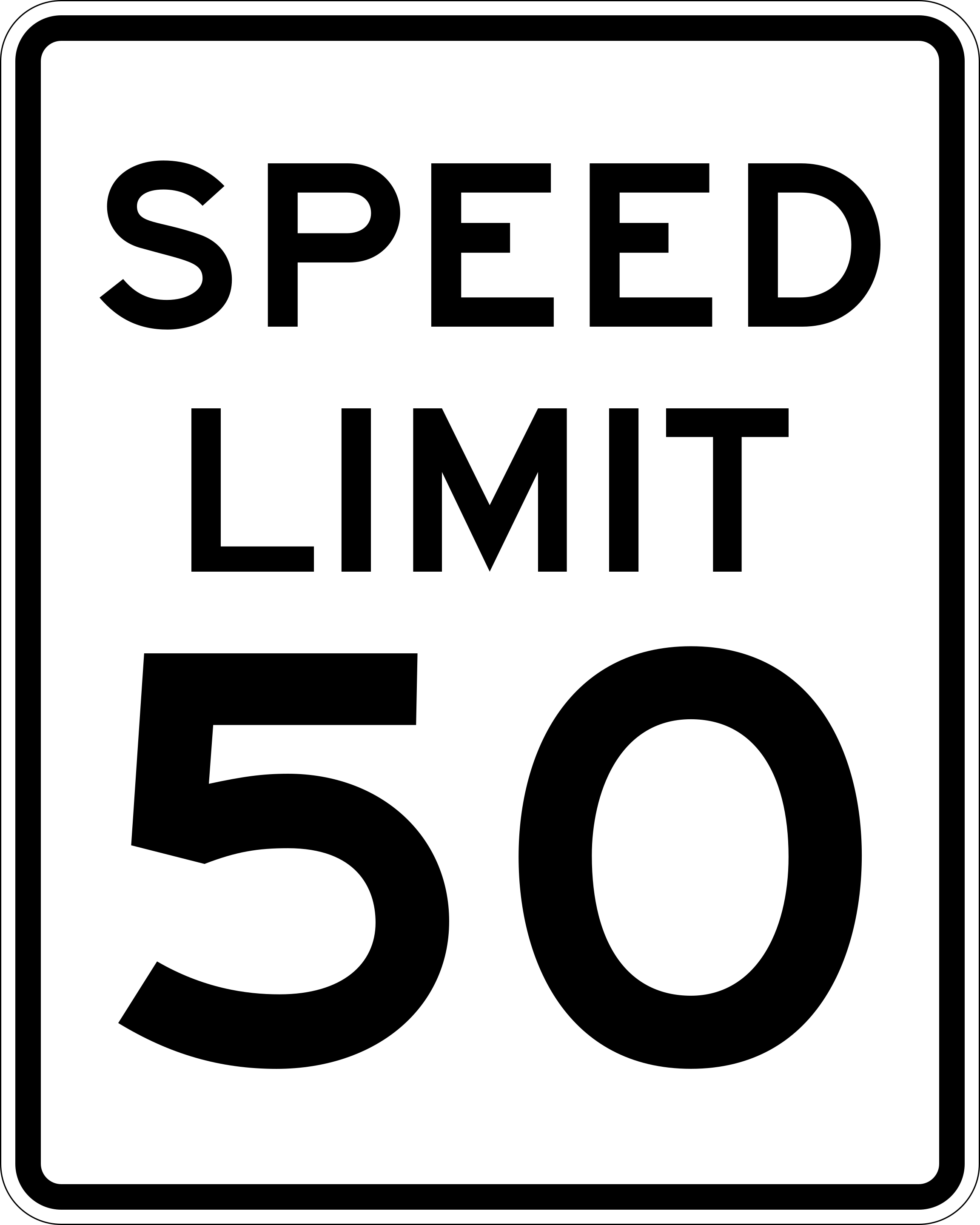
- A suggested speed used only during rain
- The speed allowed only for commercial vehicles
- The minimum speed required in every lane
- The maximum speed permitted in that area
Show answer
The maximum speed permitted in that area. A SPEED LIMIT sign communicates the maximum speed permitted in that area. It is not merely a rain advisory, a minimum required speed, or a commercial-vehicle-only rule. The posted number governs unless another official sign changes it, and the driver must still choose a lower speed when conditions make the maximum unsafe. The cue is the regulatory wording and number, read together before entering the signed area.
8. What must anyone younger than 18 present to obtain a Georgia driver's license or instructional permit?
- A vehicle title proving ownership
- A current insurance card alone
- A road test appointment receipt
- One of the listed school enrollment documents
Show answer
One of the listed school enrollment documents. Georgia requires anyone younger than 18 to present one of the school enrollment documents listed in the manual before obtaining a driver's license or instructional permit. The list includes a school enrollment certificate, diploma, GED, special diploma, high school completion certificate, recent college or vocational transcript, an adult literacy certificate showing GED pursuit, or a homeschool declaration. A vehicle title proves ownership, a test receipt shows scheduling, and an insurance card addresses coverage. The useful cue is education status: the applicant must document a qualifying school or equivalent path.
Study this in the handbook: Driver education, knowledge exam and road test
9. What type of information do Georgia's diamond-shaped warning signs generally provide?
- Mandatory licensing requirements
- Existing or possible hazards ahead
- Directions to fuel and lodging services
- Names of county boundaries only
Show answer
Existing or possible hazards ahead. Diamond-shaped warning signs alert drivers to an existing or possible hazard, so their message calls for attention and an adjustment that fits the upcoming condition. They are not the normal shape for licensing rules, service directions, or county names. A driver should read the symbol or wording, reduce speed when needed, and look beyond the sign for the condition it describes. The diamond is the first cue that the roadway may soon require a different speed, lane position, or response.
Study this in the handbook: Sign shapes and what they mean
10. When are Georgia drivers required to use headlights?
- Only after midnight on roads without streetlights
- From one-half hour after sunset until one-half hour before sunrise, and when visibility is limited
- Only during rain, never during fog or smoke
- Whenever the vehicle is parked on a public street
Show answer
From one-half hour after sunset until one-half hour before sunrise, and when visibility is limited. Georgia requires headlights during the nighttime interval beginning one-half hour after sunset and ending one-half hour before sunrise. They are also required when rain, fog, smoke, or other conditions reduce visibility. Waiting until midnight omits much of the required period, and limiting use to rain ignores fog and smoke. Check that lights are working before travel, then use them early whenever the roadway or weather makes it harder to see.
Study this in the handbook: Move Over law, school buses and emergency vehicles
11. What penalties does Georgia list for reckless driving?
- A $100 fine only
- A warning for a first offense
- Up to 12 months in jail and a fine, plus suspension for drivers under 21
- Automatic lifetime revocation
Show answer
Up to 12 months in jail and a fine, plus suspension for drivers under 21. Reckless driving in Georgia, driving in reckless disregard for the safety of people or property, can bring a fine of up to $1,000 and up to 12 months in jail. A driver under 21 who is convicted also loses all driving privileges to suspension. Examples include speeding, weaving through traffic, and improper passing. A $100 fine and a warning understate the penalty, and lifetime revocation is not the listed outcome.
Study this in the handbook: Implied consent and teen DUI suspensions
12. What is the penalty for a third Hands Free Law conviction in Georgia?
- 3 points and a fine of not more than $150
- 1 point and a $50 fine
- 6 points and a $1,000 fine
- License revocation
Show answer
3 points and a fine of not more than $150. Georgia's Hands Free Law penalties rise with each conviction: 1 point and up to $50 for the first, 2 points and up to $100 for the second, and 3 points and up to $150 for the third or later. One point and $50 is the first conviction. Six points and $1,000 are far higher than the law sets, and revocation is not listed. The points still count toward the 15 point suspension total.
Study this in the handbook: Headlights, seat belts, child seats and phones
13. Besides driver education, which program must a Georgia teen complete before getting a Class D license?
- A first aid certification
- A motorcycle safety course
- A defensive driving course for points
- The Alcohol and Drug Awareness Program (ADAP)
Show answer
The Alcohol and Drug Awareness Program (ADAP). A Georgia teen applying for a Class D provisional license must present proof of completing the Alcohol and Drug Awareness Program, known as ADAP. It is taught in most schools and is also available online. First aid and motorcycle courses are not Class D requirements. The 6 hour defensive driving course is used for points reduction, not for a first license.
Study this in the handbook: Instructional permit and Class D provisional license
14. What additional financial consequence can follow a Georgia Super Speeder conviction?
- A separate $200 state fee
- A $50 fee added to the state charge after timely payment
- A second local speeding fine set by the court
- A mandatory license renewal fee before the citation is closed
Show answer
A separate $200 state fee. A Super Speeder conviction adds a $200 state fee to any local fine imposed where the offense occurred. The amount is separate from the local citation, so paying that citation alone may leave the state charge unpaid. The $50 amount is a reinstatement fee that can follow a late payment, not the initial Super Speeder assessment. A second local fine and an automatic renewal fee are not the stated consequence. The useful cue is to separate the two levels of cost: local fine first, then the additional $200 state fee.
Study this in the handbook: Speed limits and Super Speeder
15. When must Georgia's test fee be paid?
- After a license is issued
- Only after the road test
- Prior to testing
- Only when a retest is required
Show answer
Prior to testing. Georgia states that the test fee is $10.00 and must be paid prior to testing. Paying only after the road test reverses the stated order, and the manual does not make payment conditional on receiving a license or taking a retest. The cue is the timing word prior: settle the fee before the testing attempt begins. If part of the test is failed, the manual also says that no refund will be issued, so applicants should understand the payment requirement before presenting for the examination.
Study this in the handbook: Instructional permit and Class D provisional license
16. How close to a fire hydrant may a Georgia driver stop, and only for what purpose?
- Within 15 feet only momentarily to pick up or drop off passengers
- Within 15 feet for up to 30 minutes
- Within 5 feet whenever the driver stays in the car
- Never within 50 feet for any reason
Show answer
Within 15 feet only momentarily to pick up or drop off passengers. Georgia's parking section lists places where stopping, standing, or parking is allowed only momentarily to pick up or drop off passengers. One of these is within 15 feet of a fire hydrant, alongside spots like in front of a driveway and within 20 feet of a crosswalk at an intersection. The allowance is only for a brief passenger stop, so let passengers in or out and then move on rather than waiting or parking there.
Study this in the handbook: Right of way, turns and passing
17. Work vehicles in a Georgia work zone are displaying flashing amber lights. What must you do?
- Pass them quickly to get out of the work zone
- Continue at normal speed because amber is only a caution
- Yield the right of way to them and reduce your speed
- Stop and wait until the lights turn off
Show answer
Yield the right of way to them and reduce your speed. Work vehicles and heavy equipment in Georgia work zones typically use flashing or revolving amber lights. The manual says you must yield the right of way to these vehicles and reduce your speed as you approach any work zone where vehicles have amber lights displayed. Mobile work vehicles often move as slowly as 5 miles per hour and may stop in the roadway, so give them space and follow any directions they display.
Study this in the handbook: Speed limits and Super Speeder
18. What does a steady yellow arrow that appears after a green arrow tell a Georgia driver?
- Turn only after the arrow starts flashing
- Stop immediately even if you are already in the intersection
- Oncoming traffic must now stop for you
- Clear the intersection because the protected turn is ending
Show answer
Clear the intersection because the protected turn is ending. Georgia's manual explains that a yellow arrow may appear after a green arrow and warns you to clear the intersection. The green arrow gave a protected turn, and the yellow arrow signals that this protection is about to end. If you are already in the intersection, finish the turn safely. If you have not entered and can stop safely, prepare to stop, because the signal will soon change.
Study this in the handbook: Traffic signals and pavement markings
19. What first aid does Georgia's manual give for a person suffering carbon monoxide poisoning?
- Have the victim lie down in the warm car
- Move the victim to fresh air and call emergency medical services
- Give the victim water and wait for symptoms to pass
- Restart the engine to run the heater
Show answer
Move the victim to fresh air and call emergency medical services. Cars produce carbon monoxide, a deadly gas with no odor or color. Symptoms include sudden weariness, yawning, dizziness, and nausea. Georgia's manual says to move a victim of carbon monoxide poisoning to fresh air, contact emergency medical services, and give artificial respiration if it is necessary and you are trained to do so. To prevent poisoning, never run the motor in a garage and do not drive with a defective exhaust system.
20. What should a driver do after a sudden tire blow-out?
- Turn sharply onto the shoulder immediately
- Grip the wheel, remove your foot from the accelerator, and let the vehicle slow
- Accelerate to reach a repair shop quickly
- Brake hard and steer across traffic
Show answer
Grip the wheel, remove your foot from the accelerator, and let the vehicle slow. A blow-out can make a moving vehicle swerve, so the manual emphasizes calm control. Grip the steering wheel firmly, take your foot off the accelerator, and let the vehicle roll to a stop. A sharp immediate move to the shoulder can worsen the swerve, and hard braking may cause loss of control. Accelerating adds load and speed to an already unstable vehicle. Apply brakes lightly only if necessary and safe, then move toward the shoulder after the car has slowed greatly. The cue is control first, roadside position second.
Study this in the handbook: Blowouts, skids and crashes
QualitySpace is expanding to Georgia
We are a California-based independent insurance brokerage working on licensing in more states. We cannot help with Georgia insurance yet. Leave your email and we will let you know when we can.
Every question is written from the official Georgia Drivers Manual. Need paper? Printable GA practice test with answer key.
Last verified 2026-10-05. How we check every question · Study all 500 as flashcards
Frequently asked questions
How many questions are on this Georgia practice test?
This fixed set has 20 questions. It is test 9 of 25 from the 500 question Georgia bank. The real GA exam has a 20 question road sign section with 15 correct to pass, plus 20 knowledge questions with 15 correct to pass.
What is the passing score for the real Georgia test?
15 out of 20 correct on each test (75% per section) That figure comes from the official Georgia source cited on the DMV facts page.
How does this fixed test relate to the full Georgia bank?
Each numbered test is a fixed set of questions in a fixed order, so you can retake the same test later and compare. Every test mixes road signs and the other topics in about the same proportion as the full bank. Tests 1 to 25 together cover every question in the Georgia bank once. The full practice page mixes the whole bank at random.
Last verified 2026-10-05. See the Georgia DMV facts page for sourced state details.