
Test 6 of 25 · 20 questions · Free 2026
GA Permit Practice Test 6
Jump to the test ↓A fixed 20 question set from the Georgia bank with answers and plain English explanations. The real GA exam has a 20 question road sign section with 15 correct to pass, plus 20 knowledge questions with 15 correct to pass; take the full length version on the main practice page.
Question 1 of 20 · 0 right so far
All 20 questions in test 6
Every question below comes from the Georgia question bank on this page. Open a question to see the correct answer and the explanation. Nothing here is hidden behind a signup.
1. How long is a Georgia Class C Instructional Permit valid?
- Up to 2 years
- Up to 6 months
- Until the holder turns 18 only
- Exactly 5 years
Show answer
Up to 2 years. A Georgia Class C Instructional Permit is valid for up to two years. Six months is associated with a later passenger restriction for some Class D license holders, not the permit validity period. The permit also does not end solely when the holder turns 18, and the manual does not state a five-year term. The practical cue is to separate validity from eligibility: age 15 begins the application opportunity, while the issued permit can remain valid for as much as two years.
Study this in the handbook: Instructional permit and Class D provisional license
2. How early must Georgia customers begin the written knowledge test before a Customer Service Center closes?
- At least 10 minutes before closing
- Only after the center closes
- At least 30 minutes before closing
- Any time during the final minute
Show answer
At least 30 minutes before closing. Georgia advises customers to begin the written knowledge test at least 30 minutes before the Customer Service Center closes so there is enough time to complete it. Starting ten minutes before closing may not leave the required testing window, and waiting until closing or the final minute would be even later. The cue is the appointment timing rule, not a passing score: arrive early enough to start thirty minutes before the posted closing time.
Study this in the handbook: Driver education, knowledge exam and road test
3. A Georgia driver takes a certified 6-hour defensive driving course after a moving violation citation, before court. What can the court do?
- Dismiss the ticket and refund all fees
- Double the points
- Reduce the fine by 20 percent and assess no points
- Nothing, because the course only counts after conviction
Show answer
Reduce the fine by 20 percent and assess no points. Georgia's points avoidance rule lets a defendant finish a certified 6 hour driver improvement course after a moving violation citation and before the court appearance, or as the court orders. When the certificate is presented, the court reduces the fine by 20 percent and assesses no points. The ticket is not dismissed with refunds, and the course does not add points. The plea can be accepted once every five years.
Study this in the handbook: Points, teen suspensions and revocation
4. Unless otherwise posted, what speed does the Georgia manual list for an unpaved county road?
- 25 miles per hour
- 35 miles per hour
- 55 miles per hour
- 70 miles per hour
Show answer
35 miles per hour. The manual lists 35 miles per hour for an unpaved county road unless a different limit is posted. That figure is distinct from the 70 mile per hour rural interstate limit and the 55 mile per hour rule for all other areas. A driver should still reduce speed when the surface, weather, visibility, or traffic makes the posted maximum unsafe. The practical cue is the road surface: an unpaved county road uses the 35 mph entry in Georgia's general speed-limit list. Look for a posted sign before relying on the default.
Study this in the handbook: Speed limits and Super Speeder
5. Which substance category does Georgia include in its impaired-driving rule?
- Only illegal recreational drugs
- Only medication prescribed by a physician
- Caffeine in any amount
- Certain drugs or other substances that impair safe operation
Show answer
Certain drugs or other substances that impair safe operation. Georgia includes certain drugs and other substances that impair a person's ability to operate a motor vehicle safely. The rule is not limited to illegal recreational drugs, and having a prescription does not automatically remove the impairment concern. Caffeine in any amount is not the category described. The practical cue is the effect on safe operation: if a substance reduces judgment, coordination, alertness, or control, the driver should not treat its legal status or label as permission to drive.
Study this in the handbook: Implied consent and teen DUI suspensions
6. What does the Georgia manual say is most important when there is water on the roadway?
- Accelerate to cross the water quickly
- Brake hard while turning
- Slow down
- Move onto the shoulder immediately
Show answer
Slow down. The manual emphasizes slowing down when water is on the roadway because standing water can separate tires from pavement and remove the friction needed to brake, accelerate, or steer. Accelerating adds speed to a traction problem, while hard braking and a sharp turn can make a skid less predictable. Moving onto the shoulder is not the general response and may create a new hazard. The practical cue is visible water: ease off the accelerator early, keep the vehicle pointed in its lane, and let speed decrease before control becomes uncertain.
Study this in the handbook: Hydroplaning, following distance and sharing the road
7. When backing a vehicle, where should the driver look?
- Only in the rearview mirror
- Over the right shoulder while checking all sides first
- At the front wheels while turning the steering wheel
- Only through the backup camera
Show answer
Over the right shoulder while checking all sides first. Before backing, the driver should check all sides of the vehicle and then turn the head to look over the right shoulder. Mirrors and cameras can assist, but they cannot replace a direct check for people or objects hidden outside their view. Looking only forward or relying on one device leaves blind areas unchecked. Make the walk-around or full visual scan before shifting, keep the speed very low, and continue checking as the vehicle moves.
Study this in the handbook: Parking rules and railroad crossings
8. Which sign shape means yield in Georgia?
- Circle
- Octagon
- Pentagon
- Triangle
Show answer
Triangle. The triangle is Georgia's yield shape. It tells the driver to slow to a reasonable speed for existing conditions and stop if necessary before giving way. An octagon means stop, a pentagon identifies a school zone or crossing, and a circle warns of a railroad crossing. Shape recognition is useful when distance, darkness, or glare makes the words difficult to read, so learn the shape before reaching the sign.
Study this in the handbook: Sign shapes and what they mean
9. What does Georgia law say about coasting downhill?
- Coasting in neutral is allowed to save fuel
- You must not coast with the transmission in neutral
- Coasting is allowed if you keep your foot on the brake
- Only trucks are forbidden to coast
Show answer
You must not coast with the transmission in neutral. Georgia's other laws section says the driver of any motor vehicle traveling down a hill must not coast with the gears or transmission in neutral. Stay in gear on downgrades. On a steep hill, Georgia's warning sign advice is to slow down and be ready to shift to a lower gear to control speed and protect the brakes from damage.
Study this in the handbook: Implied consent and teen DUI suspensions
10. When does Georgia permit a left turn on a red light?
- From any left turn lane after a full stop
- Only when a green arrow is also showing
- Never under any circumstances
- From the left lane of a one-way street onto a one-way street going left
Show answer
From the left lane of a one-way street onto a one-way street going left. Georgia's right of way rules say that, unless a sign prohibits it, it is permissible to make a left turn on red from the left lane of a one-way street onto a one-way street on which traffic moves toward the driver's left. You may go only after making a complete stop, yielding to all traffic, stopping for pedestrians, and deciding that you can complete the turn safely. Two-way streets do not qualify.
Study this in the handbook: Right of way, turns and passing
11. When must a driver stop at a railroad crossing?
- When the crossing signal is flashing or the gates are lowered
- Only when the driver can see a train on the nearest track
- Only when a flagman is standing in the travel lane
- When the driver is within five feet of the tracks
Show answer
When the crossing signal is flashing or the gates are lowered. Georgia requires a stop when a crossing signal flashes or the gates are lowered, among several other listed conditions. Waiting until a train is visible is unsafe because sight distance can be limited, and the stop is not dependent on a flagman standing in the lane. Five feet is also too close to describe the required approach. Treat any active crossing warning as a command to stop 15 to 50 feet from the nearest rail.
Study this in the handbook: Parking rules and railroad crossings
12. How many points does Georgia assess for unlawfully passing a school bus?
- 2 points
- 3 points
- 4 points
- 6 points
Show answer
6 points. Georgia's points chart gives 6 points for unlawfully passing a school bus, the same as aggressive driving and speeding 34 mph or more over. Two points is for things like a second child restraint offense or an open container, 3 points is for most other moving violations, and 4 points is for reckless driving or improper passing on a hill or curve. For a driver under 21, a school bus violation also means suspension.
Study this in the handbook: Implied consent and teen DUI suspensions
13. What must a driver do at a Georgia railroad crossing when warning signals indicate a train is approaching?
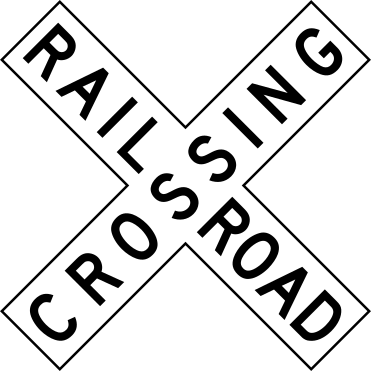
- Drive around the gate before it lowers
- Continue if the train appears distant
- Pass another vehicle on the tracks
- Stop before the crossing
Show answer
Stop before the crossing. At a railroad crossing, the driver must stop when the warning signals indicate that a train is approaching. The other choices all encourage entering or remaining in a dangerous crossing: distance is not permission to gamble, a gate must never be bypassed, and passing on the tracks is prohibited. The cue is an activated signal or lowered protection. Stop and remain clear until the warning ends and it is safe to proceed.
Study this in the handbook: Traffic signals and pavement markings
14. According to Georgia, what do regulatory signs tell drivers?
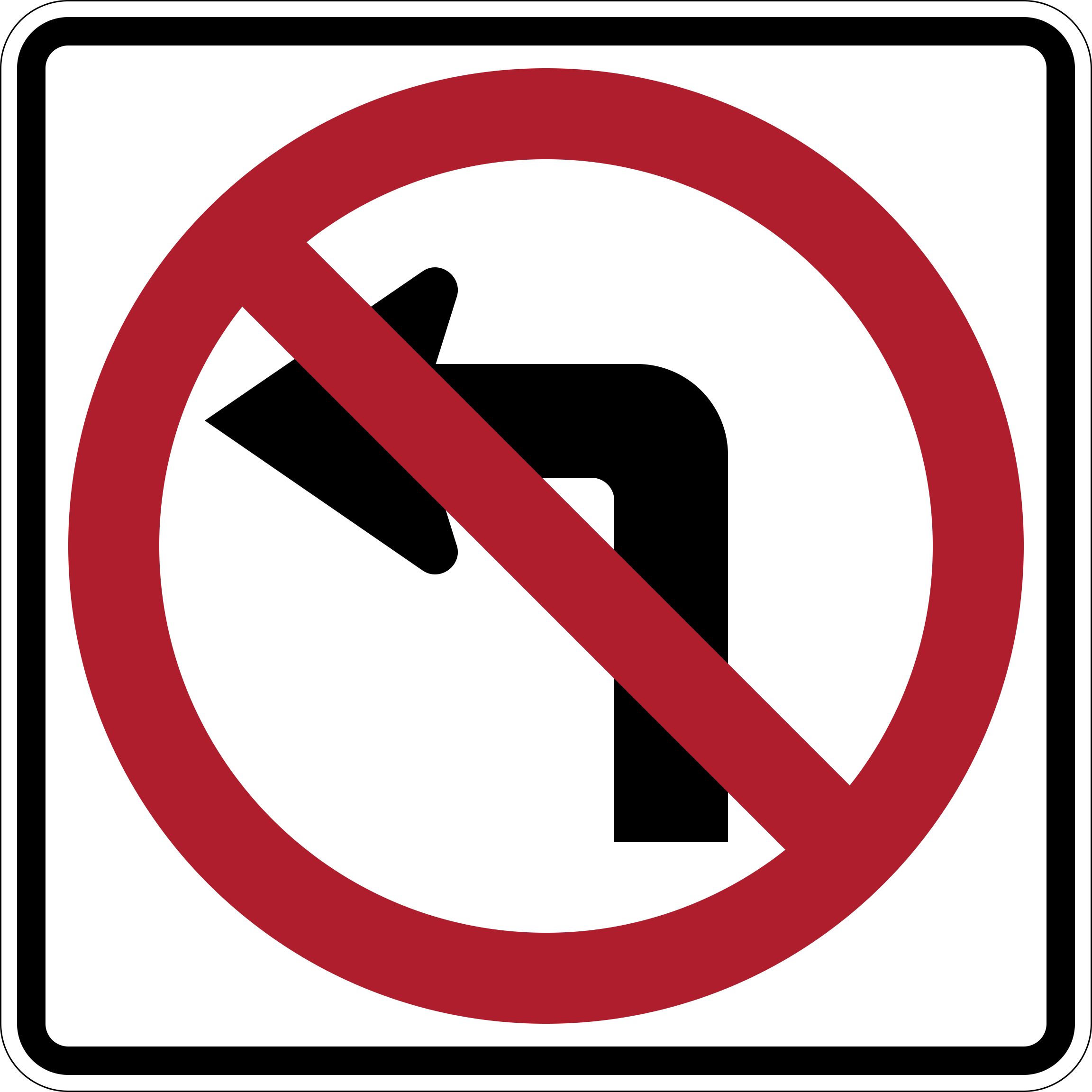
- How to repair a vehicle engine
- What they may or may not do
- The location of every fuel station
- The weather forecast for the roadway
Show answer
What they may or may not do. Georgia defines regulatory signs as instructions about what drivers may or may not do. Drivers, including bicyclists, must obey those signs in the same manner as traffic laws. The other choices describe information that regulatory signs do not provide. A useful visual cue is the red circle and slash: the picture inside shows the prohibited movement or action, while other regulatory signs state a required action or restriction.
15. If a vehicle becomes disabled on a Georgia highway, what should the driver do when possible?
- Park off the highway, leaving free passage and a clear view for 200 feet in each direction
- Leave the vehicle in the travel lane with hazard lights on
- Park on the shoulder with no need to preserve visibility
- Move the vehicle into the nearest intersection
Show answer
Park off the highway, leaving free passage and a clear view for 200 feet in each direction. Georgia says a disabled vehicle should be parked off the highway whenever practical. The driver should leave free passage and maintain a clear view of the vehicle for 200 feet in each direction. Hazard lights do not make leaving a disabled car in the travel lane safe, and a shoulder location still must not eliminate the required visibility. An intersection is a dangerous place to leave a disabled vehicle and is not the manual's instruction. The cue is the pair of protections: get off the highway and preserve 200 feet of clear sight in both directions.
Study this in the handbook: Right of way, turns and passing
16. What does a steady red traffic light require before a driver enters the crosswalk or intersection?
- A rolling stop followed by an immediate turn
- A complete stop and waiting for green
- A stop only when another vehicle is visible
- A speed increase to clear the intersection
Show answer
A complete stop and waiting for green. Georgia's manual treats a steady red light as a command to stop completely before entering either the crosswalk or intersection, then wait for the signal to turn green. The rolling-stop choice removes the required full stop, while waiting for another vehicle is irrelevant because the signal governs the movement. The speed-up choice creates the very conflict the signal is meant to prevent. The practical cue is the red indication: stop at the proper point and remain there.
Study this in the handbook: Traffic signals and pavement markings
17. When may a Georgia motorist drive in a marked bicycle lane?
- Whenever traffic in the main lane slows down
- To park briefly while picking up passengers
- Only to cross over it to make a turn, yielding to bicyclists
- Any time no bicyclist is visible
Show answer
Only to cross over it to make a turn, yielding to bicyclists. Bicycle lanes are marked by solid white lines, usually between the right traffic lane and the curb, and may show painted bicycle symbols. Georgia's manual says drivers are prohibited from driving or parking in the bicycle lane, except to cross over it to make a turn. When you cross a bicycle lane to turn, you must yield to any bicyclists who are present, checking mirrors and blind spots before you move over.
Study this in the handbook: Traffic signals and pavement markings
18. What does Georgia's steep hill warning sign advise drivers to do?
- Slow down and be ready to shift to a lower gear to protect the brakes
- Shift to neutral and coast to save fuel
- Hold the brake pedal down for the whole descent
- Speed up before the hill to keep momentum
Show answer
Slow down and be ready to shift to a lower gear to protect the brakes. The steep hill sign warns of a sharp downgrade ahead. Georgia's manual tells drivers to slow down and be ready to shift to a lower gear to control speed and protect the brakes from damage. Begin slowing before the grade, since Georgia law also forbids coasting down a hill in neutral. A lower gear lets the vehicle hold a steady speed without relying on the brakes for the whole descent.
19. What should a driver do when fog makes visibility poor?
- Reduce speed and dim the headlights
- Use bright high beams to illuminate more fog
- Turn on parking lights and continue at normal speed
- Follow the vehicle ahead more closely
Show answer
Reduce speed and dim the headlights. Fog reduces the distance a driver can see and makes bright beams reflect glare back toward the vehicle. Georgia advises reducing speed and dimming headlights, then slowing farther when another vehicle's lights appear. High beams can make visibility worse, while parking lights and normal speed provide too little warning time. Keep a larger gap, use the regular headlights, and avoid driving into dense fog when another route is available.
Study this in the handbook: Headlights, seat belts, child seats and phones
20. At what accumulation does Georgia suspend a license for points within a 24-month period?
- 10 or more points
- 4 or more points for every driver
- 15 or more points
- 24 points exactly
Show answer
15 or more points. Georgia lists suspension for any person who accumulates 15 or more points within 24 months. The phrase or more means the threshold begins at 15 and does not require exactly 15. Four points is a separate rule for drivers under 18 within a 12-month period, while 24 is the time window rather than a point total. Ten is not the stated trigger. Read the rule as a pair: 15 points, measured across 24 months.
Study this in the handbook: Points, teen suspensions and revocation
QualitySpace is expanding to Georgia
We are a California-based independent insurance brokerage working on licensing in more states. We cannot help with Georgia insurance yet. Leave your email and we will let you know when we can.
Every question is written from the official Georgia Drivers Manual. Need paper? Printable GA practice test with answer key.
Last verified 2026-10-05. How we check every question · Study all 500 as flashcards
Frequently asked questions
How many questions are on this Georgia practice test?
This fixed set has 20 questions. It is test 6 of 25 from the 500 question Georgia bank. The real GA exam has a 20 question road sign section with 15 correct to pass, plus 20 knowledge questions with 15 correct to pass.
What is the passing score for the real Georgia test?
15 out of 20 correct on each test (75% per section) That figure comes from the official Georgia source cited on the DMV facts page.
How does this fixed test relate to the full Georgia bank?
Each numbered test is a fixed set of questions in a fixed order, so you can retake the same test later and compare. Every test mixes road signs and the other topics in about the same proportion as the full bank. Tests 1 to 25 together cover every question in the Georgia bank once. The full practice page mixes the whole bank at random.
Last verified 2026-10-05. See the Georgia DMV facts page for sourced state details.