
Test 3 of 25 · 20 questions · Free 2026
GA Permit Practice Test 3
Jump to the test ↓A fixed 20 question set from the Georgia bank with answers and plain English explanations. The real GA exam has a 20 question road sign section with 15 correct to pass, plus 20 knowledge questions with 15 correct to pass; take the full length version on the main practice page.
Question 1 of 20 · 0 right so far
All 20 questions in test 3
Every question below comes from the Georgia question bank on this page. Open a question to see the correct answer and the explanation. Nothing here is hidden behind a signup.
1. According to the Georgia manual, how far does a fully loaded tractor trailer at 55 mph need to stop compared with a car?
- The same distance
- Half the distance
- 3 times the distance
- 10 times the distance
Show answer
3 times the distance. Georgia's manual says a fully loaded tractor trailer at 55 mph needs 3 times the distance a car needs to stop. Trucks weighing 80,000 pounds or more cannot stop as quickly as cars, so the same or half the distance is wrong. Ten times overstates the manual's figure. Large trucks also need more room to turn and have large blind spots called No-Zones, so do not cut in front of them.
Study this in the handbook: Move Over law, school buses and emergency vehicles
2. What does Georgia law require of a driver when state chemical testing is requested to determine whether the driver is under the influence of alcohol or drugs?
- Submission to state administered chemical testing
- Testing only after personal approval at the roadside
- Testing only after a separate civil lawsuit
- No testing unless the driver has a commercial license
Show answer
Submission to state administered chemical testing. Georgia law requires a driver to submit to state administered chemical tests of blood, breath, urine, or other bodily substances to determine whether the driver is under the influence of alcohol or drugs. The requirement does not wait for the driver to give personal approval, does not depend on a civil lawsuit, and is not limited to commercial drivers. The manual adds that refusing this testing brings a license suspension of at least one year, and a refusal of blood or urine testing may be offered into evidence at trial.
Study this in the handbook: Implied consent and teen DUI suspensions
3. What action does the Georgia manual recommend when a vehicle starts to hydroplane?
- Brake hard while turning sharply
- Accelerate until the tires cut through the water
- Turn toward the shoulder immediately
- Take your foot off the accelerator and let the car slow down
Show answer
Take your foot off the accelerator and let the car slow down. Hydroplaning reduces a driver's ability to brake, accelerate, or steer because water separates the tires from the road. The manual advises taking your foot off the accelerator and allowing the car to slow down. Hard braking and a sharp turn can make control less predictable, while acceleration adds speed to a traction problem. The useful cue is standing water: slow before reaching it and keep tires in good condition with adequate water-channeling tread.
Study this in the handbook: Hydroplaning, following distance and sharing the road
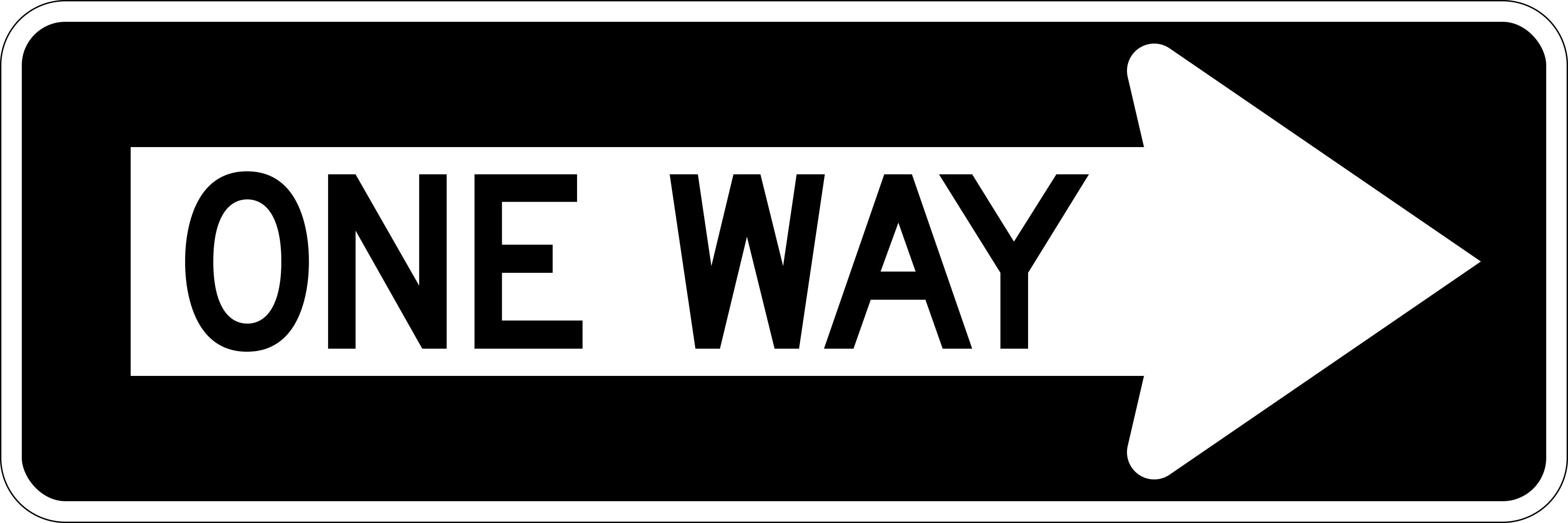
4. When facing a Georgia ONE WAY sign, in which direction may traffic travel?
- Only when a police officer is present
- In either direction outside rush hour
- Only toward the nearest shoulder
- Only in the direction of the arrow
Show answer
Only in the direction of the arrow. A ONE WAY sign limits travel to the direction shown by its arrow. The rush-hour choice invents a time exception, and neither the shoulder nor an officer changes the sign's ordinary instruction. A driver who faces traffic moving toward the sign must not continue down that road. The cue is the arrow: align the vehicle with that direction before proceeding, and never use the sign as permission for opposing travel.
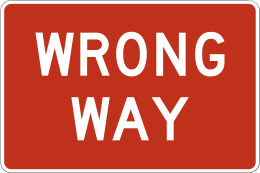
5. What does a Georgia WRONG WAY sign warn about?
- A rough surface is beginning
- A truck restriction is ahead
- The driver is approaching a one-way highway or ramp incorrectly
- A pedestrian refuge is nearby
Show answer
The driver is approaching a one-way highway or ramp incorrectly. The WRONG WAY sign warns that the driver is approaching a one-way highway or ramp from the prohibited direction. Continuing in that direction can place the vehicle against traffic, so the driver should stop the unsafe movement and correct course only when it can be done safely. Rough pavement, truck restrictions, and pedestrian refuges use different messages. The cue is the direct contradiction between the sign and the direction of travel.
6. What does a Georgia KEEP RIGHT sign direct motorists to do?
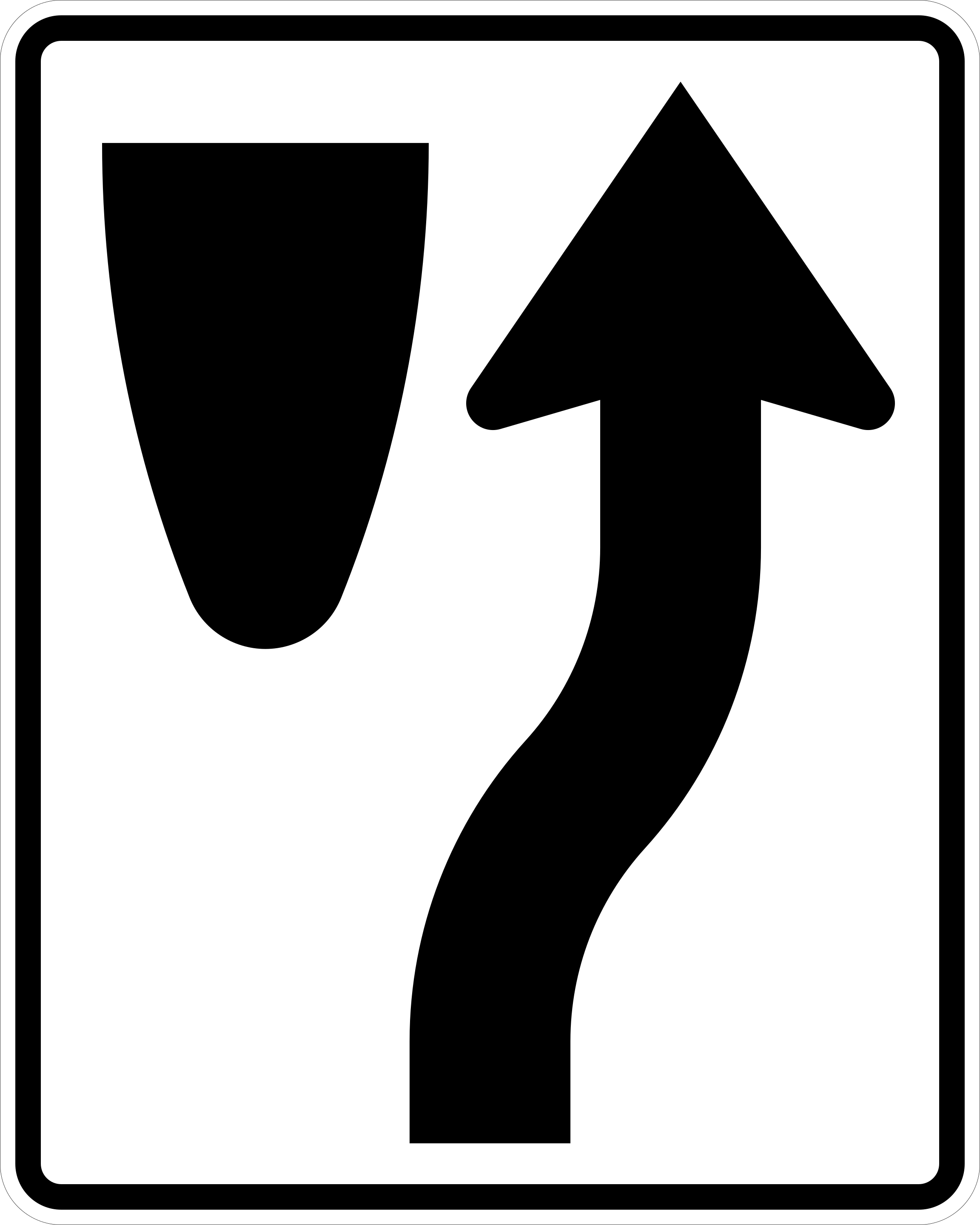
- Keep to the right of medians or obstructions
- Pass every vehicle on the right
- Drive only on the shoulder
- Use the left lane whenever traffic is light
Show answer
Keep to the right of medians or obstructions. KEEP RIGHT directs traffic to remain to the right of a median or obstruction. The sign does not create a general command to pass, authorize shoulder driving, or require the left lane when traffic is light. The cue is the obstruction or divider represented on the sign. Move right in advance, maintain a safe lane, and continue watching for other markings that govern the route around the hazard.
7. How should drivers proceed when a traffic signal is green but the intersection is still blocked?
- Move into the crosswalk to reserve space
- Enter because the green light gives unconditional priority
- Wait until the intersection is clear of traffic or approaching traffic
- Follow the vehicle ahead even if it stops in the intersection
Show answer
Wait until the intersection is clear of traffic or approaching traffic. A green signal does not make it safe to enter a blocked intersection. Georgia directs drivers to wait until the intersection is clear of traffic or approaching traffic. Treating green as unconditional priority, or following a vehicle that stops inside the intersection, turns the signal into permission to create a blockage, while stopping in a crosswalk interferes with pedestrians. Look beyond the signal before crossing the stop line and remain back until there is room to clear the intersection completely.
Study this in the handbook: Right of way, turns and passing
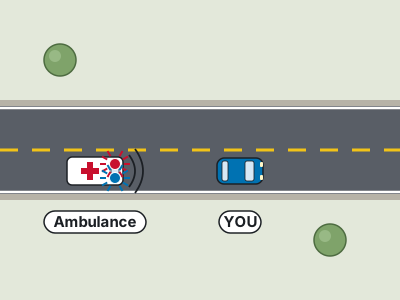
8. What action is required when an emergency vehicle approaches with its siren sounding?
- Follow it closely to use its cleared path
- Pull over to the right and stop until it passes
- Stop immediately in the middle of the intersection
- Move left and accelerate past it
Show answer
Pull over to the right and stop until it passes. An approaching emergency vehicle needs a clear path, so traffic should yield by moving to the right edge and stopping. Once it passes, Georgia law says you must not follow a fire apparatus or other emergency vehicle closer than 200 feet, while moving left can place the driver in the emergency vehicle's path. When the siren is heard, check mirrors, signal, and stop where responders can pass.
Study this in the handbook: Right of way, turns and passing
9. Which Georgia occupants must wear a seat belt?
- Only the driver
- Only passengers under 8
- Only rear seat passengers
- Everyone in the front seat, and all occupants under 18 in any seat
Show answer
Everyone in the front seat, and all occupants under 18 in any seat. Georgia law requires every front seat occupant of a passenger vehicle to wear a lap and shoulder belt, and all occupants under 18 must be belted in any seat. Limiting the rule to the driver or rear passengers is wrong. Children under 8 need an appropriate child restraint system, not just a belt. Georgia has a primary belt law, so officers can stop and cite violators without seeing another violation.
Study this in the handbook: Move Over law, school buses and emergency vehicles
10. Within what distance must you dim your high beams when following another vehicle in Georgia?
- Within 50 feet
- Within 200 feet
- Within 100 feet
- Within 1,000 feet
Show answer
Within 200 feet. Georgia says to dim your headlights when following closely, within 200 feet, behind another vehicle, and when within 500 feet of an approaching vehicle so you do not blind the driver. Fifty and 100 feet are too close before dimming, and 1,000 feet is not the rule. Also dim on lighted roads, in rain, fog, snow, or smoke, and when your vision is reduced to less than 200 feet.
Study this in the handbook: Move Over law, school buses and emergency vehicles
11. How does Georgia classify a conviction for aggressive driving?
- A civil infraction with no fine
- A misdemeanor of a high and aggravated nature
- A simple parking violation
- A felony in every case
Show answer
A misdemeanor of a high and aggravated nature. Georgia treats aggressive driving, driving with intent to annoy, harass, intimidate, injure, or obstruct another person, as a misdemeanor of a high and aggravated nature. Penalties can include jail and fines, and a driver under 21 loses driving privileges on conviction. It is not a civil infraction or a parking matter, and it is not described as a felony in every case. Tailgating, cutting in, and blocking others from passing are examples. It carries 6 points.
Study this in the handbook: Implied consent and teen DUI suspensions
12. What fine range can a Georgia driver face for disobeying a regulatory speed limit in a highway work zone?
- Not less than $100 and not more than $2,000
- Up to $250 with no minimum
- A flat $50 fine
- A warning on the first offense only
Show answer
Not less than $100 and not more than $2,000. Georgia reduces speed limits in most work zones, and official reductions use standard black and white speed limit signs. The manual warns that motorists who disobey regulatory speed limits in a work zone may be found guilty of a misdemeanor of a high and aggravated nature, punished by a fine of not less than $100 nor more than $2,000, by imprisonment up to 12 months, or both. Workers often operate within feet of open lanes.
Study this in the handbook: Speed limits and Super Speeder
13. Where does the numbering of Georgia's milepost markers start at zero?
- At the north or east border where the route ends
- At the south or west border where the route begins
- At the state capitol in Atlanta
- At the nearest county line
Show answer
At the south or west border where the route begins. Milepost markers are placed each mile along the edge of the roadway from one end of the state to the other. The Georgia manual explains that zero always starts at the south or west border where a route begins, so the numbers grow as you travel north or east. Knowing this helps you report your location in an emergency and estimate distance to an exit, since exit numbers on many highways follow the same mile count.
Study this in the handbook: Parking rules and railroad crossings
14. What does a narrow bridge warning sign mean on a Georgia road?
- The bridge ahead is closed to all traffic
- The bridge ahead has room for only two lanes of traffic
- The bridge ahead is one-way only
- Trucks must leave the road before the bridge
Show answer
The bridge ahead has room for only two lanes of traffic. Georgia's warning sign section explains that this sign means the bridge ahead allows room for only two lanes of traffic, so you should approach with caution. Warning signs like this one alert you to conditions immediately ahead that require action on your part. Slow down before the bridge, stay in your lane, and watch for oncoming traffic, since the road narrows to just two lanes.
15. When a traffic signal is not functioning at all, how should drivers treat the intersection?
- As a pedestrian-only crossing
- As an uncontrolled intersection with no yielding rule
- As a green signal for the main road
- As if a stop sign is posted for all directions
Show answer
As if a stop sign is posted for all directions. A completely nonfunctioning traffic signal requires every driver to treat the intersection as if a stop sign were posted for all directions. That means stopping, checking traffic and pedestrians, and proceeding only when the movement is safe. Treating it as uncontrolled removes the required stop, while assuming a green main road invents priority that the manual does not grant. The pedestrian-only choice is unrelated. The cue is a dark or dead signal: make a full stop in every approach direction and resolve right-of-way carefully.
Study this in the handbook: Traffic signals and pavement markings
16. After entering an intersection to make a left turn, may you change lanes?
- Yes, but only after sounding the horn
- Yes, if the lane beside you is empty
- No, you must stay in your lane through the turn
- Only if the traffic signal turns yellow
Show answer
No, you must stay in your lane through the turn. Once a driver has entered an intersection to make a left turn, the manual says lane changes are not allowed. Staying in the selected lane keeps the turning path predictable for opposing traffic, pedestrians, and other vehicles making the same movement. An empty adjacent lane does not create an exception, and a horn or signal color cannot authorize the change. Select the proper lane before entering the intersection, then complete the turn without drifting across lane lines. The cue is already inside the intersection: hold the lane until the turn is complete.
Study this in the handbook: Right of way, turns and passing
17. What fine may apply for a first violation of Georgia HOV lane restrictions?
- Up to $75
- Up to $25
- Up to $100
- Up to $150
Show answer
Up to $75. Georgia lists a fine of up to $75 for a first offense involving HOV lane restrictions. The higher amounts belong to later violations: up to $100 for a second offense and up to $150 for a third offense. The fourth or subsequent offense can also add a point to the driving record. Do not select a later-offense amount when the question describes a first violation. The cue is the sequence: first $75, second $100, third $150, with an additional point possible for the fourth or later offense.
18. How often must Georgia customers age 64 and over complete a vision screening?
- Every two years
- Every eight years
- Every five years
- Only once at age 64
Show answer
Every eight years. Georgia requires customers age 64 and over to successfully complete a vision screening every eight years. The interval is recurring, so the rule is not limited to a single screening at the moment the driver turns 64. Two years applies to updated medical information for a bioptic-lens restriction, and five years is not the interval printed here. The practical cue is the age threshold paired with the eight-year cycle: older customers should expect another screening each eight-year period.
19. When a Georgia railroad crossing requires a stop, how far from the nearest rail must the vehicle stop?
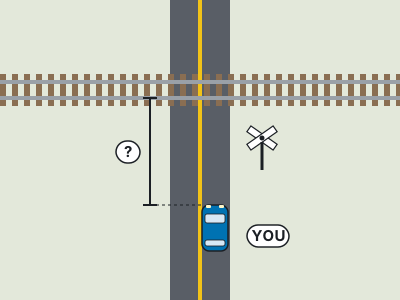
- Exactly 10 feet from the rail
- At least 100 feet away
- Within 15 feet, but never farther than 5 feet
- Within 50 feet, but not less than 15 feet
Show answer
Within 50 feet, but not less than 15 feet. Georgia requires a stopping range of no more than 50 feet and no less than 15 feet from the nearest rail when one of the listed crossing warnings applies. The driver must choose a safe point inside that interval, not an exact single distance. Ten feet is too close, and 100 feet is outside the stated maximum. The reversed 15 and 5 foot choice also misses the rule. Visualize a safety zone between 15 and 50 feet from the rail.
Study this in the handbook: Parking rules and railroad crossings
20. What must a driver do when facing a flashing yellow traffic signal?
- Stop and wait for a solid green light
- Accelerate to clear the intersection quickly
- Proceed with caution after reducing speed
- Turn off the vehicle before entering
Show answer
Proceed with caution after reducing speed. A flashing yellow signal permits movement only with caution, so slow down, evaluate the intersection, and yield when another road user has priority. It is not a command to wait for solid green, and accelerating can reduce the time available to identify a pedestrian or cross-traffic conflict. Turning off the vehicle has no connection to the signal rule. Treat the flashing indication as a warning that demands a careful approach, not as an invitation to maintain speed without looking.
Study this in the handbook: Traffic signals and pavement markings
QualitySpace is expanding to Georgia
We are a California-based independent insurance brokerage working on licensing in more states. We cannot help with Georgia insurance yet. Leave your email and we will let you know when we can.
Every question is written from the official Georgia Drivers Manual. Need paper? Printable GA practice test with answer key.
Last verified 2026-10-05. How we check every question · Study all 500 as flashcards
Frequently asked questions
How many questions are on this Georgia practice test?
This fixed set has 20 questions. It is test 3 of 25 from the 500 question Georgia bank. The real GA exam has a 20 question road sign section with 15 correct to pass, plus 20 knowledge questions with 15 correct to pass.
What is the passing score for the real Georgia test?
15 out of 20 correct on each test (75% per section) That figure comes from the official Georgia source cited on the DMV facts page.
How does this fixed test relate to the full Georgia bank?
Each numbered test is a fixed set of questions in a fixed order, so you can retake the same test later and compare. Every test mixes road signs and the other topics in about the same proportion as the full bank. Tests 1 to 25 together cover every question in the Georgia bank once. The full practice page mixes the whole bank at random.
Last verified 2026-10-05. See the Georgia DMV facts page for sourced state details.