
Test 8 of 25 · 20 questions · Free 2026
GA Permit Practice Test 8
Jump to the test ↓A fixed 20 question set from the Georgia bank with answers and plain English explanations. The real GA exam has a 20 question road sign section with 15 correct to pass, plus 20 knowledge questions with 15 correct to pass; take the full length version on the main practice page.
Question 1 of 20 · 0 right so far
All 20 questions in test 8
Every question below comes from the Georgia question bank on this page. Open a question to see the correct answer and the explanation. Nothing here is hidden behind a signup.
1. What pavement marking usually appears on a Georgia road approaching a railroad crossing?
- A white diamond symbol
- A large X with two R letters
- Yellow diagonal striping across both lanes
- A painted bicycle symbol
Show answer
A large X with two R letters. Georgia's pavement marking section explains that when a road is crossed by a railroad, the pavement is usually marked with a large X and two R letters. The manual also notes that a yellow line is placed on the right side of the center line at crossings to prevent passing. When you see the X marking, slow down, look and listen for trains, and be ready to stop if warning signals are active.
Study this in the handbook: Traffic signals and pavement markings
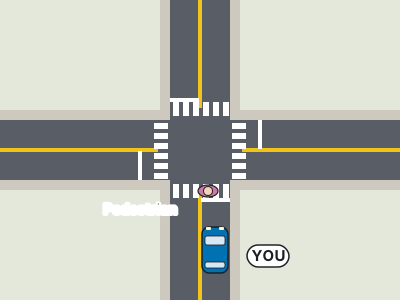
2. What must a driver do when a pedestrian is in a marked crosswalk?
- Sound the horn and continue at the posted speed
- Pass the pedestrian by crossing the center line
- Yield only if the pedestrian is running
- Stop and remain stopped until the pedestrian has cleared the driver's path
Show answer
Stop and remain stopped until the pedestrian has cleared the driver's path. Drivers must stop and stay stopped when pedestrians are in the crosswalk. A horn does not replace the duty to stop, and passing around a pedestrian can put that person in the path of another vehicle. The rule is not limited to people who are running. Approach crosswalks with the expectation that someone may enter, stop before the crossing area, and wait until the pedestrian is safely beyond the vehicle's path.
Study this in the handbook: Hydroplaning, following distance and sharing the road
3. Where does the Georgia manual say to find the recommended tire pressure?
- On the tire sidewall
- On the registration card
- At the gas station
- On the sticker in the door jamb of the vehicle
Show answer
On the sticker in the door jamb of the vehicle. Georgia tells drivers to check tire pressure before entering the vehicle, using the recommended psi located in the door jamb of the vehicle, and to measure it with a tire pressure gauge. If the psi is above the number listed on the door jamb, let air out until it matches; if it is below, add air or have a retailer help until it reaches the proper number. The tire sidewall, the registration card, and the gas station are not where the manual says to find the recommended figure.
Study this in the handbook: Hydroplaning, following distance and sharing the road
4. Under Georgia's Safety Responsibility Law, how soon must you request a hearing after receiving a suspension order?
- Within 24 hours
- Within 30 days
- Within ten days
- Within one year
Show answer
Within ten days. When a claim for crash damage is filed against a Georgia driver who failed to satisfy it, the Safety Responsibility Law brings a suspension order, and the driver may have a hearing if it is requested within ten days of receiving the order. Twenty four hours is too short, and 30 days or a year is too late. The suspension can be avoided by an SR-21 from an insurer, a signed release, or posting security.
Study this in the handbook: Points, teen suspensions and revocation
5. How close may you park to a fire apparatus stopped in answer to a Georgia fire alarm?
- Not within 500 feet
- Not within 50 feet
- Not within 100 feet
- Not within 200 feet
Show answer
Not within 500 feet. Georgia forbids parking within 500 feet of fire apparatus stopped in answer to a fire alarm, and forbids following fire apparatus or other emergency vehicles on a call closer than 200 feet. So 200 feet is the following distance, not the parking distance. Fifty and 100 feet are much too close. Vehicles on official business are exempt. Giving firefighters room keeps hoses, equipment, and crews clear.
Study this in the handbook: Move Over law, school buses and emergency vehicles
6. During the first six months after a Georgia Class D license is issued, who may ride with the teen driver?
- Only immediate family members
- Any passengers, as long as each has a seat belt
- One friend under 21
- Up to three friends under 21
Show answer
Only immediate family members. For the first six months after a Class D license is issued, only immediate family members may ride with the teen: parents and step-parents, grandparents, siblings and step-siblings, children, and anyone else who lives at the driver's home. One non-family passenger under 21 is allowed only in the second six months, and three after that. Seat belts do not change the rule.
Study this in the handbook: Instructional permit and Class D provisional license
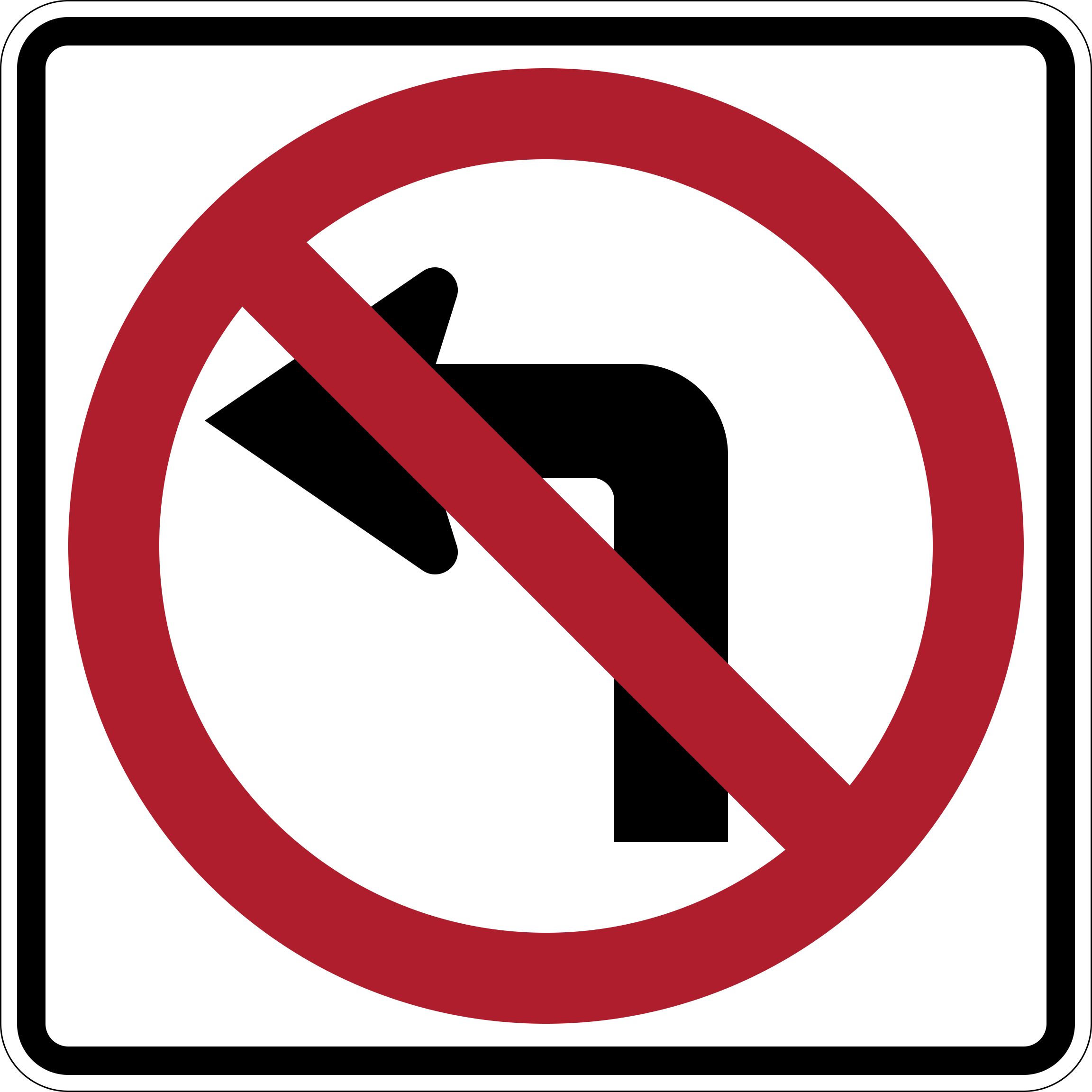
7. A Georgia regulatory sign with a red circle and slash uses the picture inside the circle to show what?
- The route number to follow
- The action that is prohibited
- The distance to the next town
- The advisory speed for a curve
Show answer
The action that is prohibited. The red circle and slash identify a regulatory prohibition, and the picture within the circle tells the driver which movement or action is banned. A route number belongs to a guide sign, distance information belongs to guide signs, and an advisory curve speed belongs with a warning. The cue is to read both parts together: the slash signals no, while the underlying symbol names the restricted behavior.
8. At what blood alcohol level is a Georgia driver under 21 irrefutably considered under the influence of alcohol?
- 0.04 or more
- Any measurable amount only after a crash
- 0.08 or more
- 0.02 or more
Show answer
0.02 or more. Georgia uses a much lower alcohol threshold for drivers under 21 than for adults. The manual says a person under 21 is irrefutably considered under the influence of alcohol when 0.02 grams or more by alcohol weight is present in the blood. The adult 0.08 figure therefore understates the standard for a younger driver, and 0.04 is not the stated level either. The rule is not limited to crashes. The cue is the leading zero and the two hundredths figure: 0.02.
Study this in the handbook: Implied consent and teen DUI suspensions
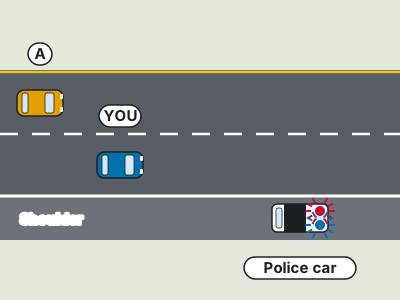
9. If a Georgia roadside emergency, sanitation, or utility vehicle is stopped on the shoulder, what must a motorist do when safe?
- Maintain speed in the adjacent lane
- Stop directly behind the service vehicle
- Move to the next lane, or slow below the speed limit and be prepared to stop
- Pass on the shoulder without reducing speed
Show answer
Move to the next lane, or slow below the speed limit and be prepared to stop. Georgia's Move Over Law requires a lane change into the next lane when safely possible. If moving over cannot be done safely, the driver must slow below the speed limit and be prepared to stop. Maintaining speed ignores the protective purpose of the law, and stopping behind or passing on the shoulder creates a new hazard. The rule covers emergency, sanitation, and utility service vehicles on the shoulder. Look ahead for the stopped vehicle, then choose the safe lane or reduced-speed response.
Study this in the handbook: Move Over law, school buses and emergency vehicles
10. What minimum score is required to pass Georgia's Class C or D road test?
- 60%
- 90%
- 80%
- 75%
Show answer
75%. The road test requires a minimum score of 75 percent. This is distinct from the road rules test, which uses a count of 15 correct answers out of 20. An applicant who remembers an 80 percent classroom-style threshold would overstate the road test standard, while 60 percent understates it. Ninety percent is not the printed minimum. A simple cue is to associate the driving evaluation with three quarters, or 75 percent, and the written road rules test with 15 of 20.
Study this in the handbook: Driver education, knowledge exam and road test
11. After stopping for a Georgia school bus that is loading or unloading, when may you move again?
- When the bus moves or turns off its signals and all passengers have cleared the roadway
- As soon as the stop arm starts to fold
- After waiting 10 seconds
- When the children reach the curb on the far side, even if lights still flash
Show answer
When the bus moves or turns off its signals and all passengers have cleared the roadway. Drivers in Georgia must stop when approaching or meeting a stopped school bus with flashing lights that is loading or unloading, except on a road divided by a median. The manual then says you must remain stopped until the bus resumes motion or deactivates its warning signals, and all loading or unloading passengers have cleared the roadway. Both conditions matter, because children may still be crossing after the lights go dark.
Study this in the handbook: Move Over law, school buses and emergency vehicles
12. What language availability does Georgia describe for its road rules tests?
- English is the only available language
- Spanish is the only available language
- Some non-English languages are available
- No language other than a sign-language interpreter
Show answer
Some non-English languages are available. Georgia states that road rules tests are available in some non-English languages. That does not mean Spanish is the only option, and it does not make English unavailable for every applicant. The manual separately requires all drivers to show that they can read and understand simple English used on highway traffic and directional signs. The key cue is the distinction between test-language availability and the basic English-reading ability expected for safe use of roadway signs.
Study this in the handbook: Driver education, knowledge exam and road test
13. When does a Georgia school zone's reduced speed limit apply?
- When the yellow warning lights are flashing
- From midnight until five in the morning
- Every weekend regardless of lights
- Only when a school employee is standing in the roadway
Show answer
When the yellow warning lights are flashing. The reduced speed in the school zone applies during the period indicated by the flashing yellow warning lights. It is not an all weekend rule, a midnight schedule, or dependent on an employee standing in the roadway. The lights provide the immediate cue that the special school zone restriction is active. Drivers should slow before entering the zone, watch for children and crossings, and continue at the posted ordinary speed only after the special period has ended.
14. What does the Georgia manual say about stimulant drugs for a drowsy driver on a long trip?
- Take them at the first sign of drowsiness
- They make it safe to keep driving
- Do not rely on them; they are likely to make driving even more hazardous
- They work only with coffee
Show answer
Do not rely on them; they are likely to make driving even more hazardous. Drowsiness and fatigue are dangerous any time you drive but especially on long expressway trips. The manual says to stop driving if you feel drowsy and not to rely on stimulant drugs, sometimes called stay awake drugs, because they are likely to make your driving even more hazardous. The manual also warns about highway hypnosis on long expressway trips and suggests exercising your eyes by shifting focus near and far, left and right, to stay alert.
15. Blue and white signs on Georgia highways direct drivers toward:
- A no-passing zone
- Service facilities
- A construction detour only
- A reduced-speed school zone
Show answer
Service facilities. Blue and white service signs direct travelers to facilities available along the highway. That can include places such as fuel, food, lodging, or other driver services identified at the roadside. A no-passing restriction is conveyed by a regulatory or warning sign, not this service-sign color. Construction detours use temporary work-zone information, while a school-zone speed restriction is a regulatory matter. Treat the blue and white panel as helpful location information, then make lane changes or turns only after checking traffic and following any separate control signs.
16. What color can Georgia warning signs also use besides the usual yellow?
- Blue with white markings
- Fluorescent green with black markings
- Red with yellow markings
- Brown with orange markings
Show answer
Fluorescent green with black markings. Georgia says warning signs can also be fluorescent green with black markings, even though the usual warning color is yellow with black markings. The alternate color helps draw attention to conditions ahead, but it does not turn the sign into a regulatory command or a route guide. Blue, red, and brown combinations serve different sign purposes in the manual. When a fluorescent green warning appears, read its symbol or wording, scan for the condition ahead, and adjust speed or position as needed.
17. What may a Georgia warning sign indicate besides a road hazard?

- A guaranteed passing opportunity
- A permanent parking permit area
- A required fuel stop
- A change in traffic direction
Show answer
A change in traffic direction. Georgia warning signs may indicate a change in traffic direction as well as road hazards or another potentially hazardous situation requiring action. A warning sign does not guarantee a passing opportunity, identify a fuel stop, or grant a parking permit. Read the symbol early and prepare for the movement change before reaching it. The useful cue is that warning signs describe conditions ahead, so the driver should adjust speed and lane position before the roadway itself demands the response.
18. If your vehicle begins to skid, what should you do first?
- Press the brake pedal as hard as possible
- Ease your foot off the accelerator
- Accelerate to force the tires to regain grip
- Turn the steering wheel sharply away from the skid
Show answer
Ease your foot off the accelerator. The first response to a skid is to ease off the accelerator, which removes power that can keep the tires from regaining grip. Hard braking, a sharp turn away from the skid, or acceleration can make the vehicle less stable. After reducing power, steer in the direction of the skid and wait until control returns before applying a light brake if needed. Keep movements measured, because abrupt corrections can turn a manageable slide into a larger loss of control.
Study this in the handbook: Blowouts, skids and crashes
19. What should a driver use to signal a change in speed while preparing to exit in the traveling lane?
- The hazard lights only after stopping
- A high-beam flash without slowing
- Brake lights or a turn signal
- The horn instead of any light
Show answer
Brake lights or a turn signal. When preparing to exit while still slowing in the traveling lane, Georgia advises using brake lights or a turn signal to show the drivers behind that speed is changing. The hazard-light choice adds a condition the passage does not require, while a high-beam flash or horn does not provide the stated warning. The cue is the combination of slowing and exit preparation: communicate the change early enough for following traffic to react, then complete the maneuver in the proper lane.
20. For a 17-year-old enlisted in the military, what permit-holding period may be waived before a Class C license is issued?
- One year and one day
- Six months exactly
- Ninety days
- Two years exactly
Show answer
One year and one day. Georgia provides an exception for a 17-year-old who is enlisted in the military: the learner's permit need not be held for one year and one day before the person proceeds toward a Class C license. Six months, ninety days, and two years are not the period identified in this exception. The cue is the combination of age and military status, because the ordinary teen licensing sequence has different timing. The applicant still has to meet the other requirements and successfully complete the licensing process described by DDS.
Study this in the handbook: Instructional permit and Class D provisional license
QualitySpace is expanding to Georgia
We are a California-based independent insurance brokerage working on licensing in more states. We cannot help with Georgia insurance yet. Leave your email and we will let you know when we can.
Every question is written from the official Georgia Drivers Manual. Need paper? Printable GA practice test with answer key.
Last verified 2026-10-05. How we check every question · Study all 500 as flashcards
Frequently asked questions
How many questions are on this Georgia practice test?
This fixed set has 20 questions. It is test 8 of 25 from the 500 question Georgia bank. The real GA exam has a 20 question road sign section with 15 correct to pass, plus 20 knowledge questions with 15 correct to pass.
What is the passing score for the real Georgia test?
15 out of 20 correct on each test (75% per section) That figure comes from the official Georgia source cited on the DMV facts page.
How does this fixed test relate to the full Georgia bank?
Each numbered test is a fixed set of questions in a fixed order, so you can retake the same test later and compare. Every test mixes road signs and the other topics in about the same proportion as the full bank. Tests 1 to 25 together cover every question in the Georgia bank once. The full practice page mixes the whole bank at random.
Last verified 2026-10-05. See the Georgia DMV facts page for sourced state details.