
Test 1 of 25 · 20 questions · Free 2026
GA Permit Practice Test 1
Jump to the test ↓A fixed 20 question set from the Georgia bank with answers and plain English explanations. The real GA exam has a 20 question road sign section with 15 correct to pass, plus 20 knowledge questions with 15 correct to pass; take the full length version on the main practice page.
Question 1 of 20 · 0 right so far
All 20 questions in test 1
Every question below comes from the Georgia question bank on this page. Open a question to see the correct answer and the explanation. Nothing here is hidden behind a signup.
1. Under Georgia's Hands Free Law, which activity is prohibited while operating a motor vehicle?
- Adjusting a side mirror before moving
- Listening to a navigation prompt
- Reading a text based communication
- Looking at the speedometer
Show answer
Reading a text based communication. Georgia's hands free rule reaches beyond physically holding a phone. Reading a text based communication is a prohibited use while operating the vehicle. Adjusting a mirror before moving and checking the speedometer are ordinary driving tasks, and hearing a navigation prompt is not the same as reading a message. The practical cue is to keep messages unread while driving and handle phone displays only when the vehicle is safely stopped in a permitted location.
Study this in the handbook: Headlights, seat belts, child seats and phones
2. If possible, what lane change should a driver make when passing a bicycle?
- Move into a lane not adjacent to the bicycle
- Drive beside the bicycle in the same lane
- Use the shoulder as the passing lane
- Sound the horn and keep the same lane position
Show answer
Move into a lane not adjacent to the bicycle. Georgia recommends moving into a lane that is not adjacent to the bicycle when the existing road and traffic conditions allow it. Driving beside the bicycle in the same lane leaves too little lateral space, while the shoulder is not a general passing lane. A horn does not create room or replace a safe lane change. Check mirrors, signal, and wait when a separate lane cannot be used safely.
Study this in the handbook: Right of way, turns and passing
3. What spacing advice does Georgia give for safe driving?
- Follow closely so traffic cannot merge
- Match the bumper gap of the vehicle behind you
- Leave no space when approaching a curve
- Keep a safe distance between you and other vehicles
Show answer
Keep a safe distance between you and other vehicles. Georgia safety guidance tells drivers to keep a safe distance between their vehicle and other vehicles. A usable gap gives more time to see a hazard, brake smoothly, and respond if traffic changes. Following closely reduces that time and can create a chain reaction when the lead driver slows. Leaving no space near a curve is especially risky because sight distance may be limited. Use roadway, weather, and traffic conditions to choose a cushion that lets you stop or maneuver without an abrupt response.
Study this in the handbook: Hydroplaning, following distance and sharing the road
4. What principle should guide a driver who technically has the right-of-way but sees another road user failing to yield?
- Yield if needed to prevent a crash
- Use the horn and keep the same path
- Insist on proceeding because the law guarantees safety
- Accelerate so the other vehicle must stop
Show answer
Yield if needed to prevent a crash. Right-of-way is something to give, not something to force. If another road user does not yield, a defensive driver should slow or yield when needed to prevent a collision, even when the law would otherwise favor that driver. A legal priority cannot protect a vehicle from impact. Watch the other road user's wheels and body position, cover the brake, and choose the action that keeps the conflict from developing.
Study this in the handbook: Right of way, turns and passing
5. During the second six months of a Georgia Class D provisional license, how many non-family passengers under 21 may ride along?
- None
- Only one
- Three
- Any number
Show answer
Only one. The Class D passenger rule tightens in stages. During the first six months only immediate family members may ride, during the second six months only one passenger under 21 who is not a member of the driver's immediate family may ride, and after the first and second six month periods up to three such passengers may ride. Family members do not count. The limit is one during the second period, not none and not three.
Study this in the handbook: Instructional permit and Class D provisional license
6. A Georgia driver under 21 refuses implied consent testing after a DUI arrest. How long is the first DUI suspension?
- A minimum of 30 days
- A minimum of 6 months
- A minimum of 5 years
- A minimum of 12 months
Show answer
A minimum of 12 months. For a Georgia driver under 21, a first DUI suspension is at least 12 months when the BAC was .08 or greater or the driver refused implied consent testing, and no limited driving permit is available. Six months is the minimum when the BAC was .02 or more but below .08, when the test results were suppressed, or when no test was given. Thirty days understates the rule, and five years is not the first DUI figure.
Study this in the handbook: Implied consent and teen DUI suspensions
7. How many points does Georgia assess for speeding 34 mph or more over the posted limit?
- 3 points
- 4 points
- 6 points
- 8 points
Show answer
6 points. Speeding 34 mph or more over the posted limit costs 6 points in Georgia, the same as aggressive driving and unlawfully passing a school bus. Three points is for 19 to 23 mph over, and 4 points is for 24 to 33 mph over. Eight points is not on the chart. At 85 mph or more on any road, a conviction also triggers the $200 Super Speeder state fee.
Study this in the handbook: Implied consent and teen DUI suspensions
8. The opposing-arrow warning sign tells you that you will soon be:
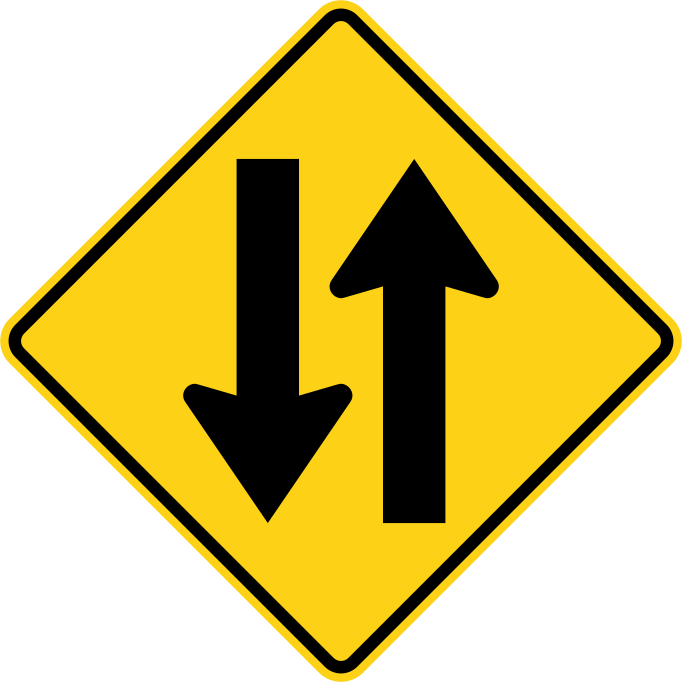
- Entering a roadway where passing is required
- Driving on a two-way highway after leaving a separated one-way road
- Approaching a median that must be crossed
- Entering a lane reserved for U-turns
Show answer
Driving on a two-way highway after leaving a separated one-way road. This warning marks the transition from a separated one-way highway to a two-way highway. That change requires renewed attention to opposing traffic and lane position. It does not require passing, crossing a median, or using a special U-turn lane. The strongest visual cue is that travel directions are no longer divided from each other. Reduce speed if needed, stay in the proper lane, and anticipate vehicles approaching from the opposite direction once the separated roadway arrangement ends.
9. What alternative may satisfy the six-hour on-the-road part of Georgia's approved driver education requirement?
- A second 30-hour classroom course
- A motorcycle permit
- A school enrollment certificate
- Completion of the DDS approved Parent/Teen Driver Guide
Show answer
Completion of the DDS approved Parent/Teen Driver Guide. Georgia permits the six-hour on-the-road component to be completed with a certified instructor or through the DDS approved Parent/Teen Driver Guide. The guide is therefore a specific substitute for that practical segment, not a replacement for every education requirement. A second classroom course addresses the wrong component. A motorcycle permit concerns another vehicle class, and a school enrollment certificate proves an enrollment condition rather than driving practice. Keep the cue tied to the number six: instructor experience or the approved Parent/Teen Guide.
Study this in the handbook: Instructional permit and Class D provisional license
10. What is the penalty for a first conviction under Georgia's Hands Free Law?
- 3 points and a $150 fine
- 2 points and a $100 fine
- No points and a warning
- 1 point and a fine of not more than $50
Show answer
1 point and a fine of not more than $50. A first Hands Free Law conviction in Georgia brings 1 point and a fine of not more than $50. A second brings 2 points and up to $100, and a third or later brings 3 points and up to $150. The law bars holding or supporting a phone with any part of the body, as well as texting and watching video. A warning with no points is not the listed penalty.
Study this in the handbook: Headlights, seat belts, child seats and phones
11. When a warning sign shows that a divided highway ends, you should:

- Prepare to change lanes or shift your lane position
- Stop in the travel lane before the divider ends
- Use the shoulder as the next regular lane
- Keep both directions separated by a new median
Show answer
Prepare to change lanes or shift your lane position. The ending divided highway warning means the current roadway arrangement will change, so prepare for a lane shift and watch for traffic moving in the new pattern. It does not promise that a median will continue, and stopping in the lane would create a hazard unless another rule requires it. The shoulder is not a normal substitute travel lane. Slow enough to evaluate the merge, signal any lane change, and keep scanning for vehicles that may be entering your path as the division ends.
12. What does a pentagon shaped Georgia sign identify?

- A one-way roadway
- A railroad crossing
- A school zone or school crossing
- A no passing zone
Show answer
A school zone or school crossing. Pentagon shaped signs identify an approaching school zone or school crossing. The railroad warning is round, one-way travel is communicated by a regulatory sign, and a no passing zone uses a different warning message. The manual notes that these school signs may be erected 150 to 700 feet before the school grounds or crossing. The cue is the five-sided shape, prompting a slower approach and careful attention for children.
Study this in the handbook: Sign shapes and what they mean
13. A limited driving permit holder in Georgia is convicted of a moving violation. What happens?
- Nothing, the permit stays valid
- The permit is revoked and the underlying suspension is extended by 6 months
- The permit is extended by 6 months
- Only a $50 fine applies
Show answer
The permit is revoked and the underlying suspension is extended by 6 months. If a Georgia limited driving permit holder is convicted of violating a law or ordinance on vehicle movement, or of breaking the permit's conditions, the Department revokes the permit and the underlying suspension is extended by 6 more months. The permit does not stay valid or get longer, and a small fine is not the only consequence. Limited permits also cannot be used to drive a commercial vehicle.
Study this in the handbook: Points, teen suspensions and revocation
14. At an uncontrolled Georgia intersection, two vehicles arrive together. Which vehicle has priority when one is on your right?
- The vehicle on your left
- The vehicle on your right
- The vehicle traveling faster
- The vehicle with more passengers
Show answer
The vehicle on your right. When vehicles reach an uncontrolled intersection at approximately the same time, the driver on the left yields to the vehicle on the right. That gives the vehicle approaching from your right priority in this situation. Speed, passenger count, and a driver's preference do not alter the basic position rule. The cue is to look across the intersection before moving: if another vehicle is on your right and arrival is simultaneous, wait and let it proceed.
Study this in the handbook: Right of way, turns and passing
15. When may a Georgia driver stop on an expressway shoulder?
- Only in an emergency
- To switch drivers or stretch
- To look at a map or retrieve an item
- Whenever traffic is light
Show answer
Only in an emergency. Georgia's expressway tips say stopping on the expressway is prohibited and that rest areas and service signs appear at frequent intervals for planned breaks. Stopping on the roadway shoulder is highly dangerous and permitted only in an emergency. The manual says switching drivers, stretching, or retrieving an item is not an emergency. If you must stop, raise the hood, turn on your hazard lights, and do not walk along the expressway looking for help.
16. At a Georgia Pedestrian Hybrid Beacon, what must drivers do when the double solid red lights change to alternating flashing red lights?
- Come to a full stop and go when pedestrians have cleared the crosswalk
- Keep driving because flashing red means the cycle has ended
- Slow down without stopping
- Wait until the beacon goes completely dark before moving
Show answer
Come to a full stop and go when pedestrians have cleared the crosswalk. A Pedestrian Hybrid Beacon stays dark until a pedestrian presses the button. Drivers then see flashing yellow, steady yellow, and double solid red, which requires a stop. Georgia's manual says the double solid red signals are followed by alternating flashing red signals, which require drivers to come to a full stop and proceed when pedestrians have cleared the crosswalk. The beacon then goes dark until activated again.
17. What are Georgia warning signs usually marked with?
- Blue backgrounds with white markings
- Green backgrounds with red markings
- Yellow backgrounds with black markings
- White backgrounds with orange markings
Show answer
Yellow backgrounds with black markings. Georgia warning signs are usually yellow with black markings, making them easier to recognize before the driver can read every detail. The color combination identifies a warning rather than a route guide, service sign, or temporary command. Blue, green, and white signs can serve other purposes, but they do not describe the standard warning-sign appearance stated here. When the yellow and black pattern appears, look for the hazard ahead, reduce speed if conditions call for it, and keep attention on changes in traffic direction or roadway surface.
18. What is the purpose of a solid white edge line along the side of the pavement?
- It separates traffic moving in opposite directions
- It serves as a safety guide for the roadway edge
- It requires the driver to change lanes
- It marks a passing lane for oncoming traffic
Show answer
It serves as a safety guide for the roadway edge. Solid white edge lines guide drivers along the side of the pavement and help identify the roadway boundary. They do not separate opposing traffic, which is the function of center lines, and they do not command a lane change. A white edge line also is not a passing lane for vehicles traveling toward you. Use it as a visual reference while maintaining a safe lane position, especially when visibility or pavement edges are difficult to judge. The cue is white at the outside edge: it guides, rather than divides opposing flow.
Study this in the handbook: Traffic signals and pavement markings
19. What does a round traffic sign tell a Georgia driver to expect?
- A school crossing ahead
- A no passing zone beginning
- A one-way roadway
- A railroad crossing ahead
Show answer
A railroad crossing ahead. A round sign is used to warn that a railroad crossing is ahead. The manual says it appears a few hundred feet before the tracks and tells the driver to slow down, look, listen, and prepare to stop. A school crossing uses a pentagon, a no passing zone has its own warning treatment, and one-way travel is shown by a regulatory sign. The cue is the round shape: begin searching for tracks and an approaching train.
Study this in the handbook: Sign shapes and what they mean
20. What minimum space must a Georgia motorist leave when passing a bicyclist?
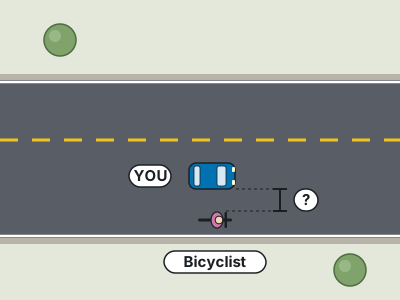
- At least one foot
- At least six inches
- At least three feet
- No fixed space if the horn is used
Show answer
At least three feet. Georgia requires a motorist passing a bicyclist to proceed around the bicycle with at least three feet between the vehicle and the bicycle at all times. The one foot and six inch options leave far less than the required room. Sounding the horn does not replace the space requirement, because the rule protects the bicyclist throughout the pass. The manual also says to change into a lane not next to the bicycle when possible, and otherwise to slow to a reasonable speed before going around with that three foot buffer.
Study this in the handbook: Hydroplaning, following distance and sharing the road
QualitySpace is expanding to Georgia
We are a California-based independent insurance brokerage working on licensing in more states. We cannot help with Georgia insurance yet. Leave your email and we will let you know when we can.
Every question is written from the official Georgia Drivers Manual. Need paper? Printable GA practice test with answer key.
Last verified 2026-10-05. How we check every question · Study all 500 as flashcards
Frequently asked questions
How many questions are on this Georgia practice test?
This fixed set has 20 questions. It is test 1 of 25 from the 500 question Georgia bank. The real GA exam has a 20 question road sign section with 15 correct to pass, plus 20 knowledge questions with 15 correct to pass.
What is the passing score for the real Georgia test?
15 out of 20 correct on each test (75% per section) That figure comes from the official Georgia source cited on the DMV facts page.
How does this fixed test relate to the full Georgia bank?
Each numbered test is a fixed set of questions in a fixed order, so you can retake the same test later and compare. Every test mixes road signs and the other topics in about the same proportion as the full bank. Tests 1 to 25 together cover every question in the Georgia bank once. The full practice page mixes the whole bank at random.
Last verified 2026-10-05. See the Georgia DMV facts page for sourced state details.