
Test 2 of 25 · 20 questions · Free 2026
GA Permit Practice Test 2
Jump to the test ↓A fixed 20 question set from the Georgia bank with answers and plain English explanations. The real GA exam has a 20 question road sign section with 15 correct to pass, plus 20 knowledge questions with 15 correct to pass; take the full length version on the main practice page.
Question 1 of 20 · 0 right so far
All 20 questions in test 2
Every question below comes from the Georgia question bank on this page. Open a question to see the correct answer and the explanation. Nothing here is hidden behind a signup.
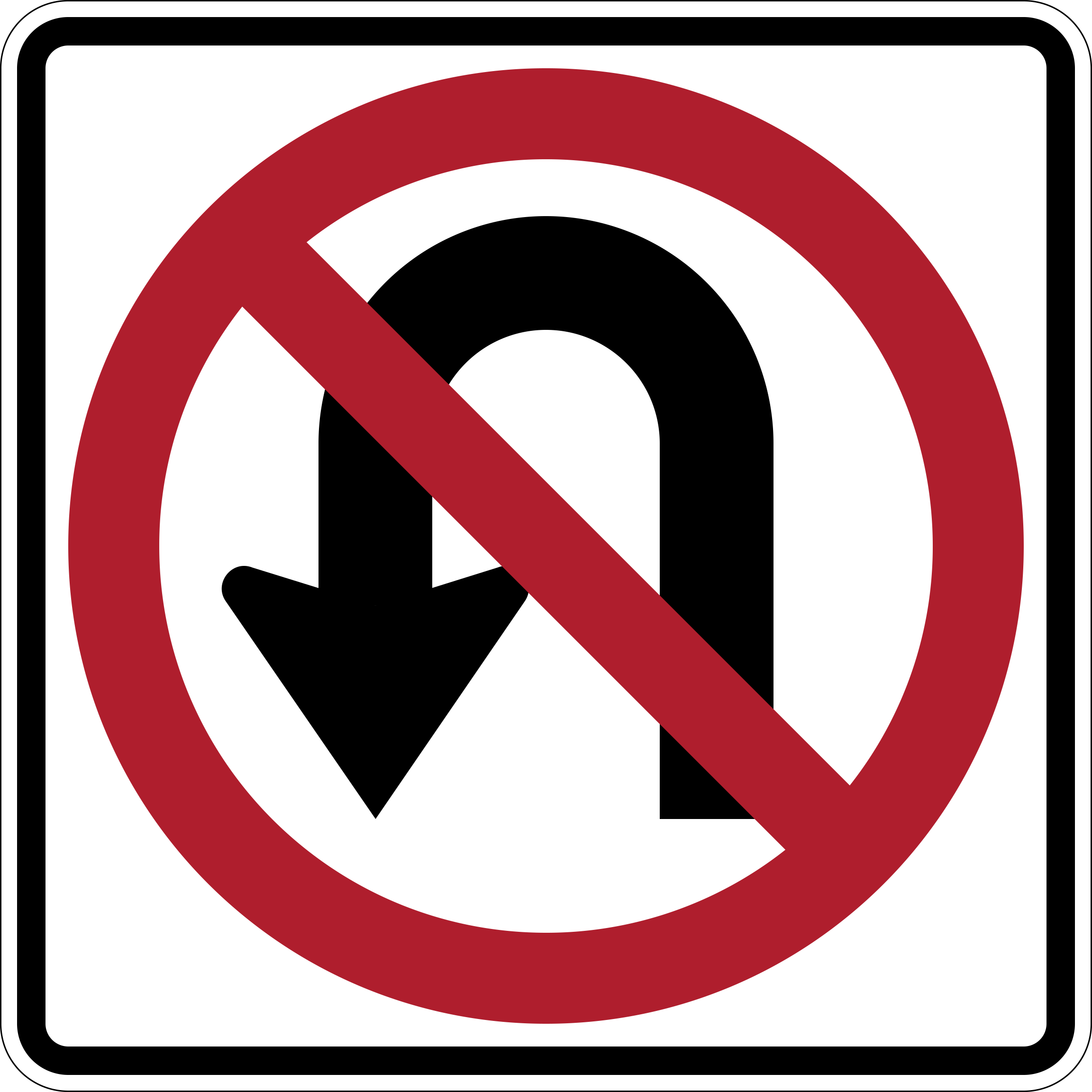
1. What movement is prohibited by a Georgia NO U TURN sign?
- Turning right at the next intersection
- Changing lanes on a multilane road
- Turning around to go in the opposite direction
- Stopping for a pedestrian
Show answer
Turning around to go in the opposite direction. The NO U TURN sign prohibits turning around so the vehicle goes in the opposite direction at that intersection. It does not by itself ban every right turn or every lane change, and stopping for a pedestrian remains a safety duty. The cue is the U-shaped reversal depicted by the sign. Keep the vehicle moving in its permitted direction and wait for a lawful location before reversing course.
2. May a Georgia driver wear headphones or a headset while driving?
- Yes, in one ear
- No, it is unlawful to drive while wearing any device that would impair the ability to hear
- Yes, if the volume is low
- Yes, for phone calls only
Show answer
No, it is unlawful to drive while wearing any device that would impair the ability to hear. Georgia makes it unlawful to operate a motor vehicle while wearing a headphone, headset, or any other device that would impair the driver's ability to hear. The driver also must not wear anything that would obstruct his or her vision while driving. The manual adds that wearing these devices is not only illegal but also unsafe. The rule as stated has no exception for wearing a device in one ear, keeping the volume low, or taking phone calls, so any device that impairs hearing is off limits behind the wheel.
Study this in the handbook: Implied consent and teen DUI suspensions
3. What penalty can a Georgia littering conviction bring?
- A $25 fine only
- A written warning
- A fine up to $1,000 and up to 12 months in jail
- A 30 day license suspension only
Show answer
A fine up to $1,000 and up to 12 months in jail. Georgia's Litter Control Law treats littering as damage to property, and a conviction is a misdemeanor with a fine up to $1,000 and a 12 month jail term. A judge can also order the person to pick up litter in a designated area. When litter comes from a vehicle, the operator is the one who violated the law. A $25 fine, a warning, or only a license suspension do not match the penalty.
Study this in the handbook: Move Over law, school buses and emergency vehicles
4. How many points does Georgia assess for speeding 19 to 23 mph over the posted limit?
- 2 points
- 3 points
- 4 points
- 6 points
Show answer
3 points. Georgia's points chart assigns 3 points for speeding 19 to 23 mph over the posted limit. Speeding 15 to 18 mph over is 2 points, 24 to 33 mph over is 4 points, and 34 mph or more over is 6 points. Accumulating 15 or more points in 24 months suspends the license, and a driver under 21 loses the license for any single 4 point violation.
Study this in the handbook: Implied consent and teen DUI suspensions
5. When entering a roundabout, what must a driver do?
- Yield to traffic already circulating and enter to the right
- Enter first because circulating traffic must yield
- Stop in the center and wait for a signal
- Travel clockwise around the center island
Show answer
Yield to traffic already circulating and enter to the right. Entering traffic must yield to vehicles already circulating in the roundabout, wait for a gap, and merge to the right. Traffic within the circle travels counterclockwise, so the clockwise choice reverses the required flow. There is no instruction to stop in the middle, and circulating vehicles do not automatically yield to an entering vehicle. Slow to the advisory speed, watch both the circulating lane and the crosswalk, then enter only when the gap is adequate. The cue is yield before entry, then counterclockwise movement.
Study this in the handbook: Traffic signals and pavement markings
6. In Georgia urban areas, where is a painted stop line usually located?
- Directly on top of the crosswalk
- About twenty feet past the stop sign
- About four feet before the crosswalk
- At the center of the intersection
Show answer
About four feet before the crosswalk. Stop lines are white lines painted across the pavement that show the point beyond which your vehicle should not cross when stopping for a traffic control device. The Georgia manual notes that in urban areas the line is usually located about four feet before the crosswalk. Stop behind the line, not at the sign or signal itself. The manual also says to stop before the crosswalk so pedestrians can cross safely.
Study this in the handbook: Traffic signals and pavement markings
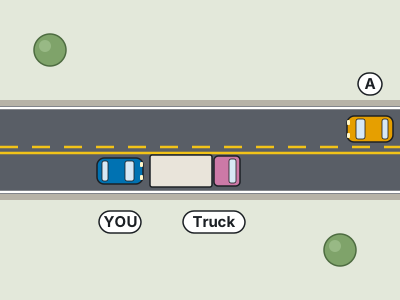
7. What does a solid yellow line nearest your vehicle mean on a two-lane road?
- The vehicle is not in a passing zone
- Passing is allowed if the driver accelerates
- Passing is required before the line ends
- The lane is reserved for left turns
Show answer
The vehicle is not in a passing zone. A solid line nearest the vehicle means the driver is not in a passing zone. The marking does not require a pass, and extra speed cannot change the restriction. A left-turn lane has a different function and should not be inferred from a center line alone. Continue behind the slower vehicle until the markings show a legal passing zone and the traffic, sight distance, and available space all support a safe maneuver.
Study this in the handbook: Traffic signals and pavement markings
8. Where should a driver generally place the hands on the steering wheel?
- Left hand at 9 o'clock and right hand at 3 o'clock
- Both hands at the top of the wheel
- Left hand at 6 o'clock and right hand at 12 o'clock
- One hand on the wheel and one on the window
Show answer
Left hand at 9 o'clock and right hand at 3 o'clock. The manual’s general steering guidance places the left hand at 9 o'clock and the right hand at 3 o'clock. Balanced hand placement keeps both hands ready for a controlled correction and avoids resting an arm on the window. The other arrangements either remove a hand from a useful control position or leave only one hand engaged. Some vehicles with airbags may have manufacturer guidance for another position, so consult the owner’s manual when it differs. The cue is two hands opposite each other, not a single-hand posture.
Study this in the handbook: Hydroplaning, following distance and sharing the road
9. How does Georgia define the offense of aggressive driving?
- Driving 10 mph over the limit
- Operating a vehicle with the intent to annoy, harass, molest, intimidate, injure, or obstruct another person
- Honking at a slow driver
- Changing lanes without signaling once
Show answer
Operating a vehicle with the intent to annoy, harass, molest, intimidate, injure, or obstruct another person. A person commits the offense of aggressive driving in Georgia when he or she operates any motor vehicle with the intent to annoy, harass, molest, intimidate, injure, or obstruct another person. Examples include tailgating, cutting in front of another driver, and blocking other drivers. Intent is the key element, so a single speeding or signal lapse is a traffic violation rather than aggressive driving. Do not respond in kind; give an aggressive driver room.
Study this in the handbook: Implied consent and teen DUI suspensions
10. A right-angle warning arrow represents:

- A sharp turn to the right
- A four-way intersection with equal priority
- A one-way street direction
- A lane that ends at a toll booth
Show answer
A sharp turn to the right. The right-angle arrow warns of a sharp right turn, so the driver should reduce speed before reaching it and remain prepared for the roadway to change direction quickly. It is not an intersection control, a one-way direction marker, or a toll-lane notice. A sharp turn can demand more steering and can magnify a speed error, especially on a slick surface. Read any advisory speed plaque, position the vehicle early, and avoid entering the turn faster than conditions allow.
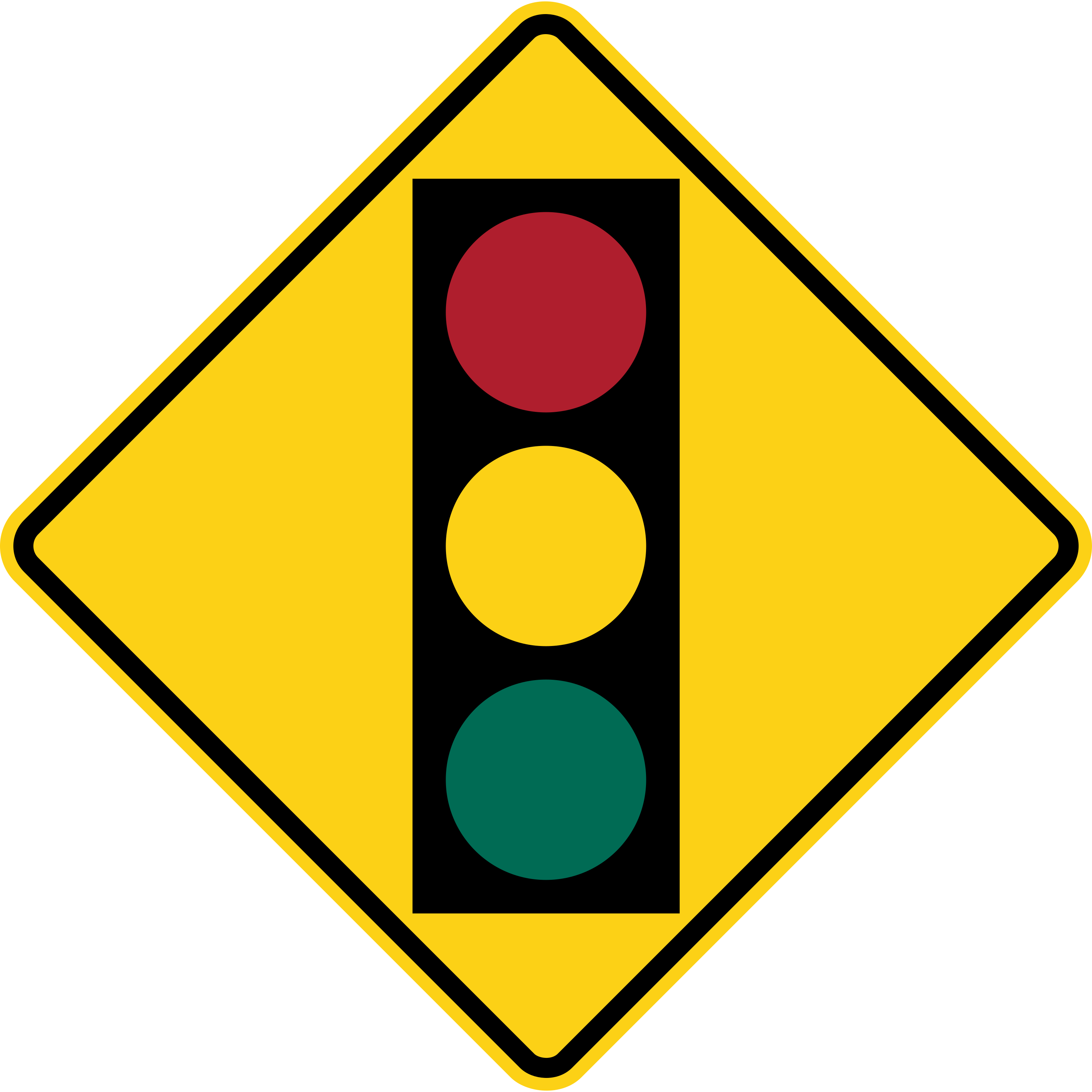
11. What should you expect after seeing the traffic-signal warning sign?
- A street where all lights are out
- Traffic signals at an intersection ahead
- A police checkpoint with no intersection
- A lane reserved for utility vehicles
Show answer
Traffic signals at an intersection ahead. The sign warns that traffic signals are present at an upcoming intersection, giving you time to reduce speed and watch the light. It does not announce that the lights are broken, so treating it as an outage would create unnecessary confusion. A checkpoint and a utility lane are unrelated to the signal symbol. The useful cue is to look beyond the sign for the intersection and be prepared for a changing indication, cross traffic, or pedestrians before entering.
12. What should a driver do if unable to drive at a posted minimum speed?
- Continue in the passing lane
- Stop in the travel lane
- Seek an alternate route
- Ignore the minimum speed
Show answer
Seek an alternate route. Georgia advises a driver who cannot travel at the minimum speed to seek an alternate route. Remaining in the travel lane while unable to keep pace can impede the normal and reasonable movement of traffic. Continuing in the passing lane does not solve the speed problem, stopping in the lane creates a hazard, and ignoring the minimum contradicts the highway rule. The cue is simple: if the vehicle cannot meet the posted floor, leave that route.
Study this in the handbook: Parking rules and railroad crossings
13. A Georgia driver is eligible for a limited driving permit during a suspension. What is the fee?
- $75
- $210
- $500
- $32
Show answer
$32. Georgia may issue a limited driving permit for a fee of $32 during certain suspensions. The permit allows only listed trips, such as driving to work, medical care, school, support meetings, court, and taking unlicensed family members to work, medical care, or school. Seventy five dollars is not a listed fee, and $210 is a DUI restoration fee. A new moving violation revokes the permit and adds 6 months to the suspension.
Study this in the handbook: Points, teen suspensions and revocation
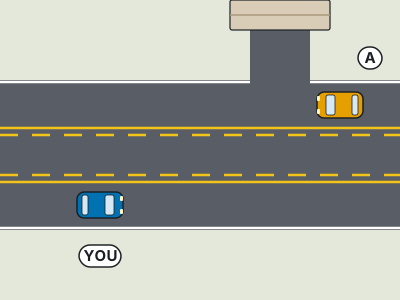
14. What is a two-way center turn lane intended for?
- Parking until traffic clears
- Driving straight through to pass slower vehicles
- Left turns, including turns into an intersection or driveway
- Traveling in either direction for as long as needed
Show answer
Left turns, including turns into an intersection or driveway. A center lane bordered by yellow markings is provided for left turns, and Georgia law prohibits using it for another purpose. It is not a passing lane, a parking strip, or a general travel lane. Enter it shortly before the left turn rather than using it to advance through congestion. Because vehicles from both directions may approach the same lane, check carefully for opposing turners before entering. The cue is center lane plus yellow borders: reserve it for the brief left-turn maneuver, not through travel.
Study this in the handbook: Traffic signals and pavement markings
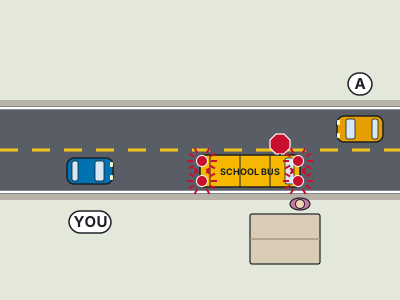
15. When a school bus stops to load or unload children, which traffic must stop?
- Only traffic directly behind the bus
- Only traffic traveling toward the front of the bus
- No traffic if the bus is on the shoulder
- Traffic approaching the bus from either direction, subject to the divided-highway exception
Show answer
Traffic approaching the bus from either direction, subject to the divided-highway exception. A stopped school bus loading or unloading children requires traffic approaching from either direction to stop, except where separate roadways are divided by a median as provided by law. Limiting the duty to vehicles behind the bus ignores opposing traffic that may cross the children's path. A shoulder location does not automatically cancel the rule. Watch for the flashing lights, stop before reaching the bus, and remain stopped until the signals end and the children are safe.
Study this in the handbook: Move Over law, school buses and emergency vehicles
16. What does a triangular traffic sign mean in Georgia?
- Stop every time before entering the intersection
- Continue at the posted speed without checking traffic
- The road is entering a school zone
- Yield to other traffic after slowing and stop if necessary
Show answer
Yield to other traffic after slowing and stop if necessary. A triangle is the yield shape. The driver must slow to a reasonable speed for conditions, stop if necessary, and give way to vehicles in the intersection or approaching closely. Stopping every time assigns the octagon's rule to a triangle, while continuing at the posted speed removes the required traffic check. A school warning uses a pentagon instead. See the triangle as an instruction to reduce speed and prepare to yield, not as permission to continue automatically.
Study this in the handbook: Sign shapes and what they mean
17. Under Georgia teen driving law, how long is the license or permit of a driver under 21 suspended for a first conviction of an offense such as reckless driving, aggressive driving, or leaving the scene of a crash?
- Six months
- Thirty days
- Until the driver turns 21
- Twelve months
Show answer
Six months. Georgia lists a six month suspension for a first conviction of the specified offenses involving drivers under 21. A second or subsequent conviction carries twelve months, so that longer period is not the first-offense figure. Thirty days is not the interval printed in this section, and the rule does not postpone suspension until age 21. The useful study cue is to pair the conviction count with the period: first conviction means six months, while repeat convictions move to twelve months.
Study this in the handbook: Instructional permit and Class D provisional license
18. What restriction is placed on a Georgia license when glasses or contacts are needed to pass the initial vision screening?
- A restriction allowing driving only at night
- A mandatory motorcycle endorsement
- A restriction prohibiting all highway driving
- A corrective lenses restriction
Show answer
A corrective lenses restriction. When glasses or contacts are needed to pass the initial vision screening, Georgia places a corrective lenses restriction on the license. That notation requires the driver to use the needed correction while driving. It does not limit driving to nighttime, require a motorcycle endorsement, or prohibit highway travel altogether. The cue is practical and visible: if corrective lenses make the screening pass, carry and use them whenever operating the vehicle.
19. A Georgia warning sign shows you are approaching a low underpass. What does it tell you to do?
- Speed up so you clear the underpass quickly
- Use your high beams inside the underpass
- Move to the left lane where the clearance is higher
- Do not enter if your vehicle or cargo is taller than the height shown
Show answer
Do not enter if your vehicle or cargo is taller than the height shown. This warning sign appears before a bridge or structure with limited overhead clearance. The Georgia manual explains that you are approaching a low underpass and should not enter if your vehicle or its cargo exceeds the maximum height indicated on the sign. If you drive a tall vehicle or carry a high load, know its total height before the trip and compare it with the number posted on the sign. When in doubt, do not enter; find another route.
20. Until when may the adult who signed a Georgia minor's application request revocation of the license or permit?
- Only during the first six months
- Any time before the minor's 18th birthday
- Only before the road test
- Until the minor's 21st birthday
Show answer
Any time before the minor's 18th birthday. The person who signed the minor's application may request revocation at any time before the minor turns 18. That authority is not limited to the first six months, the permit stage, or the period before a road test. The manual describes a request process and a nonrefundable fee, so this is a continuing authority during minority rather than an informal parental warning. The age cue is straightforward: the authority ends at the minor's eighteenth birthday, not at 21.
Study this in the handbook: Points, teen suspensions and revocation
QualitySpace is expanding to Georgia
We are a California-based independent insurance brokerage working on licensing in more states. We cannot help with Georgia insurance yet. Leave your email and we will let you know when we can.
Every question is written from the official Georgia Drivers Manual. Need paper? Printable GA practice test with answer key.
Last verified 2026-10-05. How we check every question · Study all 500 as flashcards
Frequently asked questions
How many questions are on this Georgia practice test?
This fixed set has 20 questions. It is test 2 of 25 from the 500 question Georgia bank. The real GA exam has a 20 question road sign section with 15 correct to pass, plus 20 knowledge questions with 15 correct to pass.
What is the passing score for the real Georgia test?
15 out of 20 correct on each test (75% per section) That figure comes from the official Georgia source cited on the DMV facts page.
How does this fixed test relate to the full Georgia bank?
Each numbered test is a fixed set of questions in a fixed order, so you can retake the same test later and compare. Every test mixes road signs and the other topics in about the same proportion as the full bank. Tests 1 to 25 together cover every question in the Georgia bank once. The full practice page mixes the whole bank at random.
Last verified 2026-10-05. See the Georgia DMV facts page for sourced state details.