
Test 4 of 25 · 20 questions · Free 2026
GA Permit Practice Test 4
Jump to the test ↓A fixed 20 question set from the Georgia bank with answers and plain English explanations. The real GA exam has a 20 question road sign section with 15 correct to pass, plus 20 knowledge questions with 15 correct to pass; take the full length version on the main practice page.
Question 1 of 20 · 0 right so far
All 20 questions in test 4
Every question below comes from the Georgia question bank on this page. Open a question to see the correct answer and the explanation. Nothing here is hidden behind a signup.
1. How much classroom instruction does a Georgia approved driver education course require for a 16 or 17 year old?
- 8 hours
- 24 hours
- 30 hours of classroom instruction, or an equivalent online course
- 50 hours
Show answer
30 hours of classroom instruction, or an equivalent online course. Georgia's approved driver education for a Class D license at 16 or 17 includes 30 hours of classroom instruction or an equivalent online course, plus 6 hours on the road with a certified instructor or completion of the Parent/Teen Driving Guide. Eight, 24, and 50 hours are not the classroom figure. Separately, the teen needs at least 40 hours of other driving, including 6 at night, under Joshua's Law.
Study this in the handbook: Driver education, knowledge exam and road test
2. What do Georgia warning signs alert drivers to?

- Conditions that are immediately ahead
- Only destinations beyond the next town
- The location of every legal parking space
- A guarantee that the road is free of hazards
Show answer
Conditions that are immediately ahead. Georgia warning signs alert drivers to conditions that are immediately ahead. The condition may be a road hazard, a change in traffic direction, or another situation that requires action. They do not provide a guarantee that the roadway is clear, list parking spaces, or serve only as destination signs. Treat the warning as an early cue to scan beyond the sign, adjust speed when needed, and prepare for the roadway response shown by the symbol or wording. The sign gives advance notice, so use the available distance to make a controlled decision.
3. This Divided Highway Begins sign is ahead on a multi-lane two-way road in Georgia. When may you drive left of the center line?

- Only when making a left turn
- To pass slower traffic
- Never, under any circumstance
- Whenever the road is clear
Show answer
Only when making a left turn. On a multi-lane two-way highway you must never drive to the left of the center line except when making a left turn. Once the highway becomes divided, the manual makes it unlawful to drive across the dividing section except at an authorized opening or crossover. Passing is done in the lanes on your own side. Left of center is not a passing area on a multi-lane road, and a clear road does not change the rule.
Study this in the handbook: Right of way, turns and passing
4. Before beginning a pass on a two-lane Georgia road, what must a driver check besides the rear view and side mirrors?
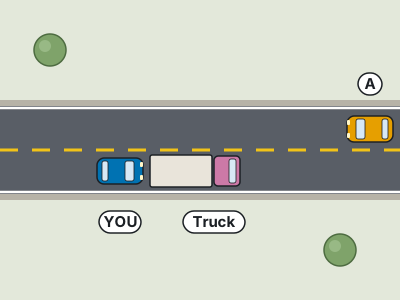
- Open the door to improve visibility
- Turn the head and look back for traffic
- Watch only the speedometer
- Look at the passenger's feet
Show answer
Turn the head and look back for traffic. Before leaving the lane to pass, the driver must check the rear view and side mirrors, then turn the head and look back to check the blind spot. Mirrors alone can miss a vehicle positioned beside the car, so the door-opening choice is both unnecessary and dangerous. The speedometer and passenger's feet cannot reveal adjacent traffic. The cue is the planned lane departure: confirm the blind spot before signaling and moving left.
Study this in the handbook: Right of way, turns and passing
5. Georgia prohibits stopping, standing, or parking within what distance of the spot across the street from a fire station driveway?
- Within 20 feet of the spot across the street
- Within 50 feet of the spot across the street
- Within 75 feet of the spot across the street
- Within 100 feet of the spot across the street
Show answer
Within 75 feet of the spot across the street. Georgia lists a location within 75 feet of the spot across the street from a fire station driveway among places where stopping, standing, or parking is prohibited. The 20, 50, and 100 foot choices change the stated distance and are not the figure in this parking list. The concrete cue is to measure from the point across the street, not from the driveway entrance in an unrelated direction. Keeping that space clear helps preserve access and visibility around emergency facilities.
Study this in the handbook: Parking rules and railroad crossings
6. What point accumulation can suspend a Georgia driver's license when the driver is under 18?
- 15 points within 12 months
- 4 points within 24 months
- 4 points within 12 months
- 6 points within 6 months
Show answer
4 points within 12 months. For a driver under 18, Georgia lists suspension after an accumulation of four points within twelve months. The age condition matters, and so does the shorter measuring period. Four points over 24 months changes the stated time window, while 15 points is the general threshold applying to any person over 24 months. Six points in six months is not the printed rule. Use the cue that the minor rule is four points in one year, distinct from the broader 15-point rule.
Study this in the handbook: Points, teen suspensions and revocation
7. What does a round Georgia railroad advance warning sign tell a driver to do?

- Ignore the sign if no bell is audible
- Accelerate to beat the train
- Stop only after crossing the tracks
- Slow down, look, listen, and prepare to stop
Show answer
Slow down, look, listen, and prepare to stop. The round advance sign appears before a railroad crossing and calls for preparation, not a race. Drivers should slow down, look, listen, and be ready to stop; if a train is approaching, they must stop. The acceleration choice risks a collision, while waiting until after the tracks is too late. Silence does not cancel the warning. The cue is the round railroad symbol, which begins the search for tracks and train movement.
Study this in the handbook: Sign shapes and what they mean
8. Which additional program must a Georgia applicant complete to obtain a Class D license at age 16 or 17?
- An approved driver education course
- A motorcycle safety course
- A commercial vehicle inspection course
- A defensive driving course after receiving the license
Show answer
An approved driver education course. For a Class D license at age 16 or 17, Georgia requires completion of a driver education course approved by DDS, along with the other listed requirements. The manual separately mentions ADAP, but that is an additional alcohol and drug awareness requirement rather than the driver education course named here. A commercial inspection course is unrelated to this noncommercial teen license. Motorcycle training serves a different license class. The key cue is the applicant's age paired with Class D: approved driver education is required before issuance.
Study this in the handbook: Driver education, knowledge exam and road test
9. In Georgia, what does a flashing yellow left turn arrow allow you to do?
- Turn left after yielding to oncoming traffic and pedestrians
- Turn left freely because oncoming traffic must stop
- Stop and wait for a steady green arrow
- Clear the intersection because the signal is about to turn red
Show answer
Turn left after yielding to oncoming traffic and pedestrians. Georgia's traffic signal page says a flashing yellow arrow means you may turn left after yielding to oncoming traffic and pedestrians, and it adds that oncoming traffic still has the green light. This is a permissive turn, not a protected one. Pull into the intersection only when it is safe, watch for a gap in oncoming cars, and check the crosswalk you are turning across before completing the turn.
Study this in the handbook: Traffic signals and pavement markings
10. When should a driver dim headlights in heavy fog?
- Only after another driver flashes high beams
- When bright lights create glare and make seeing harder
- Never, because high beams improve fog visibility
- Only on roads with a posted speed below 35 mph
Show answer
When bright lights create glare and make seeing harder. In heavy fog, bright headlights can reflect from moisture and create glare, making the road harder to see. Dimming them improves the driver view compared with adding more light to the fog. Waiting for another driver or using a speed-limit cutoff invents conditions that are not part of the guidance. Keeping high beams on because they seem brighter can reduce visibility. Slow down, increase space, and use the lower setting while watching for headlights, taillights, and roadway edges.
Study this in the handbook: Hydroplaning, following distance and sharing the road
11. How far in advance may a Georgia pentagon school sign be erected?
- Within 50 feet only
- At least 1,000 feet and no maximum
- Only at the school property line
- Not less than 150 feet and not more than 700 feet
Show answer
Not less than 150 feet and not more than 700 feet. Georgia places pentagon school zone or school crossing signs not less than 150 feet and not more than 700 feet in advance of the school grounds or crossing. The sign therefore gives advance notice within a defined range, rather than appearing only at the property line. Fifty feet is too close, and 1,000 feet exceeds the stated upper limit. The useful roadside cue is the five-sided shape followed by a measured approach zone: expect the school area somewhere 150 to 700 feet ahead.
Study this in the handbook: Sign shapes and what they mean
12. When passing on a Georgia two-lane road, you must be back in the right lane before oncoming traffic comes within what distance?
- 50 feet
- 200 feet
- 500 feet
- One car length
Show answer
200 feet. Georgia's passing rules say to wait for a passing zone and check that you have enough time and space. The manual requires you to return your vehicle completely to the right lane before the passing zone ends, before entering an intersection, and before oncoming traffic is within 200 feet of your vehicle. If you cannot be sure you will finish within that margin, do not start the pass. Passing is also prohibited on hills or curves where you cannot see oncoming vehicles.
Study this in the handbook: Right of way, turns and passing
13. Under Georgia's Slow Poke Law, what must a driver in the left passing lane do when faster traffic approaches from behind?
- Stay in the lane if driving at the speed limit
- Move over to the right so faster traffic can pass
- Speed up to match the faster vehicle
- Tap the brakes to warn the driver behind
Show answer
Move over to the right so faster traffic can pass. Georgia's Slow Poke Law, House Bill 459, says slower drivers must move out of the passing lane, which is usually the left lane, and over to the right to allow faster moving traffic to proceed. The manual stresses that this applies regardless of the speed you are traveling. Limited exceptions include traffic conditions, exiting or turning left, bad weather or hazards, paying a toll, or following an official traffic control device.
Study this in the handbook: Right of way, turns and passing
14. What is the purpose of Georgia's Move Over Law?
- To let drivers use the shoulder as a passing lane
- To require every driver to stop whenever a vehicle has hazard lights
- To protect workers and emergency personnel stopped on the roadway shoulder
- To reserve the left lane for emergency vehicles at all times
Show answer
To protect workers and emergency personnel stopped on the roadway shoulder. The law creates a buffer lane for roadside emergency, sanitation, and utility service workers and helps protect motorists who must pass their stopped vehicles. It was created to reduce injuries and deaths among police officers, paramedics, firefighters, wrecker operators, and highway construction workers. It does not turn the shoulder into a passing lane, does not require a stop for every hazard light display, and does not reserve the left lane permanently. The practical signal is a stopped service vehicle on the shoulder: move over safely or slow down and be ready to stop.
Study this in the handbook: Right of way, turns and passing
15. What does a steady yellow traffic signal warn a driver to do?
- Stop and remain until another green signal appears
- Accelerate so the vehicle enters before red
- Treat the signal as a green arrow
- Prepare to stop because the light is changing to red
Show answer
Prepare to stop because the light is changing to red. A steady yellow signal warns that the light is changing from green to red. The manual tells the driver to slow down and prepare to stop, considering traffic and the distance needed for a controlled stop. Accelerating to beat the signal increases conflict risk, and a yellow light is not a green arrow. The yellow is not an order to sit and wait for another green either; it is a warning that red is coming next. Ease off the accelerator early and stop if you can do so safely before the intersection.
Study this in the handbook: Traffic signals and pavement markings
16. After yielding to an emergency vehicle, how closely may a driver follow it?
- Within 20 feet so the route remains clear
- Not closer than 200 feet
- Within one car length at intersections
- At any distance if the emergency lights remain visible
Show answer
Not closer than 200 feet. Georgia prohibits following an emergency vehicle closer than 200 feet when it is responding with emergency equipment. Leaving that separation gives responders room to brake, maneuver, and deal with changing traffic. Staying within 20 feet or one car length is far too close, and visible lights do not create an exception. Once the vehicle passes, let it open a substantial gap before resuming ordinary travel behind it.
Study this in the handbook: Move Over law, school buses and emergency vehicles
17. A white rectangular sign that states a speed limit or other driving requirement is classified as a:
- Warning sign
- Service sign
- Guide sign
- Regulatory sign
Show answer
Regulatory sign. Georgia classifies these as regulatory signs because they tell drivers what they may or may not do, and drivers must obey them like traffic laws. The speed limit example is not optional guidance or a service marker. A warning sign would alert you to a condition ahead, while a guide sign would help with routes or destinations. When a white sign states a limit, restriction, or required movement, treat the instruction as enforceable and adjust before reaching the posted point. The useful cue is the sign's command: it regulates your driving rather than merely describing the road.
18. After a second DUI conviction in Georgia, how long is the license suspended, and when does ignition interlock permit eligibility begin?
- A minimum of 18 months, with interlock permit eligibility after 120 days
- One year, with immediate limited permit
- Five years
- 30 days, with no interlock
Show answer
A minimum of 18 months, with interlock permit eligibility after 120 days. A second DUI suspension in Georgia lasts a minimum period of 18 months, with ignition interlock permit eligibility after 120 days. A first DUI suspension in this section is shorter, a minimum of 6 or 12 months depending on the BAC reading or a refusal, and the manual says no limited driving permit is available for it. The second offense raises that minimum to 18 months.
Study this in the handbook: Instructional permit and Class D provisional license
19. What does a green traffic signal allow a driver to do?
- Enter immediately without checking for pedestrians
- Ignore vehicles already in the intersection
- Proceed only after the signal changes to yellow
- Proceed if it is safe after stopping for pedestrians and yielding to other vehicles
Show answer
Proceed if it is safe after stopping for pedestrians and yielding to other vehicles. A green signal permits movement only when the path is safe. The driver must still stop for pedestrians and yield to other vehicles before proceeding, as the manual describes. The choice that says to enter without checking removes those required safety steps. Waiting for yellow is not the signal rule, and a green indication does not erase the rights of people or vehicles already using the intersection. Use the signal as permission to move, then scan the crossing, confirm the route is open, and continue only when the maneuver can be completed safely.
Study this in the handbook: Traffic signals and pavement markings
20. After the first and second six-month periods of a Georgia Class D license, how many non-family passengers under 21 may ride?
- Only one
- None
- Only three
- Unlimited
Show answer
Only three. After the first and second six month periods following issuance of a Class D license, only three passengers under 21 who are not members of the driver's immediate family may ride in the vehicle. The limit was zero during the first six months and one during the second. Immediate family members never count against the limit. A Class D holder may apply for a Class C license upon reaching age 18.
Study this in the handbook: Instructional permit and Class D provisional license
QualitySpace is expanding to Georgia
We are a California-based independent insurance brokerage working on licensing in more states. We cannot help with Georgia insurance yet. Leave your email and we will let you know when we can.
Every question is written from the official Georgia Drivers Manual. Need paper? Printable GA practice test with answer key.
Last verified 2026-10-05. How we check every question · Study all 500 as flashcards
Frequently asked questions
How many questions are on this Georgia practice test?
This fixed set has 20 questions. It is test 4 of 25 from the 500 question Georgia bank. The real GA exam has a 20 question road sign section with 15 correct to pass, plus 20 knowledge questions with 15 correct to pass.
What is the passing score for the real Georgia test?
15 out of 20 correct on each test (75% per section) That figure comes from the official Georgia source cited on the DMV facts page.
How does this fixed test relate to the full Georgia bank?
Each numbered test is a fixed set of questions in a fixed order, so you can retake the same test later and compare. Every test mixes road signs and the other topics in about the same proportion as the full bank. Tests 1 to 25 together cover every question in the Georgia bank once. The full practice page mixes the whole bank at random.
Last verified 2026-10-05. See the Georgia DMV facts page for sourced state details.