
Test 10 of 25 · 20 questions · Free 2026
GA Permit Practice Test 10
Jump to the test ↓A fixed 20 question set from the Georgia bank with answers and plain English explanations. The real GA exam has a 20 question road sign section with 15 correct to pass, plus 20 knowledge questions with 15 correct to pass; take the full length version on the main practice page.
Question 1 of 20 · 0 right so far
All 20 questions in test 10
Every question below comes from the Georgia question bank on this page. Open a question to see the correct answer and the explanation. Nothing here is hidden behind a signup.
1. Why are reversible lane systems used on some Georgia roadways?
- To accommodate different traffic demands during the day
- To reserve every lane for stopped vehicles
- To make all lanes travel in one direction permanently
- To eliminate the need for lane-use signs
Show answer
To accommodate different traffic demands during the day. Georgia describes reversible lane systems as a way for some roadways to accommodate different traffic demands during the day. The travel direction can change during peak periods, so drivers must follow the lane-use signs and signals displayed at the time. The system does not permanently make every lane one-way, turn the lanes into stopping areas, or remove the need for signs. Before entering, check the current indication, confirm the lane direction, and leave a closed lane clear when the signs show that travel is not allowed.
Study this in the handbook: Traffic signals and pavement markings
2. In what language are Georgia road signs and the actual driving test conducted?
- Spanish only
- English and Spanish equally
- Any language selected by the applicant
- English only
Show answer
English only. Georgia conducts road signs testing and the actual driving test in English only. The availability of some non-English road rules tests does not extend to these two parts of the licensing process. Spanish only, equal bilingual testing, and unrestricted applicant choice are not the language rule stated in the manual. The practical cue is to separate road rules test availability from road signs and driving evaluation: signs and the actual vehicle test use English only.
Study this in the handbook: Driver education, knowledge exam and road test
3. Which behavior does the manual identify as an example of aggressive driving?
- Allowing another driver to pass safely
- Blocking other drivers from passing or changing lanes
- Maintaining a safe following distance
- Yielding when required
Show answer
Blocking other drivers from passing or changing lanes. The Georgia manual lists blocking other drivers from passing or changing lanes as an example of aggressive driving, along with conduct such as tailgating and cutting in front of another driver. Allowing a safe pass, keeping a reasonable following distance, and yielding when required are defensive habits rather than aggressive examples. The cue is whether the maneuver intentionally obstructs another road user. If a driver is being blocked or harassed, avoid escalating the encounter, create distance when safe, and keep attention on the roadway.
Study this in the handbook: Implied consent and teen DUI suspensions
4. When must a driver give a turn signal?
- Only when another vehicle is visible
- Only during the final second before turning
- Only when turning at a traffic signal
- Whenever making a turn to the right or left
Show answer
Whenever making a turn to the right or left. Georgia’s manual requires a signal whenever a vehicle turns right or left, with a continuous signal for enough distance to alert other drivers. The visible-vehicle choice is unsafe because a driver may be hidden from view or approaching from a side street. Signaling only at the last moment gives others too little time, and the rule applies beyond signalized intersections. Activate the indicator before the maneuver, keep it on through the approach and turn, then cancel it. The cue is every turn, even on an apparently empty road.
Study this in the handbook: Right of way, turns and passing
5. At what type of intersection does the left-yields-to-right rule apply?
- An intersection with no stop, yield, or other traffic signals
- Only a four-way stop with all drivers stopped
- Only a highway entrance controlled by a ramp meter
- Any intersection where one driver is turning left
Show answer
An intersection with no stop, yield, or other traffic signals. Georgia lists the left yields to right rule for intersections where there are no stop signs, yield signs, or other traffic signals. If two vehicles arrive at the same time, the driver on the left yields to the driver on the right. Four way stops use a similar tie breaker for vehicles arriving at about the same time, but the rule is not limited to them. A left turn does not create the rule by itself, and ramp meters are unrelated. Slow down, scan for pedestrians, and confirm the intersection is clear before proceeding.
Study this in the handbook: Right of way, turns and passing
6. How should a driver interpret a yellow advisory speed sign placed near a curve?
- As a new maximum speed that replaces the regulatory sign
- As the minimum speed required on the curve
- As guidance for a safer speed through the curve
- As a direction to stop before turning
Show answer
As guidance for a safer speed through the curve. An advisory speed sign identifies a speed at which the curve can be traveled more safely, usually below the posted maximum. It is a warning about the roadway's geometry, not a replacement for the black and white regulatory limit. Treating the number as a minimum encourages excessive speed, while stopping before every curve is not what the sign commands. Reduce speed before entering, maintain control through the bend, and account for rain or limited visibility.
Study this in the handbook: Hydroplaning, following distance and sharing the road
7. At what speed can partial hydroplaning begin in a standard passenger car, according to Georgia?
- Only above 70 mph
- Only above 55 mph
- As low as 35 mph
- Only below 20 mph
Show answer
As low as 35 mph. Hydroplaning happens when standing water builds up under the tires. Georgia's manual explains that up to about 35 mph most tires channel water away, but in a standard passenger car partial hydroplaning can begin at speeds as low as 35 mph, and at 55 mph the tires may lose all contact with the road. With no friction, you cannot brake or steer. Slow down on wet roads and keep tires with adequate tread.
Study this in the handbook: Hydroplaning, following distance and sharing the road
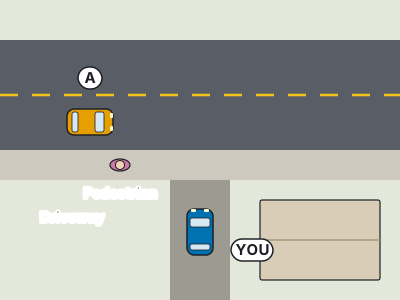
8. Before entering or crossing a highway from an alley or private road, what must a driver do?
- Accelerate into the nearest lane
- Yield only to vehicles approaching from the left
- Stop only when a sign requires it
- Stop and yield to all traffic and pedestrians
Show answer
Stop and yield to all traffic and pedestrians. A driver entering or crossing a highway from an alley, private road, or another highway must stop and yield to all traffic and pedestrians. Accelerating into the nearest lane risks crossing an occupied path, while yielding only left ignores vehicles and pedestrians from other directions. The duty applies even when a separate stop sign is not visible. Stop before the roadway, check both directions and the crossing area, then proceed only after the path is clear. The cue is entering a highway from a lesser access point: stop and yield.
Study this in the handbook: Right of way, turns and passing
9. At what age may a person apply for a Georgia Class C Instructional Permit?
- 16 years old
- 14 years old
- 15 years old
- 17 years old
Show answer
15 years old. Georgia says that a person may apply for a Class C Instructional Permit upon reaching age 15 or anytime afterward. Fourteen is below the stated threshold, while 16 and 17 are later ages rather than the first opportunity. The permit is an instructional stage, so the age answer does not by itself authorize unsupervised driving. The cue is the opening point in the licensing sequence: age 15 begins eligibility to apply, followed by the permit conditions and testing requirements in the manual.
Study this in the handbook: Instructional permit and Class D provisional license
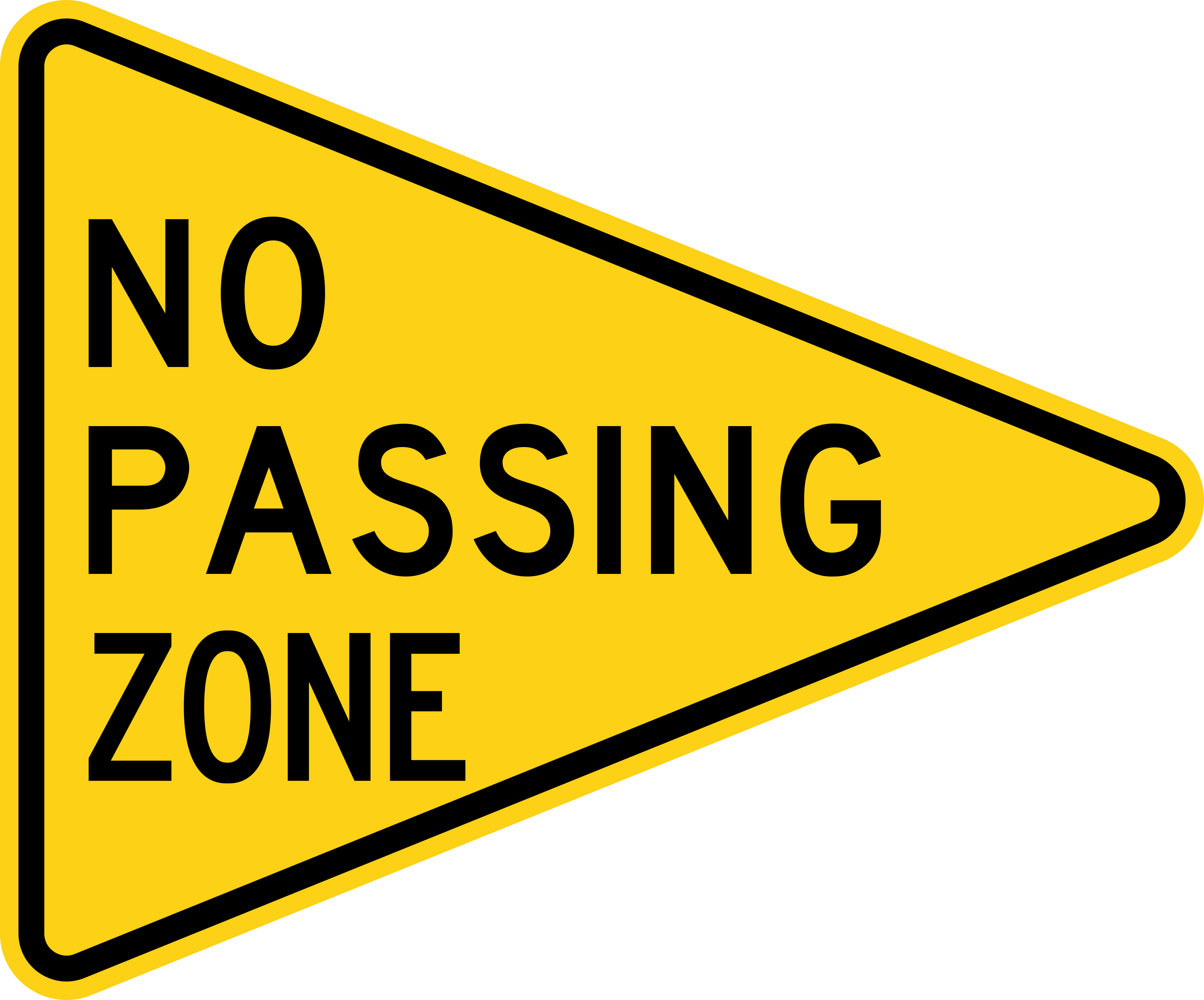
10. What does the pennant-shaped sign on the left side of the highway mark?
- The end of a no-passing zone
- The entrance to a picnic area
- The beginning of a no-passing zone
- A mandatory shoulder stopping area
Show answer
The beginning of a no-passing zone. The pennant on the left marks the beginning of a no-passing zone, so any passing maneuver must be completed before reaching it. It does not mark the zone end or identify recreation or shoulder parking. The location on the left is an important cue because it faces drivers who might otherwise begin passing. Check the center line, oncoming traffic, hills, and curves, then remain in your lane after the restriction begins. Do not use the sign as permission to pass before checking the full roadway.
11. What is posted on certain Georgia highways?
- Automatic passing permissions
- Minimum speed limits
- Railroad schedules
- Vehicle inspection dates
Show answer
Minimum speed limits. Georgia posts minimum speed limits on certain highways. A driver who cannot maintain the minimum should seek an alternate route, because moving too slowly can impede normal traffic and create a hazard. Automatic permission to pass is not created by a minimum-speed sign, and railroad schedules or inspection dates are unrelated to highway speed control. The cue is to distinguish a minimum from a maximum: one prevents unnecessarily slow travel, while the other caps speed.
Study this in the handbook: Parking rules and railroad crossings
12. A sign with traffic entering from the right tells you to:

- Move immediately onto the right shoulder
- Block the entering lane to protect your position
- Prepare to let merging traffic enter safely
- Assume the road ahead becomes one-way
Show answer
Prepare to let merging traffic enter safely. Traffic may merge from the right, so adjust speed and lane position to create a safe opening when possible. Moving onto the shoulder is not the normal response and can expose you to hazards outside the travel lane. Blocking the merging lane removes the space needed by another road user and can cause a collision. The one-way choice does not describe merging traffic. The key cue is the side arrow: check mirrors, maintain awareness of the adjacent lane, and cooperate without an abrupt maneuver.
13. What must a Georgia Class D license holder show for the 12 months before applying for a full Class C license?
- A perfect school attendance record
- No convictions for major traffic violations that carry a mandatory suspension
- 100 more hours of logged driving
- A second road test passed within 30 days
Show answer
No convictions for major traffic violations that carry a mandatory suspension. Georgia requires a Class D holder to be free, for the 12 months before applying for a Class C license, of convictions for major traffic violations that lead to a mandatory suspension. School attendance matters for getting a license under 18 but is not this step's test. Extra logged hours and a second road test are not listed requirements. Getting the Class D license in the first place required the 40 hour driving log, including 6 at night.
Study this in the handbook: Instructional permit and Class D provisional license
14. What penalties can follow a Georgia DUI conviction?
- Fines up to $1,000, jail up to 12 months, and a mandatory license suspension
- A warning and a $50 fine
- Points only, with no suspension
- A fine of $25 and community service
Show answer
Fines up to $1,000, jail up to 12 months, and a mandatory license suspension. Georgia describes DUI penalties as severe: fines up to $1,000, jail sentences up to 12 months, and a mandatory suspension of driving privileges. A warning, points only, or a small fine with community service all understate the law. A person 21 or older is under the influence at 0.08 grams, and a person under 21 at 0.02 grams. A prescription is not a defense if the medicine impairs your driving.
Study this in the handbook: Implied consent and teen DUI suspensions
15. A Georgia driver under 21 is convicted of speeding 24 mph or more over the limit. What happens?
- Only points are added
- The license is suspended
- Only a warning letter is sent
- Nothing, if it is a first offense
Show answer
The license is suspended. Georgia suspends the permit or license of a driver under 21 convicted of any listed offense for six months on a first conviction and twelve months on a later one. The list includes any offense worth four or more points, such as speeding 24 mph or more over the limit, unlawful passing of a school bus, and improper passing on a hill or curve. Points alone, a warning letter, or no action understate the rule. A limited permit is possible only for 24 to 33 mph over when the driver is at least 18.
Study this in the handbook: Instructional permit and Class D provisional license
16. What is the penalty in Georgia for violating the rules for passing a bicyclist?
- A misdemeanor punishable by a fine up to $250
- A $25 fine
- License revocation
- A warning
Show answer
A misdemeanor punishable by a fine up to $250. Georgia motorists must approach bicycles with due caution and follow the listed rules, including leaving at least 3 feet of space when passing. A violation is a misdemeanor punishable by a fine up to $250. The penalty is criminal rather than a mere warning, and the amount is far above a token fine, but it is not a revocation. Change into a lane not next to the bicycle when possible; otherwise slow to at least 10 mph under the posted limit or 25 mph, whichever is more.
Study this in the handbook: Hydroplaning, following distance and sharing the road
17. When may a motorist change lanes to pass a slower vehicle?
- Whenever the vehicle ahead is below the speed limit
- Only when it is safe to do so
- Only after moving into the shoulder
- Whenever the driver signals, regardless of traffic
Show answer
Only when it is safe to do so. A lane change to pass a slower vehicle is allowed only when the movement is safe. Being below the speed limit does not automatically make the pass legal or wise, because another vehicle may be approaching or the lane may end. The shoulder is not a substitute travel lane, and a signal communicates an intention but does not create a safe opening. Scan the lane, mirrors, and traffic gap before moving over.
Study this in the handbook: Right of way, turns and passing
18. What minimum suspension follows a Georgia driver's refusal to submit to a state-administered chemical test after a suspected DUI arrest?
- Thirty days
- Six months
- At least one year
- Only until the court date
Show answer
At least one year. Georgia treats refusal as an independent license consequence. When a driver refuses the state administered chemical testing after a suspected DUI, the license or driving privilege may be suspended for a minimum of one year. The six month period belongs to a different first DUI situation involving a BAC from.02 through below.08. The manual adds that a refusal to submit to blood or urine testing may be offered into evidence at trial. The practical cue is the refusal itself: declining the requested state test brings the one year minimum.
Study this in the handbook: Implied consent and teen DUI suspensions
19. What information can a Georgia guide sign provide?
- The road you are on and how to reach a destination
- The legal blood alcohol limit for the driver
- The exact tire pressure for your vehicle
- A command to stop at every intersection
Show answer
The road you are on and how to reach a destination. Guide signs help drivers identify the road they are using and find a destination. They may include route markers, destination names, distances, locations, arrows, or a sign telling you which facility or highway can be reached. The other choices concern vehicle operation or legal rules and are not navigation information. Read the sign early, match its route or destination to your planned movement, and allow time to position the vehicle safely. A green or rectangular guide panel should orient you, not replace normal signaling and lane checks.
Study this in the handbook: Parking rules and railroad crossings
20. What do solid double white lines between lanes mean on a Georgia road?
- Lane changes are allowed when traffic is light
- They separate traffic moving in opposite directions
- They mark a lane reserved for bicycles
- Lane changes across them are prohibited
Show answer
Lane changes across them are prohibited. Georgia uses double white lines, dashed or solid, to show where vehicles can or cannot cross into the adjacent lane. The manual says that when the double white lines are dashed, vehicles are allowed to cross over to the adjacent lane, and when the double white lines are solid, lane changes are prohibited. Do not confuse them with yellow center lines, which separate traffic moving in opposite directions.
Study this in the handbook: Traffic signals and pavement markings
QualitySpace is expanding to Georgia
We are a California-based independent insurance brokerage working on licensing in more states. We cannot help with Georgia insurance yet. Leave your email and we will let you know when we can.
Every question is written from the official Georgia Drivers Manual. Need paper? Printable GA practice test with answer key.
Last verified 2026-10-05. How we check every question · Study all 500 as flashcards
Frequently asked questions
How many questions are on this Georgia practice test?
This fixed set has 20 questions. It is test 10 of 25 from the 500 question Georgia bank. The real GA exam has a 20 question road sign section with 15 correct to pass, plus 20 knowledge questions with 15 correct to pass.
What is the passing score for the real Georgia test?
15 out of 20 correct on each test (75% per section) That figure comes from the official Georgia source cited on the DMV facts page.
How does this fixed test relate to the full Georgia bank?
Each numbered test is a fixed set of questions in a fixed order, so you can retake the same test later and compare. Every test mixes road signs and the other topics in about the same proportion as the full bank. Tests 1 to 25 together cover every question in the Georgia bank once. The full practice page mixes the whole bank at random.
Last verified 2026-10-05. See the Georgia DMV facts page for sourced state details.