Every question below comes from the Delaware question bank on this page. Open a question to see the correct answer and the explanation. Nothing here is hidden behind a signup.
1. How should a driver respond to a flashing yellow arrow?
- Make the indicated movement only after yielding to opposing traffic and pedestrians
- Treat it as a mandatory full stop in every direction
- Turn without checking because opposing traffic must stop
- Wait for a red arrow before entering the intersection
Show answer
Make the indicated movement only after yielding to opposing traffic and pedestrians. A flashing yellow arrow allows the indicated movement after the driver yields to opposing traffic and pedestrians. Full explanation in Test 1
2. A Delaware commercial motor vehicle driver has a BAC of .04. What first-offense disqualification applies?
- Five years from commercial driving
- 30 days from all driving
- One year from driving a commercial vehicle
- Lifetime disqualification on the first offense
Show answer
One year from driving a commercial vehicle. Delaware disqualifies a commercial motor vehicle driver for one year when the BAC is . Full explanation in Test 2
3. What penalty does Delaware set for a first aggressive driving conviction?
- A warning letter only
- A $100 to $300 fine and a behavior modification course within 90 days
- A one-year revocation
- A $1,500 fine
Show answer
A $100 to $300 fine and a behavior modification course within 90 days. Aggressive driving in Delaware means being convicted of three or more listed offenses, such as failure to yield, unsafe lane change, followi Full explanation in Test 3
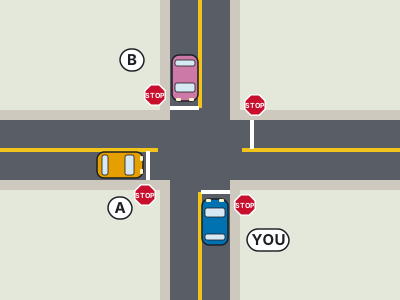
4. At a Delaware four-way stop, which vehicle goes first when vehicles arrive at different times?
- The vehicle with the largest engine
- The vehicle that reached the intersection first after stopping
- The vehicle turning left
- The vehicle arriving last
Show answer
The vehicle that reached the intersection first after stopping. At a four-way stop, Delaware says the driver reaching the intersection first goes first, but only after coming to a complete stop. Full explanation in Test 4
5. What share of Delaware fatal crashes in 2019 were impaired related, according to the manual?
- 5 percent
- 35 percent, compared with about 28 percent of fatalities nationally
- 75 percent
- 50 percent
Show answer
35 percent, compared with about 28 percent of fatalities nationally. Nationally in 2019 alcohol was involved in about 28 percent of traffic fatalities, and in Delaware in 2019, 35 percent of fatal crashes were Full explanation in Test 5
6. How many months of valid driving authority must a Delaware Level One permit holder complete before automatic Class D conversion?
- 12 months
- 6 months
- 3 months
- 24 months
Show answer
12 months. A Delaware Level One Learner's Permit automatically converts to a Class D license after the holder completes a full 12 months of valid drivi Full explanation in Test 6
7. At what ages may a Delaware applicant (without an IEP) apply for a GDL Level One Learner's Permit?
- At least 16 and less than 18
- At least 15 and less than 17
- At least 17 and less than 21
- Any age from 16 to 25
Show answer
At least 16 and less than 18. Delaware's Level One Learner's Permit is for applicants at least 16 years old and less than 18. Full explanation in Test 7
8. An emergency vehicle approaches while you are already in an intersection. Where should you pull over?
- Beside the left curb before clearing the intersection
- In the middle of the intersection
- Across the nearest crosswalk inside the intersection
- Beyond the intersection after driving through it
Show answer
Beyond the intersection after driving through it. Clear the intersection before pulling over for the approaching emergency vehicle. Full explanation in Test 8
9. During the first 12 months of Level One driving authority, how many nonfamily passengers may accompany the permit holder besides the adult supervisor?
- Two other passengers
- One other passenger
- No passengers at all
- As many passengers as the vehicle's seat belts allow
Show answer
One other passenger. During the entire first 12 months, Delaware allows an adult supervisor and one other passenger. Full explanation in Test 9
10. How does Delaware classify a third DUI offense occurring after two prior offenses?
- Civil offense only
- Class E felony
- Class C felony
- Class G felony
Show answer
Class G felony. Delaware identifies a third DUI offense after two prior offenses as a Class G felony. Full explanation in Test 10
11. What is the meaning of the orange triangular emblem on a slow-moving vehicle?

- The vehicle is authorized to travel at highway speed
- The vehicle is warning approaching drivers that it is slow moving
- The vehicle is carrying hazardous material
- The vehicle is stopped and cannot be passed
Show answer
The vehicle is warning approaching drivers that it is slow moving. The fluorescent reflective orange triangle identifies a slow-moving vehicle and warns approaching drivers to slow down immediately and proce Full explanation in Test 1
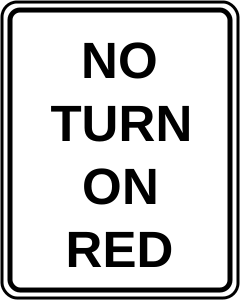
12. Your Delaware signal is red and the NO TURN ON RED sign shown here is posted at the corner. What must you do?
- Wait until the signal turns green before proceeding or turning
- Turn right after a full stop if no traffic is coming
- Turn left onto a one-way street after a full stop
- Go straight once no cross traffic is visible
Show answer
Wait until the signal turns green before proceeding or turning. Where the NO TURN ON RED sign is posted, Delaware requires you to wait until the signal turns green before proceeding or making turns. Full explanation in Test 2
13. After six months on a Delaware Level One permit, a teen wants to drive alone at 10:30 p.m. When is that allowed?
- When going directly to or from church, work, or school activities on school property
- Whenever a parent gives permission by phone
- Any night on weekends
- Never, under any circumstances
Show answer
When going directly to or from church, work, or school activities on school property. After the first six months, the permit holder may drive unsupervised from 6:00 a.m. to 10:00 p.m.; from 10:00 p.m. to 6:00 a.m. Full explanation in Test 3
14. What must Delaware drivers use when they intend to stop, turn, or change lanes?
- A horn without any signal
- Hazard lights only
- Headlights only
- A hand signal or turn signal
Show answer
A hand signal or turn signal. Delaware requires drivers to communicate an intended stop, turn, or lane change with a hand signal or turn signal. Full explanation in Test 4
15. How can a Delaware driver be declared a habitual offender?
- Any two speeding tickets
- One DUI conviction
- Any combination of three listed serious offenses, such as DUI or reckless driving, in five years
- Five parking tickets in a year
Show answer
Any combination of three listed serious offenses, such as DUI or reckless driving, in five years. Any combination of three listed offenses in a five year period, including DUI, driving without a license, driving during suspension, reckles Full explanation in Test 5
16. What duty does a Delaware driver have when overtaking a vehicle traveling in the same direction?
- Assume the passing vehicle automatically has priority
- Force that vehicle onto the shoulder
- Sound the horn until it stops
- Yield to the vehicle being overtaken
Show answer
Yield to the vehicle being overtaken. Delaware requires a driver overtaking a vehicle in the same direction to yield to that vehicle, even if the vehicle slows or stops. Full explanation in Test 6
17. A Delaware driver is convicted of driving 100 mph on a highway posted at 65. What suspension applies?
- One year
- Three months
- Six months
- No suspension because it is under 50 mph over
Show answer
One year. Delaware imposes a one-year suspension for driving 50 mph or more over the posted limit or for driving 100 mph on a highway. Full explanation in Test 7
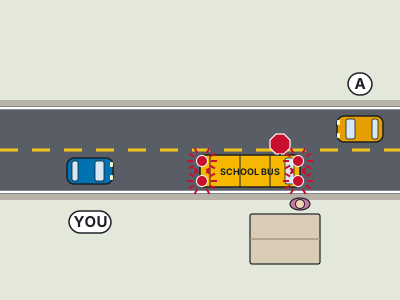
18. On a Delaware road with fewer than four lanes, who must stop for a school bus displaying flashing red lights and its stop arm?
- Only vehicles traveling toward the bus
- Only vehicles traveling behind the bus
- Traffic approaching from both directions
- Only vehicles in the bus's immediate lane
Show answer
Traffic approaching from both directions. On a roadway with fewer than four lanes, vehicles in both directions must stop before reaching a school bus that is loading or unloading chi Full explanation in Test 8
19. Approximately how long will a Delaware road exam require the applicant to drive?
- About 10 minutes
- About 30 minutes
- About 60 minutes
- About 2 hours
Show answer
About 30 minutes. The Delaware road exam requires the applicant to drive for approximately 30 minutes and do the things that are usual in normal driving. Full explanation in Test 9
20. What DMV license loss does Delaware list for a seventh or greater DUI conviction?
- 12 months
- 60 months
- 24 months
- The remainder of the driver's lifetime
Show answer
60 months. A seventh or greater DUI conviction carries a 60-month loss of license by the Delaware DMV. Full explanation in Test 10
21. What is the Delaware minimum clearance when passing a cyclist?
- Five feet only on roads with two lanes
- One foot unless the cyclist is in a marked lane
- Three feet at all times
- No set clearance if the driver uses a turn signal
Show answer
Three feet at all times. When a motorist passes a cyclist, Delaware law requires a minimum of three feet of clearance at all times. Full explanation in Test 1
22. At a Delaware intersection with no stop sign, yield sign, or traffic signal, which vehicle should you yield to?
- A vehicle coming from your left
- A vehicle coming from your right
- Only a vehicle traveling faster than you
- No vehicle, because an uncontrolled intersection has no priority rule
Show answer
A vehicle coming from your right. At an uncontrolled intersection, Delaware directs drivers to yield to vehicles coming from the right. Full explanation in Test 2
23. What should a driver do when approaching a railroad crossing where there is no room beyond the tracks?
- Enter the crossing and wait on the tracks
- Cross quickly while sounding the horn
- Stop before the tracks and wait until there is space to clear them
- Use the shoulder to create space beyond the crossing
Show answer
Stop before the tracks and wait until there is space to clear them. A driver must not begin crossing unless there is enough room for the vehicle on the far side. Full explanation in Test 3
24. What must a driver do when an authorized emergency vehicle approaches using a siren or flashing lights?
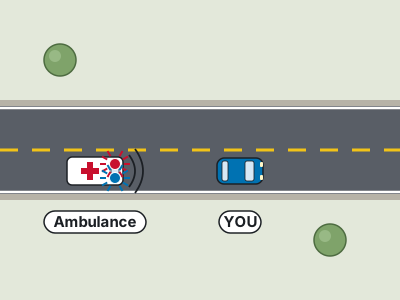
- Yield and immediately drive to the right edge or curb clear of intersections
- Stop in the travel lane wherever the driver first hears the siren
- Turn left at the next intersection to get away from the vehicle
- Maintain speed until the emergency vehicle passes on its own
Show answer
Yield and immediately drive to the right edge or curb clear of intersections. Delaware requires every other vehicle to yield to an approaching authorized emergency vehicle using the listed warning equipment. Full explanation in Test 4
25. What does it cost to convert a Delaware license to federally compliant status?
- A $20 replacement license fee, with the required compliant documents
- $72
- Nothing
- $150
Show answer
A $20 replacement license fee, with the required compliant documents. To convert your license to compliant status, visit any DMV and provide the required documents for a compliant license; a $20 replacement lic Full explanation in Test 5
26. For a first Delaware DUI offense with a BAC between .15 and .19, how long is the DMV license loss?
- 18 months
- 12 months
- 24 months
- 36 months
Show answer
18 months. For a first offense, Delaware's DMV penalty is 18 months when the BAC falls between .15 and .19. Full explanation in Test 6
27. What does a Delaware identification card cost, and when does it expire?
- $20, expiring in 4 years
- $40, expiring eight years from the applicant's next birthday
- $10, expiring in 2 years
- Free, never expiring
Show answer
$40, expiring eight years from the applicant's next birthday. The fee for a Delaware identification card is $40 and it expires eight years from the applicant's next birthday. Full explanation in Test 7
28. Under Delaware law, how far before a planned stop, turn, or lane change must you signal?
- At least 300 feet
- At least 200 feet
- At least 100 feet
- Only during the final 50 feet
Show answer
At least 300 feet. The Delaware requirement is at least 300 feet before the intended action. Full explanation in Test 8
29. Which maneuver is prohibited by the crossed U-shaped arrow sign shown here?
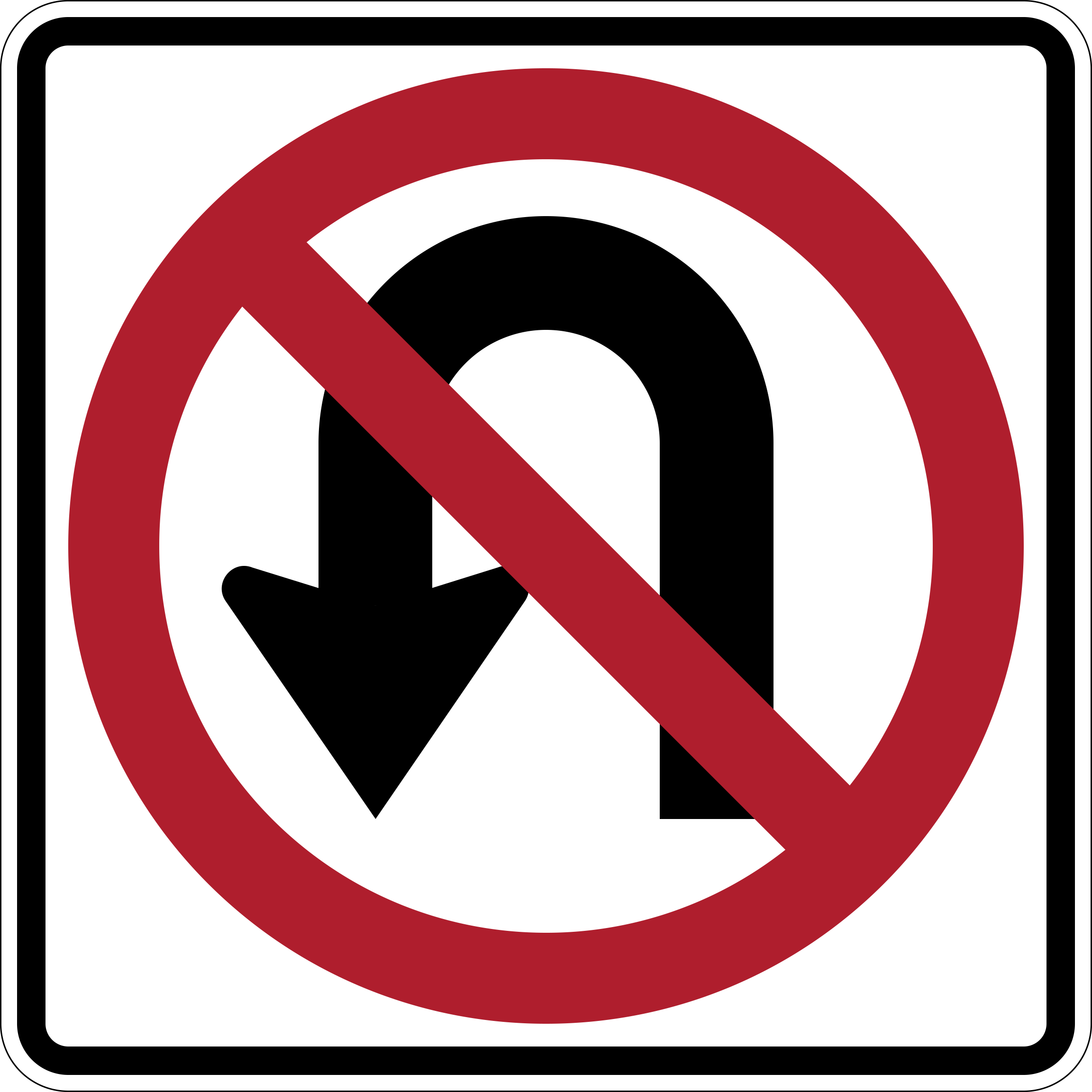
- Driving straight through the intersection
- Turning left at the intersection
- Passing a slower vehicle
- Making a U-turn at that location
Show answer
Making a U-turn at that location. The crossed U-shaped arrow bans a U-turn at the posted location. Full explanation in Test 9
30. When approaching a stationary vehicle displaying warning signals, what does Delaware's Move Over rule require?
- Keep the same speed if the vehicle is outside your lane
- Proceed cautiously and change lanes when possible, or reduce to a safe speed
- Stop beside the vehicle to ask whether help is needed
- Pass using the shoulder whenever the adjacent lane is occupied
Show answer
Proceed cautiously and change lanes when possible, or reduce to a safe speed. The rule protects people near any stationary vehicle displaying warning signals, including hazard lights, flares, cones, or caution signs. Full explanation in Test 10
31. A Delaware teen violates Level One Learner's Permit restrictions for the first time. What is the result?
- A written warning
- A two-month suspension, treated as driving without a license
- A $25 fine only
- Permanent loss of the permit
Show answer
A two-month suspension, treated as driving without a license. Delaware treats a violation of the Level One restrictions as driving without a license. Full explanation in Test 1
32. What penalties does Delaware list for a fifth DUI offense?
- A $500 fine
- A misdemeanor with 30 days
- A Class E felony with a fine up to $10,000 and three to five years in prison, plus 60 months license loss
- A one year suspension
Show answer
A Class E felony with a fine up to $10,000 and three to five years in prison, plus 60 months license loss. A fifth DUI offense is a Class E felony carrying a fine of up to $10,000 and imprisonment of not less than three years nor more than five ye Full explanation in Test 2
