
QualitySpaceQualitySpace
Display
Auto follows your device setting.
Menu

36 question exam format · Real sign images · Producer reviewed

CA Permit Practice Test

The most complete free California DMV practice test online: 275 questions verified against the California Driver's Handbook, real MUTCD sign images, audio read-aloud, and a plain-English explanation the moment you answer. Built and reviewed by a licensed California insurance producer. No account, no cost.

Questions
275
Time to clear the bank
~35 min
Passing standard
30 of 36
Reviewed by
Kevin Vu, CA #4037122

Road signsRight of waySpeed limitsParkingAlcohol & DUISafe drivingSignals & markingsLaws & paperworkEmergencies

275-question bank · Sign images & explanations · Free

California practice test has 275 questions. Every question comes with a plain-English explanation the moment you answer.

Get a day by day study plan

Optional. Three quick answers; the tests below work without it.

Age on test day

No date yet? You get a 7 day plan.

Real exam format: 36 questions, 30 correct to pass.

Your age on test day

Start here

Run 20 questions to warm up.

Find your gaps

Diagnose weak topics and retry what you've missed.

Simulate the real thing

Practice under graded exam conditions or run the whole bank.

Practice one topic

Drill a single topic, up to 20 questions with explanations.

Random draw and answer order every attempt. Scored against the real test's pass mark: 30 of 36 correct.

Free means actually free: no subscription, no auto-renew, no card required, no locked features. This site is funded by our insurance work, not by test-prep charges.

All 36 questions, CA exam length

Every question below comes from the California question bank on this page. Open a question to see the correct answer and the explanation. Nothing here is hidden behind a signup.

  1. 1. When can pavement be especially slippery during rain?

    1. After the road has completely dried
    2. Only after a full hour of heavy rain
    3. Only when the temperature is below freezing
    4. When rain first starts after dry, hot weather
    Show answer

    When rain first starts after dry, hot weather. Pavement can be very slippery when rain first begins, especially after a dry, hot spell has left oil and dust on the surface. Full explanation in Test 1

  2. 2. When may you turn right at a solid red light in California?

    1. After slowing, if the cross street is clear.
    2. Only from a one-way street onto another one-way street.
    3. After stopping, unless a NO TURN ON RED sign is posted, and yielding as required.
    4. Only when a green arrow is also displayed.
    Show answer

    After stopping, unless a NO TURN ON RED sign is posted, and yielding as required.. A solid red light requires a stop, but California allows a right turn after the stop when no NO TURN ON RED sign forbids it. Full explanation in Test 2

  3. 3. When is stopping or parking on a freeway allowed?

    1. For a phone call if you keep your hazard lights on
    2. In an emergency or when a law enforcement officer requires it
    3. Any time the shoulder is wider than your vehicle
    4. Only during daylight outside commute periods
    Show answer

    In an emergency or when a law enforcement officer requires it. Freeway stopping or parking is generally illegal, with exceptions such as an emergency, a law enforcement requirement, or a specifically per Full explanation in Test 3

  4. 4. After a collision in which someone is hurt, a driver leaves without stopping. What is that called and how seriously is it treated?

    1. A minor infraction if the damage looks small
    2. A reportable incident with no criminal exposure
    3. A civil insurance matter only
    4. A hit-and-run, which carries severe punishment on conviction
    Show answer

    A hit-and-run, which carries severe punishment on conviction. Leaving the scene, or failing to stop at all, is a hit-and-run, and California treats a conviction severely rather than as paperwork or an i Full explanation in Test 4

  5. 5. What following distance does the handbook call for behind a motorcycle?

    1. One second because motorcycles accelerate quickly
    2. Two seconds only when pavement is dry
    3. Five seconds at all speeds and on every surface
    4. A safe three-second following distance
    Show answer

    A safe three-second following distance. Behind a motorcycle, use at least a three-second following distance so you have time if the rider brakes quickly or falls. Full explanation in Test 5

  6. 6. Another driver waves you forward. What should you remember about right-of-way?

    1. You may go only if the maneuver is still safe after your own checks
    2. A hand wave transfers all legal responsibility to that driver
    3. You must always refuse because right-of-way cannot be yielded
    4. The nearest vehicle automatically loses priority
    Show answer

    You may go only if the maneuver is still safe after your own checks. Never assume another driver will give you the right-of-way or that a wave makes the movement safe. Full explanation in Test 6

  7. 7. You approach a stopped tow truck with flashing amber warning lights. What should you do?

    1. Move over and slow down when safe
    2. Stop behind it until the lights are off
    3. Keep your speed because amber lights are advisory only
    4. Pass on the shoulder to give more room
    Show answer

    Move over and slow down when safe. California drivers must move over and slow down for certain stopped emergency, tow, and road work vehicles displaying flashing lights. Full explanation in Test 7

  8. 8. What should a yellow merging-traffic sign make you do?

    Yellow merge arrow sign
    1. Stop in your lane until all ramp traffic has entered
    2. Move onto the shoulder to leave the lane open
    3. Hold your lane and adjust speed so entering traffic can blend safely
    4. Cross a double solid white line to avoid the merge area
    Show answer

    Hold your lane and adjust speed so entering traffic can blend safely. A merging-traffic sign warns that another traffic stream will join yours, so keep scanning, leave room, and change speed smoothly if needed. Full explanation in Test 8

  9. 9. What does California law say about throwing a lit cigarette from a vehicle?

    1. It is allowed if the road has no dry brush nearby.
    2. It is allowed from a stopped vehicle only.
    3. It is illegal to throw a flaming or glowing substance from the vehicle.
    4. It is illegal only inside city limits.
    Show answer

    It is illegal to throw a flaming or glowing substance from the vehicle.. California prohibits throwing a cigarette, cigar, or any other flaming or glowing material from a vehicle. Full explanation in Test 9

  10. 10. A flashing yellow left-turn arrow appears. What does it mean?

    1. Your left turn is protected from oncoming traffic
    2. You must stop and wait for a green arrow
    3. You may turn after yielding to oncoming traffic
    4. Oncoming vehicles must stop before you turn
    Show answer

    You may turn after yielding to oncoming traffic. A flashing yellow arrow allows the turn, but it is not protected. Full explanation in Test 10

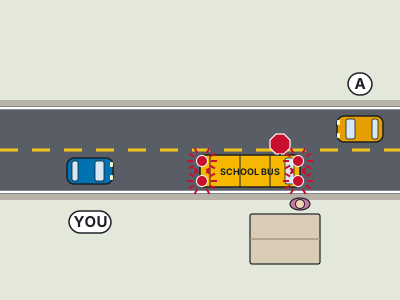
  11. 11. When a school bus flashes red lights on an undivided road, how long must you remain stopped?

    A two-lane road with one lane in each direction and a broken yellow center line. A school bus is stopped in the lane heading east with its red lights flashing and its stop arm out. Your car, blue, is behind the bus. Car A, orange, is coming toward the bus from the other direction.
    1. Only while children are visible from your lane
    2. Only until the stop arm first comes out
    3. Until the bus driver waves at one vehicle
    4. Until children are safely across and the red lights stop flashing
    Show answer

    Until children are safely across and the red lights stop flashing. California says drivers from either direction must remain stopped for a school bus with flashing red lights until the children have crossed Full explanation in Test 11

  12. 12. Which convictions make California DMV revoke a driving privilege outright, regardless of point totals?

    1. Two parking tickets in one year
    2. Any speeding ticket over 10 mph
    3. Failing to signal a lane change
    4. Hit and run, or reckless driving that resulted in injury
    Show answer

    Hit and run, or reckless driving that resulted in injury. DMV revokes the driving privilege when a driver is convicted of a hit and run, or of reckless driving that caused an injury. Full explanation in Test 12

  13. 13. A yellow sign showing a small STOP sign ahead tells you to do what?

    Yellow sign showing a small STOP sign and arrow
    1. Start slowing and prepare to make a full stop soon
    2. Maintain speed because it only marks a future parking rule
    3. Turn right at the next intersection without stopping
    4. Stop immediately at the warning sign itself
    Show answer

    Start slowing and prepare to make a full stop soon. A stop-ahead warning means the actual stop sign is coming soon, so start reducing speed and get ready for a complete stop at the proper line Full explanation in Test 13

  14. 14. A California provisional driver needs to drive to a job during the restricted late night hours. What must they carry?

    1. A note signed by their employer confirming the employment
    2. Nothing, because work trips are automatically exempt
    3. A copy of their most recent paycheck
    4. A letter from a police department
    Show answer

    A note signed by their employer confirming the employment. Driving for work is one of the recognized exceptions to the provisional restrictions, but the minor must carry a note signed by the employer Full explanation in Test 1

  15. 15. During a traffic stop, what documents must a California driver produce?

    1. A driver license, proof of insurance, and vehicle registration.
    2. Only a driver license and current address.
    3. A passport, registration, and smog certificate.
    4. Insurance information only after a citation is issued.
    Show answer

    A driver license, proof of insurance, and vehicle registration.. During a law enforcement stop, the driver must produce a driver's license, proof of insurance, and vehicle registration. Full explanation in Test 2

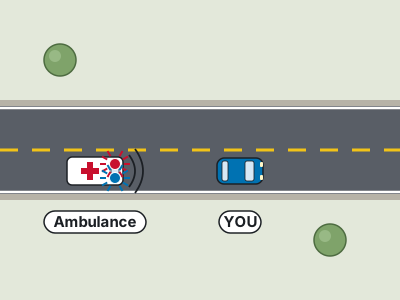
  16. 16. An ambulance behind you is using a siren and red lights. What should you do?

    A two-lane road with one lane in each direction. Your car, blue, is heading east. An ambulance with its red and blue lights flashing and its siren on is coming up behind your car in the same lane.
    1. Drive to the right edge of the road and stop
    2. Stop immediately in your lane
    3. Speed up until you reach the next exit
    4. Move left to clear the shoulder
    Show answer

    Drive to the right edge of the road and stop. Emergency vehicles using a siren and red lights have the right-of-way, so you should move to the right edge and stop until they pass. Full explanation in Test 3

  17. 17. How is a California center left turn lane marked?

    1. By a single solid white line on each side
    2. By two painted lines on each side, the inner line broken and the outer line solid
    3. By a broken white line on each side
    4. By double solid yellow lines on each side
    Show answer

    By two painted lines on each side, the inner line broken and the outer line solid. A center left turn lane sits in the middle of a two-way street and is marked on both sides by two painted lines: the inner line is broken an Full explanation in Test 4

  18. 18. A tire blows out while you are moving fast. What should you avoid doing suddenly?

    1. Braking or abruptly lifting off the accelerator
    2. Looking where you want the vehicle to go
    3. Holding the steering wheel with both hands
    4. Correcting the steering as needed
    Show answer

    Braking or abruptly lifting off the accelerator. During a blowout, a sudden brake application or abrupt release of the accelerator can upset the vehicle and cost you control. Full explanation in Test 5

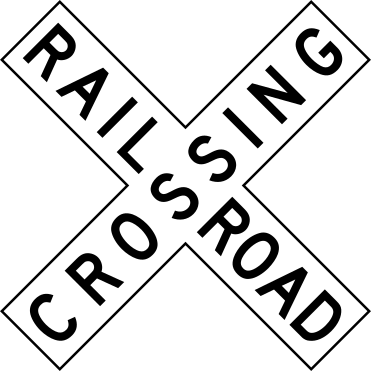
  19. 19. At this railroad crossbuck, what should you do before crossing?

    White X-shaped RAILROAD CROSSING crossbuck
    1. Cross immediately after the first train passes
    2. Stop only when a gate is present
    3. Maintain speed because trains must sound a horn
    4. Look, listen, slow down, and be ready to stop
    Show answer

    Look, listen, slow down, and be ready to stop. A railroad crossbuck marks a crossing where you must watch and listen for trains, slow down, and prepare to stop. Full explanation in Test 6

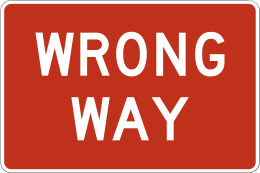
  20. 20. You see this WRONG WAY sign facing you. What should you do when safe?

    Red rectangular WRONG WAY sign
    1. Continue slowly until the next exit
    2. Back out or turn around
    3. Move to the left lane and keep going
    4. Stop in the lane and wait for a tow
    Show answer

    Back out or turn around. A WRONG WAY sign means you have entered a roadway against traffic. Full explanation in Test 7

  21. 21. What does a five-sided school sign require you to expect?

    Yellow-green pentagon with two walking figures
    1. A park entrance where vehicles may stop in the travel lane
    2. A playground where only bicycles must yield
    3. A hospital driveway with emergency vehicles entering traffic
    4. A school area, with children who may be in or near the crosswalk
    Show answer

    A school area, with children who may be in or near the crosswalk. A five-sided sign points to a school area, so slow before reaching it and watch the crosswalks and curb. Full explanation in Test 8

  22. 22. What is the maximum speed for a passenger vehicle towing a trailer on a California highway, even when the general posted limit is higher?

    1. 55 mph.
    2. 60 mph.
    3. 65 mph.
    4. 70 mph when traffic is light.
    Show answer

    55 mph.. California Vehicle Code 22406 sets a 55 mph maximum for a passenger vehicle towing another vehicle. Full explanation in Test 9

  23. 23. Which headlights should you use when driving in heavy fog or smoke?

    1. Parking lights only
    2. High beams so others can see you sooner
    3. No lights unless it is nighttime
    4. Low beams
    Show answer

    Low beams. Low beams work best in fog or heavy smoke because high beams reflect back and create glare. Full explanation in Test 10

  24. 24. What do broken white lane lines mean on a road with traffic moving in the same direction?

    1. Traffic on your side is about to become two-way
    2. Lane changes are prohibited until the next intersection
    3. The lane is reserved for emergency vehicles
    4. Changing lanes is allowed when it is safe
    Show answer

    Changing lanes is allowed when it is safe. Broken white lines separate lanes traveling in the same direction and allow lane changes when safe. Full explanation in Test 11

  25. 25. A 19-year-old in California wants to carry a sealed bottle of wine in the car. When is that allowed?

    1. Any time, as long as it stays sealed
    2. Never, under any circumstances
    3. Only on weekends
    4. Only when a person 21 or older is with them and the container is full, sealed, and unopened
    Show answer

    Only when a person 21 or older is with them and the container is full, sealed, and unopened. A driver under 21 may not carry any alcoholic beverage in a vehicle unless someone 21 or older is present, and the container must be full, s Full explanation in Test 12

  26. 26. What scanning habit helps you avoid last-minute moves and road hazards?

    1. Check mirrors only after you begin braking.
    2. Watch only the vehicle directly in front of you.
    3. Keep your eyes moving and scan at least 10 seconds ahead.
    4. Focus on the center line until reaching an intersection.
    Show answer

    Keep your eyes moving and scan at least 10 seconds ahead.. California advises drivers to keep their eyes moving and scan the road at least 10 seconds ahead. Full explanation in Test 13

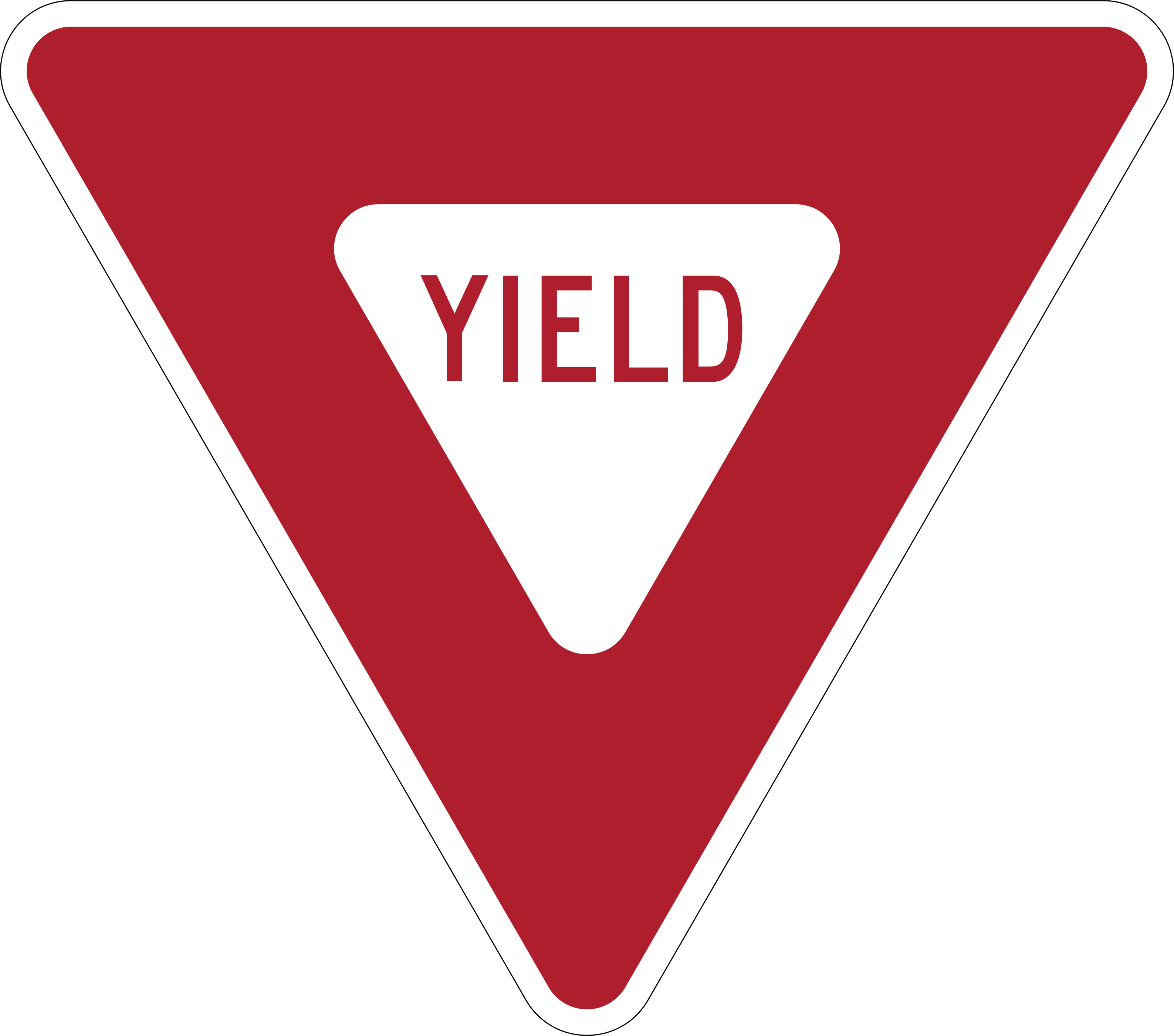
  27. 27. At this yield sign, what must you be ready to do?

    Red-bordered inverted triangle YIELD sign
    1. Speed up to match traffic before entering
    2. Stop if needed to let vehicles, bicyclists, or pedestrians pass
    3. Stop only if another driver honks
    4. Proceed first because cross traffic has the sign
    Show answer

    Stop if needed to let vehicles, bicyclists, or pedestrians pass. A yield sign tells you to slow down and be prepared to stop so other traffic or pedestrians with priority can pass. Full explanation in Test 1

  28. 28. Where must you not park on a two-way street?

    1. Within a marked legal space beside the right curb
    2. On a level street after setting the parking brake
    3. In a time-limited green curb space during posted hours
    4. On the wrong side of the street
    Show answer

    On the wrong side of the street. Parking on the wrong side of the street is prohibited, so on a two-way street you park with traffic on the right side unless a lawful except Full explanation in Test 2

  29. 29. What does a red YIELD sign tell a driver to do?

    1. Accelerate before merging into cross traffic
    2. Stop every time for at least three seconds
    3. Slow down and be ready to stop for traffic, bicyclists, or pedestrians
    4. Proceed first because cross traffic must stop
    Show answer

    Slow down and be ready to stop for traffic, bicyclists, or pedestrians. A red YIELD sign tells you to slow and be ready to stop so other vehicles, bicyclists, or pedestrians can pass before you proceed. Full explanation in Test 3

  30. 30. This round yellow sign warns of a railroad crossing ahead. If the crossing has several tracks, what should you expect?

    Round yellow RXR sign
    1. Trains only on the track nearest you
    2. Trains only during posted hours
    3. A train on any track, at any time, traveling in either direction
    4. No train once one has just passed
    Show answer

    A train on any track, at any time, traveling in either direction. The handbook tells drivers to expect a train on any track, at any time, traveling in either direction. Full explanation in Test 4

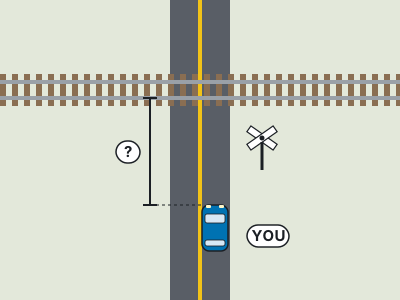
  31. 31. When a crossing device warns that a train is coming, how far from the nearest track must you stop?

    A two-lane road crosses railroad tracks at a crossing marked with a crossbuck sign. Your car, blue, is stopped heading north before the tracks. A bracket marked with a question mark shows the distance from the front of your car to the nearest rail.
    1. Only behind the vehicle ahead
    2. At least 5 feet away
    3. Exactly 100 feet away
    4. At least 15 feet away
    Show answer

    At least 15 feet away. When warning devices or a person indicate a train is coming, stop at least 15 feet from the nearest track. Full explanation in Test 5

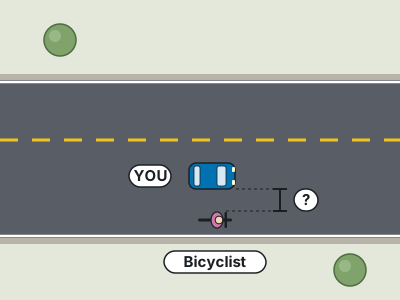
  32. 32. When you cannot change lanes to pass a bicyclist, how much clearance must you allow?

    A two-lane road with a broken yellow center line. A bicyclist is riding near the right edge of your lane. Your car, blue, is heading east and passing the bicyclist. A bracket marked with a question mark shows the side gap between your car and the bicyclist.
    1. At least two feet if traffic is light
    2. As much room as your lane allows, with no minimum
    3. One full car length
    4. At least three feet
    Show answer

    At least three feet. If you cannot move into another lane to pass a bicyclist, leave at least three feet between your vehicle and the bicycle. Full explanation in Test 6

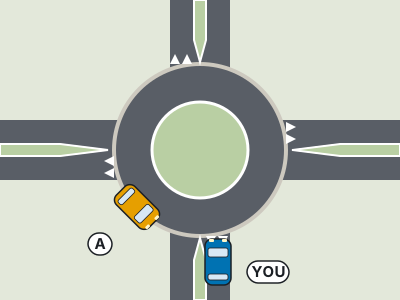
  33. 33. When entering a roundabout, who must you yield to?

    A single lane roundabout with a round center island and four entry roads, each with a yield line. Your car, blue, is on the south entry road at the yield line. Car A, orange, is already driving in the circle, to the left of your entry.
    1. Only vehicles entering from your right
    2. Only large trucks already in the circle
    3. All traffic already in the roundabout
    4. Pedestrians only after you enter
    Show answer

    All traffic already in the roundabout. Before entering a roundabout, slow down and yield to traffic that is already circulating. Enter to the right only when there is a safe gap. Full explanation in Test 7

  34. 34. Your vehicle begins to skid on a slippery surface. What should you do with the brake pedal?

    1. Press it hard until the vehicle stops
    2. Tap it rapidly while turning away from the skid
    3. Avoid using it while you ease off the accelerator
    4. Hold it halfway down to keep the wheels straight
    Show answer

    Avoid using it while you ease off the accelerator. For a slippery-surface skid, ease off the accelerator and do not use the brakes. Full explanation in Test 8

  35. 35. A yellow crossroad sign tells you to watch for what?

    Yellow plus-shaped crossroad sign
    1. A no-turn area controlled by red regulatory signs
    2. A hospital zone where sirens have priority
    3. Traffic entering or crossing from another road ahead
    4. A railroad crossing with gates and flashing red lights
    Show answer

    Traffic entering or crossing from another road ahead. A crossroad warning points to an intersection ahead where vehicles, bicycles, or pedestrians may cross your path. Full explanation in Test 9

  36. 36. A pedestrian using a white cane is at a crossing. What right-of-way rule applies?

    1. They have the right-of-way only inside a marked crosswalk
    2. They may be warned forward with a horn tap
    3. They must wait for all vehicles to clear first
    4. They have the right-of-way at all times
    Show answer

    They have the right-of-way at all times. Pedestrians using white canes or guide dogs have the right-of-way at all times. Full explanation in Test 10

Study rewards · Earned as you practice

Level 1Answer questions to earn XP
0 XP

Achievements

    Rewards are saved on your device only. They never affect your score or the real DMV test.

    Evidence-based study plan · Personalized to your exam date

    When is your driving test?

    Tell us the date and we will build a review schedule (based on learning-science research: spreading study out always beats cramming).

    How this test works

    Written for new Americans, scored like the real thing

    Every question here was written from the current California Driver's Handbook and independently fact-checked against the Vehicle Code, never copied from the DMV's sample tests. The explanations are the point: most practice sites tell you what the answer is; this one tells you why, in plain English, so the rule sticks on exam day.

    The real California knowledge test depends on your age: first-time applicants 18 and older get 36 questions and need 30 correct, and applicants under 18 get 46 questions and need 38 correct. Pick your age group above the simulator and it deals and grades the matching test. Wrong answers are remembered on your device, and the retry mode re-serves them until you have mastered every one.

    The DMV itself says "a passing score is 80%". The counts above clear that bar, so passing here means passing with room to spare.

    Fixed test set

    13 numbered tests from the bank

    Prefer studying test by test? Each numbered test is a fixed set of 20 questions from our verified bank, each with a plain-English explanation. Together the 13 tests cover 260 of the 275 questions; the practice test above draws from all 275.

    Printable CA practice test with answer key

    Study all 275 California questions as flashcards

    Cheat sheet

    Want the key numbers on one page? Keep our free California DMV cheat sheet open while you study the most-missed rules.

    Exam day

    Knowledge is half the battle. See what the science says actually helps you pass on exam day itself.

    After you pass

    The first policy is where new drivers overpay

    A brand-new license means carriers rate you as a new driver even if you have driven for years abroad. Before accepting the first number you see, ask about good student discounts, driver assignment on multi-car households, and carriers that are friendlier to newly licensed adults. That conversation is free: request a quote or explore our other California insurance tools, including the AB60 eligibility checker for drivers without federal documents.

    How we write and check these questions