Every question below comes from the Ohio question bank on this page. Open a question to see the correct answer and the explanation. Nothing here is hidden behind a signup.
1. If a railroad crossing has a stop sign posted with the crossbuck, what must drivers do?
- Stop only if a gate is descending
- Stop before proceeding
- Continue after sounding the horn
- Cross without stopping if no train is visible
Show answer
Stop before proceeding. At some railroad crossings, a stop sign is posted with the warning signs. Full explanation in Test 1
2. What does the five-sided school sign warn drivers to expect?

- A hospital entrance where vehicles must stop
- A public park where children have no crossing priority
- An adult pedestrian crossing with no speed restriction
- A school zone or school crossing requiring extra caution
Show answer
A school zone or school crossing requiring extra caution. The school sign alerts you to a school zone or school crossing. Full explanation in Test 2
3. This yellow right-angle arrow sign warns a driver about what condition ahead?

- A no passing zone ending
- A required right turn at every signal
- A one-way street ending
- A sharp right turn ahead
Show answer
A sharp right turn ahead. A yellow right-angle arrow is a warning sign, not a regulatory command. Full explanation in Test 3
4. A red circle with a slash over a U-turn arrow appears at an intersection. What does the sign mean?
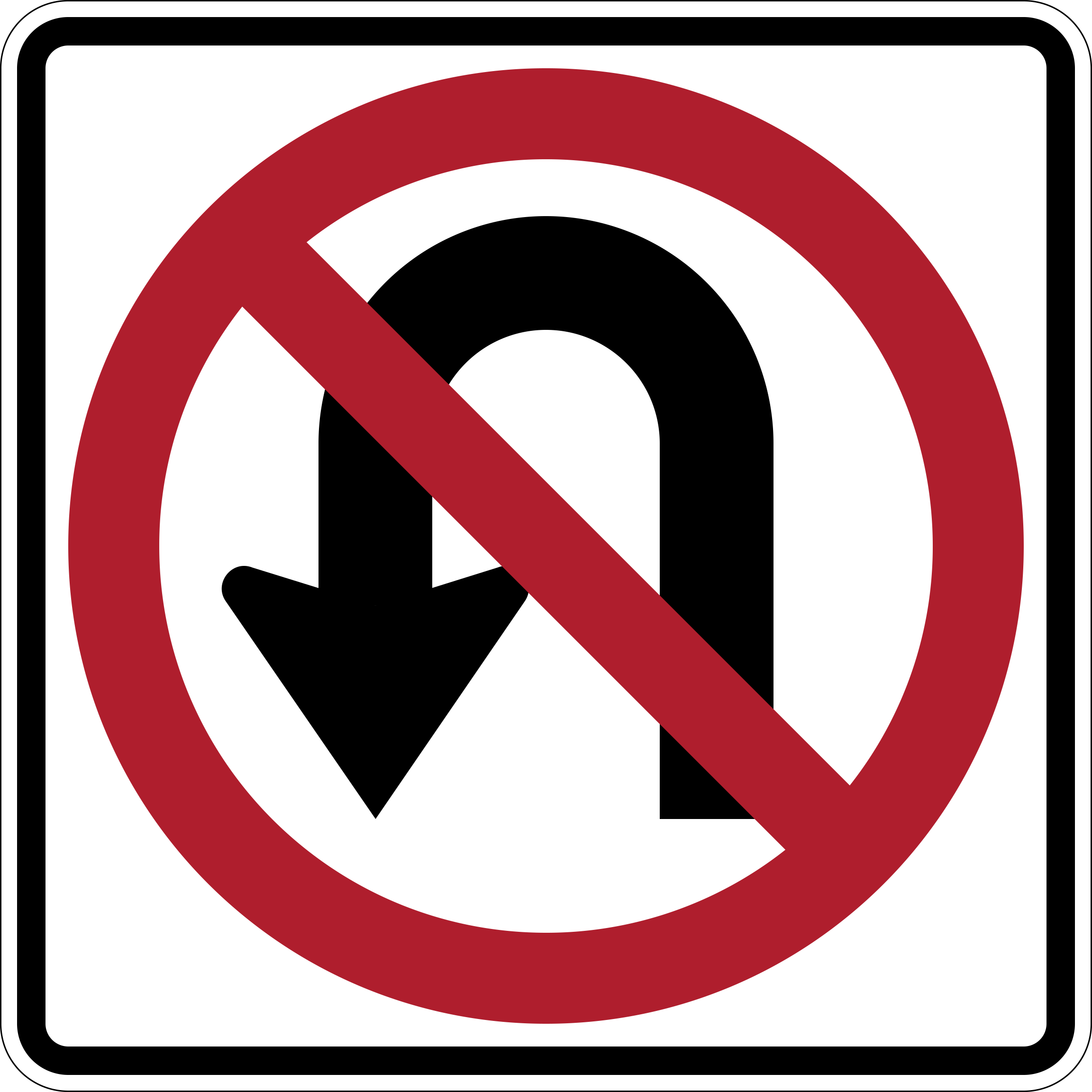
- U-turns are prohibited
- Left turns are prohibited
- The road is one-way
- U-turns are required
Show answer
U-turns are prohibited. The pictured U-shaped arrow identifies the movement, and the red slash marks that movement as prohibited. Full explanation in Test 4
5. When may a driver park in a space marked with a wheelchair symbol?
- Only when all other spaces are full
- Whenever the driver expects to stay less than five minutes
- Only when issued a removable windshield placard or accessible license plate
- Whenever another passenger remains in the vehicle
Show answer
Only when issued a removable windshield placard or accessible license plate. A wheelchair-symbol space is reserved, and Ohio says a driver may use it only with the proper removable windshield placard or accessible lic Full explanation in Test 5
6. How many Ohio penalty points accumulated within two years cause the BMV to impose a point suspension?
- 9 points
- 6 points
- 12 or more points
- 18 points
Show answer
12 or more points. The BMV imposes a 12-point suspension when a driver accumulates 12 or more points within a two-year period. Full explanation in Test 6
7. Which sign shape and color combination is normally used for warning signs in Ohio?
- Yellow with black lettering or symbols and diamond shaped
- Red circle with white letters and rectangular shaped
- Green background with white letters and circular shaped
- Blue background with yellow symbols and triangular shaped
Show answer
Yellow with black lettering or symbols and diamond shaped. Ohio says warning signs are usually yellow with black lettering or symbols and are diamond shaped. Full explanation in Test 7
8. What does Ohio prohibit a probationary driver from doing while operating a vehicle?
- Using a phone only at a red light
- Using a phone only on a highway
- Using any device, including a phone
- Using a device only after midnight
Show answer
Using any device, including a phone. The probationary license restrictions in Section 12 say the driver may not use any devices, including phones, while operating a vehicle. Full explanation in Test 8
9. The other driver in your Ohio crash had no insurance and damage was over $400. How long do you have to file a Crash Report with the BMV?
- Within 24 hours
- Within 10 days
- Within two years
- Within six months after the crash
Show answer
Within six months after the crash. An Ohio driver may file a Crash Report, form BMV 3303, with the BMV within six months after a crash when there was more than $400 in damage Full explanation in Test 9
10. A parent co-signs an Ohio license application for a 16-year-old. What responsibility does the parent take on?
- None, once the license is issued
- Liability only for parking tickets
- Joint liability for damages from the minor's negligent or willful driving until the minor turns 18
- Liability until the minor turns 25
Show answer
Joint liability for damages from the minor's negligent or willful driving until the minor turns 18. In Ohio, a parent or guardian who co-signs a minor's license application is jointly and severally liable with the minor for damages caused b Full explanation in Test 10
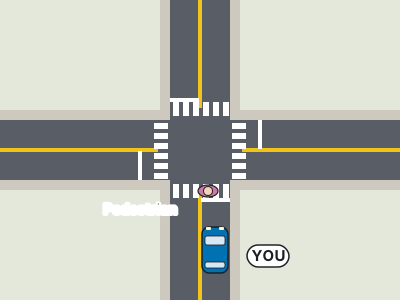
11. What do pedestrians entering or standing in an Ohio crosswalk require from a driver?
- The driver may proceed if the vehicle is already slowing
- The driver must yield the right-of-way
- The driver must sound the horn and continue
- The driver may use the crosswalk to pass another vehicle
Show answer
The driver must yield the right-of-way. Ohio requires a driver to yield the right-of-way to pedestrians entering or already in a crosswalk. Full explanation in Test 1
12. A merge warning sign appears beside your lane. What is the safest response?

- Accelerate so entering drivers must stop at the ramp
- Adjust speed and position to merge with entering traffic safely
- Move immediately onto the shoulder to create a gap
- Refuse to yield because the warning sign gives you priority
Show answer
Adjust speed and position to merge with entering traffic safely. A merge warning means traffic paths will join, so manage your speed, lane position, and following space to reduce conflict. Full explanation in Test 2
13. How many people may ride in a car driven by an Ohio TIPIC holder?
- Any number, if the supervisor approves
- Only the driver and supervisor
- Up to five, regardless of belts
- No more than the number of safety belts installed, with everyone belted
Show answer
No more than the number of safety belts installed, with everyone belted. For every Ohio TIPIC holder, the driver and all passengers must wear safety belts, and the number of occupants cannot exceed the number of s Full explanation in Test 3
14. How should a driver respond when a vehicle begins to hydroplane?
- Brake hard and turn sharply
- Accelerate until the tires regain contact
- Move immediately onto the shoulder without steering control
- Slowly ease off the gas pedal
Show answer
Slowly ease off the gas pedal. During hydroplaning, Ohio advises slowly easing the foot off the gas pedal. Full explanation in Test 4
15. Under Ohio law, what restraint must a child age 10 use?
- A safety belt
- A rear-facing child seat
- Nothing in the back seat
- A booster seat until age 15
Show answer
A safety belt. Ohio requires children at least 8 but not older than 15 to be restrained with a safety belt, and the driver is responsible for it. Full explanation in Test 5
16. What happens to an Ohio refusal suspension if the driver is later acquitted of the OVI charge?
- It is automatically canceled
- It still stands
- It changes to a 30-day suspension
- It waits until a second conviction
Show answer
It still stands. Ohio states that a refusal suspension remains in place even if the driver is ultimately acquitted of the OVI charge. Full explanation in Test 6
17. What should you do if you miss your freeway exit?
- Stop and back up on the shoulder
- Use the median opening reserved for emergency vehicles
- Take the next exit
- Make a U-turn at the end of the ramp
Show answer
Take the next exit. Ohio's driving guidance is simple when an exit is missed: take the next one. Full explanation in Test 7
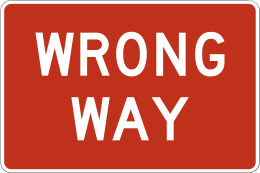
18. What information can Ohio traffic signs communicate?
- Only the current weather and pavement temperature
- Traffic rules, hazards, roadway location, directions, and roadway services
- The driver’s license status and insurance expiration date
- The vehicle’s mechanical condition and fuel level
Show answer
Traffic rules, hazards, roadway location, directions, and roadway services. Ohio describes traffic signs as information sources for traffic rules, hazards, roadway location, roadway directions, and roadway services. Full explanation in Test 8
19. In which direction must vehicles travel after entering an Ohio roundabout?
- Straight across the center island
- Clockwise around the center island
- Either direction based on the exit
- Counterclockwise around the center island
Show answer
Counterclockwise around the center island. Vehicles enter and circulate counterclockwise around a roundabout's raised center island. Full explanation in Test 9
20. A 25-year-old fails the Ohio driving test for the first time. What must they do before a second attempt?
- Complete an Abbreviated Adult Driver Training Course, unless they had approved driver education within the past year
- Wait 30 days and retest with no course
- Retake the knowledge test only
- Nothing; they may retest the same day
Show answer
Complete an Abbreviated Adult Driver Training Course, unless they had approved driver education within the past year. An Ohio applicant 21 or older who fails the maneuverability or road skills test must complete an Abbreviated Adult Driver Training Course be Full explanation in Test 10
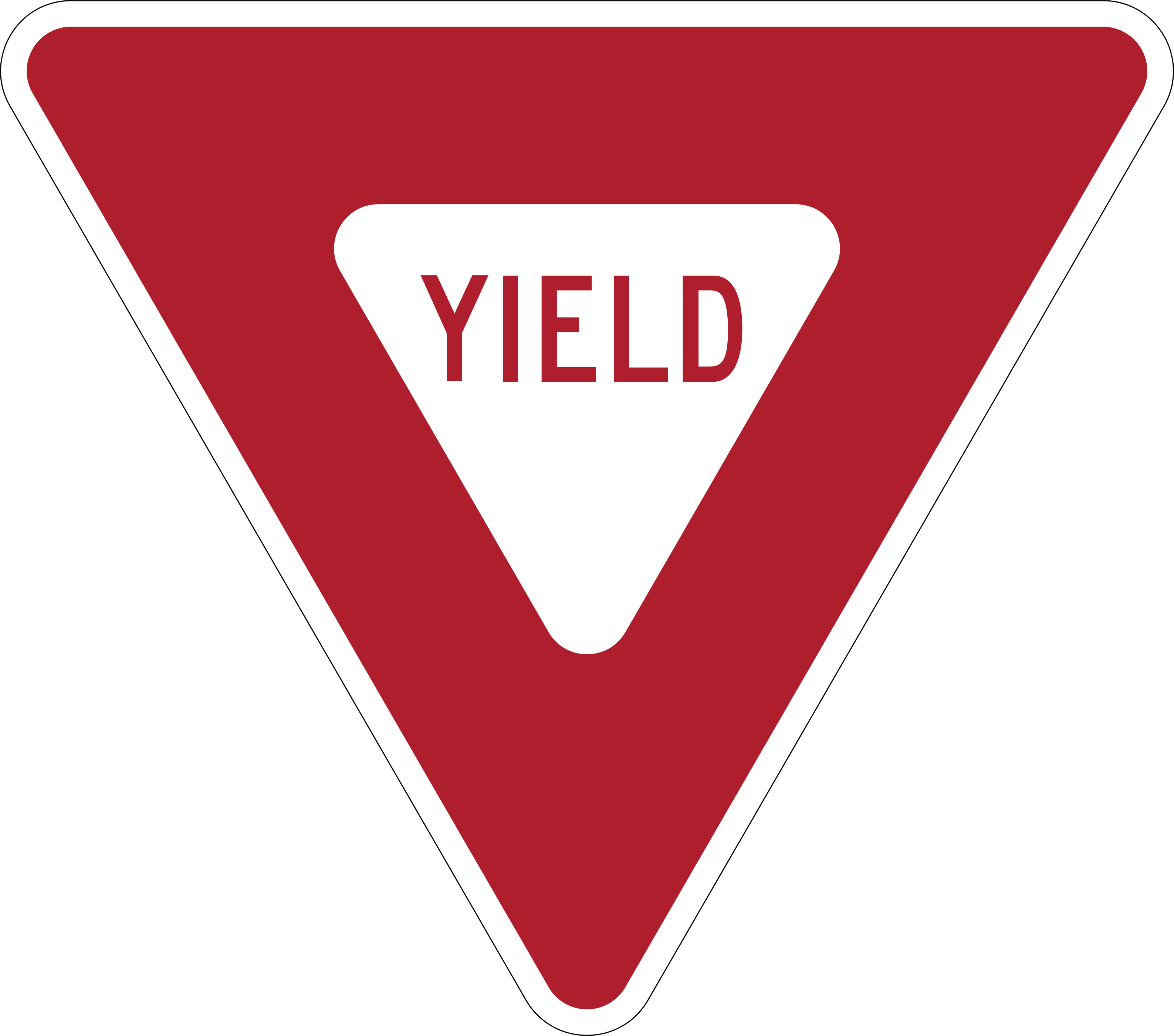
21. What does this sign require before entering the roadway?
- Make a complete stop every time
- Proceed only after a police officer signals
- Enter without checking for pedestrians
- Slow and yield, stopping if needed
Show answer
Slow and yield, stopping if needed. A yield sign tells the driver to slow down and give priority to traffic and pedestrians, stopping when necessary. Full explanation in Test 1
22. A 15-year-old Ohio TIPIC holder wants to practice driving. Who must sit in the front passenger seat?
- A parent, guardian, custodian, licensed driving instructor, or a person 21 or older acting in loco parentis
- Any licensed driver age 18 or older
- Any passenger with a TIPIC
- No one, during daylight
Show answer
A parent, guardian, custodian, licensed driving instructor, or a person 21 or older acting in loco parentis. A TIPIC holder under 16 in Ohio must have a parent, guardian, custodian, licensed driving instructor, or a person 21 or older acting in loco Full explanation in Test 2
23. What should a driver do when approaching a work zone, even if workers are not visible?
- Reduce speed and watch for signs, cones, equipment, and workers
- Keep normal speed until a worker steps into view
- Use the closed lane if it appears shorter
- Follow the vehicle ahead without leaving extra space
Show answer
Reduce speed and watch for signs, cones, equipment, and workers. Ohio directs drivers to reduce speed in a work zone even when no workers are visible. Full explanation in Test 3
24. Why should a driver allow more space ahead on a wet or snow covered road?
- The tires grip better, so extra space is unnecessary
- The posted limit automatically increases in bad weather
- The vehicle takes longer to stop and is harder to turn without skidding
- The vehicle must remain in the left lane
Show answer
The vehicle takes longer to stop and is harder to turn without skidding. Ohio explains that a slippery roadway reduces tire grip. Full explanation in Test 4
25. What must a driver do when an emergency vehicle approaches with flashing lights and an audible siren?
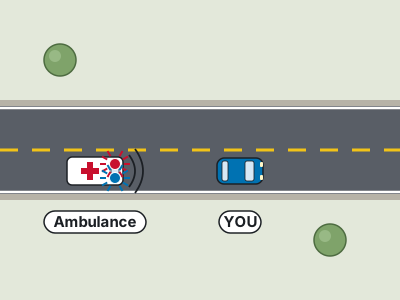
- Speed up so the emergency vehicle can follow
- Stop immediately in the nearest travel lane
- Turn left at the next intersection without checking traffic
- Pull safely to the right and stop until it has passed
Show answer
Pull safely to the right and stop until it has passed. Ohio directs drivers to pull quickly and safely to the right and stop when an emergency vehicle is approaching with the specified signals. Full explanation in Test 5
26. When does an Ohio driver license issued to someone under 21 expire?
- On the 18th birthday
- Four years after issue
- Eight years after issue
- On the driver's 21st birthday
Show answer
On the driver's 21st birthday. An Ohio license issued to someone under 21 expires on the 21st birthday and must be renewed in person, as early as 30 days before that birth Full explanation in Test 6
27. What financial responsibility document must accompany reinstatement after an Ohio 12-point suspension?
- A notarized apology letter
- A community service certificate
- A vehicle inspection waiver
- An SR-22 bond filed with the BMV
Show answer
An SR-22 bond filed with the BMV. Ohio lists filing an SR-22 bond with the BMV among the requirements for reinstating driving privileges after a 12-point suspension. Full explanation in Test 7
28. When entering a freeway, what should a driver use to merge with the traffic flow?
- The shoulder until the next exit
- The median to pass established traffic
- The acceleration lane after reaching the speed of other vehicles
- The deceleration lane before entering
Show answer
The acceleration lane after reaching the speed of other vehicles. Ohio directs a driver entering a freeway to look for a gap, signal, and use the acceleration lane to reach the speed of other vehicles befor Full explanation in Test 8
29. When turning left across an opposing traffic lane, what must the turning driver do?
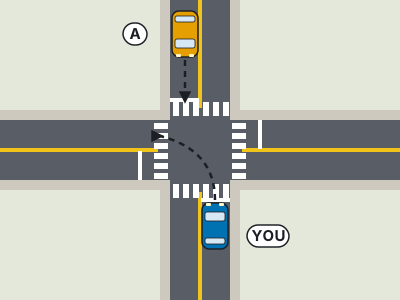
- Accelerate to claim priority
- Yield to opposing traffic
- Turn first if the signal is green
- Yield only to trucks
Show answer
Yield to opposing traffic. A left turn crosses the path of vehicles traveling toward the driver, so the turning driver must yield to opposing traffic. Full explanation in Test 9
30. Two vehicles reach an uncontrolled four-way intersection at the same time. Which vehicle has priority?
- The vehicle traveling faster
- The vehicle on the left
- The vehicle on the right
- The larger vehicle
Show answer
The vehicle on the right. When two drivers arrive at a four-way intersection simultaneously, Ohio assigns priority to the driver on the other vehicle's right. Full explanation in Test 10
31. When should Ohio headlights be used because of precipitation?
- Only after midnight during heavy rain
- Whenever windshield wipers are in use because of precipitation
- Only when high beams are permitted
- Only when another driver flashes headlights first
Show answer
Whenever windshield wipers are in use because of precipitation. Ohio requires headlights whenever windshield wipers are being used because of precipitation. Full explanation in Test 1
32. How soon after becoming an Ohio resident must you get an Ohio driver license?
- Within 10 days
- Within 60 days
- Within 30 days
- Within one year
Show answer
Within 30 days. Ohio drivers must have an Ohio issued license within 30 days of establishing residency. Full explanation in Test 2
33. How far before a turn must an Ohio driver activate a turn signal?
- At least 25 feet before the turn
- At least 100 feet before changing direction
- Only after beginning the turn
- At least 500 feet before every lane change
Show answer
At least 100 feet before changing direction. Ohio requires a turn signal at least 100 feet before changing direction. Full explanation in Test 3
34. What should a driver do when the vehicle is hydroplaning?
- Turn sharply toward the shoulder
- Brake hard until the tires grab
- Slowly ease off the gas pedal
- Accelerate to push water away
Show answer
Slowly ease off the gas pedal. When hydroplaning, Ohio advises slowly easing your foot off the gas pedal. Full explanation in Test 4
35. When does the Ohio manual list school zones as a basis for reduced speed limits?
- During weekends when the building is closed
- Only after sunset on school nights
- Only when every lane has a crossing guard posted
- During recess and while children arrive or leave during normal school hours
Show answer
During recess and while children arrive or leave during normal school hours. The school zone speed rule is tied to times when children are likely to be near the roadway: recess and normal arrival or dismissal periods. Full explanation in Test 5
36. How long must an Ohio driver under 18 hold a TIPIC before getting a license?
- At least 14 days
- At least 60 days
- At least six months
- At least one year
Show answer
At least six months. Ohio requires drivers under 18 to hold the TIPIC for at least six months before getting a license. Full explanation in Test 6
37. If an Ohio traffic signal is not working and no officer is directing traffic, how should drivers treat it?
- As a yield sign for the side street only
- As a green light for the wider road
- As a four-way stop
- As an uncontrolled intersection with no required stop
Show answer
As a four-way stop. A non-working signal is handled as a four-way stop unless a law enforcement officer is present to direct traffic. Full explanation in Test 7
38. What should a driver do with lane position after entering an Ohio roundabout?
- Do not change lanes once inside
- Change lanes only at the center island
- Change lanes before every exit
- Stop and wait before changing lanes
Show answer
Do not change lanes once inside. The manual says a driver cannot change lanes once inside the roundabout. Full explanation in Test 8
39. What is required when a school bus is stopped on a road with fewer than four lanes and its red lights are flashing?
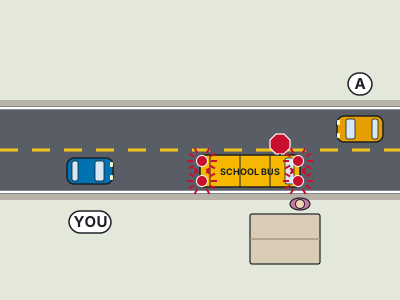
- Only traffic behind the bus must stop at least 5 feet away
- All traffic may proceed after slowing to 15 mph
- Oncoming traffic may pass if it uses the opposite shoulder
- Traffic approaching from either direction must stop at least 10 feet away
Show answer
Traffic approaching from either direction must stop at least 10 feet away. On a road with fewer than four lanes, Ohio requires traffic approaching a stopped school bus from either direction to stop at least 10 feet Full explanation in Test 9
40. At an intersection, another driver is already there before you arrive. Who should you yield to?
- The driver turning right
- The driver who sounds the horn
- The vehicle carrying more passengers
- The driver who is at or arrives before you
Show answer
The driver who is at or arrives before you. Ohio's right-of-way list tells drivers to yield to the driver who is already at the intersection or arrived before them. Full explanation in Test 10
