Every question below comes from the New Mexico question bank on this page. Open a question to see the correct answer and the explanation. Nothing here is hidden behind a signup.
1. After a railroad warning sign, what should a driver remember about the train's apparent speed?
- The train must yield if the warning sign is round
- The train is stopped whenever its engine is hard to see
- The train may be moving faster than it appears
- The train can be outrun when no gate is present
Show answer
The train may be moving faster than it appears. Railroad warnings deserve caution because a train can cover ground faster than its appearance suggests. Full explanation in Test 1
2. What two documents does the manual say a driver needs when renewing a New Mexico driver license?
- The current license and one other proof of identity
- A vehicle title and a recent fuel receipt
- A school transcript and a road test certificate
- Only a signed statement from an employer
Show answer
The current license and one other proof of identity. For renewal, the manual says to bring the current driver license plus one other proof of identity. Full explanation in Test 2
3. What is the lowest BAC threshold for New Mexico's under-21 alcohol driving rule?
- .02%
- .05%
- .08% only
- .12%
Show answer
.02%. The manual says a driver under 21 can be arrested in New Mexico for a BAC of .02%. The . Full explanation in Test 3
4. How fast do farm tractors, animal-drawn vehicles, and roadway maintenance vehicles usually travel?
- 25 mph or less
- About 45 mph
- The posted limit in every case
- At least 55 mph
Show answer
25 mph or less. These vehicles usually travel at 25 mph or less, which is why a driver should identify them early, reduce speed smoothly, or change lanes on Full explanation in Test 4
5. What does a driver do when a traffic signal changes to steady yellow?
- Reverse away from the intersection before the light changes
- Accelerate every time to beat the red indication
- Stop if it can be done safely, otherwise continue cautiously through the intersection
- Stop abruptly even when already too close to stop safely
Show answer
Stop if it can be done safely, otherwise continue cautiously through the intersection. A yellow indication warns that the signal is about to turn red. Full explanation in Test 5
6. When may a driver pass another vehicle on a multilane road under the manual's general lane guidance?
- By using the left most lane to pass slower vehicles when passing is permitted
- By using the shoulder whenever the lane is crowded
- By passing on either side without checking the other vehicle
- By driving in the lane reserved for stopped vehicles
Show answer
By using the left most lane to pass slower vehicles when passing is permitted. On a multilane road, the left most lane is intended for passing slower vehicles, but the maneuver still requires safe conditions and any app Full explanation in Test 6
7. What is the usual shape of the advance warning sign before a railroad crossing?
- A round yellow sign with an X and black RR letters
- An eight-sided red sign
- A blue rectangle with a white hospital symbol
- A green rectangle showing a route number
Show answer
A round yellow sign with an X and black RR letters. The advance railroad warning is a round yellow sign marked with an X and black RR letters. Full explanation in Test 7
8. How close to a traffic signal, stop sign, or yield sign may you park in New Mexico?
- No closer than 10 feet
- No closer than 15 feet
- No closer than 30 feet
- No closer than 100 feet
Show answer
No closer than 30 feet. New Mexico prohibits parking within 30 feet of a traffic signal, stop sign, or yield sign. Full explanation in Test 8
9. What vision standard does the New Mexico license vision test check for?
- 20/20 in both eyes without glasses
- At least 20/40 in at least one eye, with or without corrective lenses
- At least 20/40 in both eyes without glasses
- At least 20/100 in the better eye
Show answer
At least 20/40 in at least one eye, with or without corrective lenses. New Mexico's vision test measures that you have at least 20/40 vision in at least one eye, with or without corrective lenses. Full explanation in Test 9
10. When conditions are rainy, icy, or foggy, how should a driver treat a posted maximum speed?
- Treat it as a target speed that must be maintained
- Increase speed briefly to clear the bad weather
- Reduce speed when the conditions make the posted maximum unsafe
- Ignore the limit only when visibility is reduced
Show answer
Reduce speed when the conditions make the posted maximum unsafe. A posted maximum is based on ideal driving conditions, not a promise that the same speed is safe in every situation. Full explanation in Test 10
11. Which children must be secured in an approved safety device under the New Mexico manual's restraint guidance?
- Only children younger than 12 months
- Children under 24 months or weighing less than 60 pounds
- Every child under 18 years, without exception
- Children under 24 months only when seated in front
Show answer
Children under 24 months or weighing less than 60 pounds. The manual gives two triggers for an approved safety device: the child is under 24 months, or the child weighs less than 60 pounds. Full explanation in Test 1
12. A yellow signal is flashing at an intersection. What driving response does the manual call for?
- Stop and remain stopped until a green light appears
- Slow down and proceed with caution
- Speed up because the intersection has priority
- Treat the signal as permission to disregard pedestrians
Show answer
Slow down and proceed with caution. A flashing yellow light calls for reduced speed and cautious progress through the intersection. Full explanation in Test 2
13. A New Mexico provisional driver is ready to apply for an unrestricted license. How long before the application must the driver be free of any traffic conviction?
- 30 days
- Six months
- 90 days
- Three years
Show answer
90 days. An unrestricted license applicant must not have been convicted of a traffic violation in the 90 days before applying. Full explanation in Test 3
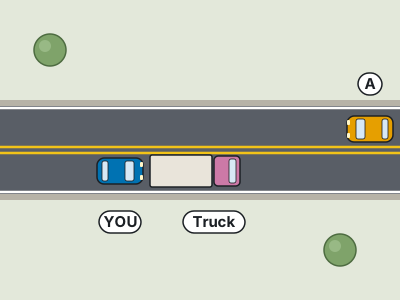
14. What does a pair of solid yellow lines between opposing traffic lanes mean?
- Passing is allowed during daylight hours
- Both directions may pass after signaling
- Only trucks may cross to pass
- Neither direction may pass
Show answer
Neither direction may pass. Two solid yellow lines separate opposing traffic where passing is prohibited for both directions. Full explanation in Test 4
15. If your headlights suddenly fail at night, what should you try first?
- Try the headlight switch a few times
- Keep driving with only the parking brake ready
- Turn off all vehicle lights immediately
- Brake hard in the travel lane
Show answer
Try the headlight switch a few times. For sudden headlight failure, the first listed action is to try the headlight switch several times. Full explanation in Test 5
16. During what hours may a provisional licensee generally not drive on New Mexico public highways?
- 10:00 PM to 4:00 AM
- 11:00 PM to 5:00 AM
- 1:00 AM to 6:00 AM
- Midnight to 5:00 AM
Show answer
Midnight to 5:00 AM. The general nighttime restriction for a provisional license runs from midnight to 5:00 AM. Full explanation in Test 6
17. Which statement about a New Mexico instructional permit is true for a 15 year old applicant?
- The applicant needs no supervised practice until age 16
- The applicant may drive alone after passing the vision test
- The applicant may skip the knowledge test if a parent signs consent
- The applicant must be enrolled in an approved driver education course
Show answer
The applicant must be enrolled in an approved driver education course. A person who is 15 or older must be enrolled in and attending a driver education course approved by the Traffic Safety Bureau. Full explanation in Test 7
18. When a New Mexico instructional permit holder practices with a licensed driver instead of an approved instructor, how long must that supervising driver have been licensed?
- At least one year
- At least six months
- At least five years
- At least three years
Show answer
At least three years. The supervising driver must be 21 or older and must have been licensed for at least three years, in New Mexico or any other state. Full explanation in Test 8
19. How does New Mexico handle a ticket for driving without insurance or without vehicle registration?
- It adds 12 points and an automatic one-year suspension
- It carries no points but requires the driver to appear in court
- It adds points, the same way a speeding ticket does
- It is a warning only and never goes to court
Show answer
It carries no points but requires the driver to appear in court. New Mexico uses points for common violations such as speeding or not wearing a seat belt, but offenses like driving without insurance or reg Full explanation in Test 9
20. What do blue service signs with white letters or symbols show?
- A warning that a railroad crossing is immediately ahead
- The posted minimum speed for a high-speed roadway
- A place where all traffic must make a U-turn
- Locations of services such as rest areas, gas stations, campgrounds, or hospitals
Show answer
Locations of services such as rest areas, gas stations, campgrounds, or hospitals. Blue service signs point drivers toward useful services, including rest areas, gas stations, campgrounds, and hospitals. Full explanation in Test 10
21. After a drink, about how long does alcohol take to reach the brain?
- 1 to 2 minutes
- About 2 hours
- About 6 hours
- 20 to 40 minutes
Show answer
20 to 40 minutes. The manual says alcohol goes from the stomach into the blood and reaches the brain in 20 to 40 minutes. Full explanation in Test 1
22. If a vehicle breaks down on a highway, what should the driver do when it is possible?
- Get the vehicle off the road and away from traffic
- Leave it in the travel lane with the engine off
- Stand behind it and wave at approaching vehicles
- Stop just beyond a hill so it is out of sight
Show answer
Get the vehicle off the road and away from traffic. For a highway breakdown, the manual's first protective measure is to get the vehicle off the road and away from traffic whenever possible. Full explanation in Test 2
23. About how fast does the body get rid of alcohol, according to the New Mexico manual?
- Three drinks per hour
- One alcoholic drink per hour
- One drink every ten minutes
- Faster if you drink coffee
Show answer
One alcoholic drink per hour. The manual says the body gets rid of one alcoholic drink per hour, and there is no way to sober up quickly. Full explanation in Test 3
24. What action is required at a red, eight-sided stop sign?
- Make a full stop at the sign or stop line
- Slow briefly and continue if the road looks clear
- Yield only to pedestrians in the crosswalk
- Stop only when another vehicle is approaching
Show answer
Make a full stop at the sign or stop line. The octagonal shape identifies a stop sign, and the required action is a full stop. Full explanation in Test 4
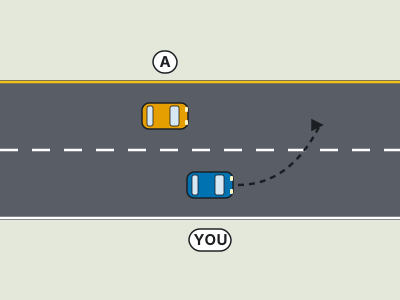
25. Which checks are required before changing lanes?
- The horn alone before crossing the lane line
- Only the rear-view mirror and a quick acceleration
- Hazard flashers without looking behind the vehicle
- Mirrors, a shoulder check for the blind spot, and a signal
Show answer
Mirrors, a shoulder check for the blind spot, and a signal. A safe lane change requires information from several viewing points. Full explanation in Test 5
26. How can you help keep a driver behind you at a safe distance?
- Keep a steady speed and signal before slowing or turning
- Brake sharply whenever the vehicle gets close
- Speed above the limit to open a gap
- Move onto the shoulder without checking
Show answer
Keep a steady speed and signal before slowing or turning. The manual recommends a steady speed and advance signaling when you need to slow down or turn. Full explanation in Test 6
27. What changes may orange work area warnings announce?
- Reduced speeds, detours, or changing road surfaces
- A permanent increase in the posted speed
- A guaranteed open lane through the work area
- A nearby railroad train schedule
Show answer
Reduced speeds, detours, or changing road surfaces. Work area warnings can announce reduced speed, detours, slow-moving construction equipment, or poor and suddenly changing road surfaces. Full explanation in Test 7
28. What should a driver do when a yellow arrow appears while turning in its direction?
- Continue with the protection of a green arrow
- Prepare to stop and yield to oncoming traffic before turning
- Turn without checking for approaching vehicles
- Treat the arrow as a flashing red signal
Show answer
Prepare to stop and yield to oncoming traffic before turning. A yellow arrow means the protection provided by a green arrow is ending. Full explanation in Test 8
29. What should a driver do during a sudden stop in a vehicle equipped with ABS?
- Use only the parking brake
- Pump the pedal rapidly until the vehicle stops
- Release the pedal whenever it vibrates
- Press the brake pedal hard and keep pressing it
Show answer
Press the brake pedal hard and keep pressing it. With an antilock braking system, the manual directs the driver to press the brake pedal as hard as possible and keep pressure on it. Full explanation in Test 9
30. A flashing red signal is equivalent to which control, and what must happen before proceeding?
- Treat it as permission to turn in any direction
- Slow briefly and continue without stopping
- Wait there until the signal becomes green
- Make a full stop, then proceed when it is safe
Show answer
Make a full stop, then proceed when it is safe. A flashing red light has the same meaning as a stop sign. Full explanation in Test 10
31. When a dashed yellow line separates opposing lanes, what may a driver do?
- Cross it only to park beside the road
- Cross it to pass when the maneuver is safe
- Treat it as a barrier that forbids every crossing
- Use the opposing lane continuously until the next intersection
Show answer
Cross it to pass when the maneuver is safe. A dashed yellow line divides traffic moving in opposite directions and allows a driver to cross for a pass when conditions make the maneuver Full explanation in Test 1
32. What is the safest practice when a driver must make or take a cell phone call?
- Drive faster so the call ends sooner
- Hold the phone below the steering wheel while moving
- Dial only while stopped at a red light in traffic
- Pull to the side of the road whenever possible
Show answer
Pull to the side of the road whenever possible. The manual identifies both dialing and talking as distractions and recommends pulling to the side of the road whenever possible before placi Full explanation in Test 2
33. What do orange work area signs warn drivers may be present near the roadway?
- Workers or equipment operating on or near the roadway
- A permanent hospital service area
- A guaranteed lane for high occupancy vehicles
- A railroad crossing with no roadway activity
Show answer
Workers or equipment operating on or near the roadway. Orange work area signs identify construction, maintenance, or emergency operations and warn that people may be working on or near the roadwa Full explanation in Test 3
34. At a stop sign, where should a driver stop when a stop line is present?
- Past the crosswalk so the front bumper reaches cross traffic
- At the stop line, before entering the intersection
- Only after crossing the intersection to see better
- Beside the sign with the vehicle partly in the next lane
Show answer
At the stop line, before entering the intersection. A stop sign requires a full stop, and the manual specifies the stop line when one is present. Full explanation in Test 4
35. What must a driver do before moving from a stop sign into the intersection?
- Wait for crossing vehicles and pedestrians to clear
- Move immediately because the stop sign gives priority
- Yield only to vehicles approaching from the left
- Proceed if the driver has waited two seconds
Show answer
Wait for crossing vehicles and pedestrians to clear. Stopping is only the first part of the stop-sign rule. Full explanation in Test 5
36. What does the Four Second Sight Distance Rule tell a driver to do?
- Speed up whenever an object is visible four seconds away
- Slow down if the vehicle reaches the object before four seconds finish
- Use four seconds only when following a motorcycle
- Count four seconds after crossing a stop line
Show answer
Slow down if the vehicle reaches the object before four seconds finish. The sight-distance rule tests whether speed matches the distance the driver can clearly see. Full explanation in Test 6
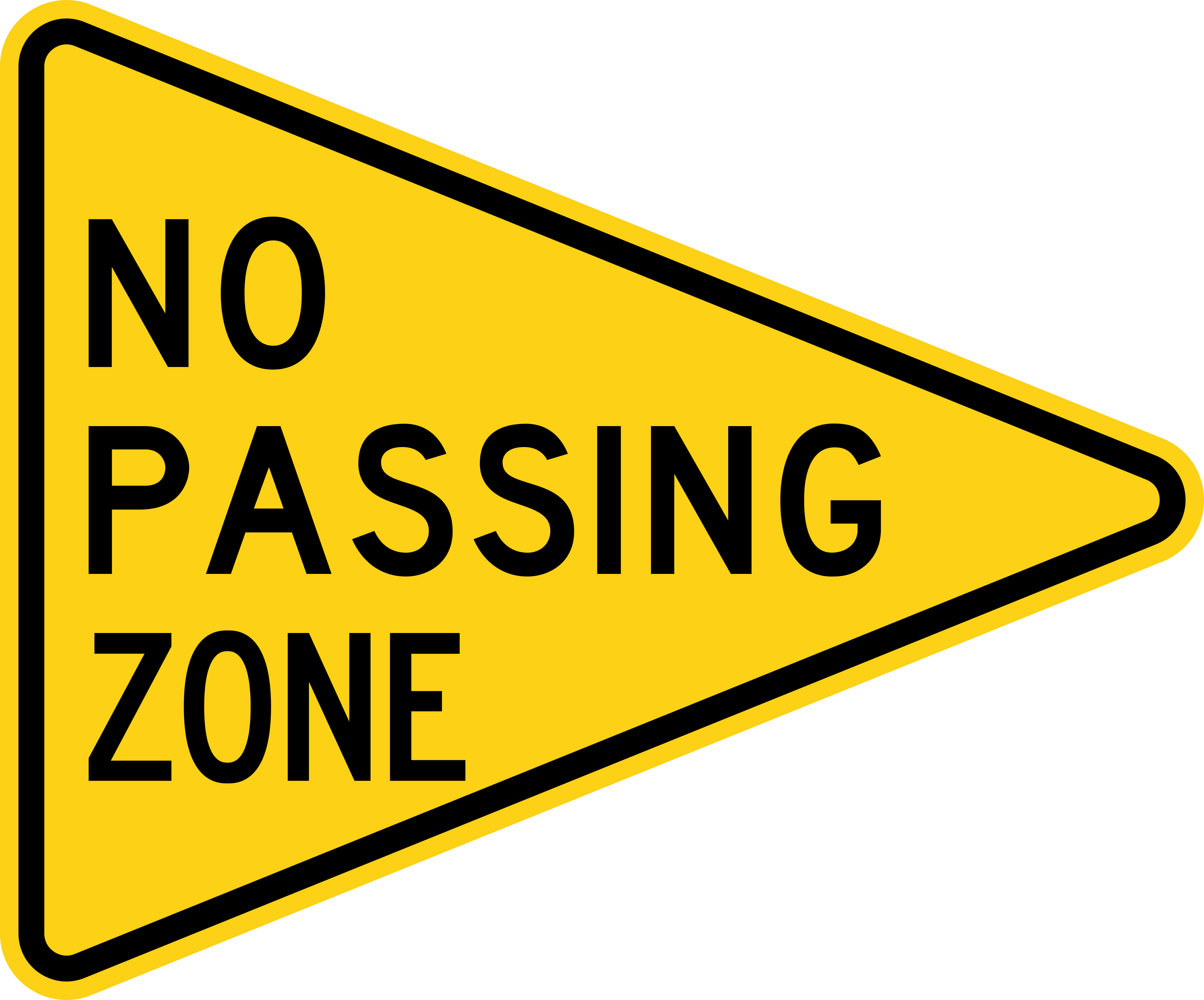
37. What does the yellow pennant-shaped sign mark?
- The beginning of a hospital service area
- A place where passing is not permitted
- A zone where passing is required
- A route for emergency vehicles only
Show answer
A place where passing is not permitted. The pennant identifies a no-passing area, where roadway conditions or hidden hazards make an overtaking maneuver unsafe or prohibited. Full explanation in Test 7
38. How far before an oncoming vehicle should a driver dim high beams under the manual's nighttime guidance?
- Within 25 feet
- About one block
- Only after the other driver flashes headlights
- At the exact moment the vehicles meet
Show answer
About one block. The manual asks drivers to dim high beams when an oncoming vehicle comes within about one block. Full explanation in Test 8
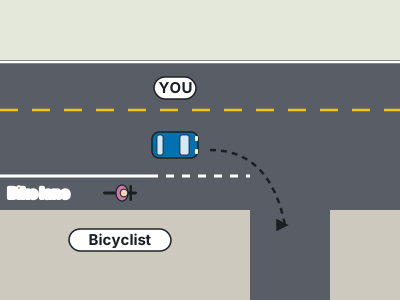
39. After passing a bicyclist on your right, what should you do before making a sudden right turn?
- Turn across the bicyclist's path immediately
- Slow down and merge behind the bicyclist
- Sound the horn and keep turning from the passing lane
- Accelerate so the bicycle cannot reach the corner first
Show answer
Slow down and merge behind the bicyclist. A bicyclist remains a road user whose path must be protected after you pass. Full explanation in Test 9
40. What should a driver do before moving from a stop into an intersection?
- Look both left and right immediately before starting
- Look only toward the vehicle's intended turn
- Trust the signal without checking either side
- Watch the rearview mirror and ignore cross traffic
Show answer
Look both left and right immediately before starting. Before moving from a stop, the driver should look left and right again, even when another signal or stop sign appears to control cross traff Full explanation in Test 10
