Every question below comes from the New Hampshire question bank on this page. Open a question to see the correct answer and the explanation. Nothing here is hidden behind a signup.
1. A right turn arrow with a red slash is posted at an intersection. Which of the manual's sign shapes and colors does it use, and what does it forbid?
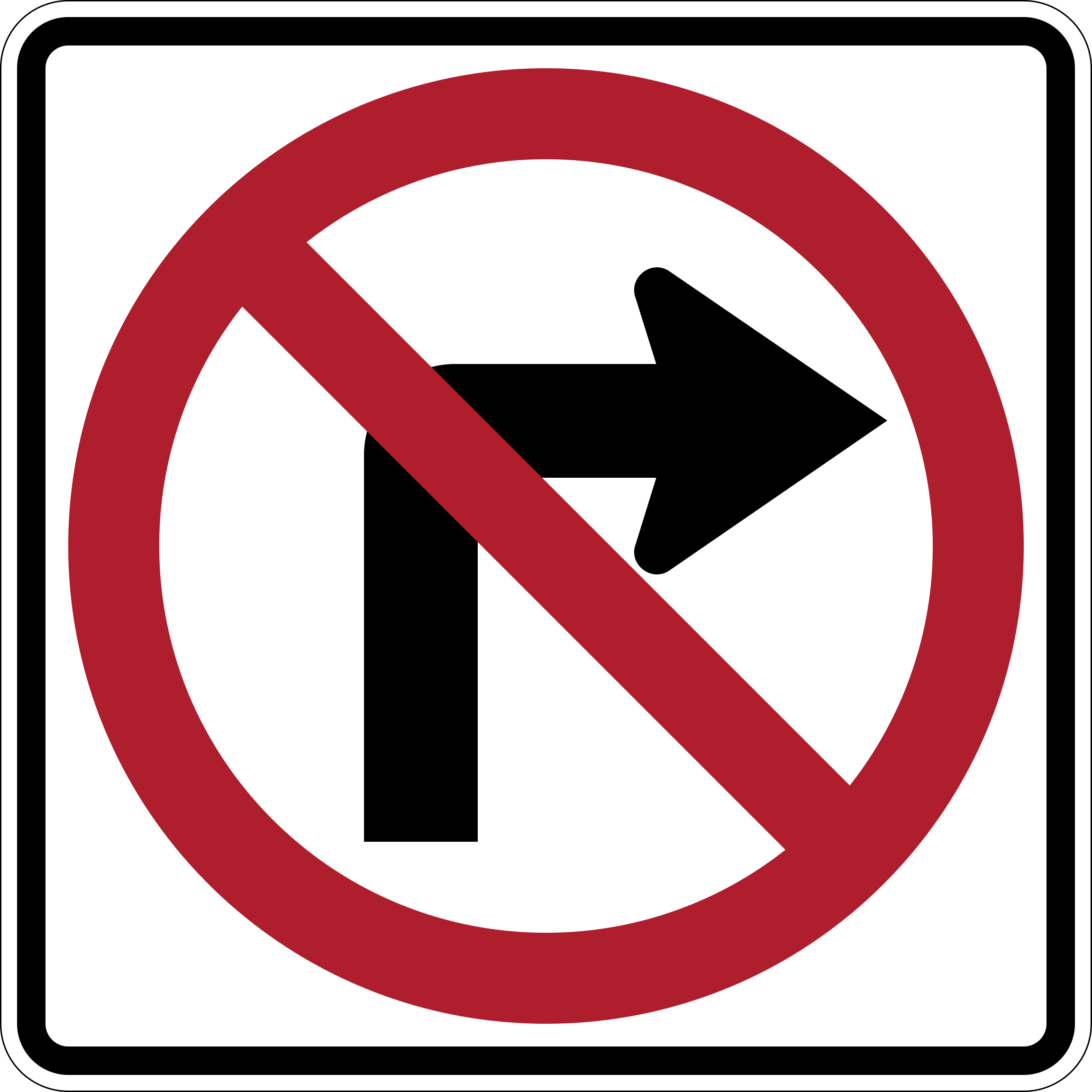
- A red prohibition symbol on a regulatory sign forbidding a right turn there
- A green guide sign recommending a left turn
- An orange work zone sign forbidding trucks
- A yellow warning diamond forbidding right turns in rain
Show answer
A red prohibition symbol on a regulatory sign forbidding a right turn there. Regulatory signs are square or rectangular, and some carry a red circle with a red slash over a symbol to prohibit an action. Full explanation in Test 1
2. What does the New Hampshire manual say about the consequences of collecting demerit points?
- They are identical for every driver
- Points can never lead to a loss of driving privileges
- They may vary depending on the driver's age
- Only commercial drivers receive demerit points
Show answer
They may vary depending on the driver's age. Excessive accrual of demerit points may result in loss of driving privileges, and the size of the points depends on the offense. Full explanation in Test 2
3. After passing a vehicle in New Hampshire, when is it safe to signal and return to your lane?
- As soon as your front bumper is ahead of the other vehicle
- When the complete front of the passed vehicle is visible in your rearview mirror
- After counting three seconds
- When the other driver flashes headlights
Show answer
When the complete front of the passed vehicle is visible in your rearview mirror. The manual's passing sequence says to continue to pass until the complete front of the passed vehicle is visible in the rearview mirror, the Full explanation in Test 3
4. About how far does the New Hampshire manual say it can take to stop at 50 mph on dry pavement with good brakes?
- About 50 feet
- About 300 feet
- About 100 feet
- About 158 feet
Show answer
About 158 feet. The manual gives one concrete braking figure: at 50 mph on dry pavement with good brakes, it can take about 158 feet to stop. Full explanation in Test 4
5. Where does the New Hampshire manual say a three-point turn should be used?
- Only when the road is too narrow for a U-turn, and only on a two-lane roadway
- At any intersection without a signal
- On any multi-lane road with light traffic
- On divided highways
Show answer
Only when the road is too narrow for a U-turn, and only on a two-lane roadway. A three point turn is reserved for a road or street that is too narrow to make a U-turn, and the manual says it should only be used on a two Full explanation in Test 5
6. This yellow winding arrow sign appears on a New Hampshire road. Which listed warning sign is it?

- Curvy Road Ahead
- Right Curve
- Sharp Curve Ahead
- Side Road Ahead
Show answer
Curvy Road Ahead. The snaking arrow is Curvy Road Ahead, warning of a series of curves rather than a single bend. Full explanation in Test 6
7. This yellow sign shows a walking person. In the New Hampshire manual's list of warning signs, what is it?

- Share the Road with Bicycles
- Pedestrian Crossing
- School Crossing
- Added Lane
Show answer
Pedestrian Crossing. Pedestrian Crossing is one of the manual's example warning signs, listed with School Crossing, Share the Road with Bicycles, Bicycle Crossin Full explanation in Test 7
8. When does New Hampshire consider a load carried on a vehicle to be secure?
- When it is covered with a tarp
- When it stays below the height of the cab
- When a red flag is tied to it
- When nothing can slide, shift, fall or sift onto the roadway, or become airborne
Show answer
When nothing can slide, shift, fall or sift onto the roadway, or become airborne. Driving with an unsecured load is against the law and dangerous, and a driver who causes a crash with one may face a costly fine. Full explanation in Test 8
9. Under RSA 265:79-c, which activity with a hand-held device is prohibited while driving in New Hampshire?
- Listening to the radio
- Talking to a passenger
- Inputting information into a GPS or navigation device
- Adjusting the climate controls
Show answer
Inputting information into a GPS or navigation device. The hand-held device law covers more than texting. Full explanation in Test 9
10. A New Hampshire road has a broken yellow line next to a solid yellow line, and the broken line is on your side. May you pass?
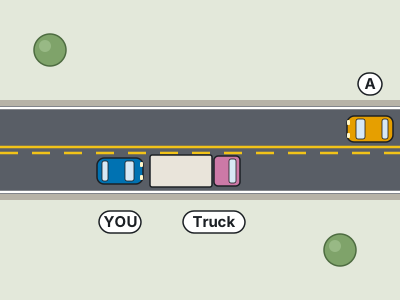
- No, the solid line applies to both directions
- Yes, when it is safe, because the line on your side is broken
- Only if the vehicle ahead signals you around
- Only at night
Show answer
Yes, when it is safe, because the line on your side is broken. With double white or yellow lines, drivers must not pass if the line on the driver's side is solid. Full explanation in Test 10
11. Another vehicle is passing you on a New Hampshire road. What must you never do?
- Maintain a constant speed
- Stay in your lane
- Increase speed to prevent the pass
- Let the vehicle return ahead of you
Show answer
Increase speed to prevent the pass. When being passed, the manual tells drivers to stay in the lane they are traveling, maintain a constant speed so the other driver can comple Full explanation in Test 1
12. Which New Hampshire applicants must complete an approved driver education program before applying for a license?
- Only applicants who failed the road test once
- Only applicants under 16
- Every applicant of any age
- All applicants who are 16 or 17 years old
Show answer
All applicants who are 16 or 17 years old. State law RSA 263:19 requires everyone who is 16 or 17 years of age and wants a driver's license to have first completed an approved driver Full explanation in Test 2
13. How does the New Hampshire manual say a backup camera should be used?
- Together with mirrors and head checks, never as the primary tool for backing
- As the only tool needed when backing slowly
- Instead of turning your head
- Only at night
Show answer
Together with mirrors and head checks, never as the primary tool for backing. Many vehicles have backup cameras, and the technology can help drivers back up safely when used in conjunction with the mirrors and proper h Full explanation in Test 3
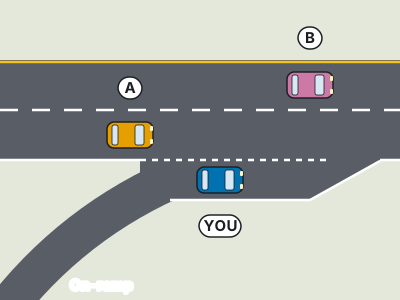
14. When entering a multi-lane highway in New Hampshire, what is the acceleration lane for?
- Stopping to wait for a large gap
- Reaching the speed of other vehicles before pulling onto the roadway
- Reading the exit signs
- Passing slower traffic on the right
Show answer
Reaching the speed of other vehicles before pulling onto the roadway. Use the acceleration lane to reach the speed of other vehicles before pulling onto the roadway, then identify a gap in traffic and merge wit Full explanation in Test 4
15. When entering a multi-lane roundabout in New Hampshire, to which traffic must you yield?
- Traffic in both lanes of the roundabout
- Only traffic in the outside lane
- No one, entering traffic has priority
- Only traffic in the inside lane
Show answer
Traffic in both lanes of the roundabout. Multi-lane roundabout tips start with lane choice, using the signs and pavement markings to pick the lane for your exit before entering. Full explanation in Test 5
16. Which device use is generally permitted for New Hampshire drivers age 18 or older?
- Using a Bluetooth or other hands-free device to send or receive information
- Holding a phone to the ear on a rural road
- Typing an address into a phone while stopped in traffic
- Reading a text at a red light
Show answer
Using a Bluetooth or other hands-free device to send or receive information. Drivers age 18 or older may use one hand to transmit on a non-cellular two way radio, use a Bluetooth enabled or other hands-free device, or Full explanation in Test 6
17. What does the New Hampshire manual give as the average perception time for an alert driver?
- A quarter second
- Three quarters of a second to 1 second
- 2 to 3 seconds
- 5 seconds
Show answer
Three quarters of a second to 1 second. Perception time is the time and distance it takes an operator to recognize that they must stop, and the manual puts the average for an alert Full explanation in Test 7
18. A flagger in a New Hampshire work zone signals you to stop. What does the manual say?
- Drivers must follow the flagger's instructions
- Stop only if the signal is a red flag
- Wait for a police officer to confirm
- Proceed slowly if no workers are visible
Show answer
Drivers must follow the flagger's instructions. In work zones, traffic may be controlled by a person with a sign or flag who tells drivers which direction to travel, to slow down or to sto Full explanation in Test 8
19. How many questions are on the New Hampshire automated knowledge test, and how long do testers have?
- 40 questions in 40 minutes
- 25 questions in 30 minutes
- 50 questions in 60 minutes
- 40 questions with no time limit
Show answer
40 questions in 40 minutes. The automated knowledge test has 40 multiple choice questions on the rules of the road and general driving conditions, and testers have 40 m Full explanation in Test 9
20. In the New Hampshire manual's standard sign colors, what does a brown sign indicate?
- Tourist and recreation guidance
- Incident management
- Road repair work warning
- Driver services
Show answer
Tourist and recreation guidance. The color chart pairs each color with a message. Brown means tourist and recreation guidance, such as parks and historic sites. Full explanation in Test 10
21. What does a purple sign or lane marking mean in New Hampshire?
- A hospital route
- E-ZPass electronic toll collection
- An evacuation route
- A school zone
Show answer
E-ZPass electronic toll collection. Purple is the newest color on the manual's list and it means E-ZPass, the electronic toll collection system that lets drivers pass through d Full explanation in Test 1
22. Your headlights suddenly go out at night on a New Hampshire road. What does the manual say to try?
- The high beam switch repeatedly
- Driving on the shoulder until a lit area
- Following the tail lights of the car ahead
- The turn signals or emergency flashers, then pull off the road as quickly and safely as possible
Show answer
The turn signals or emergency flashers, then pull off the road as quickly and safely as possible. For headlight failure the manual gives two steps: try the turn signals or emergency flashers so other drivers can see you, and pull off the Full explanation in Test 2
23. A pedestrian is crossing at a New Hampshire intersection that has no painted crosswalk lines. Must the driver yield?
- No, only marked crosswalks create a duty to yield
- Only if the pedestrian is in a school zone
- Yes, drivers must yield to pedestrians crossing at intersections even without crosswalk lines
- Only when a signal shows WALK
Show answer
Yes, drivers must yield to pedestrians crossing at intersections even without crosswalk lines. Crosswalk lines are painted to show pedestrian crossing areas, but the duty to yield does not depend on paint. Full explanation in Test 3
24. What is the minimum speed on a New Hampshire interstate highway in good conditions?
- 35 mph
- 45 mph
- 55 mph
- There is no minimum
Show answer
45 mph. The minimum speed you may drive on an interstate highway is 45 mph, unless road and weather conditions are so bad that this speed is unsafe. Full explanation in Test 4
25. What visual acuity must a New Hampshire applicant with sight in only one eye have?
- 20/40
- 20/20
- 20/70
- 20/30
Show answer
20/30. New Hampshire's vision standard is stricter for a driver who depends on a single eye: if an applicant has sight in only one eye, they must h Full explanation in Test 5
26. What must the licensed driver who brings an applicant to a New Hampshire road test do during the test?
- Ride in the back seat during the test
- Remain at the test site until the road test has been completed
- Leave and return within one hour
- Wait in the DMV lobby only if the applicant is under 18
Show answer
Remain at the test site until the road test has been completed. The applicant must bring a licensed driver to drive the test vehicle to and from the testing site, and that person is required to remain at Full explanation in Test 6
27. According to the New Hampshire manual, what happens to stopping distance when a vehicle's speed is doubled?
- It increases 4 times
- It increases 3 times
- It stays the same if the brakes are good
- It doubles
Show answer
It increases 4 times. Total stopping distance is the distance traveled from the moment a driver realizes a stop is needed until the vehicle actually stops, and sp Full explanation in Test 7
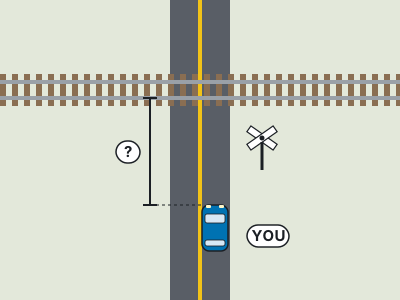
28. A train is approaching a New Hampshire crossing. How far from the nearest rail must a driver stop?
- At least 100 feet from the nearest rail
- At least 5 feet from the nearest rail
- Behind the stop line, or not less than 15 feet nor more than 50 feet from the nearest rail
- Anywhere behind the crossbuck
Show answer
Behind the stop line, or not less than 15 feet nor more than 50 feet from the nearest rail. When a train or railroad vehicle is approaching, a driver must stop behind the stop line or not less than 15 feet nor more than 50 feet from Full explanation in Test 8
29. What does a steady red arrow mean for New Hampshire drivers and for pedestrians facing it?
- Drivers may turn after stopping, and pedestrians may cross
- Only pedestrians may proceed
- Drivers may not enter unless other indications shown at the same time permit it, and pedestrians facing it shall not enter the roadway
- The arrow direction is closed to trucks only
Show answer
Drivers may not enter unless other indications shown at the same time permit it, and pedestrians facing it shall not enter the roadway. A red arrow means drivers may not enter the intersection unless permitted by other indications shown at the same time, such as a green light Full explanation in Test 9
30. If a hearing finds a New Hampshire driver to be a Habitual Offender, for how long are driving privileges revoked?
- Permanently
- 6 months to 1 year
- Exactly 5 years
- 1 to 4 years
Show answer
1 to 4 years. When a driver's record contains the number of valid convictions required by law, the driver must appear for a hearing. Full explanation in Test 10
31. What does this five-sided sign with two walking figures mean in New Hampshire?

- A hospital zone
- A pedestrian only street
- A playground with no vehicle access
- A school zone or school crossing
Show answer
A school zone or school crossing. The pentagon, or five sided sign, is reserved for school zones and school crossings. Full explanation in Test 1
32. Why does the New Hampshire manual say to avoid driving next to other vehicles for long periods?
- Your vehicle may be in their blind spot, and it reduces the space needed to avoid a collision
- It uses more fuel
- It is illegal on multi-lane roads
- It blocks their view of signs
Show answer
Your vehicle may be in their blind spot, and it reduces the space needed to avoid a collision. Space on the sides of the vehicle is what lets a driver move right or left to avoid trouble. Full explanation in Test 2
33. At a New Hampshire intersection with no white stop line but a marked crosswalk, where must a driver stop?
- In the crosswalk where cross traffic is visible
- Before entering the intersection, past the crosswalk
- Before the crosswalk
- Beside the stop sign post
Show answer
Before the crosswalk. White stop lines show drivers where to stop. Full explanation in Test 3
34. A New Hampshire traffic signal is flashing yellow. What should the driver be prepared for?
- Come to a complete stop and wait for green
- Stop, then go as at a stop sign
- Proceed at normal speed because cross traffic must stop
- Slow down, proceed with caution, and be prepared to stop for any traffic entering the intersection
Show answer
Slow down, proceed with caution, and be prepared to stop for any traffic entering the intersection. A flashing yellow traffic light means slow down and proceed with caution, and the manual adds that drivers should be prepared to stop for an Full explanation in Test 4
35. During which hours may a New Hampshire Youth Operator under 18 not drive?
- Between 1:00 a.m. and 4:00 a.m.
- Between 11:00 p.m. and 5:00 a.m.
- Between midnight and 6:00 a.m.
- Between 10:00 p.m. and 4:00 a.m.
Show answer
Between 1:00 a.m. and 4:00 a.m.. A Youth Operator license holder who is under 18 shall not operate a motor vehicle between the hours of 1:00 a.m. and 4:00 a.m. Full explanation in Test 5
36. In which situation does the New Hampshire manual say to increase the following distance?
- When following vehicles required to stop at railroad crossings, such as school buses
- When traffic is light
- When the road is dry and straight
- When following a motorcycle in daylight only
Show answer
When following vehicles required to stop at railroad crossings, such as school buses. Drivers should increase following distance on slippery roads, when following large vehicles like trucks, buses, recreational vehicles and ve Full explanation in Test 6
37. Which driver is exempt from obtaining a New Hampshire driver's license?
- A new resident who moved to the state 90 days ago
- A resident whose license expired last month
- A member of the US military stationed in New Hampshire who holds a valid home state license
- A driver whose privileges are suspended in another state
Show answer
A member of the US military stationed in New Hampshire who holds a valid home state license. The manual lists three groups exempt from getting a New Hampshire license: non-residents with a valid home state license, members of the US Full explanation in Test 7
38. What does a three-digit interstate route number with an even first digit indicate?
- A route into a city
- A scenic route
- A truck only route
- A route that goes through or around a city
Show answer
A route that goes through or around a city. Three numbered interstate routes carry their own code. Full explanation in Test 8
39. Why does the New Hampshire manual say to use low beams in fog, rain, or snow?
- Light from the high beams may cause glare and make it harder to see ahead
- Low beams are brighter in bad weather
- High beams drain the battery faster
- It is only a courtesy to other drivers
Show answer
Light from the high beams may cause glare and make it harder to see ahead. In fog, rain or snow, use the low beams. Light from the high beams reflects off the moisture, may cause glare, and makes it more difficult t Full explanation in Test 9
40. When exiting a parallel parking space in New Hampshire, when should the driver move forward into the traffic lane?
- As soon as the front bumper clears the vehicle ahead
- When the door post of the vehicle clears the rear bumper of the vehicle parked ahead
- Immediately after signaling
- After backing into the vehicle behind
Show answer
When the door post of the vehicle clears the rear bumper of the vehicle parked ahead. Leaving a parallel space starts with checking traffic in all directions with mirrors and head checks, backing as far as possible toward the Full explanation in Test 10
