Every question below comes from the Montana question bank on this page. Open a question to see the correct answer and the explanation. Nothing here is hidden behind a signup.
1. What safety chain does Montana require on a trailer of 3,000 pounds or less?
- No chain if the hitch is rated for the load
- A steel chain or cable at least a quarter inch in diameter fastened securely to the towing unit
- A rope of any size
- Chains only on trailers over 10,000 pounds
Show answer
A steel chain or cable at least a quarter inch in diameter fastened securely to the towing unit. Every trailer, semi trailer or pole trailer of 3,000 pounds gross vehicle weight or less must have on the front a steel chain or cable faste Full explanation in Test 1
2. What does this right-curving warning sign tell the driver?

- A right curve is ahead, and a suggested safe speed may be posted below
- The driver must turn right at the next intersection
- A work-zone detour requires a U-turn
- The road becomes one-way to the left
Show answer
A right curve is ahead, and a suggested safe speed may be posted below. This warning announces a right curve ahead. Full explanation in Test 2
3. What may lines and symbols on Montana roadways tell drivers?
- That every marked line may be crossed without checking traffic
- When they may pass or change lanes and which lanes to use for turns
- That shoulders are always travel lanes during congestion
- That all traffic must stop at every painted line
Show answer
When they may pass or change lanes and which lanes to use for turns. Roadway lines and symbols divide lanes, show when passing or changing lanes may be allowed, identify turn lanes, define pedestrian walkways, Full explanation in Test 3
4. What should a driver do when passing a stationary emergency or police vehicle on a highway posted at 50 MPH or more?
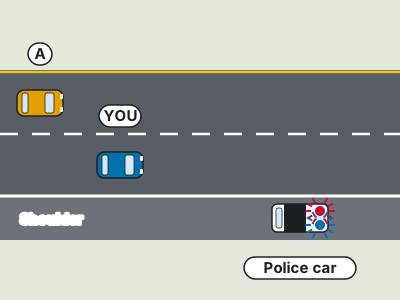
- Stop in the adjacent lane beside the emergency vehicle
- Keep the posted speed if the emergency lights are visible
- Slow to at least 20 miles below the posted speed limit
- Speed up to clear the lane before responders can move
Show answer
Slow to at least 20 miles below the posted speed limit. On a highway posted at 50 MPH or more, traffic in the lane directly beside a stationary emergency or police vehicle displaying emergency sig Full explanation in Test 4
5. What does the Montana manual count as one alcoholic drink?
- A 16 ounce beer
- Two shots
- 1.5 ounces of 80 proof liquor, 12 ounces of beer, or a 5 ounce glass of wine
- Any amount under 8 ounces
Show answer
1.5 ounces of 80 proof liquor, 12 ounces of beer, or a 5 ounce glass of wine. One alcoholic drink is 1.5 ounces of 80 proof liquor, a shot glass, straight or mixed; 12 ounces of commercial beer; or a 5 ounce glass of w Full explanation in Test 5
6. In a reversible lane, what does a green arrow displayed above the lane tell you?
- The lane is closed to all traffic
- The lane is reserved for buses
- The lane is changing and must be vacated
- The lane may be used in the direction shown
Show answer
The lane may be used in the direction shown. Reversible lanes change direction at different times, so drivers must read the overhead indication before entering. Full explanation in Test 6
7. How many months must a new Montana driver under 18 use a learner license before applying for a first-year restricted license?
- Three consecutive months
- Nine consecutive months
- Six consecutive months
- Twelve consecutive months
Show answer
Six consecutive months. A driver younger than 18 must hold the learner license for at least six consecutive months before applying for the first-year restricted lic Full explanation in Test 7
8. What may a Montana Class D license holder drive?
- Any vehicle including tractor trailers
- Motorcycles of any size
- Any non commercial vehicle under 26,000 pounds gross vehicle weight
- Only passenger cars
Show answer
Any non commercial vehicle under 26,000 pounds gross vehicle weight. A Class D basic driver license allows you to drive any non commercial vehicle under 26,000 pounds gross vehicle weight. Full explanation in Test 8
9. What does a typical yellow diamond warning sign tell a Montana driver?
- All traffic must stop at the sign
- A legal speed limit is ending immediately
- A fuel or lodging service is available
- A dangerous condition lies ahead and extra caution is needed
Show answer
A dangerous condition lies ahead and extra caution is needed. Yellow diamond signs are warning devices for dangerous conditions ahead, so the driver should approach with great caution. Full explanation in Test 9
10. When may a Montana driver use the left side of the centerline on a two-lane road?
- Whenever the road appears empty behind the vehicle
- Whenever the driver wants to avoid a rough shoulder
- Only while approaching a hill
- When overtaking and passing another vehicle safely
Show answer
When overtaking and passing another vehicle safely. On a two-lane road, Montana permits crossing left of the centerline for overtaking and passing another vehicle when the maneuver can be done Full explanation in Test 10
11. At what distance must high beams be dimmed when meeting another vehicle?
- 1,000 feet
- 500 feet
- 350 feet
- 100 feet
Show answer
1,000 feet. Montana requires high beams to be dimmed when meeting an oncoming vehicle at 1,000 feet. Full explanation in Test 1
12. A Montana court finds a driver responsible for crash damages, and the driver does not pay within 60 days. How long does the resulting suspension last?
- 30 days, then it ends automatically
- One year, whether or not the amount is paid
- Until the driver buys a new insurance policy
- Until the amount is paid or 6 years have passed
Show answer
Until the amount is paid or 6 years have passed. When a court finds a driver responsible for crash damages and the driver fails to pay within 60 days, the license and registration suspensio Full explanation in Test 2
13. What is one stated exception to the Montana first-year restricted license nighttime driving ban?
- Taking an optional late-night shopping trip
- A trip to any social event after midnight
- Driving for entertainment when a friend calls
- Travel to or from school, church, or work
Show answer
Travel to or from school, church, or work. Montana lists travel to and from school, church, or work among the limited exceptions to the 11:00 p.m. to 5:00 a.m. restriction. Full explanation in Test 3
14. How far must Montana headlights and taillights be visible on vehicles built after January 1, 1956?
- 1,000 feet
- 100 feet
- 500 feet, with white or amber light to the front and red or amber to the rear
- 50 feet
Show answer
500 feet, with white or amber light to the front and red or amber to the rear. Vehicles manufactured after January 1, 1956 must emit white or amber light to the front and red or amber light to the rear, visible for 500 Full explanation in Test 4
15. When is a driver required to use headlights because visibility is limited?
- When the vehicle is parked with its engine off
- Only when the driver is traveling above 55 mph
- Only after another driver flashes high beams
- When persons or vehicles cannot be seen for 500 feet
Show answer
When persons or vehicles cannot be seen for 500 feet. Montana requires headlights when insufficient light makes people or vehicles invisible at a distance of 500 feet. Full explanation in Test 5
16. What may a Montana driver carry instead of flares as emergency warning equipment?
- Nothing, flares are mandatory
- A single flashlight
- A white flag
- Three emergency reflective triangles meeting USDOT Safety Standard 125
Show answer
Three emergency reflective triangles meeting USDOT Safety Standard 125. As an alternative to the flares or lanterns otherwise required, three emergency reflective triangles conforming to USDOT Motor Vehicle Safet Full explanation in Test 6
17. What should you do when a vehicle is disabled and cannot be moved off the roadway?
- Remain just over a hill so traffic can pass behind you
- Stop where approaching drivers have a clear view and warn them
- Stand in the roadway to direct every approaching vehicle
- Turn off all lights so the battery will last longer
Show answer
Stop where approaching drivers have a clear view and warn them. If a disabled vehicle cannot be moved from the roadway, Montana advises stopping where other drivers have a clear view and warning road user Full explanation in Test 7
18. How far from a fire station driveway must a Montana driver park?
- 15 feet on either side of the street
- 50 feet on the same side and 100 feet across the street
- 30 feet on either side of the street
- 20 feet on the same side of the street, or 75 feet when parking on the other side
Show answer
20 feet on the same side of the street, or 75 feet when parking on the other side. Montana prohibits parking within 20 feet of a fire station driveway on the same side of the street, or within 75 feet of the driveway when p Full explanation in Test 8
19. What must everyone in a Montana teen’s vehicle do during GDL Step 1?
- Fasten only the driver’s seatbelt
- Wear a helmet
- Wear a seatbelt
- Use the seatbelt only on highways
Show answer
Wear a seatbelt. Montana requires every person in the vehicle to wear a seatbelt during this permit stage. Full explanation in Test 9
20. What hazard does this five-sided school sign identify?

- A park where stopping is prohibited at all times
- A hospital zone where emergency vehicles have priority
- A school ahead, requiring slower driving and careful attention to children
- A railroad crossing with a pedestrian-only track
Show answer
A school ahead, requiring slower driving and careful attention to children. The school warning sign means a school is ahead. Full explanation in Test 10
21. What do Montana regulatory signs communicate to drivers?
- A warning that a curve is approaching
- A scenic route and nearby recreation area
- A maximum speed or another required action
- An optional suggestion for courteous driving
Show answer
A maximum speed or another required action. Regulatory signs communicate obligations that govern how traffic must move. Full explanation in Test 1
22. Montana requires headlamps during which period each day?
- From sunset to sunrise only
- From a half hour after sunset to a half hour before sunrise
- From a half hour before sunset to a half hour after sunrise
- Only when streetlights are off
Show answer
From a half hour after sunset to a half hour before sunrise. Headlamps are required at all times from a half hour after sunset to a half hour before sunrise, and at any other time when weather or blowi Full explanation in Test 2
23. What roadway situation does the yellow crossroad warning sign identify?

- A four-way intersection with possible cross traffic
- A location where all turning movements are prohibited
- A school bus stop with children loading
- A divided highway that is ending
Show answer
A four-way intersection with possible cross traffic. The crossroad sign announces a four-way intersection and warns you to watch for traffic entering from the sides. Full explanation in Test 3
24. What is the minimum liability insurance amount for bodily injury or death of one person in a Montana crash?
- $10,000
- $25,000
- $50,000
- $100,000
Show answer
$25,000. Montana requires at least $25,000 for bodily injury or death of one person in any one accident. Full explanation in Test 4
25. How much clear road does the Montana manual say you need to pass safely?
- About 200 feet
- Over 1,600 feet, about one third of a mile
- About 400 feet
- About five miles
Show answer
Over 1,600 feet, about one third of a mile. Because you and the oncoming vehicle each cover about 800 feet in the time a pass takes, you need over 1,600 feet, about one third of a mile Full explanation in Test 5
26. If a pedestrian is already in a crosswalk when the DON'T WALK signal begins flashing, what should happen?
- The pedestrian must turn around and return to the curb
- The pedestrian should continue crossing the street
- The pedestrian should stop in the travel lane
- The pedestrian may begin a second crossing immediately
Show answer
The pedestrian should continue crossing the street. The flashing DON'T WALK display tells a person who has not started to wait, but it does not strand someone already in the crosswalk. Full explanation in Test 6
27. What does a double solid yellow centerline mean for passing?
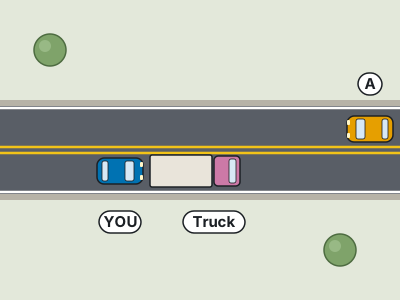
- Both directions may pass when visibility is good
- Only traffic traveling uphill may pass
- Neither direction may pass across the lines
- Passing is allowed if the horn is used
Show answer
Neither direction may pass across the lines. Two solid yellow lines separate opposing traffic where passing is restricted for both directions. Full explanation in Test 7
28. Under current Montana law, how must a child who is 2 years old but not yet 4 be restrained in a motor vehicle?
- With an adult lap belt only
- In a rear-facing or forward-facing child safety seat with an internal harness
- On an adult's lap in the back seat
- In any seat position without a restraint if under 60 pounds
Show answer
In a rear-facing or forward-facing child safety seat with an internal harness. Montana updated its child restraint law in 2021 and 2025, replacing the older rule based on age 6 and 60 pounds. Full explanation in Test 8
29. If a traffic signal is not working, what should drivers do?
- Stop as though stop signs controlled all directions
- Continue through because the intersection has no active signal
- Yield only to traffic approaching from the left
- Wait for a police officer before any vehicle may move
Show answer
Stop as though stop signs controlled all directions. Montana treats a nonworking signal as a stop-controlled intersection in every direction. Full explanation in Test 9
30. On a Montana road with three or more lanes traveling in the same direction, which lane should a driver normally use?
- The left lane, except when turning
- The right lane except when preparing for a left turn
- The center lane unless traffic is heavy
- The right lane, except to pass
Show answer
The right lane, except to pass. Montana directs drivers on roads with three or more lanes going the same way to stay in the right lane except when passing. Full explanation in Test 10
31. If heavy rain, snow, or fog limits visibility to about 200 feet, how fast may a driver safely travel?
- The posted limit, regardless of what can be seen
- No faster than 30 mph
- At least 50 mph to clear the weather quickly
- Any speed below 70 mph if headlights are on
Show answer
No faster than 30 mph. The manual says that when heavy rain, a snowstorm, or thick fog limits visibility to about 200 feet, a driver cannot safely travel faster th Full explanation in Test 1
32. At a Montana railroad crossing where no signal is active, when must a driver still stop for an approaching train?
- Only when a crossing gate is down
- When the train is within 500 feet
- When the train is within 1,500 feet of the crossing or is clearly visible and an obvious hazard
- Only when the train sounds its horn
Show answer
When the train is within 1,500 feet of the crossing or is clearly visible and an obvious hazard. A driver must stop no less than 15 feet from the nearest rail when signals, gates, stop signs, or a flagger show a train is coming, and also Full explanation in Test 2
33. How should you respond when this STOP AHEAD warning appears?

- Ignore it unless cross traffic is visible
- Stop immediately where the warning sign stands
- Accelerate to pass the upcoming stop sign before others arrive
- Begin slowing because a stop sign is ahead
Show answer
Begin slowing because a stop sign is ahead. STOP AHEAD is advance notice of a stop sign, so the driver should begin slowing and prepare for the required stop at the upcoming intersecti Full explanation in Test 3
34. At an uncontrolled intersection, what should a Montana driver do?
- Stop every time, even when the roadway is empty
- Maintain speed because no sign assigns right of way
- Cover the brake, look left, right, and left, and be ready to yield
- Yield only to vehicles approaching from the left
Show answer
Cover the brake, look left, right, and left, and be ready to yield. At an uncontrolled intersection, the driver should remove the foot from the accelerator, cover the brake, scan left, right, and left again, Full explanation in Test 4
35. What right of way does a Montana pedestrian using a guide dog or carrying a white cane have?
- Absolute right of way
- Right of way only at traffic lights
- Right of way only in marked crosswalks
- No special right of way
Show answer
Absolute right of way. A pedestrian using a guide dog or carrying a white cane has absolute right of way. Full explanation in Test 5
36. After clearing an intersection for an approaching emergency vehicle, what should a Montana driver do?
- Continue through the next several intersections
- Pull to the right and remain stopped until the vehicle passes
- Stop immediately where the vehicle is blocking traffic
- Follow the emergency vehicle to keep the route clear
Show answer
Pull to the right and remain stopped until the vehicle passes. After clearing an intersection, the driver should pull to the right and remain stopped until the emergency vehicle has passed. Full explanation in Test 6
37. Where should you stop for a STOP sign when a crosswalk is present?
- Before entering the crosswalk
- After the crosswalk, closest to the intersection
- In the center of the intersection
- Only at the far edge of the cross street
Show answer
Before entering the crosswalk. A STOP sign requires a complete stop before entering the intersection, and Montana adds that the stop should be before the crosswalk when on Full explanation in Test 7
38. What driving adjustment is called for by this slippery-when-wet warning?

- Brake hard as soon as rain begins to clear the pavement
- Reduce speed, avoid hard braking or sudden direction changes, and increase following distance
- Follow more closely so another vehicle breaks the spray
- Maintain speed and make quick steering corrections
Show answer
Reduce speed, avoid hard braking or sudden direction changes, and increase following distance. The slippery-when-wet warning calls for a slower speed, gentle braking and steering, and more space behind the vehicle ahead. Full explanation in Test 8
39. What should a driver do when approaching a roundabout with an emergency vehicle behind?
- Continue through and exit normally, then pull right where there is room
- Stop inside the roundabout immediately beside the center island
- Reverse out of the circle before the emergency vehicle reaches it
- Enter the center island to create an extra lane
Show answer
Continue through and exit normally, then pull right where there is room. A driver already in a roundabout should not pull over or stop inside the circle for an emergency vehicle. Full explanation in Test 9
40. How much total distance does it take to react and stop from 50 mph, according to the Montana manual?
- About 50 feet
- About 1,600 feet
- About 100 feet
- About 400 feet with good tires, brakes and dry pavement
Show answer
About 400 feet with good tires, brakes and dry pavement. With good tires and brakes on dry pavement, at 50 mph it can take about 400 feet to react to something you see and bring the vehicle to a st Full explanation in Test 10
