Every question below comes from the Wisconsin question bank on this page. Open a question to see the correct answer and the explanation. Nothing here is hidden behind a signup.
1. What must a driver do when a railroad crossing gate is lowering?
- Cross after the gate reaches halfway down
- Drive around it if no train is visible
- Wait and do not drive around the gate
- Stop under the gate until the bell ends
Show answer
Wait and do not drive around the gate. A lowering railroad gate means the crossing is closing for a train, so wait and never drive around or under the gate. Full explanation in Test 1
2. What action is associated with a Lane Ends warning?

- Pass on the shoulder before the lane disappears
- Stop in the ending lane and wait for traffic to clear
- Move to the other lane when it is safe
- Keep the ending lane by crossing the center barrier
Show answer
Move to the other lane when it is safe. A Lane Ends sign means the displayed right or left lane will end. Full explanation in Test 2
3. What minimum supervised driving practice must a Wisconsin permit holder complete before a probationary license?
- 40 hours, all during daylight
- 50 hours, including 10 hours in darkness
- 60 hours, including 20 hours in darkness
- 25 hours, including 5 hours in darkness
Show answer
50 hours, including 10 hours in darkness. The supervised program requires 50 total hours, divided into at least 40 hours during daylight and 10 hours during darkness. Full explanation in Test 3
4. What response does Wisconsin recommend for a Slippery When Wet warning?

- Slow down when you see the sign
- Increase speed to reduce time on the wet pavement
- Brake hard while entering the slick section
- Use the shoulder to avoid all opposing traffic
Show answer
Slow down when you see the sign. The Slippery When Wet warning means the road ahead might be slippery, and Wisconsin tells drivers to slow down when they see it. Full explanation in Test 4
5. What does a single dashed yellow line between opposing traffic lanes mean?
- Traffic travels in the same direction
- No vehicle may cross the line
- You may pass when it is safe
- The road is approaching a railroad crossing
Show answer
You may pass when it is safe. A single dashed yellow line separates traffic moving in opposite directions and permits passing when conditions make that maneuver safe. Full explanation in Test 5
6. A Wisconsin teen does not live with a parent or legal guardian. Which of these people may sign as the teen's sponsor?
- A 17 year old sibling
- A grandparent
- A family friend who is 25
- The driving school instructor
Show answer
A grandparent. When a teen applicant is not living with a parent or legal guardian, Wisconsin lets a grandparent, an aunt or uncle, a sibling 18 or older, Full explanation in Test 6
7. What must Wisconsin drivers always do to avoid hitting pedestrians, bicyclists, or other vehicles?
- Yield when needed
- Assume pedestrians will stop
- Proceed first after sounding the horn
- Yield only when a police officer is present
Show answer
Yield when needed. Wisconsin's right-of-way section puts safety ahead of claiming priority: drivers must yield when needed to avoid hitting pedestrians, bicycl Full explanation in Test 7
8. What does “right-of-way” tell drivers?
- Which vehicle has the largest engine
- Who goes first and who must wait
- When every driver may ignore pedestrians
- How fast a vehicle must travel
Show answer
Who goes first and who must wait. Right-of-way identifies which road user proceeds first and which one must wait. It does not measure engine size or set a vehicle speed. Full explanation in Test 8
9. What does a dashed yellow center line allow when it is safe?
- Parking in the center of the roadway
- Passing other vehicles
- Turning only at a traffic signal
- Driving against traffic without checking
Show answer
Passing other vehicles. A dashed yellow line separates opposing traffic but indicates that passing may be allowed when it is safe to do so. Full explanation in Test 9
10. Who is a habitual traffic offender in Wisconsin?
- Someone with two speeding tickets in one year
- Someone convicted of four or more major or 12 or more minor violations within five years
- Someone who reaches 6 points in 12 months
- Someone with one OWI conviction
Show answer
Someone convicted of four or more major or 12 or more minor violations within five years. A habitual traffic offender is someone convicted of four or more major traffic violations, or 12 or more minor violations, within five years Full explanation in Test 10
11. What must a driver do when a police car is stopped on the roadside with lights and sirens on?
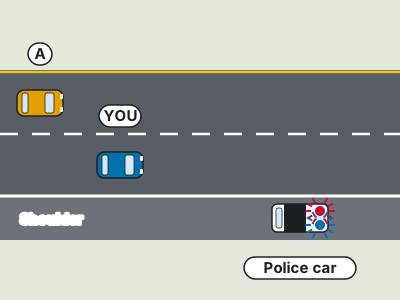
- Move over or slow down to give it room
- Stop directly behind the police car
- Pass without changing speed if the lane is open
- Turn around before reaching the stopped vehicle
Show answer
Move over or slow down to give it room. Wisconsin’s roadside rule protects officers and other emergency personnel working near traffic. Full explanation in Test 1
12. When parallel parking in Wisconsin, how long should the parking space be compared with your vehicle?
- Exactly the same length
- About 10 to 15 feet longer
- At least twice as long
- About 3 to 6 feet longer
Show answer
About 3 to 6 feet longer. The handbook's parallel parking steps start with finding a space about 3 to 6 feet longer than your vehicle. Full explanation in Test 2
13. What should you do at a flashing yellow traffic signal?
- Speed through before the signal changes
- Stop and wait for a green arrow
- Slow down, check for cross traffic, and proceed with caution
- Ignore the signal because it is not operating
Show answer
Slow down, check for cross traffic, and proceed with caution. Flashing yellow means slow down, check for cross traffic, and proceed with caution. Full explanation in Test 3
14. Where is a large vehicle's no-zone located according to the Wisconsin handbook?
- Only in the lane directly to the truck's left
- Only immediately beside the driver's door
- Exactly 50 feet behind every vehicle
- About 200 feet behind and 20 feet in front of the truck
Show answer
About 200 feet behind and 20 feet in front of the truck. The handbook places the large-vehicle no-zone about 200 feet behind and 20 feet in front of a truck. Full explanation in Test 4
15. What does an eight-sided red stop sign require?
- A complete stop, followed by waiting until the path is clear
- A rolling slowdown when no traffic is visible
- A yield only to vehicles approaching from the left
- A stop only when a pedestrian is present
Show answer
A complete stop, followed by waiting until the path is clear. The octagonal red sign is a stop sign. The driver must come to a complete stop and wait until the path is clear before continuing. Full explanation in Test 5
16. What must a Wisconsin driver do when emergency lights and sirens are approaching?
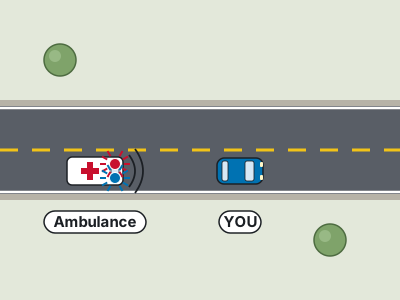
- Continue normally if the driver is in the right lane
- Stop in the middle of the intersection
- Pull to the side and stop until the vehicle passes
- Follow the emergency vehicle through traffic
Show answer
Pull to the side and stop until the vehicle passes. When emergency lights and sirens are active, the handbook tells drivers to pull to the side of the road and stop until the emergency vehicle Full explanation in Test 6
17. Which action is prohibited when crossing railroad tracks?
- Waiting for a clear path on the other side
- Looking both ways before crossing
- Stopping on the tracks
- Checking for a train even when warning signs are dark
Show answer
Stopping on the tracks. Never stop on railroad tracks. A stopped vehicle can be trapped in the path of a train, and the handbook also warns drivers not to enter unl Full explanation in Test 7
18. What score is required to pass Wisconsin's separate Highway Signs test?
- 10 correct out of 15
- 12 correct out of 15
- 13 correct out of 20
- 8 correct out of 10
Show answer
12 correct out of 15. The separate Highway Signs test contains 15 questions, and an applicant must answer 12 correctly. That is an 80 percent passing score. Full explanation in Test 8
19. When may you turn right at a steady red light in Wisconsin?
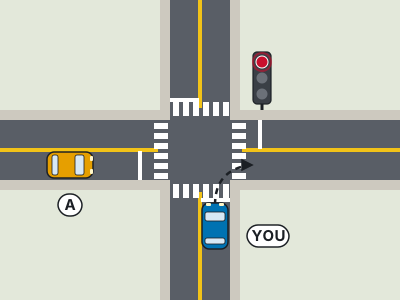
- Immediately, without stopping if the road is empty
- After stopping first, yielding to all traffic, and confirming it is safe with no prohibiting sign
- Only after the light turns green
- Whenever a vehicle behind you honks
Show answer
After stopping first, yielding to all traffic, and confirming it is safe with no prohibiting sign. A right turn on steady red requires a full stop first. Full explanation in Test 9
20. When approaching a stopped emergency vehicle with flashing lights, which lane should you use?
- The lane not nearest the stopped vehicle
- The lane nearest the stopped vehicle
- The shoulder between the vehicle and curb
- Any lane without slowing
Show answer
The lane not nearest the stopped vehicle. When an emergency vehicle is stopped with its lights flashing, move into the lane farthest from that vehicle when it is safe. Full explanation in Test 10
21. What does a steady yellow traffic light tell a driver approaching an intersection?
- Speed up because the light guarantees extra crossing time
- The light is about to turn red, so slow and stop before entering
- Stop wherever the vehicle is if the light changes
- Proceed without checking because yellow gives priority
Show answer
The light is about to turn red, so slow and stop before entering. A steady yellow warns that the signal is about to change to red. Slow down and stop before entering the intersection. Full explanation in Test 1
22. Which Wisconsin drivers have their demerit points doubled on the second conviction and after?
- Only drivers over 65
- Only commercial drivers
- Every licensed driver in the state
- Holders of a probationary license, an ID card, or no license
Show answer
Holders of a probationary license, an ID card, or no license. The point system starts every record at zero. Full explanation in Test 2
23. When is Wisconsin guidance to use low beam headlights especially relevant?
- Only when parked and idling
- When using windshield wipers
- Only when driving on a divided highway
- When no vehicle has a license plate
Show answer
When using windshield wipers. The handbook recommends using low beam headlights when you are using your windshield wipers, as well as when it is rainy, snowy, or foggy. Full explanation in Test 3
24. What does Wisconsin say about exceeding the speed limit to pass another vehicle?
- It is allowed only on two-lane rural highways
- It is allowed for less than one mile
- It is not allowed
- It is required when traffic is backed up
Show answer
It is not allowed. Passing does not give a Wisconsin driver permission to exceed the posted limit. Full explanation in Test 4
25. What vision standard does the Wisconsin handbook list for regular car applicants?
- 20/20 in both eyes with no glasses
- 20/40 in each eye, tested without glasses or contacts
- 20/200 in the better eye, with glasses allowed
- At least 20/40 in one eye and a 70-degree field of vision from the center of each eye
Show answer
At least 20/40 in one eye and a 70-degree field of vision from the center of each eye. Regular car and motorcycle applicants in Wisconsin need visual acuity of at least 20/40 in one eye, corrected or uncorrected, and a 70-degre Full explanation in Test 5
26. What should a driver do when another vehicle is still in the intersection before the driver enters?
- Use the shoulder to get around it
- Enter immediately because the turn is permitted
- Proceed if the other vehicle is smaller
- Yield until the other vehicle clears
Show answer
Yield until the other vehicle clears. A vehicle that remains in the intersection has priority over a driver who has not entered it. Full explanation in Test 6
27. When may you cross two solid yellow lines?
- Never, including for a driveway turn
- Whenever you want to pass a vehicle
- Only to change lanes at an intersection
- To turn into a driveway when it is safe
Show answer
To turn into a driveway when it is safe. Two solid yellow lines prohibit passing, but Wisconsin lists an exception for crossing into a driveway when it is safe. Full explanation in Test 7
28. Which description identifies Wisconsin's Stop sign?
- An eight sided red sign with white letters
- A round blue sign with white arrows
- A yellow diamond with black lettering
- A downward pointing red and white triangle
Show answer
An eight sided red sign with white letters. The handbook describes the Stop sign as red, marked with white letters, and shaped with eight sides. Full explanation in Test 8
29. At a four-way stop, who has priority when vehicles arrive at different times?
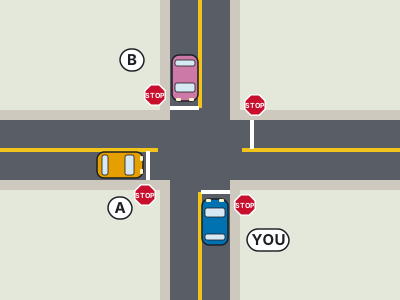
- The vehicle with the brightest headlights
- The driver making a left turn
- The largest vehicle at the intersection
- The driver or bicyclist that arrived first
Show answer
The driver or bicyclist that arrived first. At a four-way stop, arrival order controls when the arrivals are separated. Full explanation in Test 9
30. How should ABS brakes be used during an emergency stop in Wisconsin's handbook?
- Pump the pedal rapidly until the wheels lock
- Apply firm, continuous pressure to the brake pedal
- Shift to neutral before touching the brake
- Turn off the ignition while braking
Show answer
Apply firm, continuous pressure to the brake pedal. With ABS, Wisconsin instructs the driver to press the brake pedal firmly and continuously during an emergency stop. Full explanation in Test 10
31. What must a driver do if a police officer requests a prohibited alcohol concentration test?
- Agree to take the test
- Refuse unless a lawyer is present
- Take it only after reaching a police station voluntarily
- Substitute a passenger's breath sample
Show answer
Agree to take the test. Wisconsin's implied-consent section says a driver must agree to a requested prohibited alcohol concentration test. Full explanation in Test 1
32. What should you do when emergency lights and sirens announce an approaching emergency vehicle?
- Keep driving until the emergency vehicle sounds its horn
- Stop in the center of the intersection
- Pull to the side of the road and stop
- Follow closely behind the emergency vehicle
Show answer
Pull to the side of the road and stop. Wisconsin directs drivers to make room when emergency lights and sirens are active. Full explanation in Test 2
33. A pedestrian with a white cane is approaching a roadway. How far away should you stop?
- At least 10 feet away until the person is off the roadway
- No closer than 3 feet, then proceed slowly
- At least 25 feet away until another driver passes
- Only at the nearest stop line
Show answer
At least 10 feet away until the person is off the roadway. Wisconsin gives special protection to a pedestrian carrying a white cane or using a guide dog, even when that person has not yet entered the Full explanation in Test 3
34. At an uncontrolled Wisconsin intersection, which vehicles should you yield to when there are no signals or traffic lights?
- Vehicles coming from the right
- Vehicles parked along the curb
- Only vehicles sounding a horn
- Only vehicles turning into driveways
Show answer
Vehicles coming from the right. Wisconsin includes vehicles coming from the right among the road users to yield to at uncontrolled intersections. Full explanation in Test 4
35. During the daytime GDL period, how many immediate family members may ride with a Wisconsin probationary driver?
- Exactly two immediate family members
- Only one immediate family member
- No immediate family members
- Any number of immediate family members
Show answer
Any number of immediate family members. From 5 a.m. to midnight, a Wisconsin probationary driver may carry any number of immediate family members. Full explanation in Test 5
36. Why might Wisconsin’s safe driving speed be lower than the posted maximum?
- Visibility and road conditions may require a slower speed
- A driver may exceed the maximum when visibility is poor
- The posted number applies only when traffic is heavy
- A driver should always travel exactly at the posted number
Show answer
Visibility and road conditions may require a slower speed. Wisconsin describes a speed limit as the maximum, not a target that must be reached in every condition. Full explanation in Test 6
37. Who must wear a seat belt under Wisconsin law?
- Only the driver
- Only passengers under 18
- Only front seat occupants when there are no air bags
- You and your passengers, at any age
Show answer
You and your passengers, at any age. Wisconsin law requires you and your passengers to wear seat belts at any age. Full explanation in Test 7
38. When may a driver cross a dashed yellow centerline to pass?
- When the vehicle ahead is farm equipment
- Whenever the driver wants to save time
- Only after sounding the horn twice
- When passing is safe and the way is clear
Show answer
When passing is safe and the way is clear. A dashed yellow line indicates that passing may be permitted, but the maneuver still depends on safety. Full explanation in Test 8
39. At a Wisconsin intersection, what action follows a flashing red signal?
- Wait for the signal to change to green
- Slow to walking speed without stopping
- Continue if no cross traffic is visible
- Make a full stop, then proceed when safe
Show answer
Make a full stop, then proceed when safe. A flashing red indication requires the same first action as a stop sign: bring the vehicle to a complete stop. Full explanation in Test 9
40. What does a solid white line between lanes generally mean?
- You cannot cross it except for a hazard or an imminent turn within the next block
- You may cross it at any time to pass
- It separates traffic traveling in opposite directions
- It marks a lane that must be used for parking
Show answer
You cannot cross it except for a hazard or an imminent turn within the next block. A solid white line between lanes means you should not cross it in ordinary lane changes. Full explanation in Test 10
41. Before crossing railroad tracks, what should a Wisconsin driver do even if warning signs are not flashing?
- Stop on the tracks to check for traffic
- Shift gears while crossing to gain speed
- Look both ways and listen for a train
- Cross quickly without checking if the gate is raised
Show answer
Look both ways and listen for a train. The handbook calls for checking both directions before crossing railroad tracks, even when the warning devices are not flashing. Full explanation in Test 1
42. How should a driver respond to a flashing red signal?
- A left turn only
- A slow roll without stopping
- Immediate acceleration through the intersection
- A full stop, followed by proceeding when safe
Show answer
A full stop, followed by proceeding when safe. A flashing red signal is treated as a stop requirement. Come to a full stop, then continue only when the movement is safe. Full explanation in Test 2
43. Where does the Wisconsin handbook say parking is not allowed?
- Only on the left side of a one-way street
- On yellow curb markings or in front of fire hydrants
- Anywhere within one block of a business
- On every road with a paved shoulder
Show answer
On yellow curb markings or in front of fire hydrants. The handbook identifies yellow curb markings and areas in front of fire hydrants as places where parking is not allowed. Full explanation in Test 3
44. What does a posted speed limit represent in Wisconsin?
- The minimum speed required on every road
- A suggested speed that may always be exceeded while passing
- The fastest speed allowed in that area
- A speed applying only when no other vehicles are present
Show answer
The fastest speed allowed in that area. A posted speed limit is the fastest speed permitted for the area under ordinary good conditions. Full explanation in Test 4
45. When must you yield to an emergency vehicle entering a roundabout?
- When it enters with its siren on
- Only when it has no warning lights
- Only after it stops in the roundabout
- Never, because circulating traffic has priority
Show answer
When it enters with its siren on. A driver must yield when an emergency vehicle enters a roundabout with its siren on. Full explanation in Test 5
46. A driver moves to Wisconsin with a regular license from another state. Within how many days should the driver apply for a Wisconsin license?
- 30 days
- 10 days
- 60 days
- 90 days
Show answer
60 days. An out of state transfer holding a regular driver license should apply for a Wisconsin license within 60 days after moving. Full explanation in Test 6
47. What do blue service signs identify?
- A no-passing zone ahead
- The maximum speed for the roadway
- Nearby services such as camping or a hospital
- The route number of an interstate
Show answer
Nearby services such as camping or a hospital. Blue service signs direct drivers to nearby facilities, including camping areas and hospitals. Full explanation in Test 7
48. When must a Wisconsin crash be reported to police?
- Only when both vehicles need towing
- When someone is injured or killed, among other listed conditions
- Only when the crash occurs after dark
- Only when an insurance company requests a report
Show answer
When someone is injured or killed, among other listed conditions. Wisconsin lists several police-report triggers, including an injury or death. Full explanation in Test 8
49. How much room should you give a snowplow in Wisconsin when its lights are flashing?
- At least 200 feet
- At least 20 feet
- At least 50 feet
- At least 1,000 feet
Show answer
At least 200 feet. Wisconsin's winter driving tips tell drivers to give snowplows at least 200 feet of room when their lights are flashing red, amber or green. Full explanation in Test 9
50. How often should a Wisconsin driver check the rearview mirror to notice tailgating?
- Only once before starting the trip
- Every 6 to 8 seconds
- Every 30 to 45 seconds
- Only after braking hard
Show answer
Every 6 to 8 seconds. Wisconsin recommends checking the rearview mirror every 6 to 8 seconds to notice whether someone is following too closely. Full explanation in Test 10
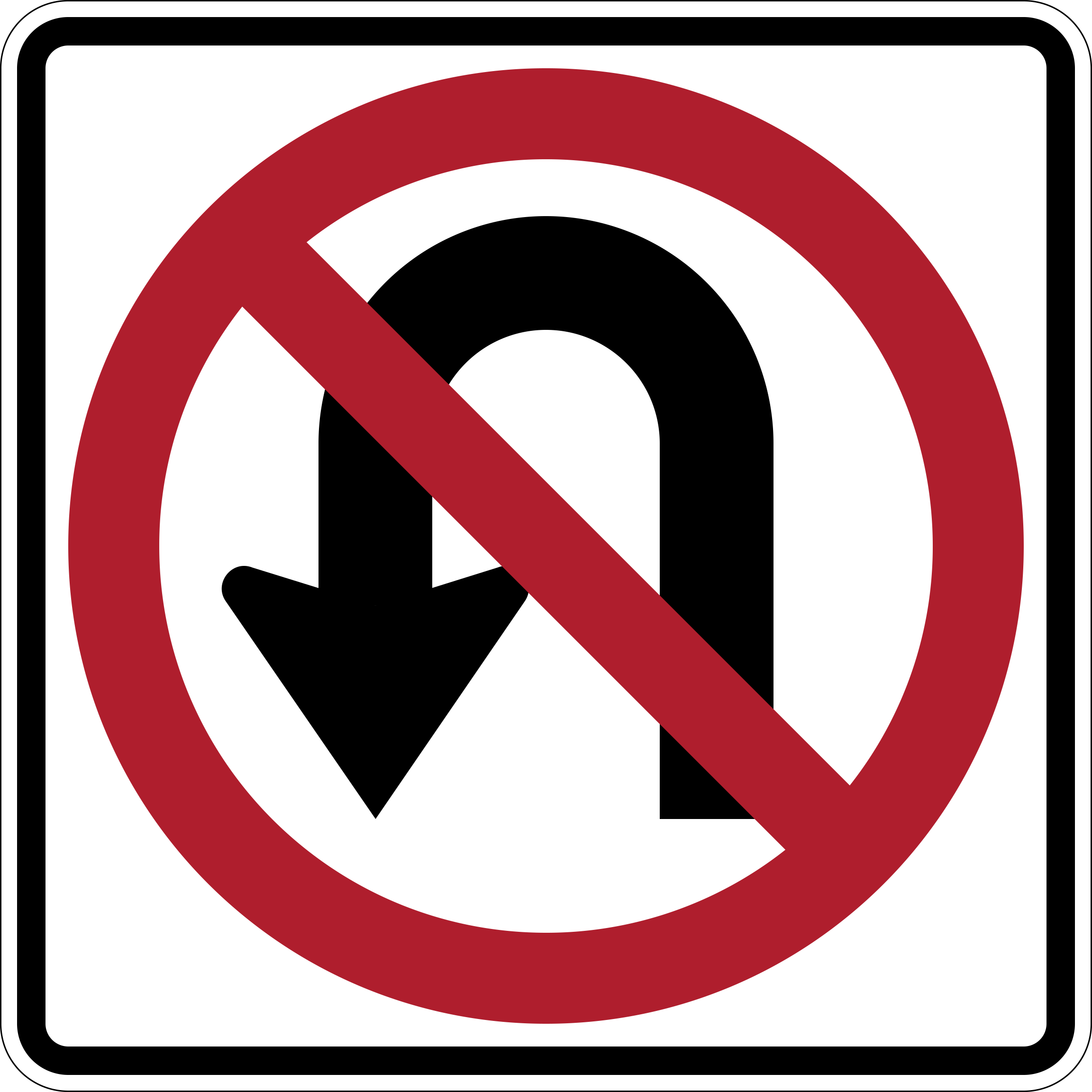
51. What movement is prohibited by this regulatory sign?
- Changing speed before a curve
- Turning into a driveway
- Moving from a one-way road to a two-way road
- Making a U-turn
Show answer
Making a U-turn. The pictured regulatory sign is the Wisconsin No U-turn sign, so it prohibits making a U-turn at that location. Full explanation in Test 1
52. What does a green arrow over a reversible lane tell you?
- The lane is closing and you must merge
- The lane is open for use
- The lane is closed to all traffic
- Traffic must travel against the normal direction
Show answer
The lane is open for use. A green arrow over a flex or reversible lane means the lane is open and can be used. Full explanation in Test 2
53. What is the purpose of an acceleration lane on a high speed roadway?
- To reverse direction before the exit
- To stop before entering the highway
- To pass every vehicle in the right lane
- To speed up as you merge with traffic flow
Show answer
To speed up as you merge with traffic flow. An acceleration lane gives an entering driver room to build speed and merge with the traffic already moving on the highway. Full explanation in Test 3
54. What guidance does the Wisconsin handbook give regular license holders about cell phone use while driving?
- Use a phone only for navigation, with no other restriction
- Use a handheld phone freely when traffic is moving slowly
- Avoid using a cell phone and try the vehicle’s hands-free option if use is necessary
- Turn the phone off by law in every situation
Show answer
Avoid using a cell phone and try the vehicle’s hands-free option if use is necessary. For regular license holders, the handbook says to avoid using a cell phone while driving and, if use is necessary, try the vehicle’s hands-f Full explanation in Test 4
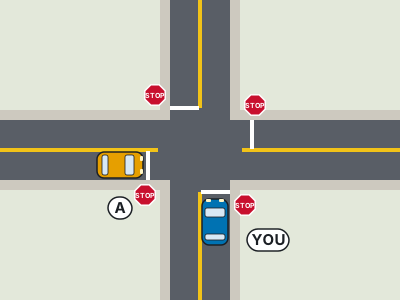
55. At a four-way stop, two drivers arrive simultaneously. Which driver proceeds first?
- The driver with the larger vehicle
- The driver on the left
- The driver going straight
- The driver on the right
Show answer
The driver on the right. When drivers reach a four-way stop at the same time, Wisconsin gives priority to the driver on the right. Full explanation in Test 5
56. What does a yellow pennant-shaped no-passing sign mean?
- A school crossing begins ahead
- Passing is prohibited in that zone
- The roadway is open only to buses
- A railroad crossing is immediately ahead
Show answer
Passing is prohibited in that zone. The yellow pennant identifies a no-passing zone, so you may not pass another vehicle there. Full explanation in Test 6
57. When may Wisconsin driving privileges be suspended or revoked for demerit points?
- After 20 points within a single week
- After 4 points in any five-year period
- Only after points are earned on two licenses
- After 12 or more points within any 12-month period
Show answer
After 12 or more points within any 12-month period. The point-system threshold is 12 or more demerit points within any 12-month period. Full explanation in Test 7
58. On a divided roadway, how should you pass a stopped emergency vehicle with flashing lights?
- Drive on the shoulder beside it
- Stop in the lane nearest the vehicle
- Move into the lane farthest from the stopped vehicle
- Turn around before reaching it
Show answer
Move into the lane farthest from the stopped vehicle. Approaching an emergency vehicle on a divided roadway requires moving into the lane not nearest the stopped vehicle, then staying in that fa Full explanation in Test 8
59. How much room must you give a bicyclist when passing in Wisconsin?
- At least one foot
- At least three feet
- At least ten feet
- Half a lane width
Show answer
At least three feet. Wisconsin tells drivers to give bicyclists at least three feet of room when passing, and to wait for oncoming traffic to clear before passin Full explanation in Test 9
60. How should a driver treat a traffic signal that has lost power?
- Use the shoulder to bypass the intersection
- Treat it as a green light if no cars are nearby
- Proceed as if the signal were a stop sign
- Wait until another driver enters first
Show answer
Proceed as if the signal were a stop sign. A dark or malfunctioning signal does not remove intersection control. Full explanation in Test 10
61. What feature helps identify this Stop Ahead warning sign?

- A blue rectangle with a railroad telephone number
- An arrow with the shape of a stop sign below it
- A circular yellow X with track lettering
- Three lane arrows showing roundabout exits
Show answer
An arrow with the shape of a stop sign below it. The Stop Ahead warning includes an arrow and the shape of the stop sign below the arrow. Full explanation in Test 1
62. What is the best option in severe weather?
- Slow down and stay alert
- Speed up and make sharp turns
- Brake rapidly in every situation
- Drive without checking conditions
Show answer
Slow down and stay alert. The handbook identifies slowing down and staying alert as the best option in severe weather. Full explanation in Test 2
63. What does a slow moving vehicle sign identify in Wisconsin?
- A vehicle carrying hazardous cargo only
- A vehicle that must travel at least 55 mph
- A road closed to farm equipment
- A vehicle that could travel at 25 mph or less
Show answer
A vehicle that could travel at 25 mph or less. Wisconsin describes the slow moving vehicle sign as a triangle with reflective orange markings and says the vehicle could travel at 25 mph o Full explanation in Test 3
64. What should a Wisconsin driver remember when turning on a steady green arrow?
- Oncoming traffic always has a green light too
- Watch for pedestrians
- Stop until the arrow changes to yellow
- Cross traffic may ignore the signal
Show answer
Watch for pedestrians. A steady green arrow lets a Wisconsin driver turn in the arrow's direction, but the handbook adds a pedestrian warning. Full explanation in Test 4
65. What should you do when this pedestrian crossing warning appears?

- Use the shoulder instead of the marked crossing
- Accelerate so pedestrians clear the lane sooner
- Stop only if a school bus is present
- Yield to crossing pedestrians
Show answer
Yield to crossing pedestrians. The pedestrian crossing warning marks a location where people may cross, and Wisconsin specifically directs drivers to yield to crossing ped Full explanation in Test 5
