Every question below comes from the Kentucky question bank on this page. Open a question to see the correct answer and the explanation. Nothing here is hidden behind a signup.
1. What visual field does Kentucky's bioptic program require?
- 180 degrees horizontally
- No field requirement
- 90 degrees in each eye
- 120 degrees horizontally and 80 degrees vertically in the better eye
Show answer
120 degrees horizontally and 80 degrees vertically in the better eye. The bioptic program requires a visual field of 120 degrees horizontally and 80 degrees vertically in the better eye, along with 20/200 acuit Full explanation in Test 1
2. Who must accompany a Kentucky permit holder while the permit holder is driving?
- Any passenger at least 18 years old in the back seat
- A licensed driver at least 21 years old in the front passenger seat
- A parent only, regardless of age or seat
- A licensed driver at least 16 years old in another vehicle
Show answer
A licensed driver at least 21 years old in the front passenger seat. A permit holder must be accompanied by a person with a valid operator’s license who is at least 21 years old and occupies the front passenge Full explanation in Test 2
3. What type of roadway location can the pictured fluorescent yellow school sign identify?

- A one-way street entrance
- A railroad crossing with several tracks
- A school zone or school crossing
- A general guide route to a city
Show answer
A school zone or school crossing. Fluorescent yellow warning signs can identify school zones and school crossings. Full explanation in Test 3
4. When Kentucky work zone signs state that fines are double, what additional condition must exist for that rule?
- The work must occur only at night
- The road must be closed completely
- At least one bona fide worker must be present
- A police car must be parked at the entrance
Show answer
At least one bona fide worker must be present. Kentucky allows doubled fines in a highway work zone when signs announce that fines are double and at least one bona fide worker is present. Full explanation in Test 4
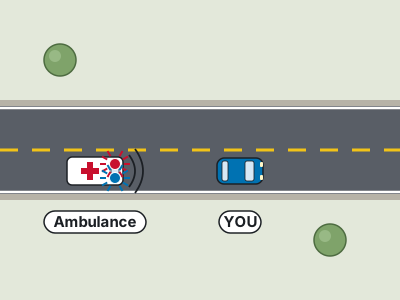
5. What should a driver do when an emergency vehicle approaches with flashing lights and a siren?
- Stop in the center of the intersection to let it choose a path
- Pull to the edge of the road, clear of an intersection, and stop
- Continue at the same speed if the emergency vehicle can pass
- Follow closely behind the emergency vehicle through traffic
Show answer
Pull to the edge of the road, clear of an intersection, and stop. When the emergency vehicle’s lights and siren are active, drivers must yield by moving to the edge of the road or curb, staying clear of an Full explanation in Test 5
6. What warning does the pictured WRONG WAY sign give?
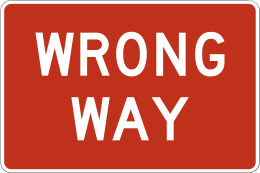
- The driver is traveling in the wrong direction
- The driver is approaching a rough pavement section
- The driver may use the lane only to pass
- The driver must stop because a school zone begins
Show answer
The driver is traveling in the wrong direction. WRONG WAY tells a driver that travel is going in the wrong direction. Full explanation in Test 6
7. At what breath alcohol level does a Kentucky ignition interlock device stop the vehicle from being operated?
- Above .02
- Above .08
- Above .15
- Above .04
Show answer
Above .02. The ignition interlock device prevents a driver from operating the vehicle if the driver's breath-alcohol concentration exceeds .02. Full explanation in Test 7
8. When may a Kentucky permit holder under 18 drive between midnight and 6:00 a.m.?
- Any time with a friend who is 18
- Never, with no exceptions
- Only on weekends
- Only if the person can demonstrate good cause for driving
Show answer
Only if the person can demonstrate good cause for driving. Permit holders under the age of 18 may not drive between midnight and 6:00 a.m. unless they can demonstrate good cause for driving. Full explanation in Test 8
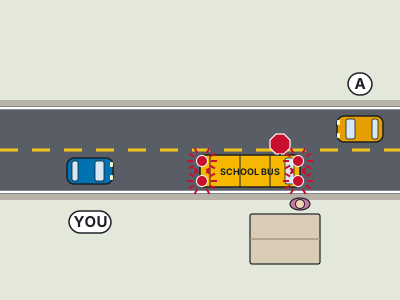
9. On a two-lane road, when may an approaching vehicle proceed after a school bus finishes loading or unloading?
- After waiting five seconds even if the bus remains stopped
- As soon as the driver sees no child nearby
- After the bus is in motion
- Before the bus finishes receiving or discharging passengers
Show answer
After the bus is in motion. On a two-lane road, a vehicle approaching a stopped school or church bus must remain stopped until the bus has completed receiving or discha Full explanation in Test 9
10. What must a driver expect from a vehicle carrying hazardous materials when it reaches a railroad crossing?
- It may bypass the crossing on the shoulder
- It may continue if no train is visible
- It stops only at crossings with gates
- It must stop at every railroad crossing
Show answer
It must stop at every railroad crossing. The manual tells drivers that vehicles carrying hazardous materials must stop at all railroad crossings. Full explanation in Test 10
11. On a main road and a minor road, which driver must yield?
- The driver who reaches the center line first
- The driver on the main road
- The driver traveling below the speed limit
- The driver on the minor road
Show answer
The driver on the minor road. Kentucky assigns the yield duty to the driver on the minor road when traffic meets a main road. Full explanation in Test 1
12. What is the safest response when an ambulance approaches using its lights and siren?
- Treat the ambulance like an ordinary passenger car
- Maintain speed until the ambulance passes without changing position
- Stop only if you are traveling behind the ambulance
- Yield the right of way and clear its path when safe
Show answer
Yield the right of way and clear its path when safe. Lights and a siren identify an urgent road user whose movement takes priority. Full explanation in Test 2
13. What is the usual appearance of a Kentucky warning sign?
- White with green letters and rectangular
- Yellow with black lettering or symbols and diamond shaped
- Blue with white symbols and circular
- Orange with red letters and octagonal
Show answer
Yellow with black lettering or symbols and diamond shaped. Most warning signs use a yellow background with black lettering or symbols and a diamond shape. Full explanation in Test 3
14. What does the online version of Kentucky's graduated licensing course cost?
- $12.50, while the classroom version is free
- $50
- Both versions are free
- $100
Show answer
$12.50, while the classroom version is free. Kentucky's July 2026 driver manual lists the acceptable ways to complete graduated licensing training: the classroom version is free for Ken Full explanation in Test 4
15. Which warning signs may be fluorescent yellow?
- Work zones, detours, and construction equipment only
- Railroad crossings, hospitals, and fuel stations
- Interstate routes, city limits, and county roads
- School zones, school crossings, and pedestrian crossings
Show answer
School zones, school crossings, and pedestrian crossings. The manual names school zones, school crossings, and pedestrian crossings as examples of warning signs that may be fluorescent yellow. Full explanation in Test 5
16. For a person under 18 convicted of an alcohol offense, what does the manual say about the license suspension?
- It is replaced by a warning with no suspension
- It is automatically canceled permanently
- It is limited to exactly 30 days
- It may be longer than the listed suspension
Show answer
It may be longer than the listed suspension. Kentucky gives the under-18 driver a possible longer license suspension after an alcohol conviction. Full explanation in Test 6
17. Where must a driver stop when a stop line appears before a crosswalk?
- At the stop line before reaching the crosswalk
- On the crosswalk so the front bumper is visible
- Past the crosswalk near the intersection center
- At the nearest driveway beyond the intersection
Show answer
At the stop line before reaching the crosswalk. When a sign or signal requires a stop and a stop line comes before the crosswalk, the stop line must be obeyed first. Full explanation in Test 7
18. Your vehicle breaks down on a roadway. Which action helps warn approaching drivers?
- Leave the vehicle in the lane with no lights so traffic can pass quietly
- Turn on emergency flashers and place warning flares behind the vehicle when available
- Stand in the travel lane and wave vehicles around the disabled car
- Turn off all lights to preserve the battery while waiting
Show answer
Turn on emergency flashers and place warning flares behind the vehicle when available. A disabled vehicle should be made visible and moved fully off the road when possible. Full explanation in Test 8
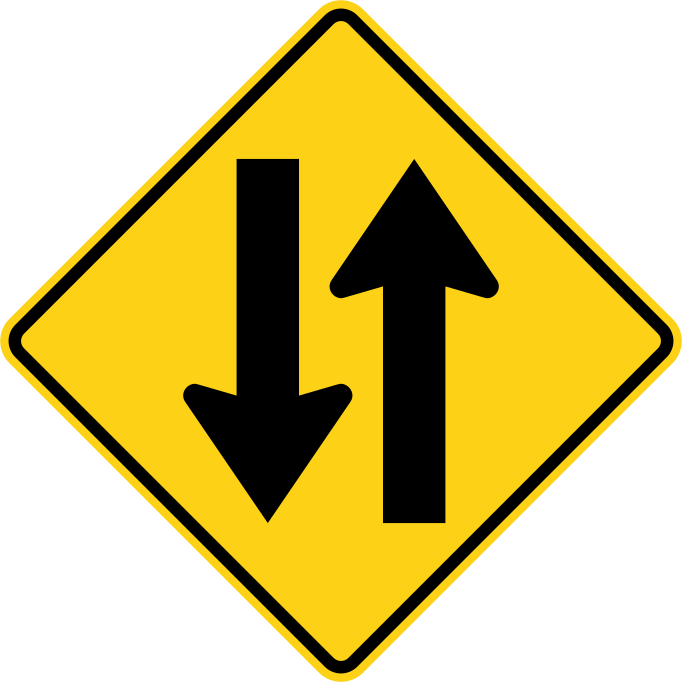
19. What response do warning signs encourage when a hazard may be ahead?
- Ignore the sign until another driver stops
- Accelerate so the hazard is passed immediately
- Slow down and be prepared to stop if necessary
- Change lanes without checking nearby traffic
Show answer
Slow down and be prepared to stop if necessary. The manual tells drivers that warning signs should prompt slower driving and readiness to stop when necessary. Full explanation in Test 9
20. What visual acuity does Kentucky's bioptic driving program require with corrective lenses?
- Any acuity with the device
- 20/40 in each eye
- 20/20 in the better eye
- 20/200 or better in the better eye, and 20/60 with the bioptic device
Show answer
20/200 or better in the better eye, and 20/60 with the bioptic device. The bioptic driving program's minimum standards are distance acuity of 20/200 or better with corrective lenses in the better eye, 20/60 or b Full explanation in Test 10
21. May a driver enter the gap between vehicles in a Kentucky funeral procession?
- Yes, when the gap is large enough
- No, unless a police or safety officer authorizes it
- Yes, after turning on headlights
- No, but only on an interstate
Show answer
No, unless a police or safety officer authorizes it. Drivers must not place their vehicle between funeral procession vehicles unless a police or safety officer authorizes that movement. Full explanation in Test 1
22. Which situation is an exception to a funeral procession’s intersection right-of-way rule?
- The procession includes more than three cars
- A driver is running late for work
- An emergency vehicle requires the right of way
- The weather is clear and dry
Show answer
An emergency vehicle requires the right of way. The manual lists an emergency vehicle’s required right of way as an exception to a funeral procession’s intersection priority. Full explanation in Test 2
23. What maximum speed may the secretary of transportation authorize on specific Kentucky highways?
- 60 mph
- 70 mph
- 65 mph
- 75 mph
Show answer
70 mph. The manual permits the secretary of transportation to increase the speed limit on specific highways to 70 mph. Full explanation in Test 3
24. What penalties does Kentucky list for a first DUI conviction within ten years?
- A $200 to $500 fine, 48 hours to 30 days in jail, and a 4 to 6 month suspension
- A $1,000 fine and 1 year in jail
- A warning and a class
- A 30 day suspension only
Show answer
A $200 to $500 fine, 48 hours to 30 days in jail, and a 4 to 6 month suspension. For a first alcohol conviction within a ten year period, the Kentucky manual lists a fine of $200 to $500 plus court costs, 48 hours to 30 d Full explanation in Test 4
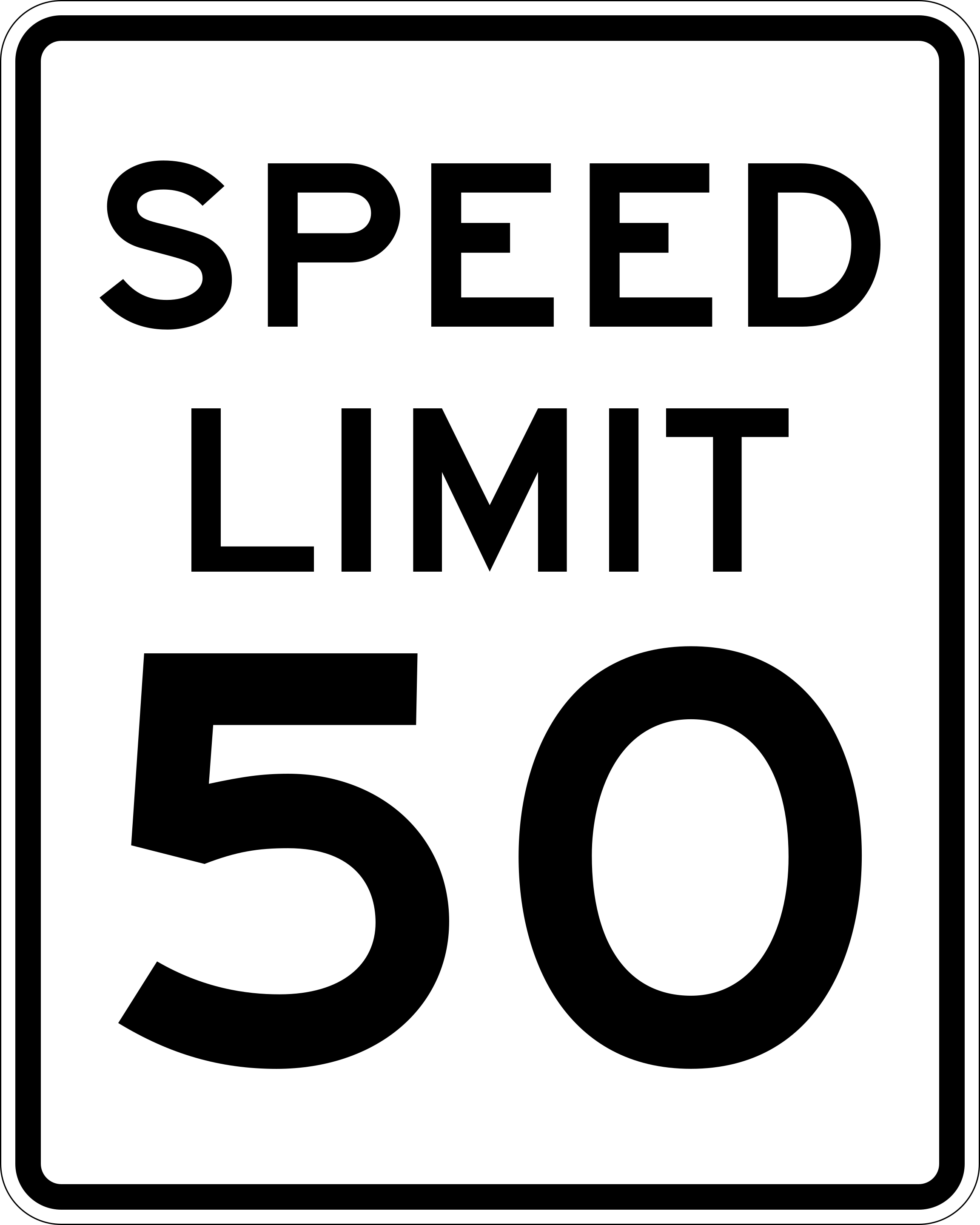
25. What does the pictured black and white SPEED LIMIT sign indicate?
- A minimum speed required in every weather condition
- A suggested speed that may be exceeded whenever traffic is light
- The maximum legal speed allowed in ideal conditions
- A truck-only speed restriction that excludes passenger cars
Show answer
The maximum legal speed allowed in ideal conditions. Black and white speed limit signs state the maximum legal speed allowed in ideal conditions. Full explanation in Test 5
26. What minimum age must an applicant reach to apply for a Kentucky operator's, motorcycle, or moped license?
- 14 years
- 15 years
- 16 years
- 18 years
Show answer
15 years. Kentucky's July 2026 driver manual lowered the licensing starting point: an applicant must have reached the fifteenth birthday before applyi Full explanation in Test 6
27. After yielding to an emergency vehicle, when may a driver leave the stopped position?
- Only after every nearby vehicle starts moving
- As soon as the siren becomes quieter
- After following the emergency vehicle for 500 feet
- After the emergency vehicle passes, unless a police officer or firefighter directs movement sooner
Show answer
After the emergency vehicle passes, unless a police officer or firefighter directs movement sooner. A driver must remain stopped until the emergency vehicle has passed. Full explanation in Test 7
28. Which lights may appear on the escort vehicle leading a Kentucky funeral procession?
- Flashing yellow, red, or blue lights
- Steady green lights only
- Flashing white lights only
- Headlights only, with no flashing lights
Show answer
Flashing yellow, red, or blue lights. A funeral procession has intersection right-of-way when it is led by an escort vehicle displaying flashing yellow, red, or blue lights. Full explanation in Test 8
29. A school bus is stopped on a two-lane road to load or unload passengers. What must approaching drivers do?
- Continue if the opposite lane appears empty
- Pass slowly if no child is visible
- Stop only when traveling behind the bus
- Stop and remain stopped until people are clear and the bus moves
Show answer
Stop and remain stopped until people are clear and the bus moves. A stopped school bus loading or unloading passengers requires a complete stop. Full explanation in Test 9
30. How fast does an air bag deploy, according to the Kentucky manual?
- In about one second
- In about one twentieth of a second, faster than a blink
- In about five seconds
- In about half a second
Show answer
In about one twentieth of a second, faster than a blink. The entire air bag deployment process takes about one twentieth of a second, faster than the blink of an eye, and side impact bags deploy ev Full explanation in Test 10
31. A yellow traffic light appears while you are approaching the intersection. What is the proper response?
- Continue at the same speed because yellow permits unrestricted entry
- Accelerate so the signal cannot turn red before you enter
- Stop when stopping can be done safely
- Reverse away from the intersection immediately
Show answer
Stop when stopping can be done safely. Yellow warns that the signal is about to become red. Full explanation in Test 1
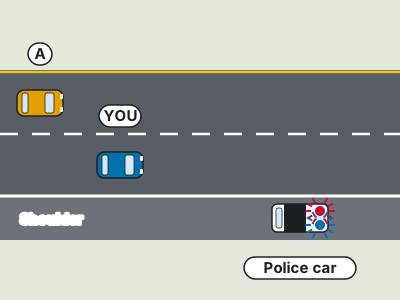
32. On a four-lane highway, what should a driver do when approaching an emergency vehicle stopped on the shoulder?
- Turn around before reaching the stopped vehicle
- Stop in the left lane beside the emergency vehicle
- Accelerate in the right lane to pass quickly
- Approach slowly and move into the left lane if it is safe
Show answer
Approach slowly and move into the left lane if it is safe. Kentucky advises drivers approaching a stopped emergency vehicle on a four-lane highway to approach slowly and move into the left lane when Full explanation in Test 2
33. What kind of instruction is identified by an octagonal traffic sign?
- A route direction to a city or town
- A warning about a possible hazard ahead
- A stop instruction
- A permission to change lanes
Show answer
A stop instruction. The octagonal shape is reserved for stop signs. Full explanation in Test 3
34. How should a driver respond as rain, snow, sleet, or ice makes the roadway slippery?
- Accelerate so the tires cross the slippery area quickly
- Maintain speed until the tires begin to skid
- Brake hard immediately while turning the steering wheel
- Reduce speed at the first sign of those conditions
Show answer
Reduce speed at the first sign of those conditions. The manual calls for an early speed reduction when traction begins to deteriorate from rain, snow, sleet, or ice. Full explanation in Test 4
35. Where should most of a trailer’s cargo weight be placed for stability?
- All cargo behind the axle
- About 60 percent in back and 40 percent in front
- Exactly half at each end
- About 60 percent in front and 40 percent in back
Show answer
About 60 percent in front and 40 percent in back. The manual recommends placing about 60 percent of a trailer’s cargo weight in the front, nearest the towing vehicle, and 40 percent in the b Full explanation in Test 5
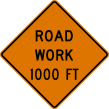
36. What do work zone signs alert drivers to?
- Work zones ahead and people working on or near the roadway
- A guaranteed open lane with no construction activity
- A nearby hospital or fuel station
- A route that permits passing in every lane
Show answer
Work zones ahead and people working on or near the roadway. Work zone signs alert drivers to roadwork ahead and warn that people may be working on or near the roadway. Full explanation in Test 6
37. What does an orange work-zone sign warn drivers about?
- A permanent interstate route designation
- A hospital entrance and ambulance parking
- Construction, maintenance, or emergency operations ahead
- A recreational area with no roadway changes
Show answer
Construction, maintenance, or emergency operations ahead. Orange work zone signs alert drivers to construction, maintenance, or emergency operations and warn that people may be working on or near th Full explanation in Test 7
38. When must a Kentucky driver yield to an emergency vehicle displaying a flashing red or blue light?
- Only after entering the intersection
- Only when the emergency vehicle is directly behind
- When the flashing light or siren signals the emergency vehicle, by pulling to the road edge
- Only when the driver can see a police officer
Show answer
When the flashing light or siren signals the emergency vehicle, by pulling to the road edge. The manual requires a driver to yield to an emergency vehicle displaying a flashing red or blue light or sounding a siren. Full explanation in Test 8
39. During what period must Kentucky drivers illuminate their vehicle headlights?
- Only when the driver is traveling on an interstate
- Only from sunset until midnight
- From one hour before sunset until one hour after sunrise
- From one-half hour after sunset to one-half hour before sunrise
Show answer
From one-half hour after sunset to one-half hour before sunrise. Kentucky requires headlights from thirty minutes after sunset until thirty minutes before sunrise. Full explanation in Test 9
40. What action is required at an octagonal red stop sign?
- Yield only to vehicles approaching from the left
- Reduce speed and continue without stopping if the road looks clear
- Come to a complete stop before proceeding
- Stop after entering the crosswalk so the view is wider
Show answer
Come to a complete stop before proceeding. The octagon is reserved for a stop command. Full explanation in Test 10
